

The Montgomery bus boycott ran from 5 December 1955 to 20 December 1956. It is one of three case studies set for Topic 6, 'The United States and the world, 1945–1989', under the Society and economy perspective. Over 381 gruelling days, Montgomery's Black community used non-violent mass protest, church logistics, and federal court challenges to break segregated city transit. The boycott pushed a 26-year-old Baptist minister named Martin Luther King Jr. into the national spotlight, proved that economic pressure could shake local white power, and ended with the landmark Supreme Court ruling Browder v. Gayle. At Higher Level, Montgomery can be asked as a 100-mark essay on Topic 6. If the SEC prescribes Topic 6 for the documents-based study in your exam year, Montgomery material can instead appear in the compulsory documents-based question. Check the SEC's prescribed-topic notice for 2027.
Chronology of the Montgomery Bus Boycott
Keeping a firm grasp on the sequence of events gives you an immediate advantage in both essay writing and documents questions.
- 2 March 1955: Claudette Colvin, a 15-year-old student, is arrested on a Montgomery bus after refusing to surrender her seat to a white rider.
- August 1955: Fourteen-year-old Emmett Till is lynched in Mississippi, and an all-white jury acquits his killers the next month.
- 1 December 1955: Rosa Parks is arrested on a city bus by order of driver James F. Blake.
- 2 December 1955: Montgomery's Black ministers gather at Dexter Avenue Baptist Church and back a one-day community bus boycott.
- 5 December 1955: More than 90% of Black passengers stay off the buses. Rosa Parks is convicted in municipal court. That afternoon, activists form the Montgomery Improvement Association (MIA) and elect Martin Luther King Jr. as president. A crowd of thousands packs Holt Street Baptist Church that night and votes to continue the boycott indefinitely.
- 30 January 1956: King's family home is bombed. He calms an armed, furious crowd outside and insists on non-violence.
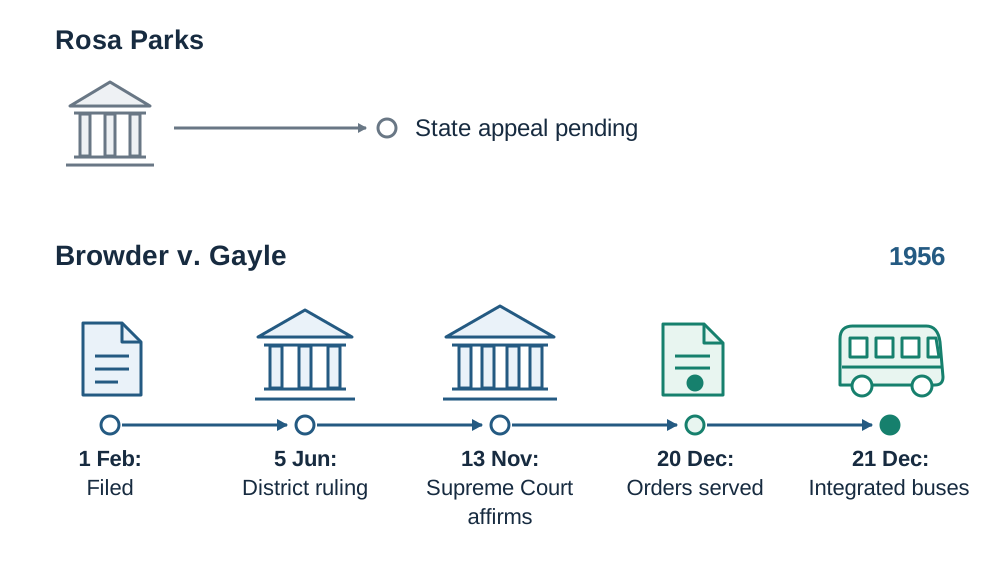
- 1 February 1956: Attorney Fred Gray files Browder v. Gayle in federal district court.
- March 1956: King is convicted under an old 1921 Alabama anti-boycott statute, which draws national and international journalists to town.
- 5 June 1956: The federal district court rules 2–1 that bus segregation in Montgomery breaks the Fourteenth Amendment.
- 13 November 1956: The US Supreme Court upholds the district court ruling.
- 20 December 1956: Federal desegregation orders are served on Montgomery city officials.
- 21 December 1956: Montgomery buses officially integrate, and King takes a seat alongside white minister Glenn Smiley.
Jim Crow Segregation and Montgomery Transit
After Reconstruction collapsed in the late nineteenth century, white Southern politicians built a legal wall between the races. These statutes, known as Jim Crow laws, enforced rigid racial segregation across all public spaces. The US Supreme Court rubber-stamped this system in 1896 with Plessy v. Ferguson, ruling that 'separate but equal' facilities did not violate the Constitution. The reality was never equal. Black citizens had to pay poll taxes and take impossible literacy tests just to vote, while inferior facilities and vigilante violence reminded them of their second-class status.
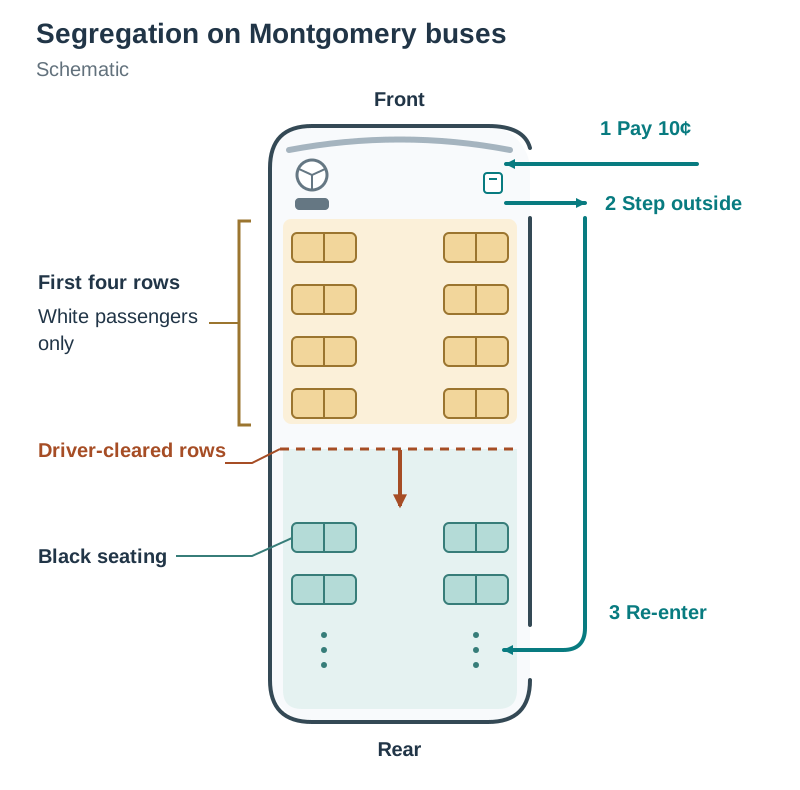
Montgomery's city buses laid bare the everyday cruelty of Jim Crow. The first four rows were reserved strictly for white passengers. Black riders sat in the back. If the white section filled up, drivers had police powers to clear an entire row of Black passengers so that a single white rider could sit. To make matters worse, Black passengers were forced to pay their ten-cent fare at the front door, get off the bus, and walk around to board through the rear. Drivers frequently pocketed their money and drove off before they could climb back on. African Americans made up about 75% of the daily ridership, yet they faced daily insults and verbal abuse from white drivers.
This domestic oppression carried heavy international costs. During the early Cold War, Washington claimed to champion global democracy against Soviet tyranny. Moscow made sure the world saw the contradiction. Soviet propaganda highlighted Southern lynchings and police brutality, making American racial injustice an acute diplomatic embarrassment for the State Department.
Catalysts: Brown, Emmett Till, and Claudette Colvin
The boycott did not erupt out of thin air in December 1955. It followed years of quiet community organisation and national shock waves. In May 1954, the US Supreme Court delivered its unanimous ruling in Brown v. Board of Education, declaring racial segregation in public schools unconstitutional. Chief Justice Earl Warren wrote that separate educational facilities were inherently unequal. This shattered the legal foundation of Plessy and gave civil rights activists fresh hope that federal courts might dismantle segregation elsewhere.
Any hope of quick Southern compliance was shattered in August 1955. Fourteen-year-old Emmett Till, visiting family from Chicago, was kidnapped, tortured, and shot in Mississippi for allegedly whistling at a white woman. His mother, Mamie Till-Mobley, insisted on an open-casket funeral in Chicago so everyone could see his battered body. Photographs published in Jet magazine horrified millions. A month later, an all-white jury took just 67 minutes to acquit the killers, who soon sold their confession to Look magazine for cash. The verdict proved to Black Americans that Southern state courts offered zero protection, and that federal action had to be forced from below.
Montgomery was already reaching boiling point. On 2 March 1955, fifteen-year-old Claudette Colvin was dragged kicking and screaming off a city bus for refusing to give up her seat. Local leaders, including E. D. Nixon (a veteran organiser with the Brotherhood of Sleeping Car Porters and former local NAACP president), considered using her arrest as a test case but decided against it. Colvin was an outspoken teenager who soon became pregnant while unmarried, and leaders worried the segregationist press would smear her character and derail the campaign. Meanwhile, the Women's Political Council (WPC), a group of Black women professors and teachers led by Jo Ann Robinson, was already laying groundwork. In May 1954, Robinson had warned Mayor W. A. Gayle that Black riders would boycott if bus abuse did not stop.
Mobilisation and the MIA's Original Demands
On Thursday, 1 December 1955, 42-year-old department store seamstress Rosa Parks got on the Cleveland Avenue bus after work. Parks was not a casual passenger who was simply tired. She had served as secretary of the Montgomery NAACP branch since 1943 and had spent the previous summer training at the Highlander Folk School in Tennessee. When driver James F. Blake ordered her and three others to stand for a white man, the others moved, but Parks stayed put. She later said her mind went straight to Emmett Till. Blake called the police, and Parks was hauled off to jail.
E. D. Nixon bailed her out that evening with the help of Clifford Durr, a white liberal Montgomery lawyer, and his wife Virginia. Nixon persuaded Parks to let the community rally behind her arrest. That night, Jo Ann Robinson and two students slipped into Alabama State College and spent the dark hours mimeographing over 35,000 leaflets. The flyers urged every Black worker in Montgomery to stay off the buses on Monday, 5 December, the day Parks was scheduled to stand trial.
On 2 December, ministers met at Dexter Avenue Baptist Church and agreed to endorse the strike from the pulpit. When Monday arrived, the response was overwhelming: more than 90% of Black passengers stayed off the buses. That morning, the municipal judge found Parks guilty of violating city segregation laws, fining her 4 in court costs. Her lawyers immediately filed an appeal, keeping her individual case tied up in the Alabama state court system.
That afternoon, ministers and civic leaders met at Mt Zion AME Church to establish a coordinating body: the Montgomery Improvement Association (MIA). They picked Dr Martin Luther King Jr., the 26-year-old pastor of Dexter Avenue Baptist Church, as president. That night, King spoke to thousands packed inside and outside Holt Street Baptist Church, and the crowd voted unanimously to carry on the boycott.
It surprises many students that the MIA did not ask to end bus segregation on day one. Their original three demands were modest reforms within the law:
- Courteous treatment of Black passengers by white bus drivers.
- Seating on a first-come, first-served basis, with Black riders filling from the back and white riders from the front, without anyone giving up a seat already taken.
- The hiring of Black drivers on predominantly Black bus routes.
The city commissioners and the bus company flatly rejected all three points. That stubborn white resistance backfired. It convinced the MIA that negotiating within the Jim Crow system was a dead end, leaving them no choice but to launch a direct constitutional assault against transit segregation itself.
Sustaining the 381-Day Boycott: Grassroots Logistics
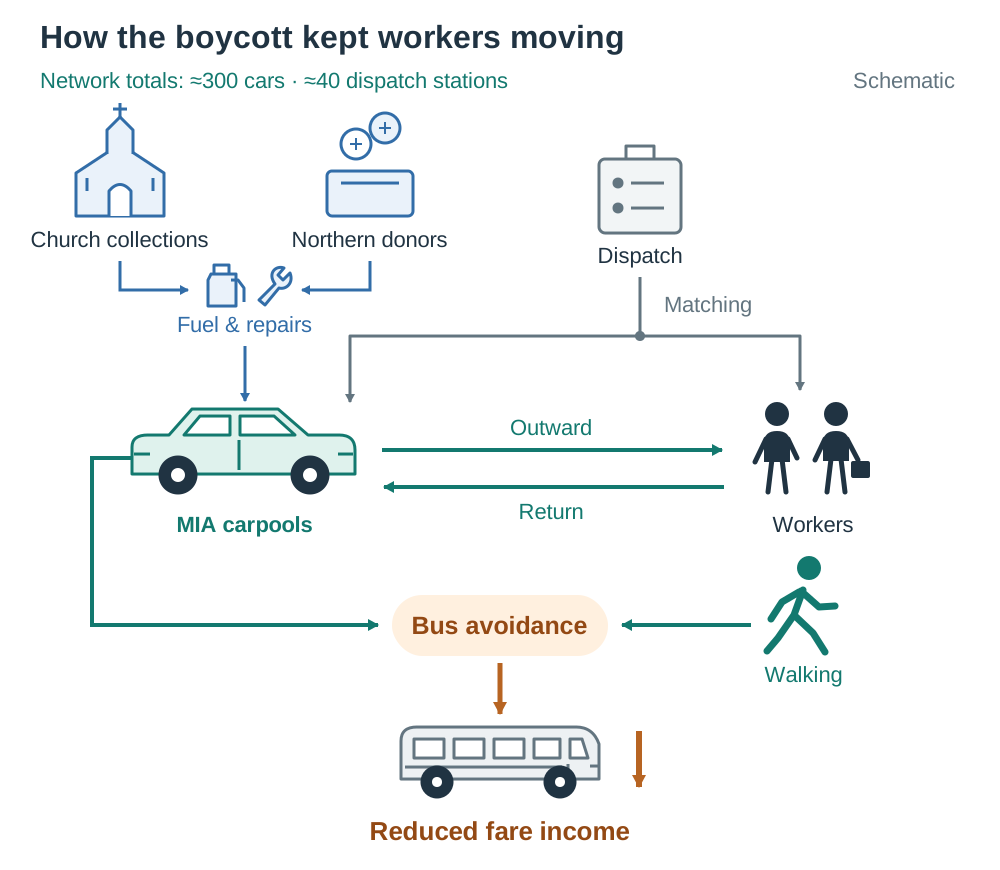
Sustaining a mass boycott for over a year required brilliant organisation and huge daily sacrifices. Because Black passengers accounted for three-quarters of the bus company's ticket sales, Montgomery City Lines was plunged into a financial crisis almost overnight. The company had to cut routes, slash driver hours, and watch its revenues dry up.
Keeping tens of thousands of workers moving every single day required an intricate logistical network:
- The Carpool Fleet: The MIA established a free transport network of about 300 private cars and station wagons. They set up roughly 40 dispatch stations throughout the city, matching drivers with domestic workers, cleaners, and labourers twice a day.
- Funding the Operation: Weekly church collections covered petrol, vehicle repairs, and spare tyres. Donations poured in from labour unions and civil rights groups across the North.
- Black Taxi Drivers: Local Black cab owners offered a cut-price 10-cent fare to match the standard bus ticket. The city cracked down by threatening to revoke taxi licences for charging below the statutory minimum fare of 45 cents, forcing the MIA to rely even more heavily on its carpools.
- Mass Rallies: Every Monday and Thursday night, thousands crowded into rotating church halls. These meetings kept spirits high, shared practical updates about routes, and drilled the crowds in non-violent discipline.
The boycott succeeded because ordinary, anonymous people bore the daily burden. Black domestic workers walked miles to work in freezing rain and summer heat rather than step onto a segregated bus. An elderly maid known as 'Mother' Pollard summed up their defiance when King checked on her: 'My feets is tired, but my soul is rested.' The human cost was heavy. Many boycotters were sacked by white employers. Rosa Parks lost her job at the Montgomery Fair department store, faced non-stop telephone death threats, and was forced to move to Detroit in 1957.
Retaliation and the Constitutional Victory in Browder v. Gayle
Montgomery Mayor W. A. Gayle and his fellow city commissioners joined the White Citizens' Council, a group of prominent segregationists using economic blackmail and intimidation to protect Jim Crow. The city police launched a campaign of harassment against the carpools, ticketing drivers for trivial matters such as lane drift or driving two miles an hour over the limit. When harassment failed, violence took over. On 30 January 1956, segregationists bombed King's home while his wife Coretta and their baby daughter were inside. King raced home, stepped onto his shattered porch, and urged an angry, armed crowd of neighbours to put away their guns and trust in non-violence.
Next, the city pressured local insurance firms to cancel policies on the MIA's church-owned station wagons. The MIA sidestepped the trap by securing vehicle insurance through Lloyd's of London. In February 1956, a local grand jury indicted King and roughly 89 other leaders under a forgotten 1921 Alabama anti-boycott statute. King went to trial in March, was found guilty, and received a $500 fine or 386 days' hard labour. The city thought the verdict would break the campaign. Instead, national newspapers and television networks sent reporters to cover the trial, making King a household name across the United States.
While the street battle raged, the real legal breakthrough was happening in the federal courts. MIA attorney Fred Gray knew that Rosa Parks's criminal appeal was trapped in biased Alabama state courts. On 1 February 1956, Gray bypassed the state system entirely by filing Browder v. Gayle in the US District Court. He filed on behalf of four Black women who had experienced discrimination on city transit: Aurelia Browder, Susie McDonald, Claudette Colvin, and Mary Louise Smith. A fifth plaintiff, Jeanetta Reese, dropped out after receiving death threats. Parks was kept off the lawsuit so her state court appeal would not slow down the federal case.
Gray argued that Montgomery's bus segregation laws violated the Equal Protection Clause of the Fourteenth Amendment. On 5 June 1956, a three-judge federal panel ruled 2–1 in the women's favour, holding that the logic of the Brown school decision applied to public transport as well. Montgomery appealed straight to Washington, but on 13 November 1956, the US Supreme Court affirmed the ruling. Federal desegregation injunctions were served on Montgomery officials on 20 December 1956. The following morning, King, Ralph Abernathy, and white activist Reverend Glenn Smiley boarded the first integrated bus, ending 381 days of resistance.
Evaluating Martin Luther King Jr. (Higher Level)
Leaving Certificate examiners regularly test Dr Martin Luther King Jr. as a key personality. At Higher Level, you must write a balanced evaluation of his contribution rather than a simplistic tribute.
Why Was King Chosen?
When the boycott began, King was only 26 years old and had been pastor of Dexter Avenue Baptist Church for barely a year. That newcomer status worked in his favour. He was untainted by the bitter personal rivalries that divided established leaders like E. D. Nixon and Rufus Lewis. He held a doctorate in theology from Boston University, spoke with extraordinary power, and possessed the intellectual skill to bridge Northern academic philosophy and Southern Black gospel tradition. Older figures were also happy to let a young newcomer take the physical and legal risks.
His Concrete Contribution
- Spokesman and Moral Voice: King gave the movement an eloquent voice. His opening speech at Holt Street Baptist Church on 5 December 1955 linked the protest to Christian love and the US Constitution, giving the community confidence.
- Philosophy of Non-Violence: Inspired by Jesus and Mahatma Gandhi, King insisted that non-violence was a moral rule, not just a tactical choice. When his home was bombed on 30 January 1956, his calm refusal to seek revenge stopped a bloody riot.
- Media Magnet: King's arrest and trial in March 1956 brought national press attention to Montgomery, generating sympathy and funding across the North.
Limitations of His Role
King did not start the boycott. Jo Ann Robinson and the Women's Political Council wrote the flyers, printed the leaflets, and launched the protest before King even agreed to take part. E. D. Nixon chose Rosa Parks as the public figurehead and pushed the clergy into action. The boycott was kept alive by thousands of working-class women who walked miles every day, and the legal victory was won in federal court by Fred Gray and the four female plaintiffs.
Historical Attitudes
- Contemporary: Black Montgomerians and white Northern liberals saw King as an inspiring, courageous leader. White Southern authorities and the FBI labelled him an outside agitator and a communist pawn.
- Current: Modern historians recognise King's genius as an orator and moral leader, but they emphasise that Montgomery was fundamentally a grassroots, woman-led campaign. King articulated the movement's goals; the community supplied the power.
Significance and the Desegregation Timeline
The Montgomery bus boycott gave the Civil Rights Movement a proven strategy: combine disciplined non-violent direct action with economic leverage and federal litigation. In January 1957, King, Ralph Abernathy, and other ministers met in Atlanta to found the Southern Christian Leadership Conference (SCLC) to export this method across the South.
Key Steps in the Desegregation Struggle
- 1948: President Truman signs Executive Order 9981, desegregating the US military.
- 1954: Brown v. Board of Education outlaws segregation in public schools.
- 1955: Emmett Till is murdered; the Montgomery bus boycott begins.
- 1956: Browder v. Gayle declares transit segregation unconstitutional.
- 1957: The SCLC is founded; federal paratroopers protect the 'Little Rock Nine' in Arkansas.
- 1960–1961: Greensboro lunch-counter sit-ins challenge segregated restaurants, and the Freedom Rides challenge segregation in interstate travel, both using Montgomery's non-violent methods.
- 1963: The March on Washington brings 250,000 demonstrators to the Lincoln Memorial.
- 1964: The Civil Rights Act outlaws segregation in public accommodations and bans employment discrimination.
- 1965: The Voting Rights Act outlaws literacy tests and restores Black political power.
Achievements and Boundaries
Montgomery scored a decisive victory against de jure segregation (separation written into law). Yet its direct impact was local and narrow. The ruling applied only to public transit. Montgomery's public parks, swimming pools, schools, and restaurants remained completely segregated. White reaction was swift and violent. Snipers fired into integrated buses, and in January 1957, extremists firebombed Abernathy's home and four Black churches. Ending the remaining legal (de jure) segregation and barriers to voting required years of further confrontation and the federal legislation of 1964 and 1965. Even then, de facto segregation (separation in practice, for example in housing and schools) and economic inequality continued well beyond 1989.
Key terms
- Boycott
- A collective refusal to buy, use, or patronise a service or business as a non-violent economic protest to force political change.
- Non-Violent Direct Action
- A protest method including boycotts, sit-ins, and marches that challenges unjust laws peacefully, refusing to retaliate even when attacked.
- Civil Disobedience
- The deliberate, open breaking of an unjust law on moral grounds, combined with an acceptance of the resulting legal penalties.
- Fourteenth Amendment
- The US constitutional amendment guaranteeing citizenship and 'equal protection of the laws' to all persons born or naturalised in the United States.
- Jim Crow Laws
- State and local statutes across the American South that enforced racial segregation and disenfranchised Black citizens from the 1870s to 1965.
- Plessy v. Ferguson (1896)
- The US Supreme Court ruling that established the 'separate but equal' doctrine, making state-mandated racial segregation legal.
- Brown v. Board of Education (1954)
- The unanimous US Supreme Court decision that declared racial segregation in public schools unconstitutional, striking down Plessy v. Ferguson in education.
- Women's Political Council (WPC)
- A civic group of Black professional women in Montgomery, led by Jo Ann Robinson, that organised the boycott and duplicated the first 35,000 leaflets.
- Montgomery Improvement Association (MIA)
- The organisation founded on 5 December 1955 to direct the bus boycott, electing 26-year-old Dr Martin Luther King Jr. as its president.
- Browder v. Gayle (1956)
- The federal court case filed by Fred Gray on behalf of four Black women that struck down Montgomery's bus segregation under the Fourteenth Amendment.
- White Citizens' Council
- An organisation of white businessmen, politicians, and professionals in the South dedicated to preserving segregation through economic pressure and intimidation.
- Southern Christian Leadership Conference (SCLC)
- A regional civil rights group established in Atlanta in 1957 by Martin Luther King Jr. and other ministers to coordinate non-violent campaigns across the South.
- De Jure Segregation
- Racial segregation that is enforced and mandated by formal written laws, as seen in the Jim Crow South.
- De Facto Segregation
- Racial segregation that exists in practice through housing patterns, social customs, and economic inequality, rather than by statutory law.
Check yourself
What proportion of daily bus passengers in Montgomery were African American prior to the boycott?
Approximately 75%.
Which local organisation printed and distributed over 35,000 leaflets calling for the 5 December boycott?
The Women's Political Council (WPC), led by Jo Ann Robinson.
Why did the MIA's initial demands avoid calling for an immediate end to segregation, and why did that stance change?
The MIA initially sought practical compromises within the law: courteous treatment, seated filling from back and front, and Black drivers on Black routes. When the city and bus company rejected all three points, leaders realised negotiation was futile and challenged transit segregation in federal court.
Name the four plaintiffs in Browder v. Gayle, and explain why Rosa Parks was not one of them.
Aurelia Browder, Susie McDonald, Claudette Colvin, and Mary Louise Smith. Rosa Parks was excluded so her ongoing criminal appeal in the Alabama state courts would not slow down the federal constitutional challenge.
How did Montgomery authorities attempt to disrupt the carpools, and how did the MIA solve the insurance problem?
Police issued hundreds of petty traffic tickets, and the city pressured local firms to cancel insurance on the MIA's church wagons. The MIA bypassed the obstacle by purchasing vehicle insurance through Lloyd's of London.
State one strength and one limitation of using a personal letter from Clifford Durr as historical evidence about the boycott.
A strength is that Durr was a Montgomery lawyer and eyewitness who understood the city's legal manoeuvres. A limitation is that as a committed supporter of the boycotters, his interpretation of the city authorities' motives reflects a partisan viewpoint.