

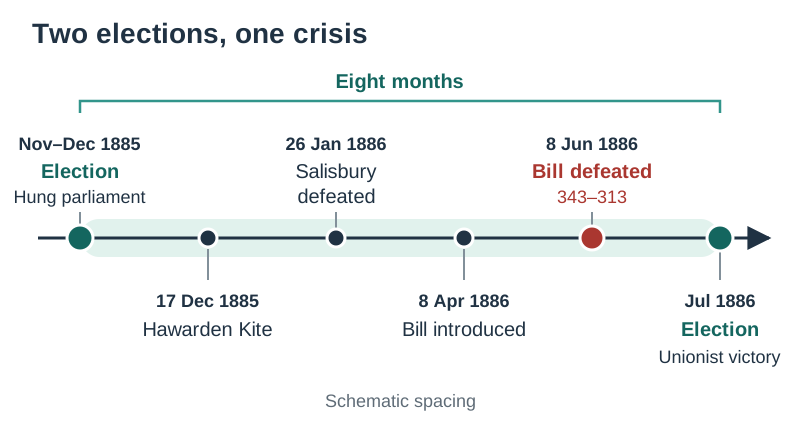
Between November 1885 and July 1886, the question of Irish Home Rule shook Westminster and redrew the political map in both Britain and Ireland. Thanks to the 1884 Reform Act, which enfranchised tenant farmers, Charles Stewart Parnell led the Irish Parliamentary Party to win 86 seats in the November 1885 general election. That swept away the Liberals in Ireland and handed Parnell the balance of power in a hung parliament. When William Ewart Gladstone came out in support of an Irish parliament, his 1886 Home Rule Bill split the British Liberals in two. On 8 June 1886, 93 Liberal rebels voted with the Conservatives to kill the bill in the Commons. The July 1886 election that followed put Lord Salisbury and the Unionists into office for most of the next twenty years, locked constitutional nationalists into a pact with the Liberals, and hardened sectarian divisions across Ulster.
Issues and Outcomes at a Glance
This case study examines why two general elections happened within eight months, what arguments dominated the debate, and how their results altered Irish and British politics.
The Core Issues
- Franchise Reform: The Representation of the People Act 1884 and the Redistribution of Seats Act 1885 created single-member county seats and enfranchised small tenant farmers, stripping landlords of electoral sway.
- The Balance of Power: Parnell wanted to win enough seats to deny either British party a working majority, forcing one of them to buy Irish support with self-government.
- Wooing Both Sides: During 1885 Parnell bargained with Salisbury's minority Conservatives first. When they refused to offer legislative independence, he turned to the Liberals.
- Gladstone's Conversion: Gladstone came to support Home Rule because coercion had broken down, the Irish electorate had delivered a clear democratic verdict, and his Christian conscience urged him to pacify Ireland.
- The 1886 Bill: Sharp arguments broke out over plans for a devolved Dublin assembly, the exclusion of Irish MPs from Westminster, financial levies, and a £50 million land purchase scheme.
- Unionist Resistance: British Conservatives, Ulster Protestants, and dissident Liberals united behind the 1801 Act of Union to defend property and imperial ties.
The Main Outcomes
- Defeat in the Commons: On 8 June 1886, the Government of Ireland Bill failed on its second reading by 343 votes to 313 after 93 Liberals rebelled.
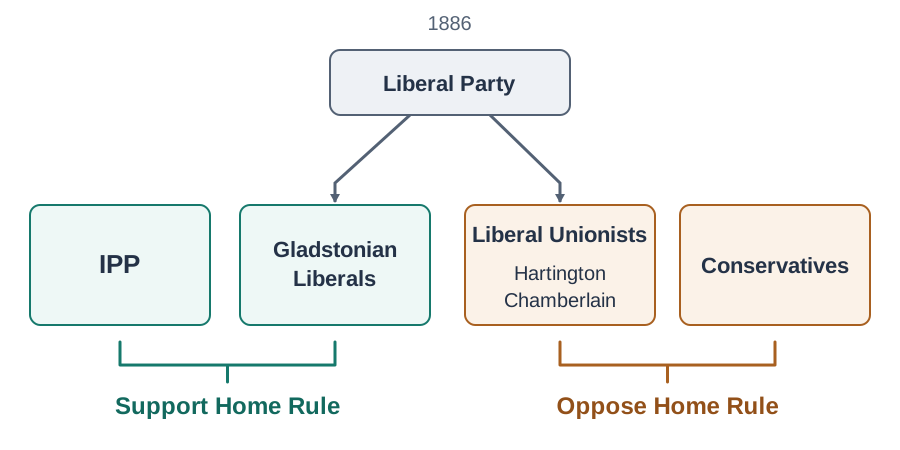
- The Liberal Split: Whigs led by Lord Hartington and Radicals led by Joseph Chamberlain walked out to found the Liberal Unionist Party, changing British party alignments for decades.
- Unionist Hegemony (1886–1905): Salisbury won a solid majority in July 1886, ushering in nearly twenty years of Conservative rule interrupted only between 1892 and 1895.
- Nationalist Dependence: The IPP kept its hold on nationalist Ireland, but Parnell was now tethered to Gladstone and dependent on British Liberal fortunes.
- Organised Ulster Unionism: The crisis forged an alliance between Protestant landowners, industrialists, and workers, leading to new bodies like the Ulster Loyalist Anti-Repeal Union.
- The 1886 Belfast Riots: Sectarian fighting broke out in Belfast during the summer of 1886, leaving around 30 people dead and hundreds injured.
Franchise Reform and the Conservative Courtship (1884–1885)
Nationalist electoral power in 1885 was built on British electoral reform. The Representation of the People Act 1884, known as the Third Reform Act, extended the household franchise from towns to rural counties. In Ireland, this change more than tripled the electorate, taking it from roughly 220,000 to over 700,000 male voters. For the first time, small tenant farmers and rural labourers who had backed the Land War could cast a ballot. Just as important, the Redistribution of Seats Act 1885 wiped out small boroughs and carved the country into single-member constituencies of roughly equal size. Combined with the secret ballot brought in back in 1872, rural voters could now support nationalist candidates without fearing eviction by their landlords.
Parnell harnessed this massive electorate through the Irish Parliamentary Party and its local branches in the Irish National League. He introduced tight discipline: every candidate signed a pledge to sit, act, and vote with the party or resign his seat.
In the summer of 1885, Parnell played a double game. Lord Salisbury formed a minority Conservative government in June after Gladstone's ministry collapsed. Salisbury made several friendly gestures to win Irish nationalist goodwill. His administration dropped the harsh Crimes Act and passed the Ashbourne Land Act (1885), which set aside £5 million in government loans to help tenants buy their farms outright. Then, on 1 August 1885, the new Lord Lieutenant, Lord Carnarvon, held a secret private meeting with Parnell, with Salisbury's knowledge but without Cabinet backing, in an empty London house. Carnarvon personally favoured some form of Irish self-government. Parnell walked away convinced that the Tories might offer a better deal than the Liberals. In November 1885, right before polling began, Parnell told Irish voters in Britain to vote Conservative. He hoped to slash Liberal majorities and produce a hung parliament where his party held the casting vote.
The 1885 Election and the Hawarden Kite
The election of November–December 1885 proved how thoroughly Parnell's machine dominated the country. The IPP captured 85 out of 103 seats in Ireland, plus T.P. O'Connor's seat in the Scotland division of Liverpool. Parnell swept every seat in Munster and Connacht and every Leinster seat except the two Dublin University seats. The Irish Liberals were wiped out completely. Even in Ulster, the result surprised observers: Parnell won 17 seats against 16 for the Unionists, showing that the northern province was not entirely unionist. Outside Ulster, the only non-nationalists elected in Ireland were the two members for Dublin University.
At Westminster, the election ended in deadlock:
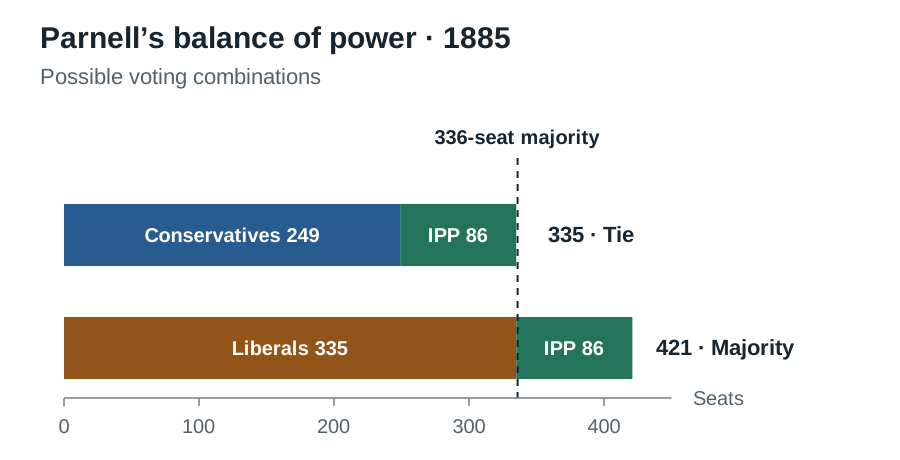
- Liberals (Gladstone): 335 seats
- Conservatives (Salisbury): 249 seats
- Irish Parliamentary Party (Parnell): 86 seats
These numbers put the balance of power straight into Parnell's hands. If his 86 MPs voted with Salisbury's 249 Conservatives, they reached 335, producing a tie with the Liberals. That meant Parnell could block Gladstone, but he could not give Salisbury a working majority on his own. Backing Gladstone, however, gave the Liberals 421 votes, creating a comfortable working majority over the Conservatives. Parnell's true leverage was on the Liberal side.
Salisbury had no intention of granting Home Rule. The stalemate broke on 17 December 1885 with the Hawarden Kite, an intentional leak to the press by Gladstone's son, Herbert. The newspapers revealed that Gladstone was ready to support an Irish parliament. Gladstone made this jump for several reasons. The 1885 election gave Ireland a democratic mandate that he felt a British government could not ignore. Years of coercion had achieved little, and his Christian beliefs urged him to right historical wrongs. On practical grounds, he could not govern without Irish votes. On 26 January 1886, Parnell's MPs voted with the Liberals to defeat Salisbury on an agricultural amendment, and Gladstone returned as Prime Minister.
The First Home Rule Bill (1886): Terms and Clashes
On 8 April 1886, Gladstone addressed a crowded House of Commons for three and a half hours to introduce the Government of Ireland Bill.
The Core Terms
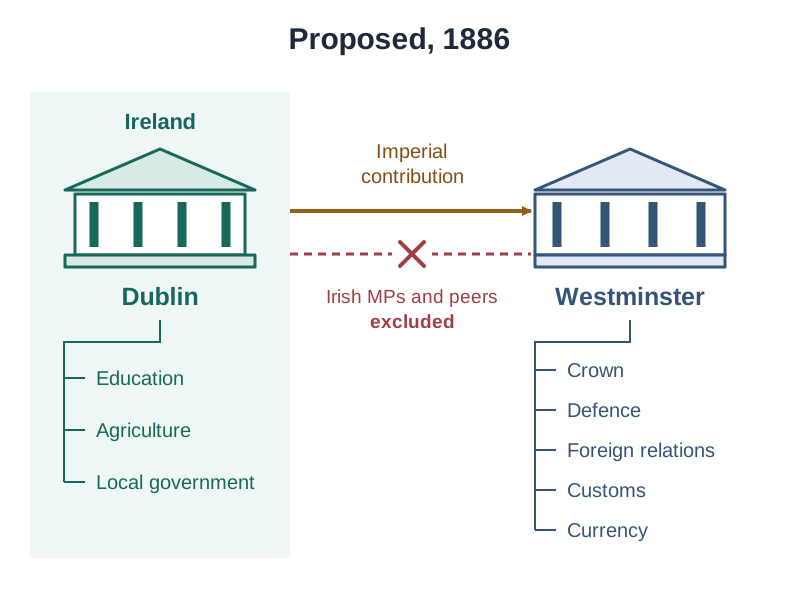
- A Devolved Dublin Parliament: A new assembly in Dublin would handle purely Irish matters, including education, direct taxation, police, local government, and agriculture.
- The Two Orders: To protect wealthy and Protestant minorities from being outvoted, the legislature had two orders that sat together but voted separately. The First Order had 28 representative peers and 75 members elected on high property qualifications. The Second Order contained 204 members elected by household suffrage. Either order held a three-year suspensive veto over bills.
- Imperial Powers Reserved to Westminster: The Westminster parliament kept full control over the Crown, defence, foreign relations, overseas trade, customs, and currency.
- Imperial Contribution: Ireland had to contribute a fixed annual quota toward imperial costs, set at one-fifteenth of imperial spending (roughly £3.25 million).
- Exclusion of Irish MPs: Irish MPs and peers were excluded from Westminster entirely. Gladstone wanted to stop Irish members meddling in British domestic policy, but critics attacked this clause as 'taxation without representation' and a breach of imperial unity.
- The Land Purchase Bill: Alongside Home Rule, Gladstone tabled a measure offering £50 million in state bonds to buy out Anglo-Irish landlords, which provoked fury among British taxpayers.
Parnell accepted the bill in principle as a fair working compromise, though he wanted better financial terms.
Unionist Mobilisation and the Liberal Split
Opposition to Gladstone's plan was fierce, rapid, and broad-based:
- The Liberal Rebellion: Lord Hartington led traditional Whig aristocrats who feared an attack on property rights and imperial defence, refusing to join the government. Joseph Chamberlain led the Radicals; he resigned from the cabinet in March 1886 because he objected to excluding Irish MPs from Westminster and disliked the £50 million land buyout. Together, Hartington and Chamberlain drew together 93 rebel MPs to form the Liberal Unionists.
- Playing the Orange Card: Salisbury condemned self-government, saying Ireland needed 'twenty years of resolute government'. His ambitious colleague, Lord Randolph Churchill, saw a chance to rally loyalist feeling for party gain. In February 1886, Churchill noted that 'the Orange card would be the one to play'. On 22 February, he spoke to an ecstatic crowd at the Ulster Hall in Belfast. Later, in a published letter in May 1886, he coined the slogan: 'Ulster will fight, and Ulster will be right.'
- Organised Resistance in Ireland: Southern landowners and businessmen set up the Irish Loyal and Patriotic Union (ILPU) in Dublin in 1885. In Belfast, northern opponents launched the Ulster Loyalist Anti-Repeal Union in January 1886. The Orange Order, which had been mostly a rural, working-class society, became the bridge between wealthy landlords, businessmen, and working men.
- Isabella Tod and Women's Unionism: Belfast Presbyterian reformer Isabella Tod, a campaigner for female suffrage and higher education, broke with Gladstone over Home Rule. Tod spoke at rallies in Ulster and England, warning that a Dublin parliament would crush civil liberties and business prosperity. Her speeches helped draw women into the unionist campaign, proving that opposition was not just a Tory preserve.
- Economic and Religious Anxieties: Ulster Protestants rallied behind the cry 'Home Rule is Rome Rule', terrified that the Catholic Church would dictate domestic legislation. Belfast factory owners and shipbuilders feared that a southern, rural parliament would impose tariffs and hike taxes, cutting Belfast off from imperial markets.
Defeat, the July 1886 Election, and the Aftermath
In the early hours of 8 June 1886, the Commons voted on the second reading of the Government of Ireland Bill. In an electric atmosphere, 93 Liberals voted against Gladstone, defeating the bill by 343 votes to 313.
Gladstone dissolved parliament at once. The July 1886 election became a direct referendum on Irish Home Rule.
General Election Results of July 1886
| Party | 1885 Seats | 1886 Seats | Net Change |
|---|---|---|---|
| Conservatives | 249 | 316 | +67 |
| Liberal Unionists | — | 77 | +77 |
| Gladstonian Liberals | 335 | 191 | -144 |
| Irish Parliamentary Party | 86 | 85 | -1 |
Together, the Conservatives and Liberal Unionists held 393 seats, giving Lord Salisbury a commanding majority of 117 over all other parties. The Unionist gains were made across England and Scotland. In Ireland, the political map barely moved: Parnell retained 85 seats, and Unionists held their core in eastern Ulster and Dublin University.
The 1886 Belfast Riots
The sectarian heat generated by the Home Rule debate spilled onto the streets of Belfast. Rioting broke out on 4 June 1886 following fights between Catholic and Protestant workers at the docks and shipyards. Disturbances continued on and off until September, leaving around 30 people dead and hundreds wounded. These clashes hardened community divisions and convinced northern Unionists that Home Rule could never be brought in peacefully.
Long-Term Consequences
- Unionist Rule (1886–1905): Backed by the Liberal Unionists, the Conservatives held power for twenty years, barring a brief Liberal government from 1892 to 1895. Salisbury and Arthur Balfour rolled out Constructive Unionism, trying to 'kill Home Rule with kindness' through land reform while suppressing agrarian crime.
- The Liberal-Nationalist Tie: The election proved that Irish nationalists could never carry Home Rule on their own; they needed an outright Liberal majority in Britain. From 1886 onward, the IPP was bound to the fortunes of the British Liberal Party.
- The Template for Ulster Resistance: The 1886 crisis joined Protestant gentry, Belfast industrialists, and Orange workers into an enduring political bloc, laying the foundation for Edward Carson's resistance campaign in 1912.
Evaluating Charles Stewart Parnell and William Gladstone
Leaving Certificate Higher Level questions frequently ask you to evaluate key personalities, balancing their tactical skill against their political blind spots.
Charles Stewart Parnell
- Achievements in 1885–1886: Parnell built the most disciplined party in the House of Commons. By taking 85 seats in Ireland, he proved that constitutional nationalism spoke for the Catholic population. He held the balance of power and forced a major British party to adopt Home Rule as official policy.
- Tactical Mistakes: Parnell miscalculated in November 1885 when he told Irish voters in Britain to back the Conservatives. It produced no lasting concessions from Salisbury and irritated many Liberals. He also underestimated the depth of Protestant feeling in Ulster, treating unionist opposition as mere bluff.
- Contemporary Views: Nationalist followers hailed him as the 'Uncrowned King of Ireland' for making Westminster listen to Irish grievances. By contrast, British Tories and the unionist press saw him as a dangerous conspirator tied to rural violence.
- Modern Historical Verdict: Historians see 1885–1886 as the summit of Parnell's authority. While they praise his parliamentary mastery, they point out that his focus on Westminster left him unprepared for the wall of Ulster Unionist resistance that took shape in 1886.
William Ewart Gladstone
- Motives and Method: Gladstone genuinely believed Home Rule would heal ancient hatreds and keep Ireland willingly inside the Empire. His handling of the party, however, was autocratic. He drafted the bill in secret with a tiny circle, alienating heavyweights like Hartington and Chamberlain before introducing it to parliament.
Key terms
- Home Rule
- The policy of creating a devolved parliament in Dublin to govern domestic Irish affairs while Westminster kept control over the Crown, defence, foreign relations, and imperial trade.
- Democracy
- The widening of the vote under the 1884 Reform Act to male agricultural householders, giving small tenant farmers the political clout to deliver 85 seats for Parnell in 1885.
- Irish Parliamentary Party (IPP)
- The constitutional nationalist party led by Charles Stewart Parnell, whose members were bound by a signed pledge to sit, act, and vote as a unified bloc.
- Balance of Power
- A situation in a hung parliament where a smaller third party holds enough votes to decide which major party can command a working majority.
- Hung Parliament
- A House of Commons in which no single political party wins an outright majority of seats (requiring 336 seats in the 670-seat parliament of 1885).
- Hawarden Kite
- The December 1885 press leak orchestrated by Herbert Gladstone that announced to the public that his father, William Gladstone, had converted to Irish Home Rule.
- Two Orders
- A voting arrangement in the 1886 Home Rule Bill where a propertied First Order and a popularly elected Second Order sat together in Dublin but voted separately, each holding a three-year suspensive veto.
- Liberal Unionists
- The faction of 93 Liberal MPs under Lord Hartington and Joseph Chamberlain who broke with Gladstone over the 1886 Home Rule Bill and later allied with the Conservatives.
- The Orange Card
- Lord Randolph Churchill's tactic of using Ulster Protestant and Orange Order sectarian fears to drum up opposition against Gladstone's Home Rule government.
- Home Rule is Rome Rule
- The unionist slogan claiming that an Irish parliament with a Catholic majority would take orders from the Vatican and discriminate against Protestants.
- Constructive Unionism
- The Conservative policy after 1886 that tried to weaken the demand for Home Rule through economic reform and tenant land purchase while strictly enforcing the law.
- Isabella Tod
- A Belfast Presbyterian social reformer and suffragist who broke with Gladstone in 1886 and organised women across Ulster and Britain to campaign against Home Rule.
Check yourself
How did the Representation of the People Act 1884 alter the Irish electorate?
It extended household voting rights to rural counties, more than tripling the Irish electorate from roughly 220,000 to over 700,000 male voters.
What secret contact took place between the Conservatives and Parnell in August 1885?
Lord Carnarvon, the Conservative Lord Lieutenant, met Parnell in an empty London house to discuss Irish self-government, though he acted without cabinet backing.
How were the parliamentary seats in Ulster split after the 1885 election?
Parnell's Irish Parliamentary Party won 17 seats, while the Unionists won 16 seats.
Why did the 1885 election numbers give Parnell more leverage with Gladstone than with Salisbury?
Backing Salisbury's 249 Conservatives produced 335 votes, an exact tie with the Liberals. Backing Gladstone's 335 Liberals gave 421 votes against 249, a working majority of 172.
What was the Hawarden Kite of December 1885?
A press leak orchestrated by Herbert Gladstone revealing that his father had decided to back Irish Home Rule.
Give one moral motive and one tactical reason for Gladstone supporting Home Rule.
Morally, he felt bound to pacify Ireland after coercion failed and respected the clear 1885 vote. Tactically, he needed Parnell's 86 MPs to run a government.
By what margin was the First Home Rule Bill defeated on 8 June 1886?
It was defeated in the House of Commons by 343 votes to 313, after 93 Liberal MPs broke party ranks and voted against it.
Who was Isabella Tod and how did she oppose Home Rule in 1886?
She was a Belfast Presbyterian suffragist who broke with the Liberals over Home Rule, travelling across Ulster and Britain to build women's unionist resistance.
What were the Belfast riots of 1886?
Violent sectarian clashes between Catholic and Protestant workers at the docks and shipyards that broke out in June 1886 and claimed around 30 lives.
How did contemporary nationalists and unionists view Charles Stewart Parnell in 1886?
Nationalists revered him as the 'Uncrowned King of Ireland' who forced Irish rights onto Westminster. Unionists condemned him as a reckless agitator allied with agrarian violence.