

The 1913 Dublin strike and lockout was the most severe industrial conflict in modern Irish history. Lasting from August 1913 to early 1914, it pitted James Larkin's militant Irish Transport and General Workers' Union (ITGWU) against William Martin Murphy and the Dublin Employers' Federation. Rooted in the severe tenement poverty and insecure casual labour of early twentieth-century Dublin, the dispute escalated into a bitter struggle involving over 20,000 locked-out workers, violent police baton charges on Bloody Sunday, and intense sectarian controversy surrounding the Kiddies Scheme. Although hunger forced the workers back by early 1914 without winning union recognition, the ITGWU survived, the dispute inspired the Irish Citizen Army, and it permanently altered the Irish labour movement.
Timeline of Key Events
Sequence of the Dispute
- January 1909: James Larkin founds the ITGWU to organise unskilled workers; headquarters moves to Liberty Hall in 1912.
- 19 July 1913: William Martin Murphy warns tramway workers against joining the ITGWU.
- 26 August 1913: The tram strike begins at 9:40 a.m. during Dublin Horse Show week.
- 30–31 August 1913: Weekend riots break out; two men are fatally injured on the quays on Saturday night, followed by Bloody Sunday baton charges on Sackville Street.
- 2 September 1913: Tenements collapse on Church Street, killing seven people.
- 3 September 1913: The Dublin Employers' Federation meets and deploys the pledge, starting the general lockout.
- 27 September 1913: The food ship SS Hare, sent by the British TUC, arrives at the Dublin docks.
- Early October 1913: The Askwith Inquiry investigates the dispute and recommends a compromise.
- Late October 1913: Controversy erupts over the Kiddies Scheme; Larkin is convicted of sedition and jailed.
- 13 November 1913: Larkin is released from prison and launches his fiery cross tour of Britain.
- 23 November 1913: James Connolly and Jack White announce the formation of the Irish Citizen Army.
- 9 December 1913: A special conference of the British TUC rejects Larkin's call for sympathetic strikes in Britain.
- January–February 1914: Starvation forces workers back on employers' terms; the dispute collapses.
Living Conditions and the Industrial Background
To explain why Dublin erupted in 1913, you have to look at the day-to-day conditions of the city's working class. Unlike industrialised Belfast, which was built on heavy engineering and shipbuilding, Dublin had almost no broad factory base. Its economy rested on commerce, shipping, transport, and brewing. This structure left tens of thousands of unskilled labourers competing each morning for casual, daily hire on the docks and in carting yards.
Housing in Dublin was among the worst in Europe. Former Georgian mansions, abandoned by the aristocracy after the Act of Union, had been carved into multi-family dwellings. About 20,000 families lived in single-room tenements, often with eight or ten people sharing one room. Running water was usually limited to a single tap in an open backyard, alongside one or two unplumbed privies for an entire house. Contagious diseases like tuberculosis flourished. Dublin's infant mortality rate was roughly 142 per 1,000 births, and its overall death rate was often reported to be worse than Calcutta's.
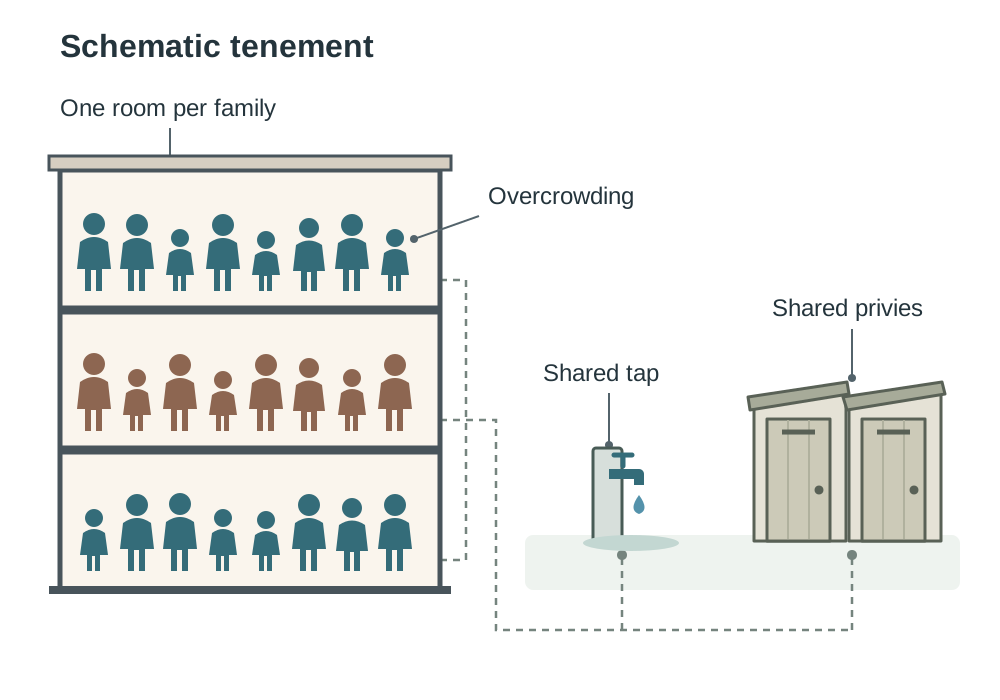
The human cost of this neglect became undeniable on 2 September 1913, when two houses collapsed on Church Street, killing seven people, including two children. This disaster, occurring in the opening days of the industrial dispute, prompted the 1914 Dublin Housing Inquiry, which found that 1,500 tenement buildings were completely unfit for human habitation.
Workplace conditions were equally precarious. Casual workers had no contracts, sick pay, or dismissal protections. On the tram lines of the Dublin United Tramways Company (DUTC), men worked up to seventeen hours a day and faced instant dismissal or arbitrary fines for small disciplinary infractions.
The Rise of Larkinism and New Unionism
Before the twentieth century, trade unions in Ireland were mostly conservative craft societies catering to skilled tradesmen such as printers, coopers, and stonemasons. These societies charged high subscription fees, protected entry into apprenticeships, and ignored the casual labourer. Unskilled workers had no voice until the arrival of 'New Unionism'.
James Larkin, born in Liverpool to Irish emigrant parents, came to Ireland in 1907 as an organiser for the National Union of Dock Labourers. Recognising that casual labourers needed an assertive, all-inclusive organisation, Larkin established the Irish Transport and General Workers' Union (ITGWU) in January 1909. From 1912, the union operated from Liberty Hall in Beresford Place. The union operated under the syndicalist motto: 'An injury to one is the concern of all.'
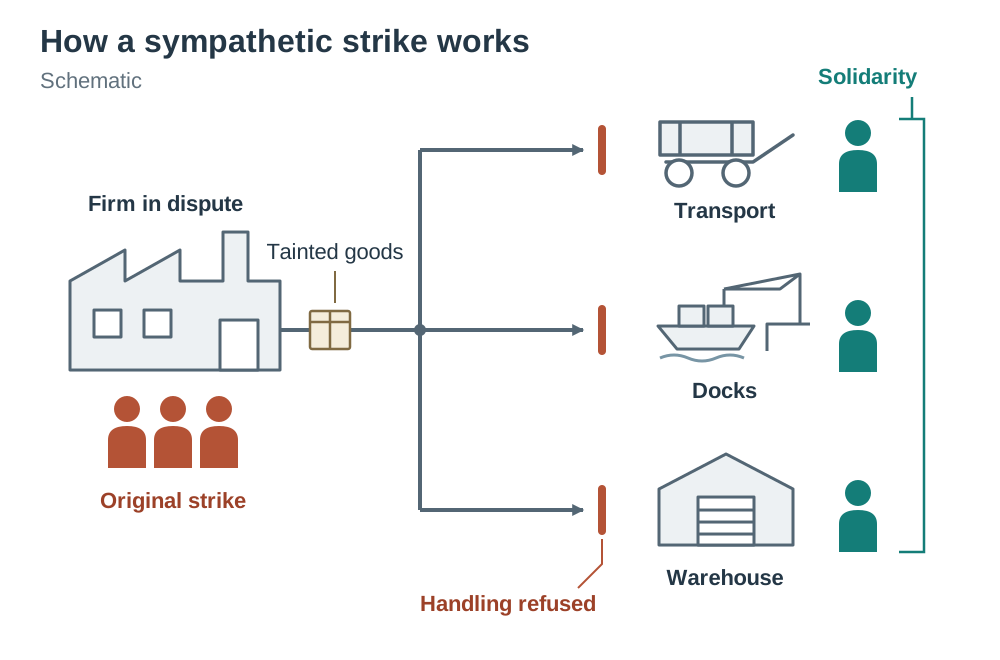
Larkin's most effective weapon was the sympathetic strike. If a company mistreated its workers or refused to negotiate with the ITGWU, workers in transport, shipping, or associated warehouses walked out in solidarity or refused to handle tainted goods originating from the offending firm. Between January and August 1913, Larkin organised around thirty strikes in Dublin, securing meaningful wage increases for carters, dockers, and coal-heavers, which deeply unnerved the city's business owners.
The Outbreak: The Tramway Strike and Bloody Sunday
The employer backlash was organised by William Martin Murphy, a formidable businessman, newspaper owner (Irish Independent, Evening Herald), owner of Clerys department store and the Imperial Hotel, and chairman of the Dublin United Tramways Company. Murphy was not opposed to traditional craft unions, but he was determined to stamp out syndicalism and what he viewed as Larkin's unpredictable, dictatorial power over trade.
In July 1913, Murphy delivered an ultimatum to his 1,700 tramway workers: they were permitted to form an internal company union, but anyone joining the ITGWU would be dismissed. Larkin accepted the challenge. He waited until Dublin Horse Show week, the busiest and most profitable week of the year for city commerce, to strike.
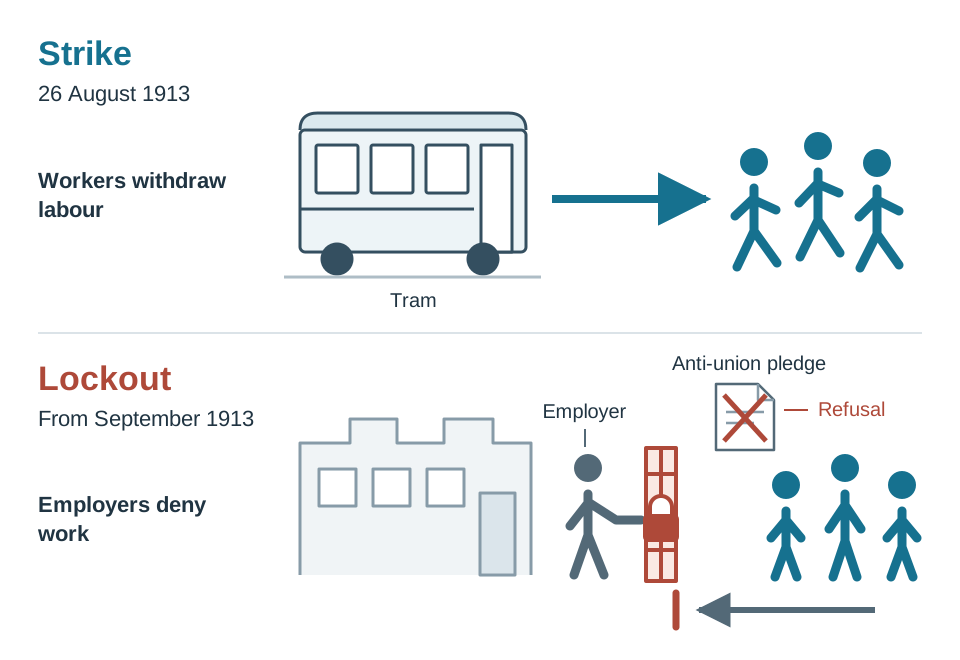
At 9:40 a.m. on 26 August 1913, approximately 700 DUTC drivers and conductors pinned red union badges to their lapels, abandoned their trams in the middle of streets, and walked off the job. Murphy reacted instantly, bringing in non-union replacement drivers and securing police escorts to keep the network running.
The crisis intensified that weekend. Dublin Castle banned a planned ITGWU protest meeting scheduled for Sunday 31 August on Sackville Street (now O'Connell Street). Tension spilled into widespread street disturbances on the night of Saturday 30 August, during which two workers, James Nolan and John Byrne, were fatally injured by police baton charges on the quays.
The next day, Sunday 31 August—remembered as Bloody Sunday—Larkin outwitted police cordons. Disguised as an elderly gentleman, he entered Murphy's own Imperial Hotel and stepped onto the balcony to speak to the crowds below. Within minutes, he was arrested. The Dublin Metropolitan Police (DMP), assisted by the Royal Irish Constabulary (RIC), baton-charged the crowd, injuring over 400 people. The ferocity of the policing outraged the public and widened the conflict across Dublin.
The General Lockout and the Askwith Inquiry
Determined to break the ITGWU once and for all, Murphy summoned employers to a meeting on 3 September 1913. Drawing together 400 firms associated with the Dublin Employers' Federation (which had been established in 1911), Murphy convinced them to enforce the pledge. Every employee had to sign an undertaking:
'I hereby undertake to carry out all instructions given to me by or on behalf of my employers, and, further, I agree to immediately resign my membership of the Irish Transport and General Workers' Union (if a member); and I further undertake that I will not join or in any way support this union.'
Over 20,000 workers refused to sign away their union membership and were locked out of their jobs. Because each wage-earner supported family members, approximately 100,000 people were pushed to the edge of destitution. Wealthier employers built a mutual defence fund to endure commercial losses, boosted by large donations, including £5,000 from Lord Iveagh of the Guinness brewery.
Alarmed by the disruption to Irish commerce, the British government stepped in, setting up a Board of Inquiry in October 1913 chaired by an experienced industrial mediator, Sir George Askwith. Larkin presented the workers' case, while employers hired the barrister and nationalist MP Tim Healy. Askwith published a compromise:
- Employers should withdraw the anti-union pledge and take back locked-out staff.
- The ITGWU should stop using spontaneous sympathetic strikes and agree to structured conciliation committees.
Larkin and the ITGWU accepted Askwith's recommendations as a basis for formal negotiation. Murphy and the Employers' Federation flatly rejected them. Aware of their superior financial reserves, employers calculated that winter weather and outright hunger would compel the workers to surrender.
Relief, the Kiddies Scheme, and the Irish Citizen Army
With no wages coming in, survival in the tenements required external help. Liberty Hall became a huge relief depot. Strikers received modest strike pay, and daily food kitchens were organised by Delia Larkin and Countess Constance Markievicz. The British Trades Union Congress (British TUC) provided direct material aid, sending over £100,000 in strike funds and chartering food relief ships, beginning with the SS Hare, which docked in late September with groceries and flour. Archbishop William Walsh of Dublin contributed privately to relief funds and tried to mediate, though the Catholic Church remained suspicious of union socialism.
Two critical developments transformed the dispute in October and November 1913:
The Kiddies Scheme
Organised by the British socialist Dora Montefiore alongside Lucille Rand, and supported by Delia Larkin, the scheme aimed to temporarily send malnourished children of strikers to hospitable trade union homes in Britain for the winter. The Roman Catholic Church, spurred by Archbishop Walsh, intervened aggressively. Priests warned that Catholic children would be spiritually corrupted in Protestant or socialist English households. Priests and members of the Ancient Order of Hibernians blocked departure points at Kingsbridge, Westland Row, and the docks. Montefiore was arrested on charges of kidnapping, and only a tiny handful of children left. The controversy alienated devout workers, divided the labour movement, and gave employers a major propaganda victory.
The Irish Citizen Army
Following repeated baton charges and the deaths of Nolan and Byrne, union leaders moved to protect workers. In November 1913, James Connolly, Jack White (a former British Army captain), and Jim Larkin founded the Irish Citizen Army (ICA) at Croydon Park. Drilling initially with hurleys and staves, the ICA provided physical defence for union rallies. Under Connolly's political direction, it soon became a disciplined, socialist-republican force with uniforms and firearms.
Women in the Dispute
The lockout involved thousands of working-class women whose experiences were vital to the struggle. In 1911, Delia Larkin had established the Irish Women Workers' Union (IWWU) to organise women who were excluded from traditional trade unions.
When the lockout spread in autumn 1913, female workers were drawn directly into the fight. At the Jacob's biscuit factory, hundreds of women refused to remove their red union badges and were locked out. They remained out until March 1914, and many were blacklisted permanently by management. In addition to industrial action, women sustained the community: the Liberty Hall soup kitchen, managed by Delia Larkin and Countess Markievicz, served thousands of hot meals daily, keeping the workforce from utter starvation through the bitter winter.
Contemporary Attitudes: How Ireland Took Sides
The lockout divided Irish society, exposing deep political and ideological fractures across nationalist Ireland:
- Arthur Griffith and Sinn Féin: Griffith was hostile to Larkin and the strike. As an economic nationalist, he argued that strikes damaged developing Irish industries and that Larkin was an English-born socialist agitator dividing Ireland. Griffith believed class conflict weakened the national struggle for independence.
- The Irish Parliamentary Party (IPP): The IPP stayed largely silent. The party drew financial and electoral backing from urban merchants, shopkeepers, and Catholic employers; Murphy himself had previously served as an anti-Parnellite nationalist MP. Leaders like John Redmond avoided the issue.
- Writers and Intellectuals: Several leading figures in the cultural revival defended the workers. The writer George Russell (AE) published a scathing open letter, To the Masters of Dublin (October 1913), condemning employers for using starvation as an economic weapon. W.B. Yeats attacked middle-class philistinism and hypocrisy in his poem September 1913 and publicly protested the intimidation that stopped the Kiddies Scheme. Patrick Pearse also wrote sympathetically about the appalling living conditions of Dublin's poor.
- The Press: The battle was fought aggressively in print. Murphy deployed the Irish Independent and the Evening Herald to portray the ITGWU as an anarchic threat to commercial life. In response, Larkin used the Irish Worker to attack Murphy and rallying workers with incendiary political cartoons and satirical broadsides.
Key Concepts: Socialism and Political Agitation
Socialism
Socialism is an economic and political ideology that argues the means of production, distribution, and exchange should be owned or regulated collectively by the community or the working class, rather than concentrated in private hands. In the context of 1913, James Connolly saw the lockout as far more than a dispute over wages; he viewed it as a crucial stage in overthrowing capitalist exploitation and building an independent workers' republic. This socialist vision directly shaped the ethos of the Irish Citizen Army and influenced the egalitarian language of the 1916 Proclamation.
Political Agitation
Political agitation is the practice of conducting energetic, highly visible public campaigns to force change from those in power, relying on mass rallies, street demonstrations, boycotts, and radical journalism rather than quiet parliamentary lobbying. Larkin was a master of political agitation. He used the Irish Worker, defied police bans on Sackville Street, and led his fiery cross speaking campaign across Britain to provoke mass public debate and pressure political authorities.
Evaluating the Key Personalities
James Larkin
- Strengths: An extraordinary orator whose emotional, fiery rhetoric gave casual workers a sense of human dignity and collective strength. He broke the old craft-union mould and built the first successful general union for unskilled labourers in Ireland.
- Weaknesses: Highly abrasive, egotistical, and impatient. His decision to launch the 'fiery cross' speaking tour of Britain, during which he publicly insulted British trade union leaders as corrupt cowards, destroyed any chance of getting the British TUC to call sympathetic strikes in December 1913.
- Historical Evaluation: Contemporary workers regarded him as a saviour, while the business class, the Catholic Church, and Sinn Féin saw him as a reckless agitator. Modern historians evaluate him as an inspirational organiser who was unsuited to long-term diplomatic strategy or practical collective bargaining.
James Connolly
- Role: While Larkin was imprisoned in late October 1913 or away campaigning in Britain, Connolly took command of the ITGWU in Dublin. He implemented a tough strategy, closing the port of Dublin to freight, and co-founded the Irish Citizen Army.
- Historical Evaluation: Connolly provided the intellectual and socialist foundation that Larkin lacked. Describing the outcome of 1913 as 'a drawn battle', Connolly recognised that although workers suffered tactical defeat, their resistance prevented the complete annihilation of industrial unionism. His experience of state violence in 1913 convinced him to merge labour interests with radical nationalism in the 1916 Easter Rising.
William Martin Murphy
- Role: The undisputed leader of the Dublin employers. Murphy demonstrated exceptional strategic resolve, marshalled 400 employers into line, and rejected government arbitration to enforce unconditional worker submission.
- Historical Evaluation: Contemporaries among the commercial elite viewed him as a brave defender of free enterprise against trade-union tyranny, while workers and intellectuals viewed him as an unyielding capitalist willing to starve children. Modern historians note that while Murphy won a tactical industrial victory in 1914, he lost the long-term moral argument, leaving his reputation permanently clouded by his ruthlessness.
Key terms
- Lockout
- An industrial tactic where employers close workplaces and refuse to let employees work until they agree to specific employer conditions, such as abandoning a trade union.
- ITGWU
- The Irish Transport and General Workers' Union, established in 1909 by James Larkin to organise unskilled and casual labourers into one general industrial union.
- Sympathetic Strike
- A strike conducted in solidarity with fellow workers in another firm or industry, often carried out by refusing to handle 'tainted goods'.
- Tainted Goods
- Materials, freight, or products manufactured or distributed by a business whose workers are on strike, which union members refuse to touch.
- Syndicalism
- A radical labour movement doctrine asserting that workers should unite in one major union and use general strikes to take control of industry.
- Dublin Employers' Federation
- An organisation of Dublin business owners formed in 1911, led by William Martin Murphy during the 1913 dispute to combat the ITGWU.
- The Pledge
- A written declaration distributed by employers in September 1913 requiring workers to resign from or promise never to join the ITGWU on pain of dismissal.
- Bloody Sunday (31 August 1913)
- The violent baton charge by the DMP and RIC on Sackville Street against citizens attending a banned ITGWU rally, injuring over 400 people.
- Askwith Inquiry
- An official British government board in October 1913 led by Sir George Askwith that proposed withdrawing the anti-union pledge in exchange for conciliation rules.
- Kiddies Scheme
- A relief plan organised by Dora Montefiore in October 1913 to send starving strikers' children to Britain, halted by Catholic Church opposition.
- Irish Citizen Army
- A workers' defence militia set up in November 1913 by Connolly, Larkin, and Jack White to protect strikers, which later fought in the 1916 Rising.
- British TUC
- The Trades Union Congress, the British trade union federation that provided over £100,000 in food and financial aid to Dublin but refused sympathetic strikes.
- Socialism
- A political and economic philosophy advocating collective or state ownership of the means of production to eliminate capitalist inequality.
- Political Agitation
- Active, public campaigning through mass assemblies, speeches, publications, and direct industrial actions to compel political or social change.
Check yourself
Why did James Larkin time the tramway strike for 26 August 1913?
He picked Dublin Horse Show week because it was the busiest commercial and visitor week of the year, ensuring maximum public attention and financial disruption for Murphy's tramway company.
What did the anti-union pledge distributed by employers on 3 September 1913 demand?
It forced workers to promise in writing that they would not belong to or support the Irish Transport and General Workers' Union (ITGWU), on pain of instant dismissal.
What two main recommendations were made by the Askwith Inquiry in October 1913?
Askwith recommended that employers withdraw the anti-union pledge and re-engage sacked workers, while the ITGWU should stop spontaneous sympathetic strikes and accept structured conciliation.
Why was the Kiddies Scheme abandoned in late October 1913?
The scheme was blocked by Catholic clergy and the Ancient Order of Hibernians, who feared that sending impoverished Catholic children to English host families would compromise their religious faith.
Why was Arthur Griffith opposed to James Larkin and the ITGWU in 1913?
Griffith was an economic nationalist who believed strikes damaged Irish industry; he viewed Larkin as an outsider who was dividing Irish society with class warfare instead of uniting it for national independence.
What did James Connolly mean when he called the lockout a 'drawn battle'?
He acknowledged that while the workers were forced back without immediate wage gains or union recognition, the employers had completely failed in their primary objective of destroying the ITGWU.