

Belfast during World War II is one of three case studies for Topic 3: 'The pursuit of sovereignty and the impact of partition, 1912–1949'. As part of the United Kingdom, Northern Ireland entered the war automatically on 3 September 1939. In the South, the government under Éamon de Valera remained neutral; in the South the war years were officially termed 'the Emergency'. Belfast served as a vital manufacturing base for Allied shipping, aircraft, and armaments. However, administrative complacency and inadequate Air Raid Precautions left the city defenceless. The 1941 Belfast Blitz devastated working-class districts, exposed deep social deprivation, prompted cross-border humanitarian aid from Dublin, and contributed directly to the political downfall of Prime Minister J.M. Andrews.
Partition, Allegiance, and the Conscription Crises
Northern Ireland entered World War II automatically when the United Kingdom declared war on Germany on 3 September 1939. Prime Minister James Craig (Lord Craigavon) pledged the province's total loyalty and resources to Westminster. For Craig and the Ulster Unionist Party, participating fully in the British war effort was a way to cement partition and prove Northern Ireland's unshakeable British identity.
Reactions across the community split along established sectarian divides. For the unionist majority, the war was a test of allegiance to the Crown. Thousands volunteered for the forces, joined the Local Defence Volunteers (later the Home Guard), or took up civil defence work. In contrast, the nationalist minority viewed the conflict as 'England's war'. Guided by the Nationalist Party and Cardinal Joseph MacRory, Catholics felt little loyalty toward a Stormont state where they faced systematic political and social discrimination.
Although Westminster passed the National Service Act introducing conscription in Britain, it excluded Northern Ireland in 1939. The British cabinet feared provoking armed nationalist resistance, inflaming Anglo-Irish relations, and disrupting Belfast's skilled workforce. In May 1941, following the devastation of the Blitz, Prime Minister J.M. Andrews pressed Winston Churchill to extend conscription to Northern Ireland to demonstrate Ulster's commitment. The proposal provoked immediate resistance. Cardinal MacRory and Catholic bishops condemned it, nationalist MPs organised mass rallies, and Éamon de Valera formally warned London that drafting northern nationalists would be treated as an act of aggression against the Irish nation. Churchill dropped the proposal in late May 1941, concluding it would cause 'more trouble than it was worth'. As a result, Northern Ireland remained the only UK region exempt from compulsory military service throughout the war.
Strategic Value and Industrial Mobilisation
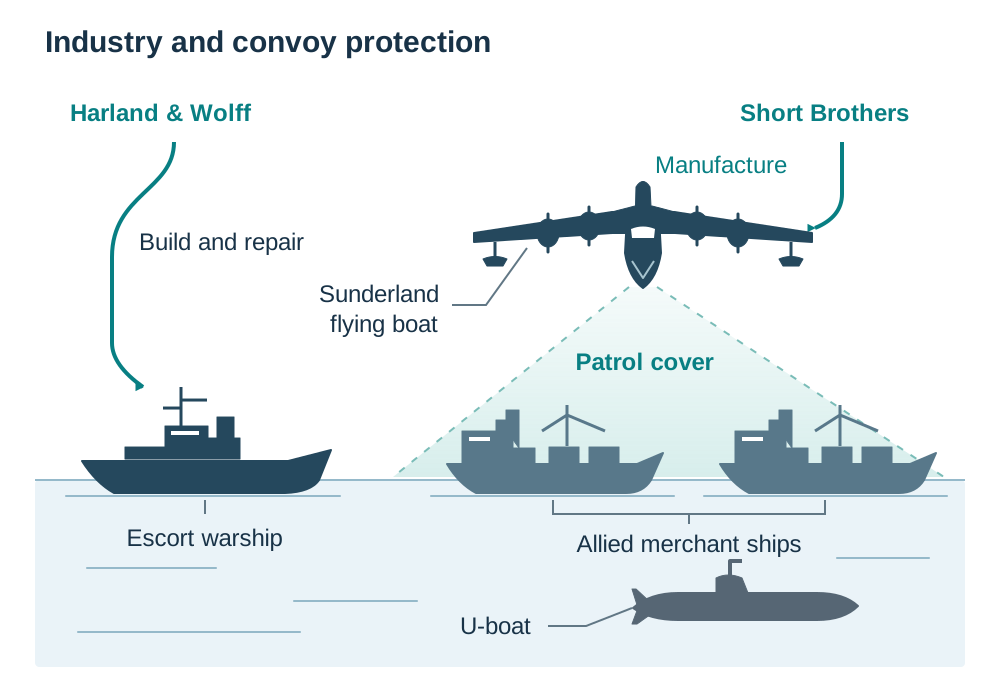
Northern Ireland's strategic importance grew immensely following the 1938 Anglo-Irish Agreement, under which Britain surrendered the 'Treaty Ports' of Berehaven, Cobh, and Lough Swilly. With southern anchorages closed to the Royal Navy, Belfast Lough and Derry became the primary naval and air bases protecting Allied convoys during the Battle of the Atlantic.
Belfast's heavy industries became critical to Britain's survival:
- Harland & Wolff: Queen's Island built roughly 140 warships—including six aircraft carriers, cruisers, and destroyers—and repaired over 3,000 vessels. At its peak in 1944, the shipyard employed more than 30,000 workers.
- Short Brothers: The Sydenham aircraft factory built approximately 1,200 Stirling heavy bombers and manufactured Sunderland flying boats, which provided vital long-range patrol cover against German U-boats. In 1943, following industrial disputes, the British Ministry of Aircraft Production intervened directly to take over plant management.
- Munitions and textiles: The Sirocco Engineering Works manufactured gun mountings and radar gear; linen mills turned out two million parachutes alongside uniform canvas; and Gallaher's factory supplied millions of cigarettes for soldier rations.
This industrial drive was slow to take off. In mid-1941, insured unemployment in Northern Ireland remained stuck near 20%, well above the British average, because Stormont was slow to win supply contracts. Only from 1942 did orders surge, cutting unemployment to around 5% by 1944. Thousands of women entered assembly lines, while the Women's Voluntary Service (WVS) coordinated welfare centres, clothing distribution, and canteen support.
Complacency, ARP Deficiencies, and Ministerial Failures
Despite Belfast's strategic value, the Northern Ireland government left the city shockingly unprotected. Cabinet ministers assumed German bombers lacked the range to reach Ulster. Even the Fall of France in June 1940, which gave the Luftwaffe bases along the French coast, failed to shatter Stormont's complacency.
Much of the early blame fell on the Minister of Home Affairs, Sir Richard Dawson Bates. Bates, who was elderly and hostile to administrative reform, delayed implementing mandatory Air Raid Precautions (ARP) and left preparation to local councils without central funding. In June 1940, Craigavon established the Ministry of Public Security under John MacDermott to take charge of civil defence. While MacDermott worked energetically, he inherited an acute shortfall in supplies and organisation that could not be repaired before the spring of 1941.
Belfast's defences were severely compromised:
- The city had only about 20 heavy anti-aircraft guns, roughly half the recommended defensive allocation.
- There were no permanent RAF night-fighter squadrons stationed in Northern Ireland, virtually no searchlights, and only a thin ring of barrage balloons.
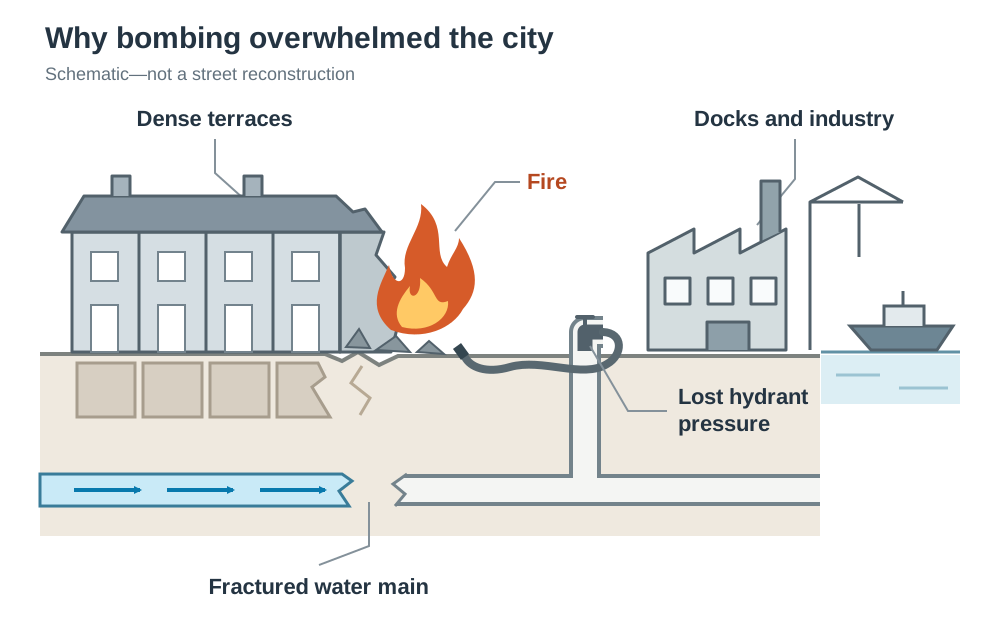
- Public shelters accommodated only a small fraction of the population. Most working-class families lived in poorly built Victorian terraces adjacent to shipyards and docks without adequate domestic shelters or escape routes.
The 1941 Belfast Blitz: Four Raids
Between April and May 1941, the German Luftwaffe launched four distinct air raids against Belfast, exposing the city's defensive vulnerabilities:
| Raid Date | Raid Name | Casualties | Damage and Significance |
|---|---|---|---|
| 7–8 April 1941 | The Dockside Raid | 13 killed, 81 injured | A small reconnaissance-in-force hit docks and factories; sirens sounded late, but Stormont insisted defences were adequate. |
| 15–16 April 1941 | The Easter Tuesday Raid | ~900–1,000 killed, 600+ injured | Massive assault by roughly 180 bombers dropping 76 parachute mines and heavy explosives; devastated dense residential terraces. Highest death toll in a single night outside London. |
| 4–5 May 1941 | The Fire Raid | 150–200 killed, hundreds burned | Heavy incendiary assault (~100,000 firebombs) focused on industry; two-thirds of Harland & Wolff damaged, halting full production for six months. |
| 5–6 May 1941 | Follow-up Raid | Light casualties | Final harassing raid causing fires across city centre before German aircraft were redeployed east. |
During the Easter Tuesday Raid, fires overwhelmed the city. Water mains fractured under high explosives, knocking out hydrant pressure. Terraced streets in the New Lodge, Antrim Road, and Shankill Road collapsed on residents trapped in cellars. City morgues overflowed immediately, forcing authorities to lay out hundreds of unidentified victims in St George's Market and the Falls Road public baths.
Cross-Border Humanitarian Aid
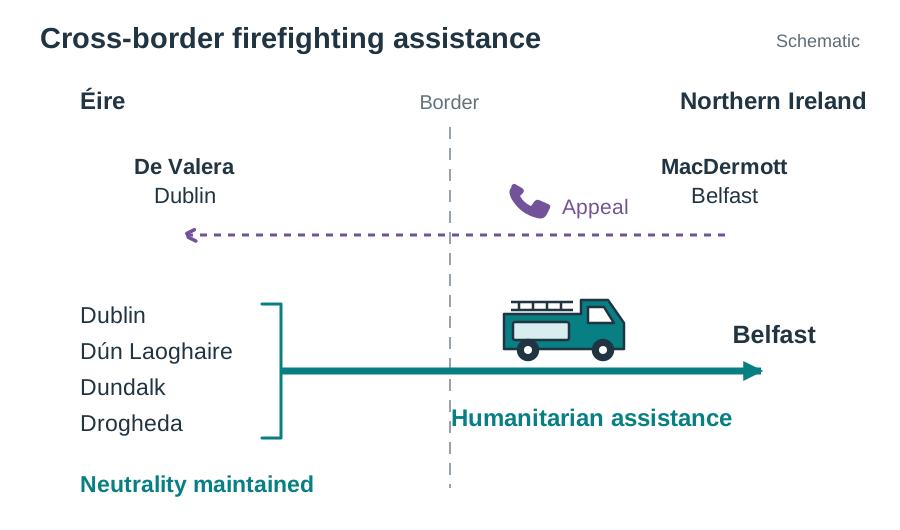
During the height of the Easter Tuesday Raid, Minister of Public Security John MacDermott realised Belfast's fire services were completely overwhelmed. With flames spreading uncontrollably through commercial and residential districts, MacDermott placed an urgent telephone call to Dublin appealing for civil defence assistance.
Taoiseach Éamon de Valera acted at once. He authorised southern fire brigades to cross the border as an emergency humanitarian act, operating strictly within Éire's policy of neutrality. Seventy-one southern firemen and 13 fire engines from Dublin, Dun Laoghaire, Dundalk, and Drogheda drove through the night without military escorts. They worked alongside northern crews for three days, pumping seawater from Belfast Lough to suppress major fires.
Speaking at Castlebar on 20 April 1941, de Valera publicly defended the decision: 'They are our people – we are one and the same people – and their sorrows in the present instance are also our sorrows.' Dublin repeated the assistance during the Fire Raid of early May. This cross-border solidarity briefly transcended partition and showed practical cooperation between North and South in a humanitarian crisis.
US Troop Presence and Long-Term Legacy to 1949
On 26 January 1942, the first contingent of United States troops landed at Dufferin Quay in Belfast. Over 300,000 American personnel passed through Ulster training camps before D-Day. Éamon de Valera immediately issued an official protest, stating that stationing foreign troops in the North without Dublin's consent implicitly endorsed partition and breached Irish sovereignty. London and Washington ignored the statement.
The American military presence brought substantial social changes: swing bands, dancehalls, high-grade rations, and encounters with African American soldiers, whom northern civilians generally treated with warmth despite the segregation rules imposed by US military police. Roughly 2,000 local women emigrated after 1945 as 'GI brides'.
The war permanently influenced the constitutional and social landscape of Northern Ireland:
- The Welfare State: The Blitz's exposure of slum housing prompted Stormont to establish the Northern Ireland Housing Trust (1945) and enact British post-war welfare reforms, including the National Health Service (NHS) and the 1947 Education Act.
- Constitutional Security: In his victory broadcast on 13 May 1945, Winston Churchill celebrated Northern Ireland's loyalty and blasted Dublin's neutrality. De Valera delivered a measured broadcast reply on 16 May. Ulster's wartime role was rewarded in the Ireland Act 1949, which gave a statutory guarantee that Northern Ireland could not be detached from the UK without the consent of the Stormont parliament.
Key terms
- Belfast Blitz
- The four German air attacks on Belfast during April and May 1941, which killed approximately 1,100 people and damaged over half the city's housing stock.
- Easter Tuesday Raid
- The devastating air assault of 15–16 April 1941 involving roughly 180 Luftwaffe bombers; it claimed up to 1,000 lives, the highest UK death toll outside London in a single night.
- Fire Raid
- The incendiary air attack on 4–5 May 1941 in which roughly 100,000 firebombs crippled industrial targets, damaging two-thirds of the Harland & Wolff shipyard.
- Air Raid Precautions (ARP)
- Civil defence arrangements meant to protect the public from aerial bombardment, including blackout discipline, gas masks, blast shelters, and rescue personnel.
- Ditching
- The nightly evacuation by up to 100,000 Belfast residents who fled into open countryside, ditches, and barns to escape nighttime bombing.
- Ministry of Public Security
- The Northern Ireland government department formed in June 1940 under John MacDermott to take civil defence responsibilities away from Dawson Bates.
- Harland & Wolff
- Belfast's Queen's Island shipyard, which constructed approximately 140 naval ships, repaired over 3,000 vessels, and employed over 30,000 workers during the war.
- Short Brothers
- Belfast aircraft manufacturer that built roughly 1,200 Stirling heavy bombers and Sunderland flying boats used for Atlantic submarine patrols.
- Conscription
- Compulsory enlistment for military service; Westminster excluded Northern Ireland in 1939 and 1941 due to strong nationalist and southern opposition.
- Sir Basil Brooke
- Minister of Commerce who helped force J.M. Andrews's resignation in April 1943, becoming Northern Ireland's third Prime Minister on 1 May 1943.
- Allegiance
- A key concept describing the political loyalty felt by the unionist majority toward Britain, contrasted with northern nationalist detachment.
- Ireland Act 1949
- Westminster legislation confirming Northern Ireland's UK status would not change without the consent of the Stormont parliament, cementing partition after the South declared a republic.
Check yourself
Why did the British government abandon its renewed plan to introduce conscription to Northern Ireland in May 1941?
Fierce opposition from Catholic bishops, nationalist MPs, and public protests, along with a formal diplomatic protest from de Valera, led Churchill to decide it was more trouble than it was worth.
Which Northern Ireland minister placed the emergency telephone call to Dublin asking for fire brigades during the Blitz?
Minister of Public Security John Clarke MacDermott.
What public statement did Éamon de Valera make to justify sending southern aid to Belfast?
"They are our people – we are one and the same people – and their sorrows in the present instance are also our sorrows."
What term describes the mass movement of up to 100,000 citizens fleeing Belfast every night to sleep in open country?
Ditching.
How did unemployment figures in Northern Ireland change between mid-1941 and 1944?
Unemployment stood high at roughly 20% in mid-1941 due to slow war contracts, but fell to about 5% by 1944 as industrial orders peaked.
How did de Valera react to the arrival of US forces in Northern Ireland in January 1942?
He formally protested that stationing foreign troops in the North without Dublin's consent implicitly endorsed partition and ignored Irish sovereignty.
What guarantee did the Ireland Act 1949 provide for Northern Ireland?
It guaranteed that Northern Ireland could not cease to be part of the UK without the consent of the Parliament of Northern Ireland.
Social Shock, 'Ditching', and the Fall of J.M. Andrews
The Blitz killed roughly 1,100 people, wrecked or damaged over 56,000 houses (about 53% of the city's housing stock), and left over 100,000 citizens homeless. The failure of ARP triggered public panic. Every evening, between 70,000 and 100,000 residents abandoned urban streets to sleep in ditches, barns, and open fields along the slopes of Cave Hill and around Lisburn in a phenomenon termed ditching.
By June 1941 around 220,000 people had left Belfast, at least for a time. Some went through official evacuation schemes, which gave priority to mothers, young children and the sick, but many left on their own. Billets in farming communities exposed stark class disparities, revealing severe child malnutrition, poverty, and skin ailments that the Stormont government had ignored for decades.
Public anger damaged the political standing of the Ulster Unionist government. Prime Minister J.M. Andrews, who had replaced Craigavon in November 1940, appeared tired and out of touch. Electoral backlash followed: Harry Midgley of the Northern Ireland Labour Party won the Stormont seat of Belfast Willowfield in December 1941, while Jack Beattie won the Westminster seat of West Belfast in February 1943. Labour unrest escalated, including an autumn 1942 wildcat strike by 10,000 aircraft machinists over wages.
Facing rebellion from backbenchers and losing the confidence of senior colleagues—including Minister of Commerce Sir Basil Brooke—Andrews resigned in late April 1943. Brooke took office as Prime Minister on 1 May 1943. He brought in younger ministers and appointed Labour MP Midgley as Minister of Public Security to signal cross-party resolve, but he pointedly refused to include any Catholic nationalists in government.