

Between 1919 and 1939, Germany changed from a liberal democratic republic into a totalitarian dictatorship. Born out of military defeat in World War I, the Weimar Republic struggled with institutional flaws, street violence, and widespread outrage over the Treaty of Versailles. Although Gustav Stresemann stabilised the currency and foreign relations during the mid-1920s, the Wall Street Crash of 1929 brought mass unemployment and bank failures. Adolf Hitler and the National Socialist German Workers' Party (NSDAP) exploited this crisis through disciplined propaganda, paramilitary intimidation, and conservative backstairs intrigue. Appointed Chancellor on 30 January 1933, Hitler dismantled democracy within eighteen months using emergency decrees, the Enabling Act, the elimination of opposition parties, and coordinated state terror.
How Weimar Germany Was Governed and the Crisis Years (1918–1929)
How Weimar Germany Was Governed
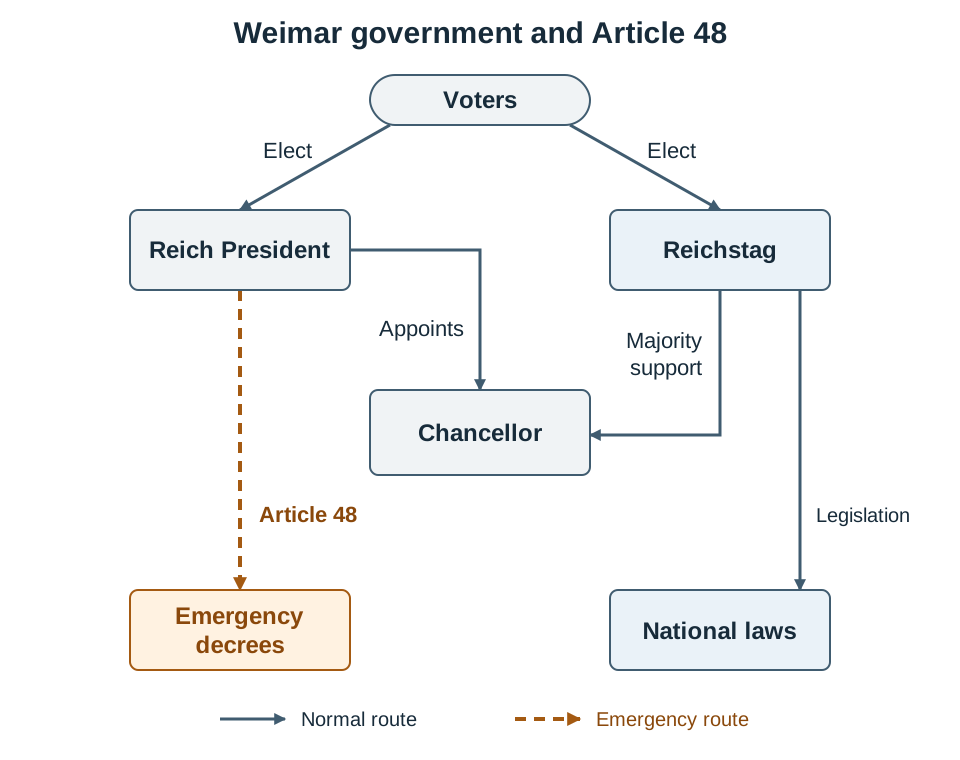
To understand why Weimar collapsed, it helps to understand how its constitution worked:
- The Reichstag: The parliament, elected by all men and women over twenty. It passed national laws and controlled the budget.
- The Reich President: The head of state, elected directly by the people every seven years. Under Article 48, the President could suspend civil liberties and pass emergency decrees without parliament during a national crisis.
- The Chancellor: The head of government, appointed by the President. To govern normally, the Chancellor needed a majority in the Reichstag.
- Coalition governments: Under proportional representation, seats were awarded based on total votes (one seat per 60,000 votes, with no minimum threshold). Because dozens of small parties entered the Reichstag, no single party ever won a majority. Parties had to form fragile coalitions, which collapsed frequently.
Key Timeline: 1918–1938
- November 1918: Kaiser Wilhelm II abdicates; Friedrich Ebert (SPD) leads the new republic.
- January 1919: Spartacist Uprising crushed; Liebknecht and Luxemburg murdered.
- June 1919: Germany signs the Treaty of Versailles.
- March 1920: Kapp Putsch fails after a general strike in Berlin.
- January 1923: French and Belgian troops occupy the Ruhr; hyperinflation erupts.
- November 1923: Munich Putsch fails; Rentenmark introduced to end inflation.
- 1924–1929: Dawes Plan (1924), Locarno Treaties (1925), and Young Plan (1929) bring recovery.
- October 1929: Wall Street Crash triggers the Great Depression.
- March 1930: Heinrich Brüning appointed Chancellor; begins ruling by Article 48 decrees.
- July 1932: Nazis peak in a free election with 37.3% (230 seats).
- 30 January 1933: Hitler appointed Chancellor in a coalition cabinet.
- 23 March 1933: Reichstag passes the Enabling Act.
- June–July 1934: Night of the Long Knives; Röhm and SA leadership purged.
- August 1934: Hindenburg dies; Hitler combines offices as Führer; army swears loyalty oath.
- September 1935: Nuremberg Laws strip German Jews of citizenship.
- November 1938: Kristallnacht pogrom marks escalating violent persecution.
Early Threats and Stabilisation
From its birth, right-wing nationalists attacked the republic using the Dolchstoßlegende ('stab-in-the-back' myth), claiming the army was not defeated in 1918 but betrayed at home by socialists, communists, and Jews. Anger intensified when the government signed the Treaty of Versailles on 28 June 1919. Under Article 231 (the War Guilt Clause), Germany and its allies were forced to accept responsibility for all war damage, establishing the legal basis for reparations, set in 1921 at 132 billion gold marks. Nationalists denounced democratic leaders as the November Criminals.
Paramilitary violence threatened the state from both sides. In January 1919, the communist Spartacist Uprising attempted to establish a council republic in Berlin. Ebert's government used the Freikorps (right-wing ex-soldier units) to crush the rebellion. Karl Liebknecht and Rosa Luxemburg were captured and murdered by Freikorps officers on 15 January 1919. In March 1920, the right-wing Kapp Putsch seized Berlin until a trade union general strike halted the coup. Nationalist gunmen also assassinated Finance Minister Matthias Erzberger (1921) and Foreign Minister Walther Rathenau (1922).
In January 1923, after Germany defaulted on timber and coal deliveries, 60,000 French and Belgian troops occupied the Ruhr Valley. Chancellor Wilhelm Cuno called for passive resistance, paying striking workers by printing paper marks. The result was catastrophic hyperinflation: by late 1923, a loaf of bread cost billions of marks. While borrowers wiped out debts, the middle class lost their savings, leaving lasting bitterness toward democracy. Gustav Stresemann halted the crisis in late 1923. His government, with Currency Commissioner Hjalmar Schacht, introduced the Rentenmark, an interim currency backed by mortgages on agriculture and industry. Stresemann then secured foreign loans under the Dawes Plan (1924), settled western borders in the Locarno Treaties (1925), joined the League of Nations (1926), and negotiated the Young Plan (1929), which lowered reparations to 112 billion Reichsmarks over 59 years.
The Great Depression and the Path to Power (1929–1933)
Adolf Hitler joined the small German Workers' Party (DAP) in Munich in September 1919. In February 1920, he announced its 25-Point Programme, demanding the abolition of Versailles, union of all Germans, exclusion of Jews from citizenship, and 'land and territory' for Germany's population. Hitler later developed this into the doctrine of Lebensraum (living space) in eastern Europe in Mein Kampf. Renamed the National Socialist German Workers' Party (NSDAP), Hitler became absolute party leader in 1921. He set up the Sturmabteilung (SA), or Brownshirts, in 1921 to protect Nazi meetings and attack opponents. Ernst Röhm helped arm and organise the SA, later becoming its Chief of Staff in 1931.
In November 1923, Hitler attempted an armed coup, the Munich Putsch. Bavarian police crushed the march, killing 16 Nazis. Hitler served nine months in Landsberg Prison, where he dictated Mein Kampf, setting out his racial theories of Herrenvolk (Aryan master race) and extreme anti-Semitism. Released in December 1924, Hitler adopted a policy of legality: the Nazis would contest elections, win seats, and destroy democracy using its own constitutional machinery.
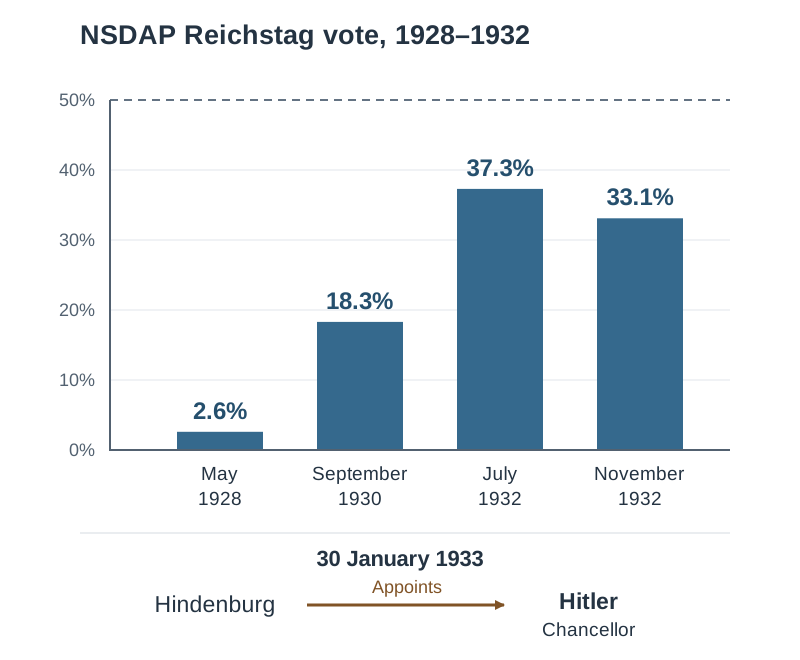
During the stable Stresemann years, the NSDAP remained marginal, winning only 2.6% of the vote (12 seats) in May 1928. In 1929, press baron Alfred Hugenberg, leader of the nationalist DNVP, allied with Hitler to campaign against the Young Plan. This alliance gave Hitler national press coverage, generous funding, and respectability among conservative elites.
The Wall Street Crash of October 1929 devastated Germany, as American banks abruptly recalled their short-term loans. By early 1932, registered unemployment passed six million. In March 1930, President Hindenburg appointed Centre Party leader Heinrich Brüning as Chancellor. Brüning pursued deflation by cutting public-sector pay and raising taxes, earning the nickname the Hunger Chancellor. When the Reichstag rejected his budget, Brüning governed through Hindenburg's Article 48 emergency powers. In 1931, Hindenburg issued 44 emergency decrees; in 1932, he issued 66 decrees while the deadlocked Reichstag passed only five laws.
Hitler and his propaganda chief, Joseph Goebbels, directed public fury toward Weimar politicians and communists, promising 'Work and Bread'. The effect on elections was dramatic:
- September 1930: NSDAP won 18.3% (107 seats), becoming the second-largest party.
- March–April 1932 Presidential Election: Hitler challenged Hindenburg. Hitler lost, but polled 36.8% in the run-off, proving his national standing.
- July 1932: NSDAP peaked at 37.3% (230 seats), becoming Germany's largest party.
The Backstairs Intrigue (1932–1933)
Hindenburg dismissed Brüning in May 1932 and appointed Franz von Papen, an aristocrat who lifted the ban on the SA, causing a summer of street violence. In November 1932 elections, Nazi support dropped to 33.1% (196 seats) while the Communist Party (KPD) rose to 16.9% (100 seats). Fearing civil unrest, Hindenburg replaced Papen with General Kurt von Schleicher in December 1932.
Schleicher failed to build a working Reichstag coalition. Bitter over his dismissal, Papen opened secret negotiations with Hitler, Hindenburg's son Oskar, and conservative industrialists. They convinced Hindenburg that a coalition cabinet headed by Hitler, with Papen as Vice-Chancellor and traditional conservatives holding eight of eleven cabinet posts, would 'tame' the Nazi leader while providing popular backing to crush the communist threat. Papen boasted, 'We have hired him.' On 30 January 1933, Hindenburg appointed Hitler Chancellor. Hitler did not seize power through an armed coup; he was invited in by a conservative elite at a moment when his electoral support was slipping.
Consolidation of Power and Gleichschaltung (1933–1934)
Between January 1933 and August 1934, Hitler systematically eliminated opposition through Gleichschaltung (coordination), bringing all public institutions under Nazi control:
- The Reichstag Fire Decree (28 February 1933): When the Reichstag building burned on 27 February, the regime blamed Dutch communist Marinus van der Lubbe. Hindenburg signed the 'Decree for the Protection of People and State', which suspended personal freedom, free speech, a free press, and the right of assembly. The police could now hold political opponents in 'protective custody' without charge, enabling the arrest of 4,000 communists and socialists before the 5 March election, where the Nazis won 43.9% of the vote.
- The Enabling Act (23 March 1933): Officially titled the 'Law for the Removal of the Distress of People and Reich', this transferred law-making power from the Reichstag to the cabinet for four years. Hitler's government could now pass laws, even those altering the constitution, without parliament or the President. With 81 KPD deputies jailed or in hiding, and armed SA men lining the Kroll Opera House, the Centre Party voted in favour after Hitler pledged to protect Catholic schools and rights. The bill passed by 441 votes to 94; only the Social Democrats (SPD), led by Otto Wels, voted against.
- Elimination of Opposition and Federal States (April–July 1933): On 7 April 1933, the Law for the Restoration of the Professional Civil Service purged Jews and political opponents from the administration. On 2 May 1933, the SA seized trade union offices and arrested leaders; all unions were forced into the state-run German Labour Front (DAF) under Robert Ley. In July 1933, after the SPD was banned and the Centre Party dissolved itself, the 'Law Against the Formation of New Parties' made the NSDAP the sole legal party. In January 1934, the Law for the Reconstruction of the Reich abolished state (Länder) parliaments, centralising power in Berlin.
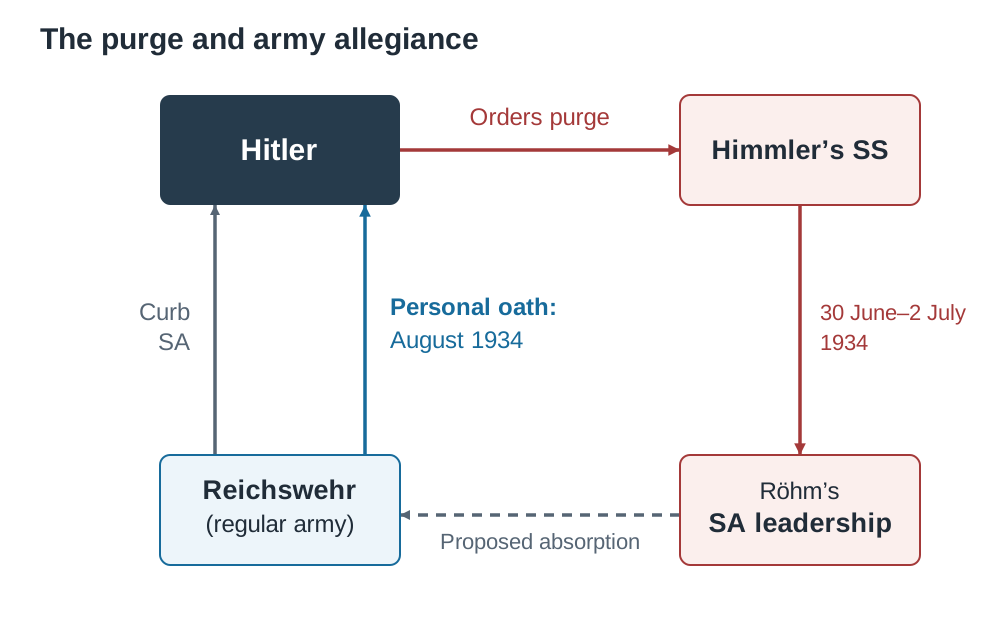
- The Night of the Long Knives (30 June–2 July 1934): SA leader Ernst Röhm demanded that his 3-million-strong Brownshirts absorb the regular army (Reichswehr) and carry out a 'second revolution' against big business. The army generals refused to support Hitler unless the SA was curbed. Hindenburg was dying, and Hitler needed the army's allegiance to succeed him. Hitler ordered Heinrich Himmler's SS to purge the SA leadership. Röhm, former Chancellor Schleicher, and conservative critics were executed. An estimated 200 people were murdered. The army high command congratulated Hitler for removing the SA threat.
- The Oath to the Führer (August 1934): President Hindenburg died on 2 August 1934. Hitler merged the offices of Chancellor and President, taking the title Führer und Reichskanzler. Every soldier and officer in the army swore a personal oath of unconditional obedience to Adolf Hitler. On 19 August 1934, a national plebiscite approved Hitler's combined powers with an 89.9% vote.
The Nazi Economy: Work, Autarky, and Rearmament (1933–1939)
When Hitler took office in January 1933, six million Germans were unemployed. To secure his dictatorship, Hitler had to deliver on his promise of 'Work and Bread' (Arbeit und Brot).
Job Creation and State Control
The regime financed public construction through deficit spending. The state built government complexes, housing, and the autobahns (a national motorway network designed for military mobility). In 1935, the Reich Labour Service (RAD) became compulsory: all men aged 18 to 25 had to complete six months of manual labour on public projects, working for pocket money and food. Unemployment figures dropped partly because women were pressured out of paid jobs and Jews were stripped of civil service, medical, and legal positions, removing them from official registers.
Schacht's New Plan (1934) and Göring's Four-Year Plan (1936)
Economics Minister Hjalmar Schacht introduced the New Plan (1934) to tackle currency shortages. He controlled foreign trade, requiring government approval for all imports. Schacht signed bilateral trade treaties with south-eastern European nations (such as Hungary, Romania, and Yugoslavia), paying for raw materials with German manufactured goods rather than scarce foreign gold or cash.
By 1936, Hitler prioritised rapid rearmament over consumer goods. He appointed Hermann Göring to lead the Four-Year Plan (1936), aiming to achieve autarky (economic self-sufficiency) and make Germany war-ready within four years. Göring expanded the domestic production of raw materials and synthetic alternatives (Ersatz), including synthetic oil made from coal, synthetic rubber (Buna), and low-grade domestic iron through the state-owned Reichswerke Hermann Göring.
Impact on Workers
Independent collective bargaining ended with the destruction of trade unions. The German Labour Front (DAF) froze wages and banned strikes. To prevent working-class unrest, the DAF operated the Strength Through Joy (KdF) organisation, providing subsidised theatre trips, sporting events, and cruise holidays. The DAF also collected savings stamps for the Volkswagen ('people's car'), though production shifted to military vehicles before any consumer received a finished car. By 1939, registered unemployment fell below 500,000, and industry suffered acute labour shortages. However, this recovery was an unsustainable war economy financed by mounting government debt.
Controlling Society: Youth, Women, Terror, and Church Relations
To construct an ideologically unified Volksgemeinschaft (People's Community), the regime used terror, education, and social policy.
Youth and Education
Nazi policy aimed to raise physically tough boys prepared for military service and girls trained for motherhood. In schools, teachers had to join the Nazi Teachers' League, and the curriculum was revised to prioritise physical training, German history, and 'racial science'. Textbooks glorified Hitler, and Mein Kampf became required reading. Outside school, the Hitler Youth (Hitlerjugend) for boys and the League of German Girls (Bund Deutscher Mädel, BDM) absorbed all rival youth movements. Under the Hitler Youth Law of 1936, the organisation received official state status, and membership became compulsory in 1939.
Women in the Nazi State
Nazi ideology restricted women to the domestic sphere, summarised as Kinder, Küche, Kirche (children, kitchen, church). Women were pushed out of senior civil-service posts and many legal and medical jobs, and from 1936 they could not become judges or state prosecutors. Under the Law for the Encouragement of Marriage (1933), newlywed couples received a loan of 1,000 marks; for each child born, 25% of the loan was forgiven. In 1938, the regime created the Mother's Cross (bronze for four children, silver for six, gold for eight or more). By 1937, severe factory labour shortages forced the regime to encourage women back into industrial employment, exposing the practical contradictions of Nazi ideology.
Terror and the Police State
State terror operated through Heinrich Himmler, who became Chief of the German Police in 1936, uniting the SS and the secret state police (Gestapo). In March 1933, the SS opened the first concentration camp at Dachau for political prisoners. The Gestapo operated above the law, holding suspects indefinitely under 'protective custody'. Historians like Robert Gellately have shown that the Gestapo had limited personnel and relied heavily on voluntary denunciations from ordinary citizens reporting colleagues, neighbours, and relatives.
Church-State Relations
On 20 July 1933, Vice-Chancellor Franz von Papen signed the Reichskonkordat with Cardinal Pacelli (Vatican Secretary of State, later Pope Pius XII). The Catholic Centre Party had dissolved itself on 5 July. Under the agreement, Catholic clergy were barred from party-political activity, while the Nazi regime guaranteed freedom of worship, Catholic schools, and church youth organisations. Hitler quickly breached the Concordat by closing Catholic youth clubs and arresting priests on fabricated charges. In March 1937, Pope Pius XI issued the encyclical Mit brennender Sorge ('With Burning Anxiety'), which was smuggled into Germany and read from pulpits, condemning Nazi racism, state idolatry, and treaty violations.
Among Protestants, the regime promoted a centralised Reichskirche under Reich Bishop Ludwig Müller, teaching 'Positive Christianity' purged of Jewish heritage. In response, dissident pastors, including Martin Niemöller and Dietrich Bonhoeffer, formed the Confessing Church (Bekennende Kirche) in 1934 to defend orthodox Christian theology against Nazi control. Niemöller was arrested in 1937 and imprisoned in concentration camps until 1945. (Note: students comparing fascist church policy should contrast Hitler's Concordat violations with Mussolini's Lateran Pacts of 1929 in Italy.)
Anti-Semitism and State Persecution (1933–1938)
Nazi anti-Semitism was not merely religious prejudice; it treated Jewish people as a biological threat to the Aryan race. Persecution unfolded through deliberate, escalating stages between 1933 and 1938:
- The April Boycott (1 April 1933): The regime held a nationwide, day-long boycott of Jewish-owned shops, law firms, and medical practices. SA men stood outside storefronts painting Stars of David, though public indifference led the regime to pause general boycotts.
- Professional and Cultural Exclusion (1933): The Civil Service Law of 7 April 1933 expelled Jews from government offices, universities, and schools. On 10 May 1933, Goebbels organised public book burnings across university towns, destroying works by Jewish, socialist, and liberal writers like Albert Einstein, Sigmund Freud, and Karl Marx.
- The Nuremberg Laws (15 September 1935): Announced at the annual Nuremberg Rally, these laws provided legal status for racial persecution:
- The Reich Citizenship Law: Deprived German Jews of their citizenship, reducing them to 'subjects of the state' without voting or political rights.
- The Law for the Protection of German Blood and Honour: Prohibited marriage and sexual relations between Jews and citizens of 'German or related blood'.
- The 1936 Olympic Pause: The regime temporarily lowered anti-Semitic street signs and muted press attacks during the 1936 Berlin Olympic Games to avoid foreign boycotts and present a respectable image to international visitors.
- Kristallnacht (9–10 November 1938): When Herschel Grynszpan, a 17-year-old Polish Jew, shot German diplomat Ernst vom Rath in Paris, Joseph Goebbels used the death to orchestrate a nationwide pogrom. SA men and party mobs burned over 1,000 synagogues, ransacked 7,500 Jewish businesses, and murdered at least 91 Jewish people. Police and fire brigades stood by as synagogues burned, and the Gestapo and SS arrested about 30,000 Jewish men and sent them to concentration camps such as Dachau, Buchenwald and Sachsenhausen. The regime then fined the German Jewish community one billion Reichsmarks for the damage, barred Jews from public schools, and accelerated forced 'Aryanisation' (the seizure of Jewish businesses).
Case Study: The Nuremberg Rallies, Propaganda, and Key Personalities
Case Study: The Nuremberg Rallies
Held annually each September at the Nazi Party Grounds in Nuremberg, these week-long rallies served as the primary display of the totalitarian state. Nuremberg was chosen because it was a historic imperial city of the Holy Roman Empire, linking Hitler's regime to a thousand-year German past. It was also centrally located and had hosted party gatherings in 1927 and 1929.
Each gathering carried a specific political theme:
- 1933: 'Rally of Victory' (celebrating the appointment to power).
- 1934: 'Rally of Unity and Strength' (staged after the Night of the Long Knives to demonstrate SA loyalty under its new leader, Viktor Lutze).
- 1935: 'Rally of Freedom' (celebrating rearmament and the announcement of the Nuremberg Laws).
- 1936: 'Rally of Honour' (marking the remilitarisation of the Rhineland).
- 1937: 'Rally of Labour' (celebrating the reduction of unemployment).
- 1938: 'Rally of Greater Germany' (celebrating the union with Austria, the Anschluss).
- The 1939 'Rally of Peace' was cancelled due to the invasion of Poland.
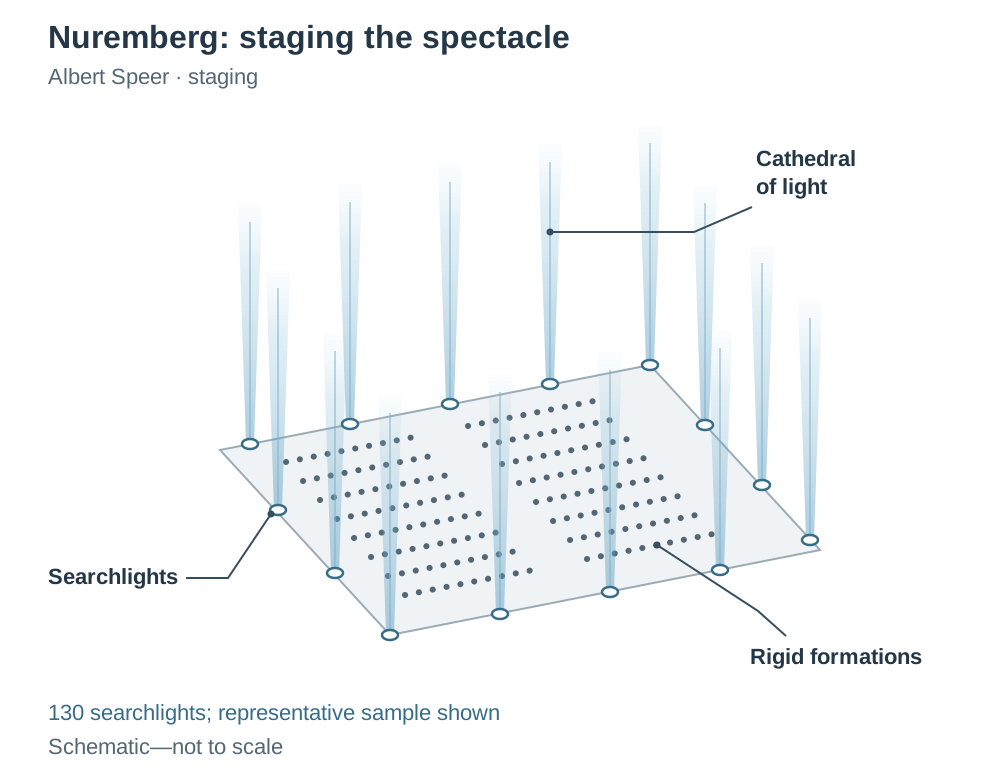
Hundreds of thousands participated: SA and SS units, Hitler Youth boys, and Reich Labour Service men marching with polished spades. For attendees, participation was an honour, but demanding: historical records describe forced marches, exhaustion, and hours of standing in rigid formations. Architect Albert Speer designed the Zeppelin Field and placed 130 anti-aircraft searchlights around the arena, shining beams thousands of metres into the night sky to create a cathedral of light. Speer designed the setting. The rallies also used quasi-religious rituals: Hitler consecrated new swastika flags by touching them with the 'Blood Flag' carried in the 1923 Munich Putsch. The rallies submerged personal individuality into a disciplined collective mass and reinforced the Führer cult.
Joseph Goebbels (1897–1945)
Goebbels joined the NSDAP in 1925 and served as Gauleiter of Berlin from 1926. In March 1933, Hitler appointed him Minister of Public Enlightenment and Propaganda. Goebbels controlled the press, radio, theatre, and cinema through the Reich Chamber of Culture. He promoted the Volksempfänger (People's Receiver), a cheap radio priced at 76 Reichsmarks. While its limited tuning range made foreign stations difficult to pick up, listening to foreign broadcasts became a criminal offence in September 1939. By 1939, 70% of German homes owned a radio. Goebbels incited the 1938 Kristallnacht pogrom and later delivered the famous 'Total War' speech in Berlin in 1943. On 1 May 1945, Goebbels and his wife Magda poisoned their six children and committed suicide in Hitler's bunker.
- Evaluation: Contemporaries viewed Goebbels as an energetic, persuasive speaker. Modern historians recognise him as an expert manipulator of mass psychology who normalised racial persecution, though historians point out that his propaganda succeeded primarily when it reinforced existing nationalist, anti-communist, and anti-Versailles prejudices.
Leni Riefenstahl (1902–2003)
Originally a dancer and film actress, Riefenstahl directed The Blue Light (1932), which caught Hitler's attention. Hitler commissioned her to film the 1934 Nuremberg Rally, resulting in Triumph of the Will (Triumph des Willens, 1935). She deployed 30 cameras, camera tracks, dynamic aerial shots from aeroplanes, and low-angle shots looking up at Hitler against the open sky to present him as a messianic redeemer. In Olympia (1938), covering the 1936 Berlin Games, she introduced slow-motion shots and underwater cameras, celebrating Aryan physical strength. In 1949, a denazification tribunal categorised her as a fellow traveller (a sympathiser who did not hold formal party office). She maintained until her death in 2003 that she was an apolitical artist.
- Evaluation: Contemporary: she was celebrated in Nazi Germany, and Olympia won the top prize at the 1938 Venice Film Festival, though some foreign critics already saw her films as Nazi propaganda. While her cinematic innovations are acknowledged by film scholars, modern historians conclude that her work knowingly glorified a brutal regime, providing the aesthetic imagery that legitimised the Führer cult.
Adolf Hitler and Historical Interpretations
Hitler established personal authority through charismatic oratory and the systematic dismantling of legal limits. In historiography, Intentionalist historians (such as Klaus Hildebrand) argue Hitler followed a deliberate blueprint laid out in Mein Kampf, driving foreign policy and racial violence from above. In contrast, Functionalist (Structuralist) historians (such as Martin Broszat and Hans Mommsen) argue the Third Reich was an administrative tangle of competing party and state bodies, where officials radicalised policies by 'working towards the Führer'. Students should draw on both perspectives when assessing Hitler's leadership in an essay conclusion.
(Note: Hitler's foreign policy (1933–1939), the Nazi state in war and wartime alliances are also part of this syllabus topic (Dictatorship and democracy in Europe, 1920–1945); study them in the separate notes for this topic.)
Key terms
- Fascism
- An authoritarian, ultra-nationalist political movement characterised by dictatorial power, militarism, suppression of opposition, and the subordination of individual rights to the state.
- Dictatorship
- A system of government where absolute power is held by a single leader or small group, unrestricted by law, independent courts, or free elections.
- Totalitarianism
- A form of government where the state seeks total control over all public and private life, including politics, the economy, education, and culture, enforced by terror and propaganda.
- Führer cult
- The systematic use of propaganda, mass rallies, and media to depict Adolf Hitler as an infallible, god-like saviour of the German nation.
- Propaganda
- Information, often selective, biased, or misleading, disseminated systematically by the state to shape public opinion and control behavior.
- Anti-Semitism
- Prejudice, hostility, discrimination, or state-directed persecution against Jewish people.
- Article 48
- The emergency decree provision of the Weimar Constitution allowing the Reich President to suspend civil liberties and pass laws without the Reichstag.
- Dolchstoßlegende
- The right-wing 'stab-in-the-back' myth claiming that the German army was not defeated in World War I but betrayed at home by socialists, communists, and Jews.
- November Criminals
- A derogatory term used by German nationalists to vilify the Weimar politicians who signed the November 1918 armistice and the Treaty of Versailles.
- Rentenmark
- The emergency currency introduced in November 1923 by Stresemann's government, with Hjalmar Schacht as Currency Commissioner, backed by mortgages on land and industry to stop hyperinflation.
- Lebensraum
- The Nazi foreign policy objective of conquering 'living space' in Eastern Europe to supply land and raw materials for the Aryan population.
- Herrenvolk
- The Nazi racial doctrine asserting that Germanic Aryans constituted a biological 'master race' entitled to dominate other peoples.
- Enabling Act
- The constitutional law passed on 23 March 1933 that gave Hitler's cabinet full power to enact legislation without Reichstag approval for four years.
- Gleichschaltung
- The Nazi policy of 'coordination' through which all social, political, economic, and administrative institutions were brought under party control.
- Night of the Long Knives
- The SS purge of 30 June–2 July 1934 in which Ernst Röhm, the SA leadership, and political rivals were murdered, securing the support of the army.
- Nuremberg Laws
- The anti-Semitic laws enacted in September 1935 that stripped German Jews of their citizenship and banned marriage or sexual relations between Jews and Aryans.
- Autarky
- An economic policy aimed at total national self-sufficiency, eliminating dependence on foreign imports through synthetic production and state controls.
- Reichskonkordat
- The treaty signed on 20 July 1933 between Vice-Chancellor Papen and the Vatican, in which the Church agreed to clergy political neutrality in exchange for religious rights.
- Reichskirche
- The centralised, Nazi-controlled Protestant church led by Reich Bishop Ludwig Müller, designed to enforce 'Positive Christianity'.
- Volksempfänger
- A cheap, mass-produced domestic radio commissioned by Joseph Goebbels to ensure Nazi broadcast propaganda reached every German household.
Check yourself
What two constitutional provisions undermined the political stability of the Weimar Republic?
Proportional representation (allocating one seat per 60,000 votes without a minimum threshold, which fragmented parliament into short-lived coalitions) and Article 48 (which allowed the President to enact emergency decrees and bypass parliament).
What did the Nuremberg Laws of 15 September 1935 enact?
The Reich Citizenship Law stripped German Jews of their citizenship, and the Law for the Protection of German Blood and Honour banned marriage and sexual relations between Jews and Aryans.
Give two methods the Nazi regime used between 1933 and 1938 to reduce official unemployment figures.
State-funded public works (such as the autobahns and public buildings) and the introduction of the compulsory Reich Labour Service (RAD) in 1935, alongside removing married women and Jews from official employment registers.
Why was Leni Riefenstahl categorised as a 'fellow traveller' by a denazification tribunal in 1949?
She was identified as a sympathiser who promoted the Nazi regime through her propaganda films (such as Triumph of the Will and Olympia), but was not an official member of the Nazi Party or guilty of formal party crimes.
What power did the Enabling Act of 23 March 1933 give to Hitler's cabinet?
It transferred law-making powers from the Reichstag to the cabinet for four years, allowing Hitler's government to pass laws, including constitutional changes, without parliament or the President.
What was the purpose and outcome of the Night of the Long Knives in 1934?
Hitler ordered the SS to execute Ernst Röhm and the SA leadership to remove their demand to absorb the regular army and carry out a 'second revolution', thereby securing the loyalty of the Reichswehr generals.
What was the Confessing Church and which prominent pastors led it?
A dissident Protestant movement founded in 1934 to resist Nazi control and reject the state-backed Reichskirche; its prominent leaders were Martin Niemöller and Dietrich Bonhoeffer.