

Between 1972 and 1974, Northern Ireland underwent a dramatic constitutional experiment. In response to mounting violence and the disaster of Bloody Sunday in January 1972, the British government suspended the 51-year-old Stormont parliament and introduced Direct Rule from London. Seeking a political settlement, British Prime Minister Edward Heath and Northern Ireland Secretary William Whitelaw designed a framework based on cross-community power-sharing and an Irish Dimension. This policy culminated in the Sunningdale Agreement of December 1973 and the formation of Northern Ireland's first power-sharing Executive in January 1974, led by Ulster Unionist Brian Faulkner alongside Gerry Fitt of the SDLP. However, intense unionist opposition to the proposed Council of Ireland, continued Provisional IRA violence, an anti-agreement landslide in the February 1974 UK general election, and a crippling general strike by the Ulster Workers' Council (UWC) in May 1974 forced the Executive's collapse after just five months.
The Fall of Stormont and the Imposition of Direct Rule (1972)
By early 1972, security in Northern Ireland had broken down. The introduction of internment without trial in August 1971 alienated the Catholic minority, sparked intense street violence, and acted as a major recruiting sergeant for the Provisional IRA. On 30 January 1972, British paratroopers shot dead 13 unarmed civil rights marchers in Derry, and a fourteenth died later from his injuries. Bloody Sunday convinced British Prime Minister Edward Heath that the unionist administration at Stormont could no longer manage law and order.
Heath met Northern Ireland Prime Minister Brian Faulkner on 22 March 1972 and demanded that all security, police, and justice powers be transferred from Belfast to London. Faulkner refused to accept this demotion and resigned on 24 March 1972 alongside his cabinet. On 30 March 1972, the British Parliament passed the Northern Ireland (Temporary Provisions) Act. This measure prorogued the Stormont parliament, suspending it without abolishing it immediately. Direct Rule was now in force: law-making for Northern Ireland passed to Westminster, mainly through Orders in Council, while the executive duties of government were handed to a new British cabinet minister, the Secretary of State for Northern Ireland. William Whitelaw was appointed the first Northern Ireland Secretary.
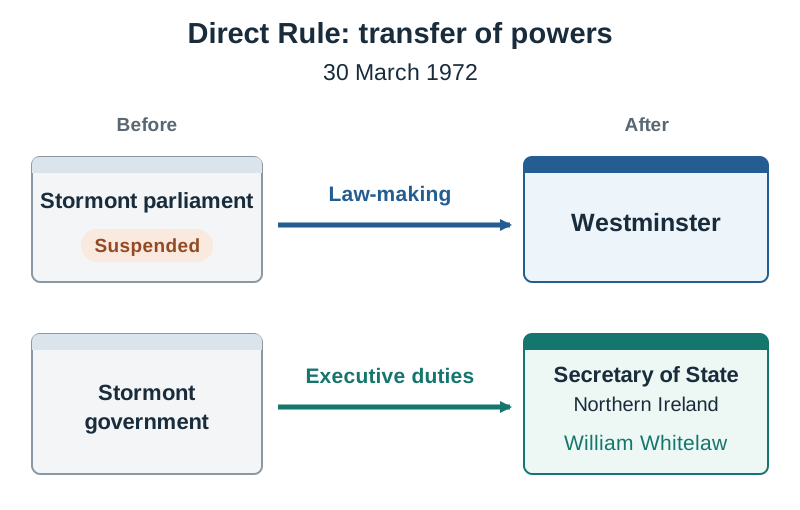
Direct Rule was planned as a temporary emergency measure. Except for the five months of the power-sharing Executive in 1974, it remained the system of government in Northern Ireland until powers were devolved under the Good Friday Agreement in December 1999. The response divided the community sharply:
- Nationalists and republicans welcomed the fall of the Unionist Party regime that had governed Northern Ireland since 1921. However, the Provisional IRA insisted that Direct Rule changed nothing fundamental, because British sovereignty remained in place.
- Unionists and loyalists felt betrayed and abandoned by London. William Craig set up the Ulster Vanguard movement to organise resistance. At a rally in Belfast's Ormeau Park in March 1972, Craig warned that Vanguard might have to mobilise and that 'it may be our job to liquidate the enemy'. Loyalist paramilitaries expanded alongside this political anger, uniting under the Ulster Defence Association (UDA).
Escalation: Bloody Friday, Operation Motorman, and the 1973 White Paper
Direct Rule brought no immediate peace. The year 1972 proved to be the bloodiest of the entire conflict, claiming 479 lives. On 21 July 1972, an afternoon remembered as Bloody Friday, the Provisional IRA set off 22 bombs across Belfast within 80 minutes, targeting bus stations, railway depots, and busy shopping streets. Although telephone warnings were telephoned in, the sheer number of devices overwhelmed emergency services. Nine people died, including two soldiers and seven civilians, and 130 people suffered injuries. The horror of the attack provoked public outrage and provided London with the justification to launch Operation Motorman on 31 July 1972. Using 22,000 troops, the British Army removed the barricades around republican 'no-go areas' in the Bogside and Creggan in Derry and across nationalist districts of West Belfast.
Alongside these military operations, the British government moved to construct a new political framework:
- The Border Poll (8 March 1973): Heath organised a referendum asking voters if Northern Ireland should remain part of the UK or join the Republic of Ireland. Nationalist parties boycotted the poll. While 98.9% voted to remain in the UK, overall turnout was just 58%, rendering the result incapable of bridging the sectarian divide.
- The Constitutional White Paper (20 March 1973): Titled Northern Ireland Constitutional Proposals, this document rejected simple majority rule. It proposed a 78-seat Assembly elected by proportional representation (Single Transferable Vote), compulsory power-sharing between unionists and nationalists on an Executive, and an institutional Irish Dimension to manage North–South cooperation.
Elections to the new Assembly took place on 28 June 1973. Faulkner led a faction of the Ulster Unionist Party (UUP) that backed the White Paper, securing 24 seats. The nationalist Social Democratic and Labour Party (SDLP) won 19 seats, and the cross-community Alliance Party won 8. Crucially, anti-White Paper unionists led by Ian Paisley of the Democratic Unionist Party (DUP) and William Craig of Vanguard won 27 seats, signalling strong resistance from much of the unionist community.
The Sunningdale Conference (December 1973)
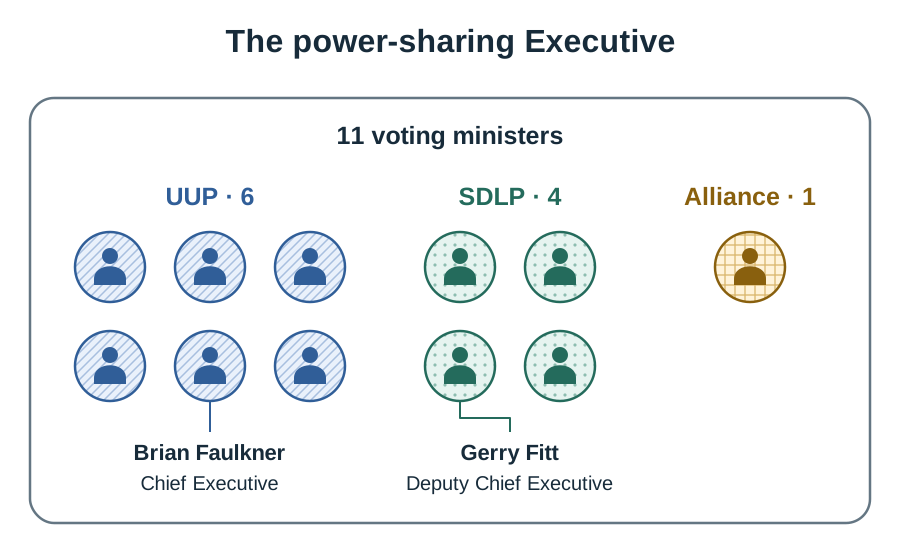
In November 1973, preliminary talks at Stormont Castle produced an agreement between Faulkner's UUP, Gerry Fitt's SDLP, and Oliver Napier's Alliance Party to form an Executive of 11 voting ministers: 6 UUP, 4 SDLP, and 1 Alliance. Brian Faulkner was designated Chief Executive and Gerry Fitt Deputy Chief Executive.
To finalise the remaining issues, Heath convened a tripartite conference from 6 to 9 December 1973 at the Civil Service College in Sunningdale, Berkshire. Tripartite meant three distinct interests were represented: the British government led by Heath, the Irish coalition government led by Taoiseach Liam Cosgrave, and the parties of the incoming Northern Ireland Executive. Northern Ireland Secretary Francis Pym, who had replaced Whitelaw on 2 December 1973, helped direct discussions. The agreed communiqué rested on three pillars:
1. The Power-Sharing Executive
The 11-member cross-community cabinet, agreed in November, was formally approved to assume devolved power on 1 January 1974. Gerry Fitt became Deputy Chief Executive and John Hume became Minister for Commerce.
2. Status and Consent
The agreement established the consent principle. The Irish government formally accepted that Northern Ireland's status as part of the United Kingdom could not change without the consent of a majority of its people. The British government affirmed that if a majority in Northern Ireland ever expressed a wish to join a united Ireland, London would support that decision.
3. The Council of Ireland
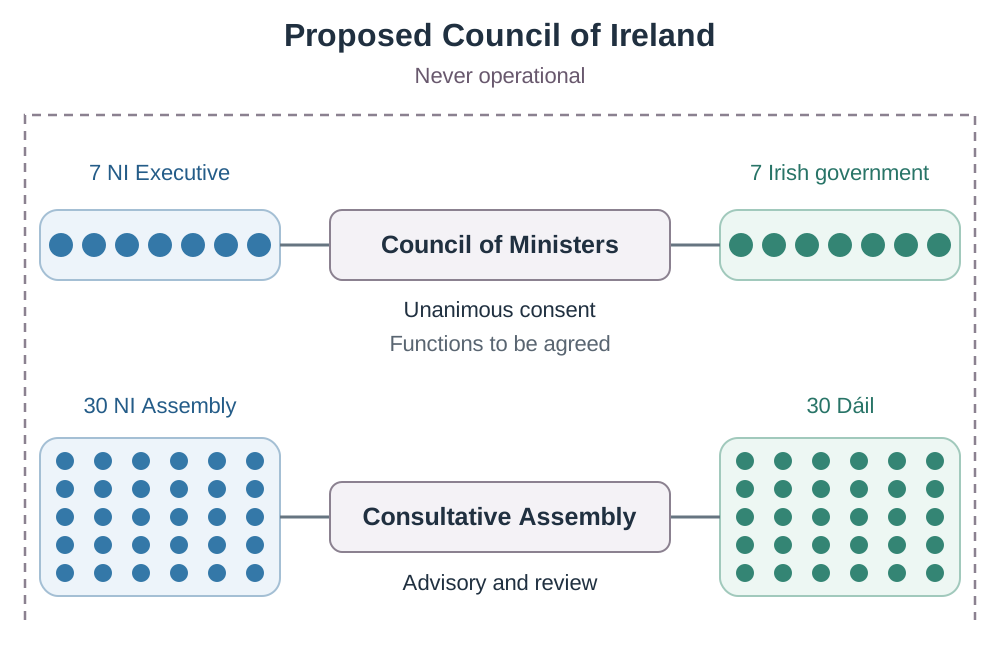
To give institutional form to the Irish Dimension, Sunningdale agreed to establish a Council of Ireland, but it never became operational. The proposed Council of Ministers would include seven ministers from each administration and act by unanimous consent, with executive and harmonising functions to be agreed. A separate 60-member Consultative Assembly, divided evenly between the Dáil and the Northern Ireland Assembly, would have advisory and review functions. Studies were to identify areas for cooperation, such as tourism, transport and electricity generation.
Security, Extradition, and the Boland Case
Unionists demanded that the Republic extradite fugitive IRA suspects to Northern Ireland. Taoiseach Liam Cosgrave and his Minister for Foreign Affairs, Garret FitzGerald, refused this request on the grounds that Irish law forbade extradition for political offences. Instead, the conference set up a joint Law Enforcement Commission to examine other legal mechanisms, such as trying suspects in the jurisdiction where they were arrested. Unionists felt Faulkner had conceded power-sharing while gaining almost nothing in return on security.
To make matters worse, Faulkner's request that Dublin delete Articles 2 and 3 of the Irish Constitution, which claimed jurisdiction over the whole island, was turned down by Cosgrave, who explained that an amendment referendum could not pass. Suspicions hardened when former minister Kevin Boland challenged the agreement in the Irish High Court. The court ruled that the Sunningdale declaration on Northern Ireland was merely an expression of government policy, leaving the constitutional territorial claim of Articles 2 and 3 fully intact.
Opposition: The Provisional IRA and Unionist Resistance
Opposition to Sunningdale came from both extremes of the political spectrum.
Republican Opposition
The Provisional IRA and Sinn Féin rejected the agreement entirely. They objected to the formal acceptance of Northern Ireland's constitutional status by Dublin, regarding the consent principle as southern betrayal and an endorsement of partition. Republicans dismissed the Council of Ireland as meaningless window dressing designed to prop up British rule. To destroy the settlement, the IRA kept up its bombing campaign in Northern Ireland and Britain throughout the life of the Executive, carrying out operations such as the M62 coach bombing in England on 4 February 1974. Furthermore, the British government kept internment in operation, which embarrassed the SDLP in front of its nationalist supporters and weakened enthusiasm for the Executive on the ground.
Unionist Backlash and the 1974 Election
For unionists, the Council of Ireland looked like an embryonic all-Ireland government. Their fears were stoked when, on 17 January 1974, SDLP assembly member Hugh Logue delivered a speech in Trinity College Dublin, describing the Council of Ireland as the vehicle that would 'trundle Unionists into a united Ireland'. Hardliners seized on the phrase as proof that Faulkner had sold out the Union.
Faulkner suffered a sequence of political blows across early 1974:
| Date | Event | Political Impact |
|---|---|---|
| 4 January 1974 | Ulster Unionist Council (UUC) Vote | The UUP's governing body rejected the Council of Ireland by 427 votes to 374. Faulkner was forced to resign as party leader, replaced by anti-agreement Harry West, though he stayed on as Chief Executive with a minority faction. |
| 22 January 1974 | Assembly Disruption | Anti-agreement unionists led by Ian Paisley physically took over the front benches in the chamber; the Royal Ulster Constabulary (RUC) had to enter the building and carry them out. |
| 28 February 1974 | UK General Election | Anti-agreement unionists formed the United Ulster Unionist Council (UUUC), uniting the DUP, Vanguard, and anti-Faulkner unionists under the slogan: 'Dublin is just a Sunningdale away'. The UUUC swept 11 of the 12 Westminster seats in Northern Ireland, taking 51% of the total vote. Gerry Fitt was the only pro-agreement MP elected. |
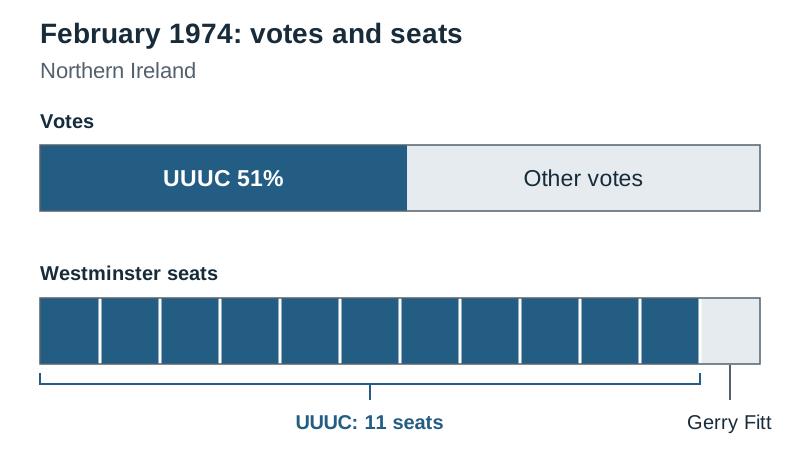
The February 1974 election destroyed any claim that the Executive held the support of the unionist majority. The election also brought Harold Wilson's minority Labour government into office in Britain. Wilson appointed Merlyn Rees as Northern Ireland Secretary. Hoping to draw paramilitaries towards constitutional politics, Rees de-proscribed the Ulster Volunteer Force (UVF) in April 1974, meaning it was no longer a banned organisation under British law. However, Rees adopted a passive approach and proved reluctant to deploy the security forces to support Faulkner.
The Ulster Workers' Council Strike and the Fall of the Executive (May 1974)
The final blow came through industrial and paramilitary action. In 1973, loyalist shop stewards established the Ulster Workers' Council (UWC). The group was led by shipyard shop steward Harry Murray. Its co-ordinating committee brought together loyalist politicians and paramilitaries: it was chaired by Vanguard assembly member Glenn Barr and included Andy Tyrie of the UDA.
On 14 May 1974, the Northern Ireland Assembly voted 44 to 28 to reject a motion condemning Sunningdale. That evening, Harry Murray announced an indefinite general strike, which began on 15 May.
Methods of the Strike
The Ulster Workers' Council strike brought Northern Ireland to a standstill through two tactics:
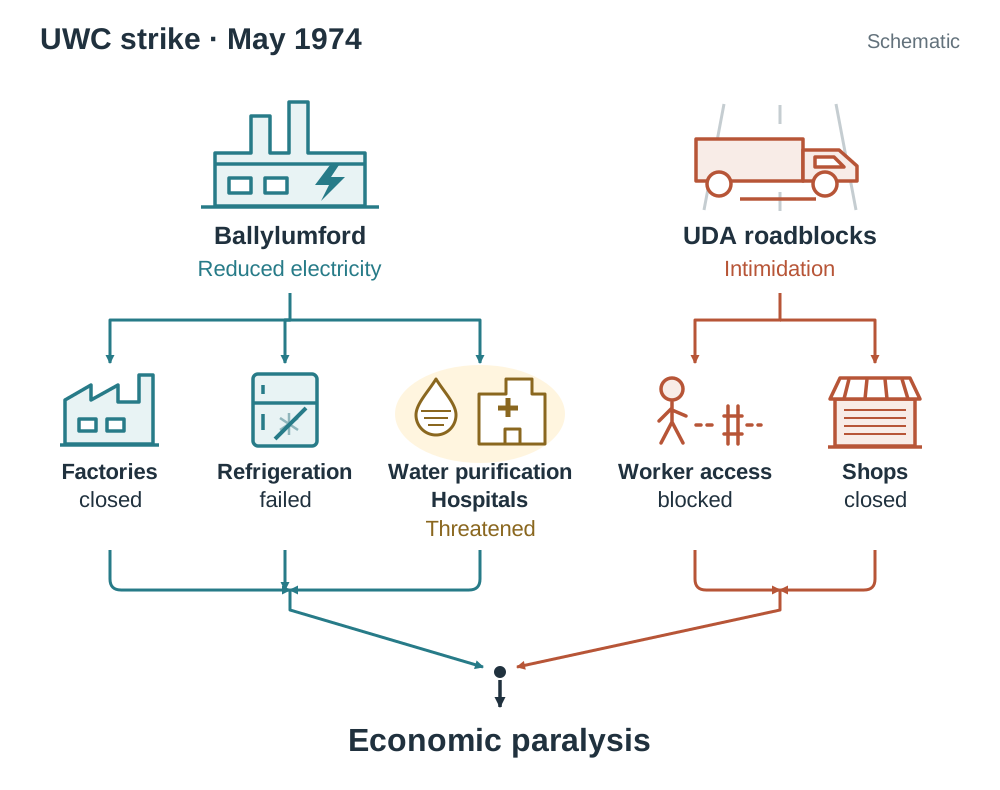
- Control of Essential Utilities: Workers at Ballylumford power station near Larne cut electricity generation drastically. Rolling blackouts closed factories, spoiled refrigerated goods on farms, and threatened water purification plants and hospitals. SDLP Minister for Commerce John Hume worked around the clock trying to keep basic fuel supplies moving, but had few resources.
- Paramilitary Enforcement: Masked UDA men erected roadblocks across Belfast and regional towns using hijacked lorries, buses, and felled trees. Intimidation was widespread; shopkeepers were ordered to pull down their shutters and workers were turned away from their jobs.
On 17 May 1974, the third day of the strike, the UVF detonated three car bombs in Dublin and one in Monaghan without warning, killing 33 civilians. It was the deadliest single day of the Troubles. Sammy Smyth, a spokesman for the UDA and UWC, remarked chillingly that he was happy with the bombings because they proved the North was at war with the Republic.
British Paralysis and Resignation
Faulkner and the Executive urged Merlyn Rees to use the army to clear the roadblocks and break the strike. Rees held back from a broad confrontation, fearing armed conflict with the Protestant working class. Troops did not clear the barricades or run Ballylumford. On 25 May, Prime Minister Harold Wilson delivered a televised address condemning the strike organisers as 'people who spend their lives sponging on Westminster and British democracy'. The insult backfired completely: insulted unionists wore pieces of sponge on their lapels in defiance, uniting moderate Protestants behind the stoppage.
On 27 May, the army did take over selected petrol stations to supply essential users. The UWC escalated the stoppage in response, threatening a complete shutdown of essential services. On 28 May, after Rees refused to meet UWC representatives, Brian Faulkner resigned as Chief Executive alongside his unionist colleagues. The power-sharing Executive collapsed immediately after just five months. The Assembly was prorogued, and Direct Rule returned.
Focus on: Brian Faulkner (1921–1977)
Brian Faulkner is a named key personality whose career highlights the dilemmas faced by moderate unionism.
Early Career and Rise
Elected as UUP MP for East Down in 1949 at the age of 28, Faulkner was the youngest member of the Stormont parliament. As Minister of Home Affairs (1959–1963) he built a reputation as a hardliner by effectively containing the IRA Border Campaign. Later, as Minister of Commerce (1963–1969), he demonstrated great administrative ability, travelling abroad to attract manufacturing investment to Northern Ireland. In January 1969 he resigned from Terence O'Neill's cabinet over the Cameron Commission into civil rights violence, a move that confirmed his image as an ambitious political rival.
Prime Minister (March 1971 – March 1972)
Faulkner succeeded James Chichester-Clark as Prime Minister in March 1971. He introduced token reforms, offering opposition MPs chairmanships of parliamentary committees. However, on 9 August 1971, he gambled on internment without trial. Over 340 men were arrested in the opening sweep; all were from the nationalist community, and many had no links to terrorism because of outdated intelligence provided by the RUC Special Branch. Internment proved a catastrophe, provoking Catholic outrage, an immediate surge in violence, and the civil rights march in Derry that led to Bloody Sunday. When Heath demanded control of law and order in March 1972, Faulkner resigned, ending half a century of devolved unionist government.
Chief Executive and Later Years
Faulkner showed remarkable ideological flexibility between 1973 and 1974. He accepted compulsory power-sharing with the SDLP and negotiated the Sunningdale Agreement, braving bitter insults from former colleagues. Yet he failed to secure changes to Articles 2 and 3 or genuine extradition from Dublin, exposing his flank to hardliners. After losing the Ulster Unionist Council vote on 4 January 1974, he resigned as UUP leader days later, but persevered as Chief Executive until the UWC strike forced him out. He later formed the Unionist Party of Northern Ireland (UPNI), which was crushed in elections. He retired from politics, received a life peerage, and died in a riding accident in March 1977.
Strengths, Weaknesses, and Historical Attitudes
- Strengths: A gifted administrator, an energetic campaigner, and a pragmatist willing to break unionist taboos to seek a negotiated peace.
- Weaknesses: The disastrous introduction of internment, underestimating the depth of unionist hostility to the Council of Ireland, and overestimating the willingness of the British government to stand by him during the strike.
- Attitudes: Contemporaries were divided. Nationalists in 1971 remembered him as the architect of internment, while loyalists in 1974 branded him a traitor who had sold out to Dublin. Historians today generally view him as a tragic, complex figure: a cautious traditionalist who grew into a brave reformer, only to find that his concessions came too late to save his career or the province.
Roles of Other Key Personalities: John Hume and Ian Paisley
Two other named syllabus personalities played critical, opposing roles throughout the Sunningdale experiment.
John Hume (SDLP)
John Hume was the intellectual force within the SDLP and a key negotiator at Sunningdale. He argued that no political settlement could endure unless it addressed two fundamentals: internal power-sharing between both traditions in the North, and an external Irish Dimension reflecting the nationalist community's Irish identity. Hume fought hard for the Council of Ireland, insisting on a Council of Ministers with meaningful executive potential. As Minister for Commerce in the Executive, he worked urgently to maintain electricity and food supplies during the May 1974 strike, repeatedly urging London to confront loyalist paramilitaries. Hume's two-pillar formula—power-sharing and cross-border institutions—ultimately formed the foundation of the 1998 Good Friday Agreement.
Ian Paisley (DUP)
Ian Paisley was the leading political opponent of the Sunningdale Agreement. Representing hardline evangelical Protestantism and militant unionism, he condemned power-sharing as a betrayal of the democratic majority and attacked the Council of Ireland as a Trojan horse for a 32-county republic. Paisley led protests inside the Assembly, leading to the dramatic scene on 22 January 1974 when RUC officers carried him from the chamber. He helped form the UUUC electoral alliance, which wiped out pro-agreement unionism in the February 1974 Westminster election. Paisley sat on the co-ordinating committee of the UWC strike, using his oratorical gifts to rally working-class loyalists. To his followers he was the uncompromising defender of Protestant heritage; to his opponents he was a destructive spoiler who brought down Northern Ireland's best chance for peace.
Assessing the Agreement: Why It Collapsed and Its Significance
An essay on this topic requires a clear, balanced evaluation of why the agreement failed and what it accomplished historically.
Five Causes of the Executive's Collapse
- Unionist Hostility to the Council of Ireland: Mainstream unionists believed the cross-border body compromised British sovereignty, a fear deepened by the Boland case and Hugh Logue's 'trundle' speech.
- The February 1974 Election: The UUUC won 11 of 12 Westminster seats, which stripped the Executive of its democratic mandate within the unionist community.
- Republican Opposition and IRA Violence: Continued car bombings in Northern Ireland and Britain destroyed public confidence in the promise that power-sharing would bring security, while internment alienated Catholic opinion.
- The UWC Strike: Industrial action at Ballylumford and paramilitary roadblocks set up by the UDA paralysed the province's economy within a fortnight.
- British Inaction: Prime Minister Harold Wilson and Secretary of State Merlyn Rees refused to order the army to dismantle roadblocks or run power stations, leaving Faulkner with no choice but to resign.
Historical Significance and Legacy
Although Sunningdale collapsed after five months, its key ideas – power-sharing, the consent principle and a North–South dimension – influenced later initiatives. Consent and the Irish Dimension reappeared in the 1985 Anglo-Irish Agreement and the 1993 Downing Street Declaration, and all three were combined again in the 1998 Good Friday Agreement. This continuity prompted SDLP deputy leader Seamus Mallon to make his famous observation that the Good Friday Agreement was simply 'Sunningdale for slow learners'.
Working with Evidence: The Sunningdale Case Study and the DBQ
The documents-based study (DBQ) topic is prescribed by the State Examinations Commission and rotated periodically among the Later Modern syllabus topics. When Topic 5 is the prescribed topic, the Sunningdale case study can be examined through primary extracts, such as the reporting of Robert Fisk (Point of No Return) on the May 1974 strike. At other times, Sunningdale appears as an essay question.
When working with primary documents on the strike, candidates must show four specific skills:
- Comprehension: Extracting factual detail directly from the text (for example, identifying barricades of hijacked lorries, fires, or blackouts in Belfast).
- Comparison: Examining two documents to find points of agreement and disagreement. For example, a candidate might compare a British Army report claiming the strike was maintained purely through paramilitary terror with a loyalist leaflet insisting the stoppage was a spontaneous working-class protest.
- Criticism: Evaluating the strengths and limitations of a source by questioning its provenance, purpose, and language. Eyewitness reporting offers immediate, detailed observation, but edited extracts can omit crucial context or display personal bias.
- Contextualisation: Connecting the source to the wider historical picture. Contextualisation carries a higher weighting at Higher Level than at Ordinary Level. Candidates must link descriptions of silent factories and unpoliced barricades to the wider political realities: Merlyn Rees's fear of confronting loyalists, Wilson's 'sponging' broadcast, and Faulkner's final resignation.
Key terms
- Direct Rule
- The system introduced on 30 March 1972 by which Northern Ireland was governed from London through a Secretary of State, suspending the devolved Stormont parliament.
- Internment
- Arrest and detention without trial, introduced by Brian Faulkner on 9 August 1971, which targeted Catholics and caused an escalation in violence.
- Bloody Sunday
- The shooting dead of 13 unarmed civil rights marchers (a fourteenth dying later) by British paratroopers in Derry on 30 January 1972.
- Power-Sharing
- A system of cross-community government where unionist and nationalist politicians hold ministerial office together, introduced in the 1974 Executive.
- Irish Dimension
- The policy principle that any political settlement in Northern Ireland must recognise its links with the Republic of Ireland through formal North–South institutions.
- Consent Principle
- The rule that Northern Ireland remains part of the UK unless a majority of its population votes for change, accepted by Dublin and London at Sunningdale.
- Council of Ireland
- A proposed cross-border body agreed at Sunningdale, with a 14-member Council of Ministers and a 60-member Consultative Assembly. It never became operational.
- Articles 2 and 3
- Articles in the 1937 Irish Constitution claiming legal jurisdiction over the entire island of Ireland, which unionists demanded Dublin remove during talks.
- Ulster Workers' Council (UWC) Strike
- A 14-day loyalist general strike in May 1974 combining industrial action and paramilitary intimidation that forced the collapse of the power-sharing Executive.
- UUUC
- The United Ulster Unionist Council, an electoral coalition of anti-agreement unionists that won 11 of 12 Westminster seats in February 1974.
- Bloody Friday
- The afternoon of 21 July 1972 when the Provisional IRA detonated 22 bombs across Belfast within 80 minutes, killing 9 people and injuring 130.
- Operation Motorman
- A British Army operation on 31 July 1972 using 22,000 troops to dismantle barricades around republican 'no-go areas' in Derry and Belfast.
Check yourself
On what date did the Northern Ireland (Temporary Provisions) Act come into force, introducing Direct Rule?
30 March 1972.
What was the party composition of the 11 voting members of the 1974 Power-Sharing Executive?
6 Ulster Unionists (Faulkner faction), 4 SDLP members, and 1 Alliance Party member.
Give two reasons why unionists fiercely opposed the proposed Council of Ireland.
They feared it was an embryonic all-Ireland parliament, a fear reinforced when Dublin retained Articles 2 and 3 and Hugh Logue claimed it would 'trundle' unionists into a united Ireland.
How did the Provisional IRA react to the Sunningdale Agreement?
They rejected it because Dublin accepted Northern Ireland's status within the UK, and they continued their bombing campaign in Northern Ireland and Britain.
How many Westminster seats did the anti-agreement UUUC coalition win in the February 1974 UK general election?
11 out of 12 seats, securing 51% of the popular vote.
What phrase used by British Prime Minister Harold Wilson in his 25 May 1974 broadcast alienated the unionist population?
He described the strike organisers as people 'sponging on Westminster and British democracy'.