

This case study examines Lyndon B. Johnson's escalation of United States military involvement in Vietnam between 1963 and 1968, and its damaging impact on his presidency. Guided by containment (the US policy of stopping communism spreading to new countries) and the Domino Theory, Johnson transformed a limited advisory commitment into a major ground war involving over 536,000 US troops by late 1968. While Johnson intended to focus his presidency on the Great Society and his War on Poverty, the ballooning financial costs, mounting casualties, and an intractable military stalemate derailed his domestic agenda. The Tet Offensive in January 1968 shattered official claims of impending victory, exposing a profound credibility gap that fractured the Democratic Party, energised the anti-war movement, and led Johnson to announce on 31 March 1968 that he would not seek re-election.
Background: Division, Containment, and Inherited Commitments
How Vietnam Came to be Divided
Before 1954, Vietnam was a French colony in Indochina. Ho Chi Minh founded the communist-led Viet Minh in 1941 to fight for independence. Following the Second World War, the Viet Minh fought French forces from 1946 until France's decisive defeat at Dien Bien Phu in May 1954. The United States had paid a large share of France's military costs from 1950 under President Harry Truman, driven by the policy of containment.
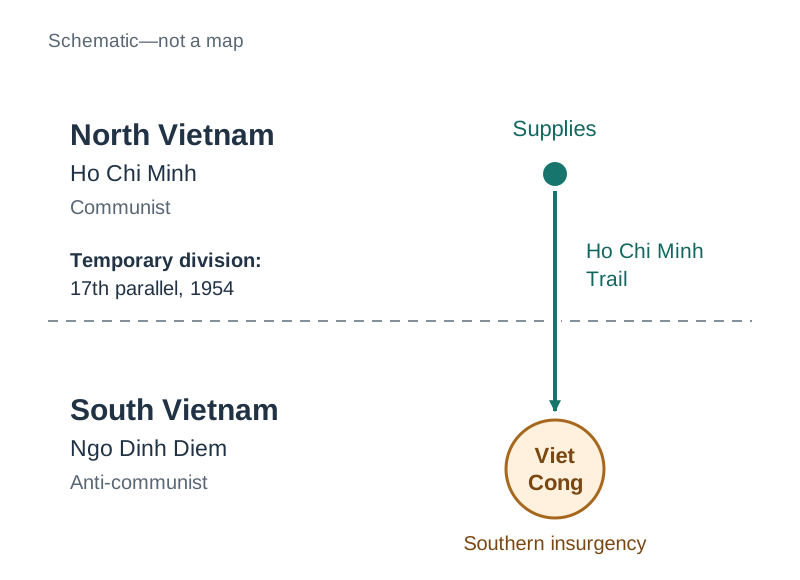
The 1954 Geneva Accords temporarily divided Vietnam at the 17th parallel into a communist North under Ho Chi Minh and an anti-communist South under Ngo Dinh Diem. Nationwide elections were scheduled for 1956 to reunify the country, but Diem, backed by the US, refused to hold them, fearing Ho would win easily. In 1960, southern rebels founded the National Liberation Front, known as the Viet Cong, to overthrow Diem through guerrilla warfare, sustained by supplies moving south along the Ho Chi Minh Trail.
Kennedy, Diem, and the Escalating Crisis
Under Dwight D. Eisenhower and John F. Kennedy, Washington supported Saigon through military equipment and advisers. Kennedy expanded this force from under 1,000 to approximately 16,000 advisers by late 1963. However, Diem's autocratic rule, nepotism, and persecution of the Buddhist majority provoked widespread revolt. Diem's Strategic Hamlet Programme forcibly uprooted peasants into barbed-wire stockades, driving many into the arms of the Viet Cong. On 2 November 1963, Diem was ousted and murdered in a military coup tacitly approved by the Kennedy administration. Kennedy was assassinated in Dallas three weeks later.
Key Timeline of Johnson's Presidency
- November 1963: Diem and Kennedy assassinated; Johnson becomes president.
- August 1964: Gulf of Tonkin incident and congressional resolution.
- November 1964: Johnson wins presidential election in a landslide.
- February–March 1965: Pleiku attack; Operation Rolling Thunder launched; US Marines land at Da Nang.
- July 1965: Johnson approves open-ended troop build-up.
- April 1967: Martin Luther King Jr. delivers his 'Beyond Vietnam' speech.
- October 1967: Anti-war March on the Pentagon.
- 30–31 January 1968: Communist forces launch the Tet Offensive.
- 27 February 1968: Walter Cronkite reports an unwinnable stalemate.
- 12 March 1968: Johnson narrowly wins the New Hampshire primary (49%) as a write-in candidate; anti-war senator Eugene McCarthy takes a shock 42%.
- 31 March 1968: Johnson announces a bombing halt and declares he will not run for re-election.
The Gulf of Tonkin and the 1964 Election
The Incidents in the Gulf
In early August 1964, naval skirmishes off the North Vietnamese coast gave Johnson the excuse he needed to use open military force. On 2 August, the destroyer USS Maddox was conducting electronic surveillance while supporting secret South Vietnamese commando raids (OPLAN 34A) against North Vietnamese radar stations. Three North Vietnamese torpedo boats engaged the Maddox, which returned fire with carrier air support. Two nights later, on 4 August, the Maddox and the USS Turner Joy reported a second attack during heavy seas and stormy weather. Even though the ship's captain cabled doubts about sonar and radar errors before Johnson spoke, the White House acted immediately.
The Blank Cheque
Johnson addressed the American public on television, denouncing 'open aggression on the high seas' and ordering retaliatory air strikes. On 7 August 1964, Congress passed the Gulf of Tonkin Resolution with near-unanimous support. Only two senators, Wayne Morse of Oregon and Ernest Gruening of Alaska, voted against it. The resolution authorised the president to take 'all necessary measures to repel any armed attack against the forces of the United States and to prevent further aggression'. It handed war-making power directly to the executive without requiring a formal constitutional declaration of war.
The 1964 Campaign
Johnson exploited his posture of firm moderation in the November 1964 presidential election against conservative Republican Barry Goldwater. Goldwater openly advocated unrestricted bombing and suggested giving field commanders control of tactical nuclear weapons. Johnson countered with a pledge of restraint, assuring voters in October: 'We are not about to send American boys nine or ten thousand miles away from home to do what Asian boys ought to be doing for themselves.' Johnson captured 61% of the popular vote, securing massive Democratic majorities in Congress.
Americanisation and Military Escalation (1965-1967)
From Air Strikes to Ground Combat
Following his inauguration, Johnson quickly escalated the conflict. The Saigon government was on the verge of total collapse, cycling through military juntas before Air Vice-Marshal Nguyen Cao Ky and General Nguyen Van Thieu established a fragile government in mid-1965. Johnson also feared that 'losing' South Vietnam would bring the kind of attacks Truman faced after China became communist in 1949, and would wreck support for his Great Society. On 7 February 1965, the Viet Cong attacked a US barracks at Pleiku, killing eight American soldiers. Johnson ordered immediate reprisal air strikes and on 2 March initiated Operation Rolling Thunder, a systematic bombing campaign against North Vietnam.
To protect the vital Da Nang air base from guerrilla infiltration, Johnson deployed 3,500 US Marines on 8 March 1965. This began the Americanisation of the war: US forces took over the main fighting from the South Vietnamese army (ARVN). When bombing failed to break Hanoi's supply lines, Johnson authorised major open-ended ground commitments in July 1965.
Escalation by the Numbers
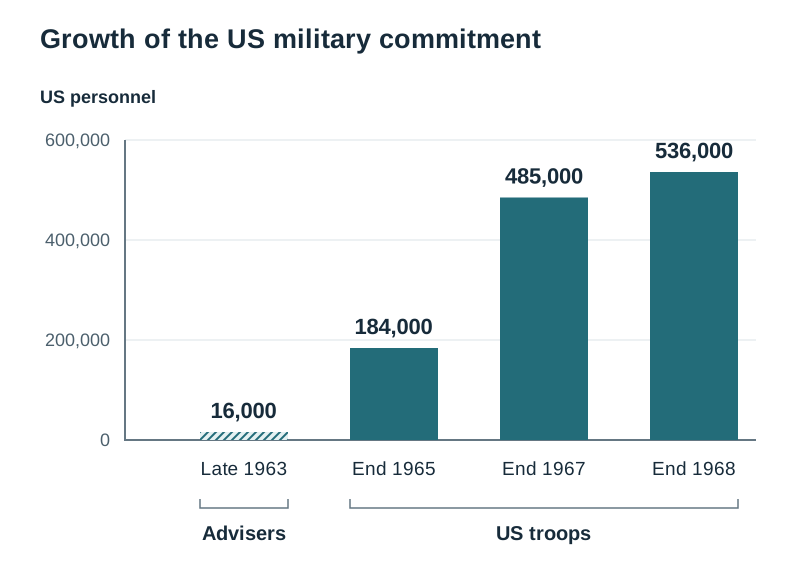
- Late 1963: 16,000 military advisers
- End of 1965: 184,000 US troops
- End of 1967: 485,000 US troops
- End of 1968: 536,000 US troops (the total US peak reached roughly 543,000 in early 1969 under Nixon)
Tactics of Attrition
Military commander General William Westmoreland and Secretary of Defense Robert McNamara instituted a war of attrition. Rather than capturing and holding territory, success was measured by enemy body counts. American units conducted search and destroy patrols using helicopters to locate enemy forces and call in heavy artillery and napalm. The US sprayed millions of gallons of chemical defoliants, such as Agent Orange, to clear jungle cover and destroy crops.
These tactics caused severe civilian suffering without breaking the communist insurgency. The Viet Cong fought at close quarters to neutralise American air strikes, used underground tunnel networks such as Cu Chi, and replenished losses via the Ho Chi Minh Trail. Over three and a half years, Rolling Thunder dropped more bomb tonnage than the US had used during the entire Korean War, though it failed to halt the flow of North Vietnamese soldiers and weapons into the South.
The Domestic Toll: The Great Society, the Anti-War Movement, and the Credibility Gap
Cost and the Great Society
Johnson's main ambition was domestic reform. His Great Society programme passed landmark legislation: the Civil Rights Act (1964) banning public segregation, the Economic Opportunity Act (1964) creating the War on Poverty, the Voting Rights Act (1965), Medicare and Medicaid (1965) providing healthcare for the elderly and poor, and the Elementary and Secondary Education Act (1965). However, by 1967 the war cost over 25 billion by 1968. In 1968 he was forced to accept a 10% income-tax surcharge, which Congress passed only on condition of deep domestic spending cuts, starving his anti-poverty programmes.
The Draft and the Anti-War Movement
University 'teach-ins' started in March 1965 at the University of Michigan, followed by the Students for a Democratic Society (SDS) march on Washington in April. Opposition expanded rapidly because the draft system allowed college students to defer (postpone) their service, leaving working-class and minority men to shoulder the combat burden. African Americans made up roughly 11% of the US population but accounted for over 20% of early combat deaths. Heavyweight champion Muhammad Ali, who had said in 1966 'I ain't got no quarrel with them Viet Cong', refused induction in April 1967 and was stripped of his world title. On 4 April 1967, Martin Luther King Jr. gave his famous 'Beyond Vietnam' speech at Riverside Church, describing the conflict as an enemy of the poor for consuming resources needed to rebuild American cities. In October 1967, the March on the Pentagon drew 100,000 protesters.
Television and the Credibility Gap
Vietnam was the first televised war. Nightly newscasts brought raw footage of firefights, burning villages, and coffins directly into American homes. The contrast between official briefings insisting there was 'light at the end of the tunnel' and the graphic reality on television created a deep credibility gap. Protesters outside the White House regularly chanted: 'Hey, hey, LBJ, how many kids did you kill today?'
The Tet Offensive and Johnson's Exit (1968)
The Shock of Tet
On 31 January 1968, during the Vietnamese lunar new year holiday, over 80,000 North Vietnamese and Viet Cong troops launched the Tet Offensive, attacking more than 100 cities, provincial capitals, and military bases across South Vietnam. In Saigon, a 19-man commando unit breached the US Embassy grounds, fighting for six hours before being killed or captured. In Hue, communist fighters held the ancient citadel for four weeks of brutal street combat before being dislodged.
A Military Defeat but a Political Victory
Militarily, Tet was an absolute failure for the communists. They briefly seized parts of several cities, including most of Hue for about four weeks, but were driven out everywhere and lost roughly 45,000 fighters, leaving their southern Viet Cong infrastructure decimated. However, politically and psychologically, Tet was an overwhelming victory for Hanoi. It shattered White House claims that the enemy was on the brink of defeat. CBS anchor Walter Cronkite visited Vietnam in February 1968 and told viewers the conflict was mired in an unwinnable stalemate. Johnson concluded: 'If I've lost Cronkite, I've lost Middle America.'
The Political Fallout
When Westmoreland requested 206,000 more troops, new Secretary of Defense Clark Clifford and the 'Wise Men' (a group of senior foreign-policy elder statesmen) told Johnson that further escalation would tear the country apart. In the New Hampshire Democratic primary on 12 March 1968, Johnson won only narrowly as a write-in candidate with 49% against anti-war senator Eugene McCarthy's 42%. Days later, Robert F. Kennedy entered the presidential race. Facing political isolation, domestic unrest, and military deadlock, Johnson addressed the nation on 31 March 1968. He announced a partial bombing halt to pursue peace talks and declared: 'I shall not seek, and I will not accept, the nomination of my party for another term as your President.'
Impact Abroad and Evaluation of Johnson as a Key Personality
Impact Abroad (1965–1968)
- Prestige and Imperialism: The failure of the world's greatest superpower to defeat a guerrilla army damaged American international standing. Critics around the world accused Washington of running an imperialist war.
- Strained Alliances: British Prime Minister Harold Wilson firmly refused to send troops, despite Johnson's lobbying. Anti-war protests erupted across European capitals, such as the March 1968 Grosvenor Square demonstration in London. Only a handful of allies (Australia, New Zealand, South Korea, Thailand, and the Philippines) contributed forces.
- Cold War Friction: The Soviet Union and China provided North Vietnam with advanced anti-aircraft missiles, artillery, and economic aid. Washington avoided an all-out ground invasion of North Vietnam out of fear of bringing China into a direct war, repeating the Korean conflict.
- Destruction in Vietnam: Over two million Vietnamese civilians were killed or displaced, agricultural land was contaminated by chemicals, and ancient heritage sites were destroyed.
Evaluating Johnson: Contemporary and Current Perspectives
- Contemporary Views (1963–1968): 'Hawks' accused Johnson of fighting a timid war 'with one hand tied behind his back', demanding unrestricted bombing and ground incursions into Laos, Cambodia, and the North. 'Doves' and anti-war activists viewed him as deceitful, warmongering, and indifferent to social justice. Some civil rights leaders, most famously Martin Luther King in April 1967, broke with him over military spending and the draft, although others such as Roy Wilkins stayed loyal.
- Current Historical Views: Historians often view Johnson as a tragic figure, captured in Robert Dallek's description of a 'flawed giant'. He was a legislative mastermind whose extraordinary achievements in domestic civil rights and healthcare were brought down by a foreign conflict he did not understand and feared to lose. While some historians point out that he inherited a rigid Cold War containment consensus that trapped any president, others like Fredrik Logevall demonstrate that Johnson had genuine opportunities to de-escalate in 1964–65 but chose escalation to protect his personal image and political leverage.
Core Judgement: Johnson's presidency was a tale of two wars. He largely won the war on legal segregation, but lost both the war in Vietnam and the war on poverty because he attempted to fight all three at once.
Key terms
- Containment
- The cornerstone US Cold War foreign policy aimed at stopping the expansion of communism beyond the borders where it already existed.
- Domino Theory
- The Cold War belief that if one country fell to communism, neighbouring countries would inevitably collapse in sequence like a row of dominoes.
- Viet Cong
- The National Liberation Front (NLF), a communist guerrilla movement formed in South Vietnam in 1960 to overthrow the US-backed Saigon government.
- Gulf of Tonkin Resolution
- A joint congressional resolution passed in August 1964 that gave President Johnson sweeping authority to conduct military operations in Southeast Asia without a formal declaration of war.
- Operation Rolling Thunder
- A sustained aerial bombardment campaign against North Vietnam from March 1965 to late 1968, intended to cut supplies along the Ho Chi Minh Trail and force Hanoi into peace talks.
- Americanisation
- The transformation of the Vietnam conflict in 1965 from an advisory mission into a direct US ground war, where American forces assumed primary responsibility for combat.
- War of Attrition
- A military strategy used by General Westmoreland that aimed to wear down the communist forces by killing fighters faster than they could be replaced, assessed using 'body counts'.
- Great Society
- Lyndon Johnson's ambitious domestic legislative programme designed to eliminate poverty and racial injustice, which was ultimately starved of funds by the Vietnam War.
- Credibility Gap
- The difference between what the Johnson administration told the public about progress in the war and what Americans could see with their own eyes on television news reports.
- Tet Offensive
- A surprise nationwide offensive launched by communist forces in January 1968 that resulted in a tactical military defeat for the Viet Cong but dealt a fatal psychological blow to US public support.
Check yourself
What power did the Gulf of Tonkin Resolution grant to President Johnson in August 1964?
It gave him broad power to use military force in Southeast Asia to repel attacks and prevent aggression without a formal declaration of war or further congressional approval.
Which two US senators voted against the Gulf of Tonkin Resolution in August 1964?
Wayne Morse of Oregon and Ernest Gruening of Alaska.
What incident in February 1965 prompted Johnson to order reprisal air strikes and launch Operation Rolling Thunder?
A Viet Cong mortar assault on a US military base at Pleiku, which killed eight American soldiers.
Name two major domestic laws passed under Johnson's Great Society and state what each achieved.
The Civil Rights Act (1964), which banned public segregation and employment discrimination, and the Voting Rights Act (1965), which outlawed literacy tests and protected minority voting rights.
Why is the 1968 Tet Offensive described as a military defeat but a political victory for the communists?
Communist forces lost roughly 45,000 fighters and failed to hold any cities, but the scale of the attacks shattered official US claims of progress and destroyed American public support for the war.
Why did Martin Luther King Jr. describe the Vietnam War as an enemy of the poor in April 1967?
He argued that war spending diverted money away from anti-poverty programmes while poor and Black young men were drafted and killed in disproportionately high numbers.
Give one contemporary criticism of Johnson from the 'hawks' and one from the 'doves'.
Hawks argued that he fought with one hand tied behind his back by limiting bombing and troop movements, while doves argued that he misled the public, escalated the war needlessly, and starved social reform.
What two key announcements did Johnson make during his national television address on 31 March 1968?
He announced a partial halt to the bombing of North Vietnam to open peace talks, and declared that he would not seek or accept nomination for another term as president.