

Optional Unit 6: Global Interdependence is an option for Higher Level students only. It explores how economic decisions, politics, and environmental crises link societies across the globe. You examine changing views of development, multinational companies, climate pressures, forced migration, debt burdens, land ownership, gender equality, and sustainable development. On the terminal examination paper, this unit is tested through a single 80-mark discursive essay marked on Significant Relevant Points (SRPs) and an Overall Coherence (OC) score.
The 80-Mark Discursive Essay Architecture and Skills
Your option essay carries 80 marks, which represents 20% of the entire written exam. Unlike the short questions in Part One or the 30-mark multi-part questions in the Core and Elective units, this question asks for a full discursive essay written under strict time limits.
You have 2 hours and 50 minutes for the written paper. Set aside 35 minutes for your option essay: spend three minutes drafting aspect headings, thirty minutes writing, and two minutes checking that you included named places and figures. State Examinations Commission marking schemes score the essay through one of two frameworks:
- Three-aspect layout: 3 aspects at 20 marks each, where each aspect earns up to 4 marks for identifying the topic and 16 marks for discussion via 8 SRPs (3 × 20 = 60 marks, plus 20 marks for Overall Coherence = 80 marks).
- Four-aspect layout: 4 aspects at 15 marks each, where each aspect earns up to 3 marks for identification and 12 marks for discussion via 6 SRPs (4 × 15 = 60 marks, plus 20 marks for Overall Coherence = 80 marks).
The mark breakdown changes from year to year. You should aim for four clearly labelled aspect headings with seven or eight developed SRPs in each. Extra accurate points protect your score.
An SRP is an individual piece of factual geographical information. It can be a named place, a statistic, a piece of legislation, a specific organisation, or a step in an explanatory chain. Broad opening lines score very little. Writing 'Multinationals create local jobs' might earn credit once, but repeating broad claims will not fill an aspect. By contrast, noting that 'Pfizer has invested roughly €8 billion in Ireland since 1969' and 'its Ringaskiddy plant in Co. Cork synthesises active pharmaceutical ingredients' gives you two distinct SRPs.
The 20 Overall Coherence marks reward clear structure, correct geographical terms, balanced arguments, and staying on topic. Turn the prompt into your headings so the examiner sees that you are answering the actual question. If the paper gives you stimulus material like a table, map, or cartoon, pull figures from it directly to support your points. For percentage share, divide the part by the total and multiply by 100, such as Germany handling 4,773 thousand tonnes out of an EU total of 14,243 thousand tonnes to get 33.5%.
6.1 Views, Indicators, and Models of Development
Defining and Measuring Development
Economic growth tracks an increase in the cash value of goods and services produced by an economy. Development means something broader: it measures lasting improvements in daily living standards, including schooling, clinics, clean water, personal safety, and democratic freedoms. A country can show rising economic growth on paper while ordinary families struggle if export earnings leave the country or stay in the hands of a small elite.
Geographers measure development through several indices:
- Gross National Income (GNI) per capita: Total domestic and foreign income earned by residents divided by the population, adjusted for local living costs. It gives a quick comparison, but national averages hide severe domestic inequality.
- Human Development Index (HDI): A composite score between 0 and 1 compiled by the UN Development Programme. It tracks three dimensions: health (life expectancy at birth), education (mean and expected years of schooling), and material living standards (GNI per capita). Cuba often scores higher on the HDI than its income alone suggests, whereas some oil-producing states slide down the table because oil wealth does not automatically build schools or hospitals.
- Gini coefficient: A ratio from 0 (perfect equality) to 1 or 100 (one household holds all wealth), revealing the domestic inequality that average figures conceal.
- Multidimensional Poverty Index (MPI): Measures direct deprivation across households, checking whether families lack electricity, clean drinking water, or proper sanitation.
Deconstructing Historical Classifications
- Eurocentric thinking: A cultural bias that treats Western European and North American industrial society as the universal benchmark for human progress. It presumes traditional societies must adopt Western consumer patterns to develop.
- First, Second, and Third World: A Cold War framework grouping capitalist states into the 'First World', communist nations into the 'Second World', and unaligned countries into the 'Third World'. It is outdated because countries once grouped as the Third World now include wealthy industrial hubs like South Korea and Singapore alongside low-income agrarian states.
- The North-South Divide (Brandt Line): Drawn up by the 1980 Brandt Commission, this line split the wealthy northern hemisphere from the poorer south. You can sketch this map in the exam: show the line running south of the United States, north of Mexico, across the Mediterranean, dipping south of China, and looping around Japan while swinging south to place Australia and New Zealand in the 'North'. The boundary fails on simple geography: Australia is a high-income southern country, while northern nations like Moldova face persistent economic struggles.
- MEDCs and LEDCs: Labelling countries as More or Less Economically Developed simplifies complex societies into cash averages, ignoring regional differences.
Imagery and Representation
Charity appeals that portray developing communities as helpless victims reinforce patronising stereotypes. In Ireland, non-governmental organisations follow the Dóchas Code of Conduct on Images and Messages, which requires signatories to present people with dignity, highlight local skills, and avoid sensationalist pictures.
Contrasting Models of Development
The Determinist Model
Environmental determinism claims that physical features, climate, and minerals dictate economic success. While good soil and natural harbours give regions a start, this idea fails to explain modern patterns. Singapore and Japan have few mineral reserves and very little farmland, yet they rank among the world's wealthiest economies through schooling, modern ports, and trade. Meanwhile, the Democratic Republic of Congo holds massive deposits of cobalt, copper, and coltan, but conflict and corruption keep it near the bottom of the HDI. Physical geography sets challenges, but political choices and institutions decide what happens.
Modernisation Model (Rostow, 1960)
Walt Rostow argued that every national economy moves through five stages:
- Traditional society: Subsistence farming, local barter, and limited technology.
- Preconditions for take-off: Commercial farms emerge, transport improves, and savings fund new ventures.
- Take-off: Rapid growth in manufacturing, cities expand, and investment accelerates.
- Drive to maturity: New industries spread, consumer goods appear, and services grow.
- Age of mass consumption: High disposable income, mass retail, and a dominant service sector.
Rostow assumed all societies start from the same baseline and want to copy the Western model. He ignored the impact of European empires, where railways and ports were built to ship raw minerals out to Europe rather than connect regional towns. Modernisation often creates crowded slums and heavy pollution without acknowledging that Western industrial growth drew heavily on raw materials extracted from colonies.
Dependency Theory and the Colonial Legacy
Dependency theory argues that lower-income countries remain poor because the world trading system drains wealth from an exploited periphery to enrich an industrialised core. European powers drew colonial borders across ethnic boundaries, leaving a legacy of civil tension. Railways connected inland mines straight to the coast instead of linking domestic communities. When Zambia gained independence, its economy relied almost entirely on exporting unrefined copper, leaving its national budget vulnerable whenever global copper prices dropped. Peripheral nations face unequal terms of trade: the prices of exported farm crops and raw ores climb far more slowly than the costs of imported heavy machinery.
The Grassroots (Bottom-Up) Model
Bottom-up development backs projects chosen, managed, and run by local people using appropriate technology and local materials. Because these initiatives answer real neighbourhood problems, local communities keep them running long after foreign specialists leave.
6.2a The Interdependent Global Economy and Multinational Corporations
A multinational corporation (MNC) is a business that runs factories or provides services in more than one country. MNCs coordinate roughly 80% of world trade through international supply networks, linking boardrooms in home countries with assembly plants and retail markets worldwide.
Multinational Case Study: Pfizer
Pfizer is one of the world's largest pharmaceutical companies. Its operations show how corporate decisions link a manufacturing producer region with consumer markets across the globe.
Impacts on the Producer Region: Ireland
- Capital Investment: Pfizer opened its first Irish manufacturing plant at Ringaskiddy, Co. Cork, in 1969. It has invested around €8 billion across its Irish facilities.
- Employment: The company employs roughly 5,000 workers across sites in Ringaskiddy and Little Island in Cork, Grange Castle in Dublin, and Newbridge in Co. Kildare, creating jobs for industrial chemists, biochemists, and process technicians.
- Economic Multiplier: Pfizer hires Irish haulage firms, security contractors, and maintenance teams, while paying corporation taxes into the Irish Exchequer.
- Technology Transfer: Partnerships between Pfizer and colleges like University College Cork and University College Dublin give Irish graduates direct training in commercial biotechnology.
- Peripheral Vulnerability: Strategic decisions come from executive headquarters in New York. Changes in corporate tax rules abroad or boardroom mergers can lead to sudden restructuring in Ireland.
Impacts on Consumer Regions
- Access to Medicines: Pfizer supplies prescription treatments and vaccines to patients in over 100 countries along international transport routes.
- The Patent Cliff and Generic Drugs: Multinationals use patents to protect exclusive drug prices so they can pay back research costs. When Pfizer's patent on the cholesterol treatment Lipitor ended, generic drug firms made identical copies, causing prices to fall by over 90% (from roughly 10 in many markets).
- Distribution Inequalities: Commercial pharmaceutical markets follow buying power. During the rollout of COVID-19 vaccines, high-income nations secured advance purchase deals, which left poorer nations with vaccination rates below 10% during initial distribution.
6.2b Global Environmental Issues: Deforestation, Desertification, and Global Warming
Purchasing habits in consumer markets drive environmental damage thousands of kilometres away in producer regions.
Deforestation in the Brazilian Amazon
Between 1978 and 2022, loggers and farmers cleared roughly 761,000 km² of the Brazilian Amazon. The largest commercial cause is cattle ranching, which accounts for about 80% of all cleared land. Pará state alone has lost more than 270,000 km² of rainforest to pasture.
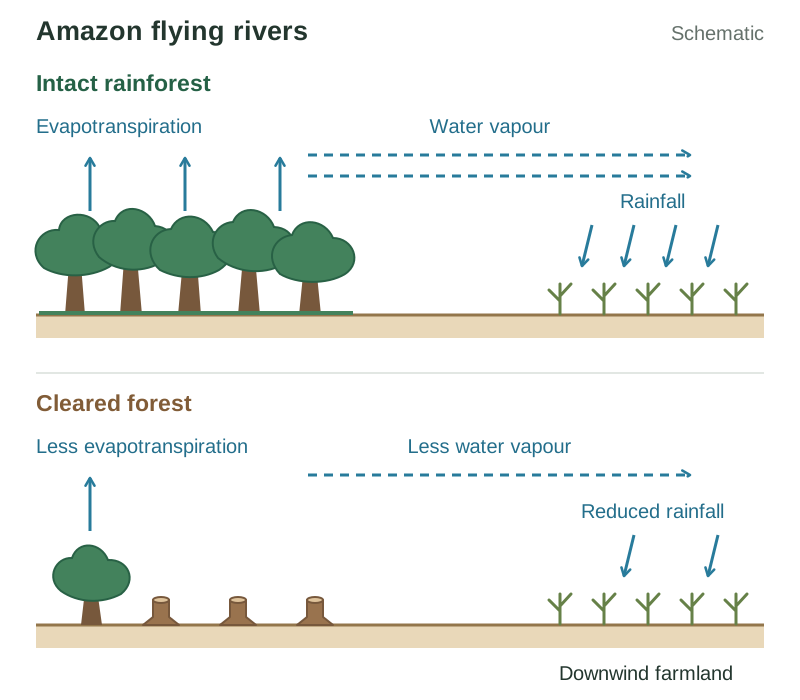
Commercial cash crops also drive tree clearance. Mato Grosso grows roughly 26% of Brazil's soybean harvest, shipping millions of tonnes to Europe and China for livestock feed. Cutting and burning these forests releases huge volumes of stored carbon into the air. The Amazon basin holds between 140 and 150 billion metric tonnes of carbon in its biomass and soil. Felling trees also damages flying rivers—enormous corridors of water vapour produced by rainforest evapotranspiration that account for 25% to 30% of South America's rainfall. Losing forest cover shortens the rainy season and lengthens droughts across South American farmland.
Desertification in the African Sahel
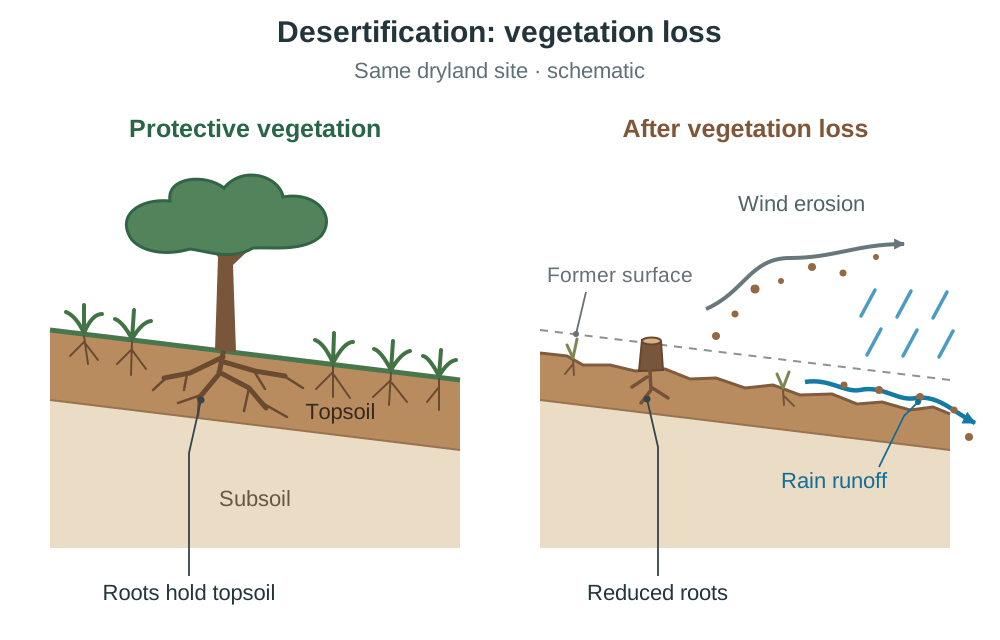
Desertification happens when dryland or semi-arid land loses its vegetation and soil nutrients through human misuse and changing weather patterns. It is not sand dunes marching forward; the soil simply degrades where it lies. The Sahel forms a 5,000 km semi-arid strip running through Senegal, Mali, Burkina Faso, Niger, and Chad.
- Human Pressures: The region's population has doubled since the 1960s. Overgrazing across roughly 70% of rangelands eats away grass cover, while continuous cropping without fallow seasons drains the soil. Chopping trees for firewood strips away root networks, leaving bare ground exposed to wind and rain.
- Climatic Drivers: The Sahel is warming at roughly 1.5 times the global rate, causing erratic downpours, flash floods, and prolonged dry spells.
- Human Consequences: More than 30 million people across this belt suffer from food insecurity. Loss of topsoil forces farming families off the land, creating over 270,000 internally displaced people in Mali alone.
Global Warming and Climate Justice
The enhanced greenhouse effect takes place when human activity releases excess gases like carbon dioxide and methane, trapping heat in the lower atmosphere.
- International Action: The Paris Agreement (2015) committed governments to keep global temperature increases well below 2°C above pre-industrial levels, targeting 1.5°C. At COP27 in 2022, delegates agreed to set up a loss and damage fund to support developing nations hit by climate disasters. The EU Green Deal requires member states, including Ireland, to cut net emissions by 55% by 2030 and reach carbon neutrality by 2050.
- Climate Justice: Developing nations produce very little historic greenhouse emissions, yet they face the worst consequences. In Bangladesh, rising seas flood low-lying delta farmlands with saltwater, ruining rice crops. Low-lying island states like Tuvalu and the Maldives face losing their freshwater lenses and physical territory to rising tides.
6.2c Social and Political Decisions: Migration, Refugees, and Human Rights
Economic Migrants vs Political Refugees
- An economic migrant chooses to move to another country to find work, earn higher wages, or improve living standards. They keep their passport and the diplomatic protection of their home government.
- A political refugee is forced to escape across an international border because they have a well-founded fear of persecution based on their race, religion, nationality, political opinion, or social group. Under the 1951 UN Refugee Convention and its 1967 Protocol, host countries must provide protection and cannot deport refugees back to dangerous conditions (non-refoulement).
Irish Migration Patterns and National Policy
- EU Enlargement: When the European Union expanded in 2004, Ireland gave immediate access to its job market to citizens from the ten new member states. Attracted by the economic boom, roughly 200,000 Eastern European workers, primarily from Poland and Lithuania, moved to Ireland by 2008.
- Critical Skills Permits: Ireland opted out of common EU immigration policies under Protocol 21 and does not issue the EU Blue Card. Instead, the State brings in qualified non-EU professionals through the Critical Skills Employment Permit (CSEP). More than 40% of doctors registered with the Medical Council of Ireland were trained abroad, mostly in Pakistan, India, and the Philippines.
- Emigration Cycles: Recessions reverse migration trends. Following the 2008 banking crash, over 390,000 people emigrated from Ireland between 2008 and 2013, roughly half of them Irish citizens.
Displacement and European Policy
War and political persecution have displaced more than 110 million people across the globe. In 2015, over one million people crossed the Mediterranean into Europe; Germany accepted more than 470,000 asylum applications that year, while Sweden took the highest share relative to its population. In 2022, following the invasion of Ukraine, the EU activated its Temporary Protection Directive for the first time, giving roughly four million displaced Ukrainians residence rights, medical care, housing, and work permits without waiting for individual asylum hearings. Ireland took in over 100,000 Ukrainian arrivals under this rule.
Human Rights and Direct Provision
The Universal Declaration of Human Rights (1948) guarantees that every person has the right to seek asylum, work under fair conditions, and access healthcare. Denying these basic rights sets back development; in Afghanistan, the Taliban's decision to bar girls from secondary school and university strips the economy of half its future educated workforce.
In Ireland, people seeking international protection live in the Direct Provision system while awaiting decisions. First set up as a temporary measure in 2000, processing delays mean applicants stay for an average of over two years. The Ombudsman and the Irish Human Rights and Equality Commission have pointed out serious flaws, including crowded rooms, limited cooking facilities, and long-term institutionalisation of young children. Although the Government published a White Paper promising own-door accommodation, the system remains in operation.
6.3 Empowering People: Debt, Aid, NGOs, Participation, Land, Gender, and Exploitation
The Debt Burden and Structural Adjustment
When governments take on massive loans, annual interest payments swallow money that should go to basic public services:
The Cycle of Poverty Diagram: You can draw this in your exam as a six-step circle: Low national incomes → Weak tax returns → Heavy overseas borrowing → High annual interest payments → Cuts to schools, clinics, and clean water → Less skilled, less healthy workforce → Back to low national incomes.
During the 1970s, many developing nations borrowed heavily to build dams and roads. In the 1980s, world interest rates jumped while export prices for raw minerals fell, leaving borrowers unable to clear their debts. The International Monetary Fund (IMF) and World Bank stepped in with Structural Adjustment Programmes (SAPs). To receive emergency credit, governments had to cut public spending, sell off state utilities, end food subsidies, and push farms into cash crops for export. SAPs forced hospitals to charge fees and led to lower primary school attendance.
Campaign groups like Jubilee 2000 demanded debt relief. Under the Heavily Indebted Poor Countries (HIPC) Initiative in 1996 and the Multilateral Debt Relief Initiative in 2005, over thirty nations saw unpayable debts cancelled, provided the money saved went straight into primary schools and health clinics. After receiving debt relief, Uganda and Tanzania ended primary school fees, and classroom enrolment rose sharply. However, debt pressures have returned; Zambia defaulted on its sovereign bonds in 2020 and Sri Lanka followed in 2022 as borrowing costs surged.
Irish Bailout Comparison: In September 2008, the Irish Government issued a blanket bank guarantee covering liabilities of roughly €440 billion. By November 2010, the State took an €85 billion adjustment loan from the EU and IMF. Austerity budgets raised standard VAT to 23%, brought in the Universal Social Charge, and pushed unemployment up to 15.9% in 2012.
The Aid Debate: Who Benefits?
Official Development Assistance (ODA) includes bilateral aid (government to government), multilateral aid (through agencies like the UN), emergency humanitarian shipments, and long-term development funds. The UN recommends that wealthy donor states allocate 0.7% of Gross National Income as ODA. Ireland's policy paper, A Better World, aims to hit this 0.7% target by 2030; annual Irish ODA totals roughly €2 billion.
- Bilateral Aid: Irish Aid gave €39.7 million to Ethiopia in 2023. As untied aid, these funds are spent locally on African suppliers rather than on Irish contractors. The programmes back climate-smart farming in the dry Afar and Somali regions, alongside girls' schooling and maternal health clinics.
- Aid Criticisms: Tied aid forces recipient nations to purchase machinery and hire consultants from the donor country, raising costs and holding back local business. Big shipments of free food aid can ruin local trade; during the 1990s, subsidised American rice flooded Haiti, undercutting local growers and leaving the island reliant on imported grain. Corrupt regimes also skim off funds; despite receiving billions of dollars in foreign aid after its 2010 earthquake, Haiti remains one of the poorest nations in the Americas because foreign contractors bypassed domestic public offices.
Non-Governmental Organisations (NGOs)
NGOs run independently from government foreign policy, putting donations straight into local community work. The Forum for African Women Educationalists (FAWE) works across more than 30 African countries, using bursaries, teacher training in gender-sensitive classrooms, and lobbying to keep girls in school. In Mali, FAWE helped lift female primary school enrolment from 53% to 69% between 2008 and 2014.
Decision-Making and Participation: Top-Down vs Bottom-Up
Top-down development is designed by central ministries or international banks with minimal input from residents. Large hydroelectric dams show the downside: reservoirs flood farmland and force families off their land without consultation.
Bottom-up development puts local residents in charge. In Ireland, 31 Local Enterprise Offices (LEOs) provide direct mentoring and start-up grants to local businesses. The EU LEADER programme channels rural development money through local action groups made up of farmers and community leaders. Globally, decision-making power remains skewed: every country gets a vote in the UN General Assembly, but votes in the IMF and World Bank depend on capital shares, giving wealthy economies total control over lending terms.
Land Ownership Patterns
Skewed land distribution causes long-term rural poverty. In Brazil, 1% of landowners control roughly 45% of all arable land on vast commercial estates (latifundia), which has forced millions of rural workers into city favelas and sparked land disputes. By contrast, the Wyndham Land Purchase Act (1903) in Ireland gave tenant farmers low-interest, state-backed loans to buy out Anglo-Irish estates, creating a secure society of small owner-occupiers.
Co-operatives help small farmers pool crops, buy fertilizer in bulk, and purchase processing machinery on a democratic, one-member-one-vote basis. The Irish Co-operative Organisation Society (ICOS), founded by Horace Plunkett in 1894, links 150,000 members and turns over €12 billion annually across dairy and livestock marts. In Brazil, agricultural co-operatives affiliated with the OCB grow half the nation's domestic food.
Differing Gender Roles
In many developing countries, women do the bulk of subsistence farm labour but hold legal title to very little land, which stops them from securing commercial bank loans. Walking miles for water and collecting firewood causes severe time poverty, keeping young girls out of primary school. Installing communal boreholes frees up daily hours for schooling and paid work.
Microfinance offers small loans to women without commercial collateral. The Grameen Bank in Bangladesh lends directly to women in solidarity groups; borrowers purchase sewing equipment or livestock and use the profits to buy food and pay school fees. In Rwanda, following the 1994 genocide, the 2003 constitution reserved at least 30% of parliamentary seats for women. Rwandan women now hold 61% of parliamentary seats, passing laws that protect equal land inheritance rights and punish gender-based violence.
Exploitation of People and Resources
Exploitation occurs when workers or natural resources are used for commercial profit without returning fair value to the community.
- Sweatshops in Supply Chains: Garment workers in Bangladesh make clothes for Western retailers on low wages. In April 2013, the Rana Plaza factory building collapsed in Dhaka, killing 1,134 garment workers who had been ordered to work despite visible wall cracks. The disaster led to the legally binding Accord on Fire and Building Safety in Bangladesh, signed by over 200 clothing brands.
- Primary Commodities: Côte d'Ivoire and Ghana produce 60% of the world's cocoa, yet farmers earn only a tiny slice of the retail price of a chocolate bar; most profit goes to roasting and retail firms in Europe and North America. In the Democratic Republic of Congo, children and informal miners dig cobalt out of dangerous hand-dug pits for rechargeable batteries.
- Exploitation in Ireland: The Workplace Relations Commission has uncovered abuses involving migrant workers in commercial mushroom tunnels, meat plants, and trawlers, including wages below the minimum wage and substandard accommodation.
- Resource Plunder: Between 50% and 90% of logging in the Brazilian Amazon happens without legal permits. Wildcat gold miners (garimpeiros) wash toxic mercury into rivers, poisoning fish stocks relied on by indigenous groups like the Yanomami.
6.4 Sustainable Development, Fair Trade, Justice, and Self-Reliance
The 1987 Brundtland Report defined sustainable development as 'development that meets the needs of the present without compromising the ability of future generations to meet their own needs'. It balances three pillars: environmental care, economic viability, and social justice, codified in the UN's 17 Sustainable Development Goals (SDGs).
Sustainable Forestry and Energy Management
- Sweden's Boreal Forestry: Sweden's Forestry Act of 1903 legally requires every harvested timber plot to be replanted. Overseen by the Swedish Forest Agency, foresters cut roughly 1% of standing timber each year, giving the cold boreal forest time to regrow. They leave stands of native broadleaf trees (oak and birch) and harvest in irregular shapes so wildlife corridors stay intact. Sawmill dust and wood waste are compressed into 3.5 million tonnes of biofuel pellets each year.
- Costa Rica's PES Programme: Deforestation cut Costa Rica's forest cover from 75% in the 1940s to about 25% by the 1980s. In 1997, the government started the Payment for Environmental Services (PES) scheme, paid for by a 3.5% tax on fossil fuels. The scheme pays farmers to protect standing trees, protect headwaters, and plant native saplings. Forest cover has climbed back over 54%, supporting a multi-billion-dollar ecotourism trade that finances rural clinics and schools.
- Geothermal Energy in Iceland and Kenya: Iceland produces virtually all its electricity from renewables: roughly 70% from glacial river hydro stations and 30% from geothermal steam. Geothermal hot water heats 89% of Icelandic homes through district pipes. Iceland works with the UN Environment Programme to train African engineers; in Kenya, geothermal wells in Hell's Gate National Park generate roughly 45% of the national electricity grid.
Sustainable Resource Management in Ireland
- Wind Power: Onshore wind farms like Galway Wind Park and Oweninny in Co. Mayo supply over 30% of Ireland's electricity, cutting down coal and gas imports.
- Circular Economy: The 2002 plastic bag levy cut single-use plastic bag consumption by more than 90%. In 2024, Ireland launched the Re-turn deposit return scheme on bottles and cans to lift recycling rates.
- Fisheries Management: Commercial fishing in Irish waters is controlled by EU Total Allowable Catches (TACs) and net mesh rules to stop overfishing.
- Climate Legislation: The Climate Action Plan legally commits Ireland to cut net greenhouse emissions by 51% by 2030, funded by a rising carbon tax.
Fair Trade: Systems and Realities
Traditional commodity trading leaves smallholders at the mercy of volatile market prices. The Fairtrade model uses two financial mechanisms:
- A Fairtrade minimum price covering sustainable farming costs that acts as a floor during global market slumps.
- A Fairtrade premium, an extra cash payment paid straight to the farmers' co-operative to fund local projects like classrooms, boreholes, and maternity units.
- Producer Example: Kuapa Kokoo in Ghana is a Fairtrade cocoa co-operative owned by smallholder farmers. The co-operative owns shares in Divine Chocolate, giving growers dividends from chocolate bars sold in European shops. Premium funds have built clean water wells and primary schools in rural villages. In Ireland, Fairtrade Ireland certifies supermarket items, and towns like Clonakilty hold Fair Trade status.
- The Reality Check: Research indicates that only about 32% of the extra retail price paid by supermarket shoppers reaches the farming co-operative; the rest goes to shipping, roasting, packaging, and supermarket shelf mark-ups.
Justice Issues and Marginalised Minorities
- Irish Travellers: Recognized by the State as an indigenous ethnic minority in 2017, Travellers face severe discrimination. Census data shows a Traveller unemployment rate around 80%, with fewer than 15% completing second-level education compared to over 90% of the settled population. Traveller men live roughly 15 years less and Traveller women 11 years less than the general population, with suicide rates six times higher. Halting sites often suffer from poor drainage, damp, and lack of maintenance.
- Indigenous Peoples in Brazil: Brazil's 818,000 indigenous people belong to more than 300 distinct tribes, holding rights to 12% of the national territory. However, state agencies like FUNAI lack resources, leaving reserves vulnerable to wildcat miners (garimpeiros), cattle ranchers, and illegal loggers who clear forest and poison rivers with mercury.
Self-Reliance: Development as Self-Help
Self-reliance means building local solutions using community skills and assets instead of relying on external aid.
- The Ludgate Hub (Skibbereen, Co. Cork): Facing rural youth emigration, local business people partnered with telecommunications providers in 2016 to turn an old bakery into Ireland's first 1 GB digital hub. It has supported over 70 permanent jobs and dozens of start-ups, keeping young professionals in West Cork.
- Café Femenino (Peru): Working with indigenous women coffee growers in the Amazonas region, this initiative diversified household income by reintroducing organic quinoa farming (raising family earnings by 30%), building ventilated kitchen stoves to cut smoke inhalation, and setting up community centres (Casas Café Femenino) to train women in leadership.
Key terms
- Significant Relevant Point (SRP)
- A single factual geographical statement carrying two marks in Leaving Certificate Higher Level marking schemes, comprising a named location, specific statistic, policy, organisation, or step in a process.
- Overall Coherence
- A twenty-mark assessment awarded to the Higher Level Option essay evaluating essay structure, logical flow, geographical terminology, and relevance to the title.
- Human Development Index (HDI)
- A composite index from 0 to 1 created by the United Nations to assess development through life expectancy at birth, average and expected schooling years, and GNI per capita.
- Eurocentric Thinking
- An academic and cultural bias that judges non-Western societies and development paths exclusively against Western European and North American history and standards.
- The Brandt Line
- A visual divide introduced in the 1980 Brandt Report splitting the world into an affluent northern core and an impoverished southern periphery, now obsolete due to countries like Australia.
- Determinist Model
- A theory proposing that a nation's economic and social progress is dictated by physical geography, climate, and natural resource availability.
- Modernisation Model (Rostow)
- A development theory proposing that all societies progress through five linear stages from subsistence farming to industrial take-off and high mass consumption.
- Dependency Theory
- An economic model arguing that developing countries are held back because global trade pumps wealth from a poor periphery to enrich an industrialised core.
- Multinational Corporation (MNC)
- An enterprise headquartered in one country that owns, coordinates, and manages manufacturing, service, and supply networks across multiple sovereign states.
- Flying Rivers
- Massive atmospheric vapour corridors generated by tropical rainforest evapotranspiration that travel across continents to produce major regional rainfall.
- Desertification
- The degradation of land productivity in semi-arid and dry sub-humid environments driven by climatic variability and human pressures such as overgrazing.
- Economic Migrant
- A person who chooses to move across international boundaries to find better employment, higher wages, or an improved living standard, retaining home government protection.
- Political Refugee
- An individual forced to cross borders due to a well-founded fear of persecution based on race, religion, nationality, social group, or political belief, protected by the 1951 Refugee Convention.
- Direct Provision
- The system established by the Irish State in 2000 to provide accommodation, basic meals, and living allowances to international protection applicants awaiting legal decisions.
- Structural Adjustment Programmes (SAPs)
- Economic conditions attached to IMF and World Bank loans from the 1980s requiring borrowing countries to cut public spending, privatise services, and prioritise cash exports.
- Official Development Assistance (ODA)
- Official government funding provided to promote the economic development and welfare of lower-income nations, with an international UN target of 0.7% of GNI.
- Tied Aid
- Foreign development funding granted on the binding condition that recipient states spend the money on goods, engineering, or services supplied by the donor country.
- Latifundia
- Large commercial agricultural estates common in Latin America, historically worked by low-wage rural labourers and producing monoculture cash crops for export.
- Co-operative
- An enterprise democratically owned and controlled by its working members on a one-member-one-vote basis, allowing smallholders to pool resources and achieve economies of scale.
- Sustainable Development
- Development meeting the needs of the present generation without compromising the ability of future generations to meet their own economic, social, and environmental needs.
- Fairtrade Minimum Price
- A guaranteed floor price paid to certified producer co-operatives that protects smallholder farmers against sudden crashes in world commodity markets.
- Self-Reliance
- A bottom-up development model where communities use local skills, natural assets, and democratic participation to meet their own needs without external dependency.
Check yourself
Distinguish between economic growth and development, and name two indicators used in the Human Development Index.
Economic growth is an increase in the monetary value of goods and services produced by an economy (GNI/GDP). Development is a broader improvement in people's quality of life, health, and education. Two indicators in the HDI are life expectancy at birth and mean/expected years of schooling (alongside GNI per capita).
What is the UN recommended target for Official Development Assistance as a proportion of national income, and what is Ireland's target date?
The UN target is 0.7% of Gross National Income (GNI). Under its 'A Better World' policy, Ireland has committed to reaching this target by 2030.
Write three Significant Relevant Points (SRPs) evaluating the impact of a named MNC on a consumer region.
(1) Pfizer distributes medicines and vaccines to consumer markets in over 100 countries worldwide. (2) When Pfizer's patent on Lipitor expired, generic competition drove consumer prices down by over 90%. (3) Commercial advance-purchasing during COVID-19 saw high-income consumer markets prioritised, leaving lower-income nations with early vaccination rates below 10%.
How do top-down and bottom-up decision-making differ in development, and what is one Irish body illustrating local participation?
Top-down development is planned and funded by central governments or large bodies with little local consultation (e.g. major dam schemes). Bottom-up development is directed by local communities to meet their own priorities. In Ireland, Local Enterprise Offices (LEOs) or LEADER groups illustrate local participation.
What are 'flying rivers', and how does Amazon deforestation affect them?
'Flying rivers' are vast atmospheric corridors of water vapour generated by rainforest evapotranspiration that supply 25% to 30% of South America's rainfall. Deforestation reduces tree cover, weakening this moisture conveyor and lengthening droughts across the continent.
What percentage of parliamentary seats in Rwanda are held by women, and what policy drove this outcome?
Women hold approximately 61% of parliamentary seats in Rwanda, the highest proportion globally, driven by a 2003 post-genocide constitutional quota reserving at least 30% of parliamentary seats for women.
How did the 1903 Wyndham Land Purchase Act change land tenure in rural Ireland?
It provided low-interest, state-backed loans and a cash bonus to landlords, enabling more than 250,000 tenant farmers to buy out their holdings and turning Ireland into a country of small owner-occupiers.