

Economic development describes how a country increases its wealth while improving living standards, healthcare, education, and basic infrastructure for its people. Under Elective Unit 4 of Leaving Certificate Geography, this topic investigates why economic activity is distributed unevenly across the globe and examines how physical, social, cultural, and political factors shape developing economies. You will study financial metrics like Gross Domestic Product (GDP) and Gross National Product (GNP) alongside composite social indicators such as the Human Development Index (HDI). Using India as the primary case study, this note examines the legacy of British colonialism, India's shift from post-independence protectionism to market liberalisation after 1991, the operation of multinational companies, the core-periphery model, and pressing global justice issues including debt, unfair terms of trade, and climate change. It concludes with an Ireland-India comparison to demonstrate that levels of economic development are dynamic and change over time.
Defining a Developing Economy and Measuring Development: GDP, GNP, and GNI*
A developing economy is a country with relatively low income per person, a large share of its workforce employed in primary activities such as subsistence farming, and limited provision of modern infrastructure, healthcare, and education. These nations are usually industrialising and frequently carry the institutional and economic scars of colonial rule. Countries are broadly grouped into the wealthy Global North and the developing Global South. Rapidly growing nations that bridge this gap, such as India, Brazil, and China, are often described as newly industrialised countries (NICs).
India exemplifies a developing economy: its Gross National Income (GNI) per capita is roughly US60,000 in Ireland), roughly 45% of its workforce remains in agriculture, and its HDI score of roughly 0.64 places it in the medium human development bracket.
Geographers use three main economic indicators to assess output and income:
Gross Domestic Product (GDP)
GDP is the total monetary value of all finished goods and services produced within the territorial borders of a country over one year. It counts all economic activity within the state, regardless of whether it is generated by local domestic firms or foreign-owned multinational corporations (MNCs).
Gross National Product (GNP)
GNP measures the total economic value generated by the citizens and domestic enterprises of a country in a year, including earnings from abroad:
GNP = GDP + net factor income from abroad
Net factor income from abroad equals the money domestic citizens and national firms earn overseas and bring home, minus the profits that foreign-owned multinationals make inside the country and repatriate to their overseas headquarters.
Modified Gross National Income (GNI*)
Ireland is the prime example of why this distinction is critical. Ireland hosts global multinationals such as Apple, Google, and Pfizer. When these companies repatriate billions of euro in profits, that money leaves the Irish domestic economy. This massive foreign output inflates Irish GDP, meaning GDP suggests living standards that do not reflect what domestic households actually receive. In Ireland, GNP is far lower than GDP. The Central Statistics Office (CSO) developed modified GNI (GNI*) to strip out multinational accounting distortions, giving a far more accurate measurement of domestic living standards.
To compare countries of different population sizes, economists calculate output per person:
GNP per capita = GNP ÷ population
Limitations of GNP per capita
- It is a national average: It conceals extreme wealth inequality. An oil-exporting nation like Nigeria may record substantial national oil revenues, but if that wealth remains in the hands of a small political elite, the vast majority of the population remains in deep poverty.
- It misses informal and unpaid work: Subsistence farming, street vending, and unpaid family care work are excluded from official bank accounts and tax data, severely undercounting productive labour in developing nations.
- It counts environmental destruction as economic growth: Short-term gains from clear-cutting tropical rainforests or over-extracting groundwater registers as positive GNP growth, ignoring the permanent loss of natural capital.
The Human Development Index (HDI) and Broad Measures of Progress
Because purely financial metrics overlook quality of life, the United Nations Development Programme (UNDP) created the Human Development Index (HDI). Scored on a decimal scale from 0.0 to 1.0, it measures three equally weighted components:
- Health: Measured by life expectancy at birth, which reflects clean water access, nutrition, sanitation, and hospital care.
- Education: Measured by mean years of schooling completed by adults aged 25 and older, combined with expected years of schooling for school-age children.
- Standard of living: Measured by GNI per capita adjusted for Purchasing Power Parity (PPP), which accounts for differences in local price levels between countries.
Countries scoring 0.800 or higher fall into the 'very high' human development category, while those below 0.550 are classed as 'low'. In recent UN Human Development Reports, Ireland regularly scores around 0.95 (ranking in the top ten worldwide), supported by life expectancy exceeding 82 years and high third-level educational attainment. By contrast, India scores approximately 0.64 (ranking around 130th), placing it in the 'medium' development tier. Sub-Saharan countries like Niger or Chad sit near the bottom due to low life expectancy and limited primary school completion.
Advantages of HDI
- It provides a broad, human-centred view of development, exposing instances where strong economic growth fails to improve public health or education.
- It highlights state spending choices. For example, some resource-rich nations achieve high GNI per capita but languish with low HDI scores because state revenues are spent on military expansion rather than schools and medical clinics.
Limitations of HDI
- It is still a national average that conceals severe internal inequalities between regions, genders, and social classes.
- It omits vital quality-of-life elements, such as personal safety, political freedom, gender-based violence, and environmental pollution.
Factors Shaping Uneven Levels of Economic Development
Uneven levels of development do not happen by accident. According to syllabus statement 4.2, they evolve through the complex interaction of four major factor groups: physical, social, cultural, and political.
Physical Factors
Climate, relief, and natural resources place natural boundaries on economic productivity:
- Climate and water supply: India's agricultural economy relies heavily on the seasonal summer monsoon. A weak or delayed monsoon causes harvest failure and drives rural debt across the rain-fed Deccan plateau. Conversely, fertile alluvial plains fed by perennial rivers and canal networks in Punjab and Haryana support high-yield wheat production.
- Coastal access: Coastal states with natural deep-water ports (such as Maharashtra and Tamil Nadu) trade easily on international shipping lanes, whereas landlocked northern states (such as Bihar) suffer from high transport costs and geographic isolation.
Social Factors
Public health, educational access, and demographic pressures dictate whether citizens can participate in the modern economy:
- Literacy and human capital: Kerala achieved a literacy rate of 94% (2011 census) by prioritising state investment in schools and clinics. This high literacy underpins a skilled service workforce and high female autonomy. In contrast, Bihar recorded a literacy rate of roughly 62%, leaving millions trapped in low-paid, unskilled agricultural labour.
- Demographic pressure: Rapid population growth in poorer northern states stretches public schools, maternity wards, and water sanitation systems beyond capacity.
Cultural Factors
Social hierarchies, gender roles, and language norms affect economic participation:
- Gender participation: Low female school completion and low female labour force participation (around 25% to 30% in India) prevent half the population from participating equally in the formal economy.
- Caste hierarchies: Although legally banned, traditional caste prejudices in rural communities can restrict lower-caste groups from owning land or accessing higher-wage employment.
- Language advantages: The widespread teaching of English in secondary and higher education gave India a decisive global advantage when competing for IT and back-office service contracts.
Political Factors
Governance, political stability, and state policy exert the strongest influence of all:
- Colonial extraction: Two centuries of British imperial rule systematically suppressed domestic Indian enterprise.
- Post-independence policy: The protectionist 'Licence Raj' restricted private competition between 1947 and 1991, keeping economic growth to 3% to 4% annually. The decisive shift to economic liberalisation in 1991, accompanied by Special Economic Zones (SEZs) and the 2014 'Make in India' initiative, accelerated GDP growth to 6% to 8%.
- Conflict and corruption: Political corruption and cross-border tensions with Pakistan divert billions in public capital into defence budgets rather than primary education and rural health clinics.
The Core-Periphery Model at Global and National Scales
The core-periphery model explains why economic wealth, technology, and decision-making power concentrate in specific geographic hubs while other regions remain dependent and underdeveloped.
Core Characteristics
A core region possesses modern transport infrastructure, advanced research institutions, high wage levels, political power, and an influx of private capital and young skilled workers.
Periphery Characteristics
A peripheral region is geographically isolated or neglected, reliant on low-value primary commodities (farming, mining), characterized by out-migration of young workers, and politically dependent on the core.
Global Scale
At the global scale, three primary economic cores dominate world trade: North America, the European Union, and the Pacific Rim (Japan, South Korea, China). These hubs control global financial markets, high-tech research, and multinational headquarters. The global periphery includes large parts of sub-Saharan Africa, which remain excluded from global manufacturing networks and export low-cost ores and crops. India functions primarily in the semi-periphery: it provides outsourced software services, pharmaceutical manufacturing, and assembly labour, while ultimate intellectual property and headquarter decisions remain in Western cores.
National Scale: India's Internal Core and Periphery
India has developed sharp domestic core-periphery divides:
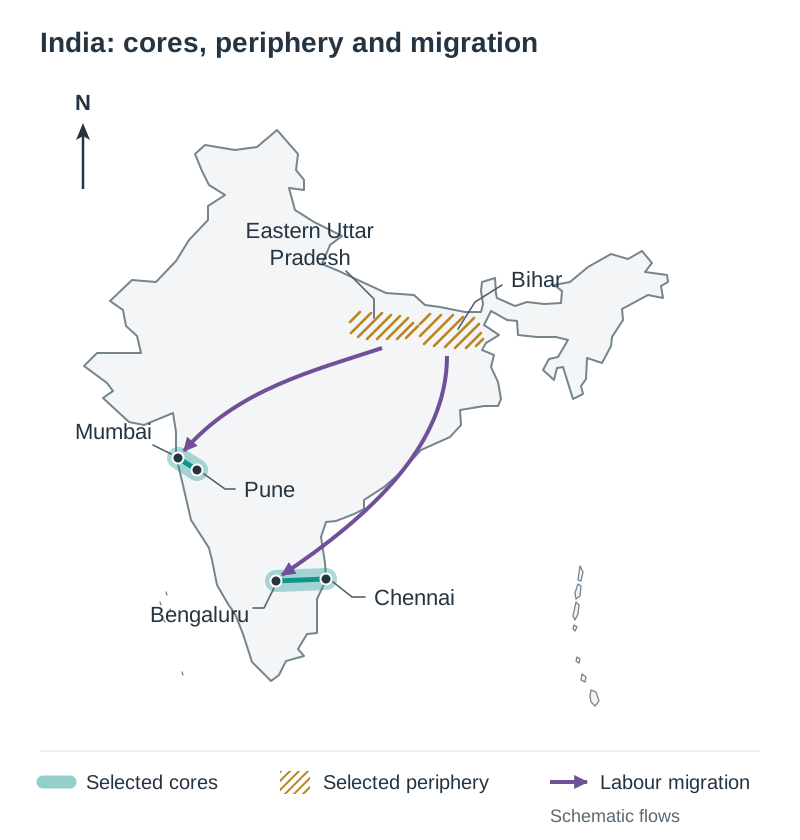
- National cores: The Mumbai-Pune industrial belt in Maharashtra and the Bengaluru-Chennai technology corridor act as powerful urban cores. They capture foreign direct investment, boast international airports and expressways, and attract university graduates.
- National periphery: Inland northern states like Bihar and eastern Uttar Pradesh form an economic periphery. They suffer from frequent river flooding, poor road networks, low literacy, and underfunded schools, acting as labour reserves that export young migrant workers to Mumbai and Bengaluru.
Colonialism and Underdevelopment: The Case of India (1757–1947)
Colonialism is the political, military, and economic control of a territory and its people by an outside power, structured to enrich the imperial ruler. British dominance began through the East India Company after 1757 and transitioned to direct British Crown rule from 1858 until independence in 1947. During this era, India was forced into a dependent peripheral role to fuel Britain's Industrial Revolution.
Deindustrialisation
In 1750, India produced approximately 25% of the world's manufactured goods, famous globally for its hand-spun cotton textiles. British authorities imposed steep import tariffs on finished Indian cloth entering Britain, while flooding Indian markets tariff-free with cheap, factory-milled cloth from Manchester. This deliberate policy destroyed India's domestic handloom industry, throwing millions of skilled weavers out of work and reducing India's share of global manufacturing to barely 2% by 1900.
Cash-Crop Monoculture and Famine
Colonial administrations forced farmers to switch land from subsistence food crops (rice and wheat) to commercial cash crops required by British factories, including raw cotton, jute, tea, and indigo. High cash land taxes pushed smallholders into chronic debt to moneylenders. Stripping rural villages of their stored grain reserves left them defenseless against monsoon failures, causing devastating famines. The Bengal Famine of 1943 claimed roughly 3 million lives while grain was requisitioned to support wartime imperial armies.
Extractive Infrastructure
Thousands of kilometres of railway tracks and deep-water ports (Calcutta, Bombay, Madras) were engineered by colonial authorities. However, these transport networks were built strictly to haul raw materials out of inland agricultural and mining basins to the coast for export to Britain, and to move military garrisons inland. They did not link domestic towns or integrate internal trade.
Social Fractures and Partition
Colonial administrators formalised and rigidified caste categories in official censuses to divide local resistance, while providing Western education solely to a small English-speaking elite to run the civil service. At independence in 1947, adult literacy was below 18%. The rushed withdrawal of British rule caused the violent Partition of India and Pakistan, triggering cross-border displacement that killed an estimated one million people and produced ongoing geopolitical defence spending.
Adjustments to the Global Economy: From Protectionism to Liberalisation
Following independence in 1947, Indian economic policy moved through two contrasting phases:
1. Protectionism and the Mixed Economy (1947–1991)
Deeply suspicious of foreign exploitation, Prime Minister Jawaharlal Nehru implemented an inward-looking socialist model centred on self-sufficiency:
- Import substitution: The government erected high tariff walls and import quotas to protect domestic industries from foreign imports.
- The 'Licence Raj': Heavy industries such as steel, coal, energy, and transport were nationalised. Private businesses had to obtain complex government licences to manufacture goods, set prices, or expand factory floors. This bureaucracy bred inefficiency, limiting annual GDP growth to a sluggish 3% to 4%.
- The Green Revolution: In the 1960s and 1970s, the state introduced High-Yielding Variety (HYV) wheat and rice seeds, synthetic fertilisers, and tube-well irrigation. While this achieved national food security, the benefits were geographically confined to well-watered northern states like Punjab and Haryana, leaving dryland regions behind and depleting regional water tables.
2. Economic Liberalisation (1991 to Present)
By 1991, rising oil prices caused by the Gulf War and falling export income caused a severe balance-of-payments crisis. India was left with barely three weeks' worth of foreign currency reserves to pay for essential imports. To secure emergency financial relief from the International Monetary Fund (IMF), India was forced to accept structural adjustment terms that opened its economy:
- Tariff reductions: Average import tariffs were cut sharply, dropping from 72.5% in 1991 to below 25% by 1996, and later falling below 20%.
- Abolition of industrial licensing: The bureaucratic 'Licence Raj' was dismantled for almost all industrial sectors, freeing private firms to expand output.
- Welcoming Foreign Direct Investment (FDI): Foreign companies were permitted to invest in manufacturing, retail, telecommunications, and financial services.
- Expansion of domestic Indian MNCs: Private Indian conglomerates became global players. Tata Steel bought Corus (formerly British Steel) for over $12 billion in 2007, and Tata Motors purchased Jaguar Land Rover in 2008, reversing historic colonial financial flows.
The Global Division of Labour, MNCs, and Maruti Suzuki Case Study
Opening the economy connected India directly to the New International Division of Labour (NIDL). In this system, parent multinational corporations retain high-value research, product design, and executive headquarters in core developed nations, while shifting labour-intensive manufacturing and back-office services to developing nations offering low operating costs.
India leveraged its massive pool of low-cost, English-speaking, engineering and technical graduates to become the premier global destination for Information Technology (IT) and Business Process Outsourcing (BPO). Cities like Bengaluru (Bangalore), Hyderabad, and Pune developed state-of-the-art software technology parks. Foreign giants like IBM, Accenture, and Microsoft established major offshore facilities, while homegrown IT leaders like Infosys and Tata Consultancy Services expanded worldwide. India's IT and BPO sectors employ over 5 million people directly.
Named MNC in a Developing Economy: Maruti Suzuki India
To examine how multinational corporations operate inside a developing economy, consider Maruti Suzuki India, the country's largest passenger car manufacturer. Established in 1982 as a joint venture between the Indian government and Suzuki Motor Corporation of Japan, Suzuki now holds a majority controlling stake.
- Sourcing and manufacturing: Basic car assembly takes place at large manufacturing complexes in Gurugram and Manesar (Haryana) and in Gujarat. Suzuki relies on an extensive network of domestic Indian component suppliers located nearby, generating thousands of indirect manufacturing jobs.
- Division of labour: High-value engine research, complex robotics, and top executive decision-making remain concentrated in Suzuki's headquarters in Hamamatsu, Japan, while assembly line work and routine parts manufacturing are carried out in India.
- Markets: The bulk of production supplies India's rapidly growing domestic middle class, with surplus vehicles exported to peripheral and semi-peripheral markets across Africa and Latin America.
Positive Impacts of the MNC
- Direct employment of tens of thousands of workers, with a strong economic multiplier effect supporting thousands of local supply firms and service jobs.
- Substantial tax revenue for the Indian exchequer and significant foreign currency earnings through vehicle exports.
- Introduction of advanced Japanese automation, manufacturing techniques, and quality-control standards into the Indian engineering workforce.
Negative Impacts of the MNC
- Much of the assembly workforce is hired on temporary or contract arrangements at wages well below Japanese standards.
- Significant portions of company profits are repatriated home to Suzuki's corporate headquarters in Japan rather than reinvested into local Indian community development.
- Massive manufacturing complexes contribute to heavy traffic congestion, groundwater consumption, and dangerous air pollution in the Delhi National Capital Region.
- Assembly plants remain footloose over the long term; if Indian manufacturing costs rise, parent corporations can relocate production to lower-cost nations.
Global Issues, Trade Justice, Debt, and Aid
Evaluating economic patterns from a global justice perspective means asking who benefits from international trade, who bears the social and ecological costs, and whether developing countries receive equitable treatment in international institutions.
Unfair Terms of Trade and Tariff Escalation
Developing countries frequently export low-value primary commodities (such as tea, coffee, and raw iron ore) that experience volatile global prices, while importing high-cost technology and machinery from developed economies. This causes declining terms of trade: developing nations must export increasing volumes of raw materials just to purchase the same piece of imported equipment. Furthermore, wealthy nations impose tariff escalation: tariffs are set low or at zero on unprocessed raw materials (like green coffee beans) but rise sharply if the product is roasted or packaged. This tariff barrier blocks developing countries from adding value domestically.
The World Trade Organisation (WTO) and Farm Subsidies
Although the WTO is mandated to enforce non-discriminatory international trade rules, developing countries argue the organisation favours wealthy nations. Massive agricultural subsidies provided under the European Union's Common Agricultural Policy (CAP) and the US Farm Bill artificially lower world crop prices. When these subsidised crops are sold on world markets, unsubsidised small farmers in India and across Africa cannot compete.
Debt Burdens and Structural Adjustment
Developing nations that borrowed heavily from commercial banks and international agencies in the 1970s and 1980s became trapped in debt cycles as interest rates rose. Many states spend more annual revenue servicing foreign debt than they invest in domestic primary education and healthcare. Structural adjustment programmes (SAPs) demanded by the IMF and World Bank as loan conditions forced governments to cut spending on health, education, and farming subsidies, disproportionately hurting the rural poor.
International Aid: Types and Critique
- Bilateral aid: Direct government-to-government aid (such as Irish Aid financing rural clinics in East Africa).
- Multilateral aid: Channeled through international organisations such as the UN or World Bank.
- NGO aid: Administered by charities like Trócaire and Concern, focusing on community development.
- Tied aid: A contentious system where donor governments require recipient countries to spend aid funds on goods, equipment, or contractors from the donor nation, recycling the money back to the wealthy state.
Fairtrade
The Fairtrade movement ensures certified smallholder cooperatives receive a guaranteed minimum floor price for crops like tea, coffee, and cocoa, protecting them from market crashes, plus a Fairtrade social premium to finance community schools, clean wells, and clinics. However, Fairtrade represents only a tiny percentage of overall global commodity trade.
MGNREGA, India's rural employment guarantee scheme, provides up to 100 days of paid manual work a year to every rural household that requests it, as a social-justice response to rural poverty.
Brain Drain and Climate Justice
- Brain drain: India funds elite medical schools and technology institutes (IITs), only to lose thousands of doctors and software engineers annually to higher-paying careers in the US, the UK, and Ireland.
- Climate justice: India is the world's third-largest total emitter of greenhouse gases because coal fuels its electrical grid. Yet on a per-capita basis, an Indian citizen produces roughly 2 tonnes of CO2 annually, compared to roughly 14 tonnes for an American citizen. Because Western industrial cores generated the vast majority of historical carbon emissions, developing countries demand international climate finance and green technology sharing to expand renewable power without halting poverty reduction.
Changing Levels of Development Over Time: Contrasting India and Ireland
A core principle of Leaving Certificate Geography is that levels of development are never permanent. Economies change over time through changes in government policy, resource development, and integration into world markets. Contrasting Ireland with India illustrates this evolution.
In the 1950s, Ireland was an underdeveloped, protectionist agricultural economy. By 1950, 90% of Irish exports went to Britain, dominated by live cattle. Emigration was high and living standards lagged far behind mainland Western Europe. Starting in the late 1950s, Ireland transformed its economy by changing direction:
- Abandoning protectionism: Ireland dismantled import tariffs to pursue export-led growth.
- Tax incentives: Export Profits Tax Relief (1956) was introduced, which eventually developed into the 10% manufacturing rate and the landmark 12.5% corporation tax rate (with a 15% minimum effective rate introduced in 2024 for the largest multinational groups under the OECD agreement).
- Education investment: Free secondary education was introduced in 1967, followed by a nationwide network of Regional Technical Colleges (now Technological Universities) to supply skilled technicians for incoming multinationals.
- European integration: Joining the EEC in 1973 provided access to the European single market, while billions in EU Structural and Cohesion Funds modernised national roads, ports, water treatment, and training schemes.
Note the caution discussed earlier: while Irish GDP per capita is flattered by multinational profit repatriation, Ireland's GNP and GNI* still rose from well below the European average in 1960 to comfortably above it today. Development levels shifted dramatically within two generations.
Comparing Ireland and India shows common ground: both rejected failed protectionist models, invested in an educated, English-speaking workforce to attract foreign direct investment, and experienced rapid service-sector growth. However, scale and colonial destruction created very different starting points. India had to modernise across a population exceeding 1.4 billion people, with deep colonial deindustrialisation, high rural illiteracy, and a massive agricultural workforce, leaving its development far more uneven than Ireland's.
Key terms
- Developing Economy
- A country characterised by low average income per person, heavy dependence on agriculture, and underdeveloped infrastructure, healthcare, and education.
- Gross Domestic Product (GDP)
- The total market value of all finished goods and services produced within a country's physical borders over one year.
- Gross National Product (GNP)
- The total value of goods and services produced by the citizens and domestic enterprises of a country in a year, calculated as GDP plus net factor income from abroad.
- Modified GNI (GNI*)
- An economic metric developed in Ireland that strips out the distorting effects of multinational profit repatriation and intellectual property transfers to reveal true domestic income.
- Human Development Index (HDI)
- A United Nations index scored between 0.0 and 1.0 combining life expectancy, mean and expected years of schooling, and GNI per capita at purchasing power parity.
- Core-Periphery Model
- A spatial model demonstrating how wealth, modern infrastructure, and decision-making concentrate in an urban core, while peripheral regions remain dependent suppliers of labour and raw materials.
- Colonialism
- The political, military, and economic domination of a territory and its people by a foreign power, structured primarily to extract raw commodities and secure captive markets.
- Deindustrialisation
- The destruction or deliberate dismantling of a country's manufacturing capacity, illustrated by British factory textiles wiping out India's domestic handloom industry.
- Cash-Crop Agriculture
- The cultivation of agricultural commodities (such as cotton, tea, and indigo) for cash sale on world markets rather than food crops for local subsistence.
- Import Substitution
- A trade policy that protects domestic industries from foreign competition through heavy tariffs, import quotas, and state-subsidised manufacturing.
- Economic Liberalisation
- The dismantling of government trade barriers, import tariffs, industrial licensing, and foreign ownership limits to open an economy to global market forces.
- Foreign Direct Investment (FDI)
- Financial capital invested by a multinational company into physical facilities, production plants, or joint ventures in an overseas nation.
- New International Division of Labour (NIDL)
- A global production arrangement where research, design, and headquarters stay in developed cores while manufacturing and back-office services relocate to lower-wage developing countries.
- Terms of Trade
- The ratio between the price a country receives for its exports and the price it pays for its imports; declining terms of trade mean more raw exports are needed to buy the same imports.
- Tied Aid
- Foreign aid money provided with the condition that the recipient government must spend the funds on goods, equipment, or services supplied by the donor nation.
- Brain Drain
- The substantial emigration of highly educated professionals, such as doctors and software engineers, from developing countries to wealthier developed economies.
Check yourself
A country has a GNP of €60 billion and a population of 20 million people. Calculate its GNP per capita.
GNP per capita = €60,000,000,000 ÷ 20,000,000 = €3,000 per person per year.
Name the four groups of factors that shape uneven levels of economic development under syllabus sub-unit 4.2.
Physical factors (e.g. monsoon climate, relief), social factors (e.g. literacy rates, healthcare), cultural factors (e.g. caste systems, status of women), and political factors (e.g. colonialism, government liberalisation).
What three core dimensions are evaluated in the United Nations Human Development Index (HDI)?
Health (measured by life expectancy at birth), education (measured by mean years of schooling for adults and expected years of schooling for children), and standard of living (measured by GNI per capita at purchasing power parity).
Give one example of a global economic core and one example of a region in the global periphery.
Global core: The European Union or North America (holding capital, corporate headquarters, and high-tech research). Global periphery: Sub-Saharan Africa (largely excluded from global manufacturing, exporting raw commodities).
How did British colonial policy cause deindustrialisation in India's handloom textile industry?
The British administration placed heavy tariffs on Indian finished cloth entering Britain, while flooding Indian markets tariff-free with cheap, machine-made cloth from Manchester, destroying traditional weaving livelihoods.
What economic crisis occurred in India in 1991, and what major policy shift did it cause?
An acute balance-of-payments crisis left India with only three weeks of foreign exchange reserves, forcing it to accept IMF conditions, end its protectionist 'Licence Raj', cut tariffs from 72.5% to below 25%, and open to foreign direct investment.
State one positive and one negative economic effect of Maruti Suzuki operating in India.
Positive: Direct employment of tens of thousands of workers and technology transfer to domestic component suppliers. Negative: Repatriation of vehicle profits back to Suzuki's headquarters in Japan and widespread use of low-wage contract labour.
Why does tariff escalation in wealthy nations hinder industrial development in developing economies?
Tariff escalation means wealthy nations charge zero or low tariffs on raw materials (like cocoa beans) but high tariffs on finished manufactured goods (like chocolate), discouraging developing nations from processing goods locally.