

The European Union operates as one of the world's most influential trading blocs, comprising 27 member states and generating over 15% of global merchandise trade. In the Leaving Certificate exam, EU material appears across three distinct sections: Part One short questions (8 marks each for factual recall), Section 2 Regional Geography (Questions 4–6, focusing on European regions, enlargement, and political, economic, and social challenges), and Section 3 Economic Geography (Questions 7–9, focusing on trade patterns, multinational investment, and the Common Agricultural and Fisheries Policies). Each full question in Part Two is worth 80 marks, broken into sub-questions where a 30-mark part requires roughly 15 Significant Relevant Points (SRPs) and a 20-mark part requires 10. Understanding the EU requires examining trade within the Single Market, external global agreements, structural and cohesion policies, and current challenges spanning political union, the 21-member Eurozone, and regional inequality.
Trade Concepts, the Single Market, and Ireland's Global Role
Before examining European trade, three core terms must be understood:
- A tariff is a tax placed on imported goods, which makes them dearer and protects domestic producers.
- A quota is a strict physical limit on the volume or value of a good permitted into a country over a specific time.
- A non-tariff barrier is any obstacle to trade other than a tariff, such as customs paperwork, border inspections, import licences, or differing health and packaging standards. Brexit did not introduce tariffs on goods passing between the EU and the UK, but it introduced substantial non-tariff friction.
A trading bloc is an association of countries that agree to reduce or remove trade barriers between themselves. The European Union operates as a customs union, where member nations abolish internal tariffs and enforce a Common External Tariff (CET) on products arriving from third countries. In 1993, the EU established the Single Market, deepening integration by securing the Four Freedoms:
- Free movement of goods: Products manufactured in any member state circulate without customs duties, border checks, or national quotas.
- Free movement of services: Businesses and qualified professionals can deliver commercial, legal, and financial services in any member state.
- Free movement of capital: Investment capital, company earnings, and personal funds move between member countries without discriminatory charges.
- Free movement of labour: EU citizens have the legal right to live, work, study, or retire in any member state without requiring national work permits.
Ireland's Role in the Global Economy
Ireland's economic position relies heavily on acting as a European gateway for non-EU multinational corporations. Being an English-speaking, common-law member of the Single Market and the euro allows firms established here to trade tariff-free with over 440 million consumers. This status attracted major US investment, including Intel (Leixlip), Apple (Cork), Pfizer (Ringaskiddy), and tech giants like Google and Meta (Dublin's Silicon Docks). Since Brexit, Ireland stands as the only English-speaking, common-law member state in the EU.
Assessing this position requires recognising significant vulnerability. A narrow cluster of foreign-owned multinationals accounts for a disproportionate share of Irish exports, capital investment, and corporation tax receipts. Shifting corporate strategies, parent-company tax restructuring in the United States, or loss of patent rights on blockbuster pharmaceuticals can immediately damage national revenues. Furthermore, international tax changes, such as the 15% global minimum corporate tax rate implemented through the OECD and the EU, diminish parts of the competitive tax edge Ireland held previously.
Internal and External Trade Patterns
More than 60% of all goods produced across EU member states are traded internally within the Single Market. Trade flows follow distinct economic specialisations, with central industrial nations exchanging machinery and technology for agricultural goods and components from the periphery.
Internal Trade Patterns
Germany acts as the industrial core of the EU, exporting high-value motor vehicles, precision tools, and industrial chemicals while importing food produce, minerals, and sub-assemblies. Ireland operates an open, export-led model directed toward continental members:
- Exports to the EU: Ireland primarily exports high-value, low-bulk commodities, notably pharmaceuticals, organic chemicals, medical devices, computer components, and processed food such as beef, cheddar cheese, and infant formula. Germany, France, the Netherlands, and Belgium represent Ireland's leading continental export destinations. Belgium ranks exceptionally high because the port of Antwerp serves as the continental distribution hub for Irish pharmaceutical freight.
- Imports from the EU: Ireland relies on continental partners for manufactured goods, importing vehicles and industrial machinery from Germany, aircraft and chemicals from France, and refined goods through the Netherlands.
External Trade Patterns
The EU negotiates international trade agreements on behalf of all member states under its Common Commercial Policy. Bilateral treaties, such as the Comprehensive Economic and Trade Agreement (CETA) with Canada and the EU-Japan Economic Partnership Agreement, remove tariffs on most goods over time, giving small economies such as Ireland far greater negotiating leverage than they could exercise alone.
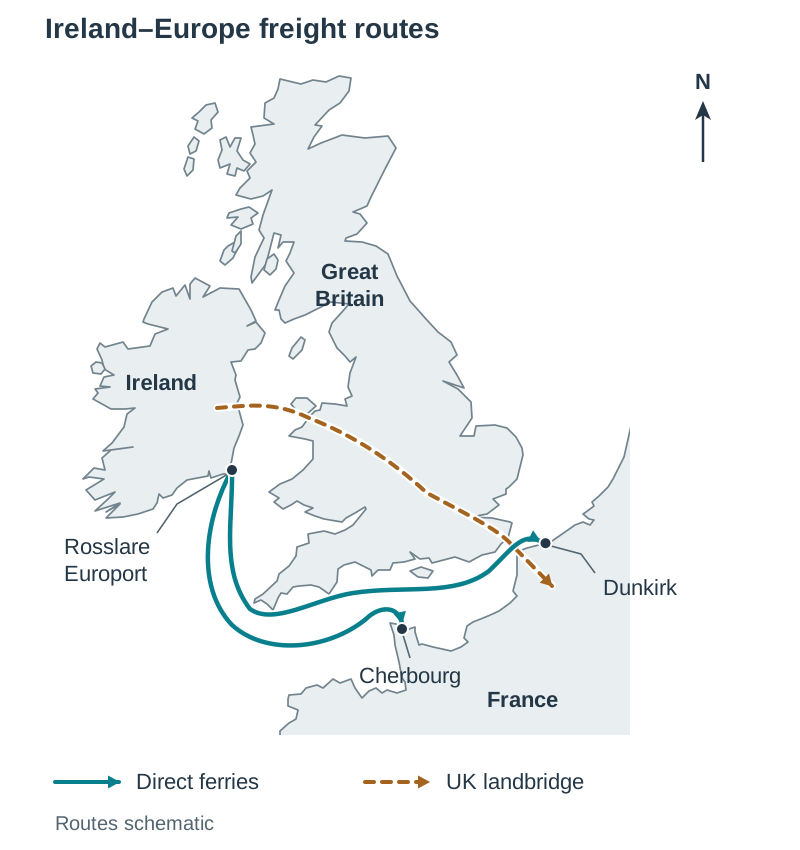
While the EU is Ireland's primary collective trading bloc, the United States remains Ireland's single largest individual export destination, taking vast shipments of pharmaceuticals and medical diagnostics. The departure of the United Kingdom from the EU in 2020 altered freight corridors. To bypass non-tariff customs delays along the UK landbridge, Irish hauliers switched to direct roll-on/roll-off maritime ferry sailings from Rosslare Europort to Cherbourg and Dunkirk, demonstrating how shifting geopolitical borders directly alter regional transport geography.
The Common Agricultural Policy (CAP) and Irish Farming
Introduced in 1962, the Common Agricultural Policy (CAP) was created to ensure food security, stabilise farm commodity prices, and maintain decent incomes for rural producers. When Ireland joined in 1973, the CAP transformed an undercapitalised agricultural sector.
Guaranteed Prices and Structural Surpluses
Early CAP rules provided farmers with guaranteed floor prices. If open market prices fell below an agreed baseline, European intervention agencies bought the excess produce through intervention buying. While this policy stabilised farm incomes and encouraged modernisation, paying subsidies based purely on volume produced massive structural surpluses. During the 1970s and 1980s, open-ended incentives created infamous 'butter mountains' and 'wine lakes'. Subsidised European agricultural surpluses were dumped onto international markets at artificially low prices, harming commercial farming in developing nations such as Jamaica.
Modern Policy Reforms and Decoupling
To halt runaway storage costs and comply with international trade rules, the EU restructured the CAP through several major reforms:
- Milk Quotas (1984): The EU placed hard national ceilings on milk output to halt excess dairy production. These restrictions governed European dairy farming until their abolition in 2015.
- Decoupling (2003 Fischler Reforms): The EU cut the link between direct cash subsidies and production volumes. Instead of receiving aid per animal reared or hectare harvested, farmers received a Single Farm Payment calculated on farm area, requiring compliance with environmental and animal-welfare regulations through cross-compliance.
- Current CAP Structure (2023–2027): CAP operates across two distinct pillars. Pillar 1 provides direct income maintenance via the Basic Income Support for Sustainability (BISS), which remains conditional on statutory environmental rules. Pillar 2 funds rural development, farm diversification, and environmental action. In Ireland, the Agri-Climate Rural Environment Scheme (ACRES) serves as the current Pillar 2 environmental initiative, compensating farmers for planting native hedgerows, protecting watercourses, and managing sensitive peatlands.
Economic Importance and Environmental Tensions
CAP direct payments inject over €1 billion into rural Ireland annually, underpinning commercial dairying in Munster and Leinster while providing the primary income for marginal beef and sheep farms in Mayo, Galway, and Donegal. However, modern environmental directives create intense friction. When EU milk quotas ended in 2015, Irish dairy herds expanded, driving national milk output up by more than 50%. This commercial intensification increased nutrient run-off into rivers and lakes, creating a direct clash with the EU Nitrates Directive.
Ireland operates under a nitrates derogation that allows intensive dairy farms to stock cattle above general EU stocking limits. Because river water quality has failed to show sustained recovery, the European Commission reduced maximum derogation limits in vulnerable river catchments. This change has forced commercial dairy farmers to cut cow numbers, rent expensive supplementary grazing land, or export slurry, showing the sharp conflict between agricultural output and EU environmental law.
The Common Fisheries Policy (CFP) and Coastal Communities
Fish do not stay inside national boundaries; a shoal swimming off Donegal may spawn in waters claimed by another state. For that reason, the EU manages European seas as a shared resource rather than leaving each country to exploit its coastal waters as it pleases. The Common Fisheries Policy (CFP) was introduced in 1970, establishing equal access to Community fishing waters, and was revised in 1983 into a formal conservation and quota system.
Conservation Mechanisms
- Total Allowable Catches (TACs): Marine biologists assess commercial fish populations annually. The EU Council uses this scientific advice to establish Total Allowable Catches, capping the legal harvest tonnage for each commercial species across specific sea zones.
- National Quotas and Relative Stability: Each TAC is divided among member states as national quotas. Quotas are allocated using the principle of relative stability, which locked national percentage shares to fishing fleet catch figures recorded during the early 1970s.
- Fleet Decommissioning: To tackle fleet overcapacity, where powerful trawlers exhaust dwindling stocks, the EU funds the scrappage of commercial vessels to bring catching power into balance with biological limits.
- The Landing Obligation: Introduced in 2015, the landing obligation bans discards—the practice of dumping dead, unmarketable fish back into the ocean. Catches of quota-managed species must be brought ashore and deducted from the vessel's national quota.
Consequences for Irish Fishing Ports
The CFP remains Ireland's most contentious EU policy. When Ireland joined the EEC in 1973, its fishing fleet was small, made up mostly of inshore boats fishing close to the coast. Because national quotas were tied permanently to 1970s catch records, Ireland received less than 20% of the fish harvest inside its own Exclusive Economic Zone (EEZ), while industrial fleets from Spain, France, and the Netherlands secured the majority.
Commercial fishing sustains entire peripheral coastal settlements, supporting fish processing, ice production, haulage, and marine repair yards in harbours like Killybegs, Castletownbere, and Rossaveal, where few alternative jobs exist. When quotas are exhausted, catching stops and land-based processing workers face immediate lay-offs. Although EU funding has modernised harbour facilities at Castletownbere and expanded aquaculture (such as salmon and rope-grown mussel farming in Connemara), Brexit dealt another blow. Under the 2020 trade settlement, EU fleets returned a proportion of their quota shares to the UK, costing the Irish fleet approximately 15% of its overall quota value, concentrated in valuable pelagic mackerel and prawn fisheries.
Regional Development, Cohesion, and the EU Budget
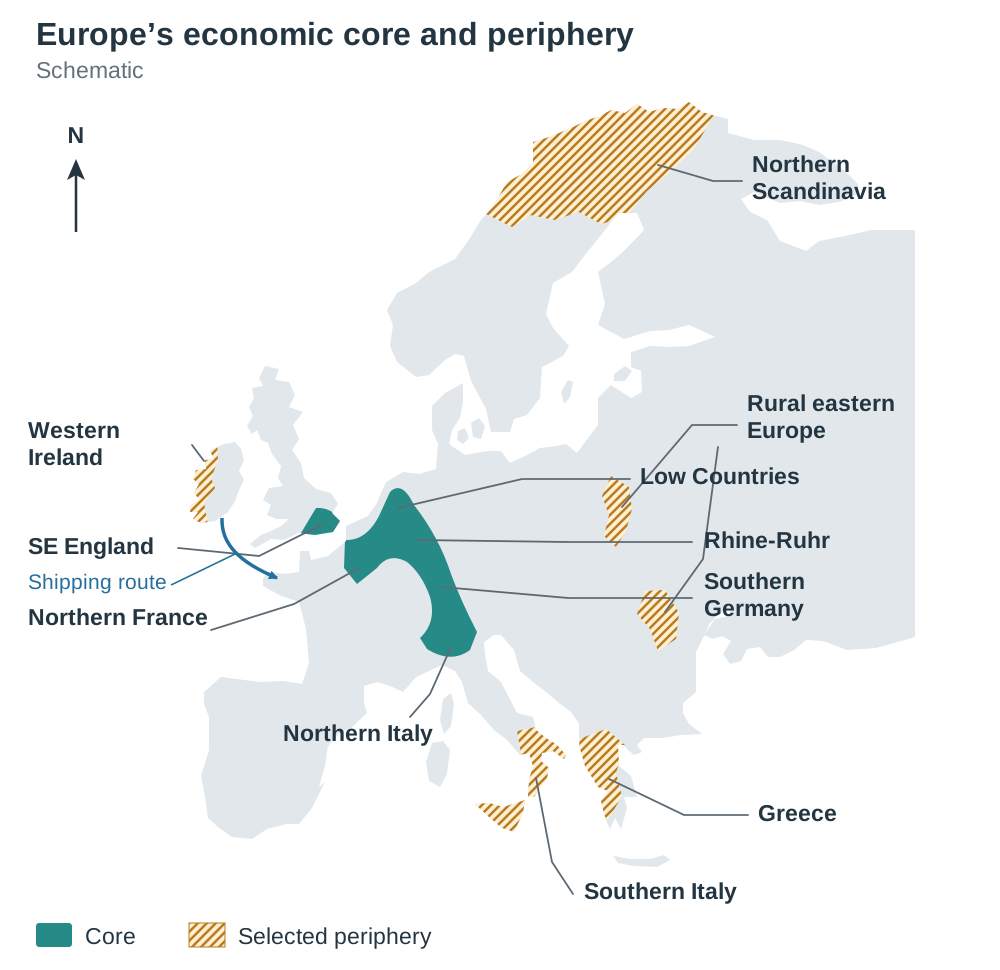
Economic prosperity across the European Union is geographically unequal. Prosperous core regions, such as the Paris Basin, the Randstad in the Netherlands, and southern Germany, benefit from dense motorway networks, deep-water ports like Rotterdam and Antwerp, and immense consumer markets. Conversely, peripheral regions, such as western Ireland, the Italian Mezzogiorno, and eastern European borderlands, face geographical remoteness, lower wages, and outward migration.
Describing the Core and Periphery on a Sketch Map
In an exam sketch map of Europe, the European core forms an arc running from south-east England through northern France, the Low Countries, the Rhine-Ruhr, and southern Germany into northern Italy. This core features high population density and major transport corridors. The periphery consists of an outer rim: western Ireland, northern Scandinavia, southern Italy, Greece, and rural eastern Europe. Mark Ireland on the north-western rim with an arrow showing maritime shipping routes connecting it across the Celtic Sea to the continental core.
Cohesion Policy and Structural Funds
The EU uses Cohesion Policy to bridge regional economic disparities, allocating grants through specific investment programmes:
- European Regional Development Fund (ERDF): Finances tangible infrastructure, regional enterprise, and digital networks in less-developed areas. In Ireland, the ERDF co-funded key arterial roads such as the M1 Dublin-Belfast corridor, the M7 and M8 inter-urban motorways, the Dublin Port Tunnel, and regional industrial projects like modernised cheese processing at Carbery Group in West Cork.
- European Social Fund (ESF+): Invests in human capital by funding vocational training, apprenticeships, youth employment schemes through Youthreach, and skill programmes delivered across Technological Universities.
- Cohesion Fund: Dedicated to member states with a Gross National Income (GNI) per capita below 90% of the EU average. It funded major rail and environmental projects in Ireland until sustained national economic growth made the state ineligible in the early 2000s.
- Just Transition Fund: Supports industrial regions switching away from fossil fuels. In Ireland, it targets the Midlands, funding alternative green enterprise and retraining after Bord na Móna ceased commercial peat extraction for electricity generation.
The EU Budget and Changing Irish Status
The EU budget is funded through national contributions based on gross national income, customs tariffs on external imports, and a small levy on VAT receipts. States with below-average wealth receive more funding than they pay in; richer states become net contributors. Since 1973, Ireland has received tens of billions of euro from the EU in total, the bulk of it CAP payments, alongside substantial structural and cohesion funding. Economic studies estimated that structural and cohesion funding raised the level of Irish GNP by roughly 2% to 4%. Rapid domestic growth combined with the entry of lower-income eastern member states moved Ireland from being a major net recipient into an overall net contributor in the mid-2010s. To manage remaining disparities, Ireland's regional aid map was reorganised: originally classified as a single Objective 1 region, it was later split into two and is now divided into three regional assemblies (Northern and Western, Southern, and Eastern and Midland).
Political Union, Enlargement, and Sovereignty Debates
The EU is a dynamic territorial region whose boundaries have shifted through repeated treaty changes and enlargements.
Development and Enlargement Timeline
- 1951: The European Coal and Steel Community is established, pooling coal and steel resources among six nations to prevent future European conflict.
- 1957: The Treaty of Rome establishes the European Economic Community (EEC). The six founding members are France, West Germany, Italy, Belgium, the Netherlands, and Luxembourg.
- 1973: First enlargement: Ireland, the United Kingdom, and Denmark join.
- 1981: Greece joins.
- 1986: Spain and Portugal join, widening regional wealth gaps and expanding structural funding budgets.
- 1993: The Maastricht Treaty formally creates the European Union and outlines the pathway to a single currency; the Single Market launches.
- 1995: Austria, Finland, and Sweden join.
- 2004: The largest single enlargement: ten nations join, largely from former communist eastern Europe: Poland, Hungary, Czechia, Slovakia, Slovenia, Estonia, Latvia, Lithuania, alongside Malta and Cyprus.
- 2007: Bulgaria and Romania join.
- 2013: Croatia joins (the most recent entrant).
- 2020: The United Kingdom leaves (Brexit), marking the first territorial contraction of the bloc.
- Present: Candidate countries include Ukraine, Moldova, Serbia, Montenegro, Albania, North Macedonia, Bosnia and Herzegovina, Georgia, and Turkey. Enlargement requires unanimous consent from all member states, so any single country can exercise a veto.
Political Union and Its Limits
While qualified majority voting (QMV) applies to most common laws, enabling the EU to pass environmental standards without unanimous approval, complete political integration faces obstacles:
- The Unanimity Requirement: Sensitive policies—including taxation, foreign policy and defence, territorial enlargement, and treaty amendments—demand unanimity. A single state can block action, as demonstrated by Hungary repeatedly holding up EU financial packages and sanctions related to the war in Ukraine.
- Common Foreign and Security Policy: Member states have distinct defence doctrines. While France and Poland advocate stronger integrated European defence structures, Ireland, Austria, and Malta maintain military neutrality. Ireland participates in EU peacekeeping and common security research but retains the 'triple lock' (requiring approval from the Government, the Dáil, and the United Nations) before sending troops overseas, resisting binding mutual defence commitments.
- Rule-of-Law Clashes: The EU has withheld regional structural funds from Hungary over concerns regarding judicial independence and anti-corruption standards, prompting accused governments to claim national sovereignty is being infringed.
- Democratic Referendums and Sovereignty: Irish voters rejected the Nice Treaty in 2001 (passing it on a second vote in 2002) and rejected the Lisbon Treaty in 2008 (passing it in 2009 after securing legal guarantees on neutrality, taxation rights, and ethical matters). Brexit remains the clearest instance of a nation prioritizing sovereignty over Single Market integration.
- Cross-Border Arrangements: Under the Northern Ireland Protocol and the Windsor Framework, Northern Ireland adheres to EU Single Market standards for physical goods to prevent a hard customs frontier on the island of Ireland, creating an economic border within the Irish Sea.
Monetary Union in the Eurozone
Ireland adopted the euro in 1999, when currency exchange rates were locked, and euro notes and coins entered physical circulation in January 2002. The currency is now shared by 21 of the 27 EU member states, Bulgaria having joined the euro area on 1 January 2026. Non-euro members like Poland, Sweden, and Denmark remain in the Single Market while preserving national currencies. Sharing a currency removes exchange risks, but it strips member states of monetary sovereignty. The European Central Bank (ECB) in Frankfurt sets a single base interest rate across the entire zone.
During the Celtic Tiger, low ECB interest rates suited to sluggish economic conditions in Germany inflated a credit and property bubble in Ireland. Following the 2008 financial collapse, Ireland could not devalue its currency to regain competitiveness or set independent interest rates, ultimately requiring an EU-IMF financial bailout in 2010 that imposed external spending and tax targets.
Taxation sovereignty remains a point of friction. Ireland guarded its 12.5% corporation tax rate to attract US foreign direct investment, but in 2024 the European Court of Justice upheld an order that Apple must pay Ireland €13 billion in uncollected taxes, finding that historic Irish tax rulings constituted illegal state aid.
Current Economic and Social Challenges Facing the EU
Exam questions frequently require candidates to explain the challenges facing the EU under two specific headings: economic challenges and social challenges.
Economic Challenges Facing the EU
- Regional Inequality: Living standards in Luxembourg and Ireland are several times higher than those in Bulgaria or Romania. Within individual nations, disparities remain sharp: unemployment across the southern Italian Mezzogiorno is roughly twice that of industrial Lombardy in the north.
- Energy Dependence and Costs: Before 2022, the EU relied on Russia for a large portion of its natural gas imports. Russia's invasion of Ukraine forced an urgent switch to imported liquefied natural gas (LNG) and renewables, driving inflation upwards and harming energy-intensive industries such as German chemical and steel manufacturing.
- Global Competitiveness: The EU is losing ground to the United States and China in cutting-edge industries. US state subsidies attract clean-technology manufacturing across the Atlantic, while lower-cost Chinese electric cars and solar panels have undercut European manufacturers, prompting the EU to introduce protective tariffs on Chinese electric vehicle imports in 2024.
- Industrial Relocation: Free capital movement allows companies to shift operations to lower-cost member states. In 2009, computer manufacturer Dell closed its manufacturing facility in Limerick, cutting 1,900 jobs to relocate PC assembly to Łódź in Poland.
- Brexit: The departure of the UK removed the EU's second-largest net contributor, reduced total budget receipts, and imposed customs friction on Irish exporters dependent on the British marketplace.
Social Challenges Facing the EU
- An Ageing Population: Declining fertility rates across the EU alongside longer life expectancy have expanded the proportion of citizens aged over 65, particularly in Italy and Germany. This shifts the dependency ratio, meaning fewer workers pay income taxes to fund pensions, hospital care, and nursing-home facilities for a growing elderly cohort. Governments have responded by raising national retirement ages, sparking widespread public protests.
- Migration and Asylum Pressures: The EU remains an attractive destination due to political safety, higher living standards, and the rule of law. Surges in arrivals—including the 2015 Mediterranean crisis (largely from Syria and Afghanistan), dangerous sea crossings to frontline states (Italy, Greece, and Spain), and over four million displaced Ukrainians receiving shelter under the EU Temporary Protection Directive (with over 100,000 arriving in Ireland)—place severe pressure on housing, emergency accommodation, healthcare, and educational facilities. Germany receives the highest volume of first-time asylum applications annually.
- Uneven Distribution and Political Strains: Frontline Mediterranean states argue that northern nations do not accept an equitable share of arrivals. In response, the EU adopted the Pact on Migration and Asylum (2024) to establish shared financial and relocation responsibilities among member states. Public anxiety over migration has contributed to the rise of nationalist and anti-immigration political parties across Europe, making consensus on common social policies difficult to achieve.
- Internal Brain Drain: Regional wage disparities encourage younger, qualified graduates from peripheral economies (such as parts of eastern Europe and southern Italy) to migrate to wealthy metropolitan cores (such as Dublin, Munich, and Amsterdam), stripping peripheral communities of skilled workers and worsening regional stagnation.
Geographical and Quantitative Data Skills for EU Questions
Leaving Certificate Part A stimulus questions and short questions frequently provide statistical tables, trade graphs, or population figures. Use the following quantitative procedures and present every working step clearly.
1. Balance of Trade Calculation
The balance of trade measures the difference between the total value of merchandise exports and merchandise imports over a specific timeframe:
Balance of trade = value of exports − value of imports
- A positive balance indicates a trade surplus (exports exceed imports).
- A negative balance indicates a trade deficit (imports exceed exports).
Worked calculation: An EU trade table indicates that Ireland exported goods valued at €84 billion to continental member states while importing goods worth €36 billion from them.
Balance = €84bn − €36bn = +€48 billion (trade surplus of €48 billion).
2. Percentage Share Calculation
To calculate the proportion of EU trade or fishing vessels accounted for by a single member state:
Percentage share = (part ÷ total) × 100
Worked calculation: An exam table shows the total EU fishing fleet contains 75,000 vessels, of which Spain operates 9,000.
Percentage share = (9,000 ÷ 75,000) × 100 = 12.0%
3. Missing Value in a Pie Chart
A complete pie chart represents 100%. To find a missing slice X, sum the given percentages and subtract from 100:
Missing share X = 100% − sum of known shares
Worked calculation: A pie chart shows EU exports to trading partners: USA 28%, UK 18%, China 12%, Switzerland 8%, and Other countries X.
X = 100 − (28 + 18 + 12 + 8) = 100 − 66 = 34%
4. Percentage Points versus Percentage Change
Exam questions distinguish between an arithmetic difference and a relative percentage change:
- If Ireland's share of EU dairy exports rises from 20% to 25%, the absolute increase is: 25 − 20 = 5 percentage points.
- The relative percentage growth of that share is: [(25 − 20) ÷ 20] × 100 = (5 ÷ 20) × 100 = 25%.
Key terms
- Trading Bloc
- A group of countries that establish formal agreements to reduce or remove tariffs and trade restrictions between themselves.
- Tariff
- A customs duty or tax imposed by a government on imported goods to raise domestic revenue and protect local industries.
- Quota
- A physical limit on the quantity or value of a specific commodity permitted into a country over a defined timeframe.
- Non-Tariff Barrier
- Any trade restriction other than a tariff, including customs paperwork, border inspections, health certifications, or technical packaging standards.
- Single Market
- An integrated economic territory across EU member states operating under the Four Freedoms: free movement of goods, services, capital, and labour.
- Common External Tariff (CET)
- A unified customs tax applied uniformly by all EU member states on commercial goods entering from countries outside the bloc.
- Common Agricultural Policy (CAP)
- A comprehensive EU system of agricultural income supports, rural development funding, and market rules introduced in 1962 to maintain farm viability and food security.
- Intervention Buying
- An early CAP mechanism where EU authorities purchased surplus agricultural produce at a fixed floor price when market prices dropped.
- Decoupling
- The CAP reform principle separating direct income payments to farmers from agricultural production volumes, basing payments on farm area and environmental compliance instead.
- Basic Income Support for Sustainability (BISS)
- The core direct income payment under Pillar 1 of the modern CAP, paid to eligible farmers per hectare provided they observe statutory management rules.
- Cross-Compliance
- The mandatory requirement that farmers must satisfy statutory environmental, public health, and animal-welfare standards to receive their direct CAP payments.
- Common Fisheries Policy (CFP)
- An EU policy regulating access to European sea areas, vessel capacity, and annual scientific catch limits to prevent fish stock depletion.
- Total Allowable Catch (TAC)
- The maximum allowable catch tonnage set annually by the EU Council for an individual fish stock in a defined maritime zone.
- Relative Stability
- The CFP principle that allocates fixed percentage shares of annual fish quotas to member states based on their catch volumes recorded in the early 1970s.
- Discards
- Undersized, unwanted, or over-quota fish caught commercially and thrown back into the ocean, a practice largely banned under the EU landing obligation.
- Exclusive Economic Zone (EEZ)
- A maritime zone extending up to 200 nautical miles from a country's coastline over which that nation holds sovereign rights regarding marine resources.
- European Regional Development Fund (ERDF)
- An EU structural fund aimed at reducing regional imbalances by co-financing major transport infrastructure, telecommunications, and business innovation.
- European Social Fund (ESF+)
- An EU funding instrument dedicated to developing human capital through investments in job training, apprenticeships, education, and social inclusion initiatives.
- Just Transition Fund
- A targeted EU cohesion fund supporting regions moving away from fossil fuels, such as assisting communities in the Irish Midlands affected by the end of industrial peat harvesting.
- Net Contributor
- A member state whose payments into the central EU budget exceed the total funding it receives back in farm subsidies, structural grants, and regional aid.
- Qualified Majority Voting (QMV)
- An EU voting system in the Council where decisions require support from 55% of member states representing at least 65% of the total EU population, preventing single-nation vetoes.
- Unanimity
- A voting procedure requiring the consent of all 27 member states, preserved for sensitive matters such as foreign policy, defence, taxation, and treaty revisions.
- Sovereignty
- The independent legal power and authority of an individual nation to govern itself, enact legislation, and set taxation free from outside control.
- Dependency Ratio
- The ratio comparing the economically dependent population (children aged 0–14 and elderly aged 65+) against the working-age population (aged 15–64).
Check yourself
Name two of the six founding member states of the European Economic Community (1957).
Any two of: France, West Germany, Italy, Belgium, the Netherlands, or Luxembourg.
In what year did Ireland join the EEC, and which two other countries joined at the same time?
Ireland joined in 1973 alongside the United Kingdom and Denmark.
Name the four core freedoms guaranteed within the EU Single Market.
The free movement of goods, services, capital, and labour.
What is the key difference between a tariff and a quota?
A tariff is a customs tax added to the price of an imported product, whereas a quota is a physical limit placed on the quantity of a good that may be imported.
What does the term 'decoupling' mean in relation to CAP payments?
Decoupling severed direct farm subsidy payments from production volumes, paying farmers area-based income supports linked to environmental compliance instead.
Under the Common Fisheries Policy, what is the practice of 'discards' and what is its legal status?
Discards refer to catching unwanted or over-quota fish and throwing them back into the sea to die; the practice is banned under the EU landing obligation, requiring catches to be landed and counted against quota.
Name two policy areas where EU decisions still require unanimous approval from all member states.
Any two of: taxation, foreign policy and defence, EU territorial enlargement, or changes to EU treaties.
State one economic benefit and one challenge that inward migration brings to the EU.
A benefit is filling critical labour shortages in health, construction, and agriculture while widening the tax base; a challenge is placing sudden pressure on local housing, healthcare, and educational facilities.
If an EU nation exports €110 billion in goods and imports €145 billion, what is its balance of trade?
€110bn − €145bn = −€35 billion, which represents a trade deficit of €35 billion.
A port handles 36,000 tonnes of fish landings, of which 9,000 tonnes are mackerel. What is mackerel's percentage share?
(9,000 ÷ 36,000) × 100 = 25%.