

Energy extraction is studied as a primary activity in Core Unit 2 (2.2 mining/energy), while electricity generation is a secondary activity. Energy shapes trade, regional development, and environmental sustainability, and is examined mainly through Elective Unit 4, sub-unit 4.5 (Environmental impact). This topic examines the distinction between finite fossil fuels and expanding renewable alternatives, Ireland's shifting energy mix, the environmental consequences of fossil fuel combustion (including urban smog, acid rain as a European transboundary issue, and global climate change), European energy models, formal Environmental Impact Assessments (EIAs), and acute local and global conflicts surrounding resource extraction and infrastructure.
1. Energy Classification, the Electricity-Energy Gap, and Numbers to Know
How this is asked: Appears frequently in Part One short questions and Part Two Elective Unit 4 Part A stimulus data questions.
Every economy depends on energy, and how a country produces it shapes its trade, its regional development, and its environment. Natural energy resources fall into two categories:
- Non-renewable resources are finite geological formations created over millions of years by heat and compression. Because they cannot regenerate within a human lifespan, exploiting them permanently depletes reserves. They include coal, crude oil, natural gas, peat, and uranium. Fossil fuels continue to supply over 80% of global primary energy.
- Renewable resources are continuous natural flows that replenish naturally over short cycles and are theoretically inexhaustible if managed soundly. They include wind, solar radiation, flowing water (hydroelectric power), biomass, and geothermal heat.
The Electricity vs Total Energy Distinction
A major trap in Leaving Certificate Geography is confusing electricity generation with total primary energy consumption:
- Total primary energy consumption accounts for all energy used across an entire economy, including transport fuels (petrol, diesel, aviation kerosene), direct thermal heating in homes and commercial buildings, and industrial processing.
- Electricity generation is merely an energy carrier generated from primary fuels. While wind generates roughly one third (about 30–35%) of Ireland's electricity, fossil fuels still provide over 80% of total primary energy because heating and transport rely almost completely on oil and gas.
Think of a household in rural Galway. Its lights and kettle may run on wind-generated electricity, but the oil in its central heating boiler and the diesel in its car are fossil fuels. Those two uses swamp electricity in raw energy terms. That is why Ireland can maintain one of the highest shares of wind electricity in Europe while remaining heavily fossil-fuel dependent overall.
Core Numbers Worth Learning
Geography marking schemes reward exact statistics. Memorise these eight figures:
- 30–35%: wind's typical share of Irish electricity generation, varying with annual weather.
- 80%: statutory target for electricity from renewables by 2030 (Climate Action Plan).
- 51%: legally binding national greenhouse gas emissions reduction target by 2030 compared to 2018 levels.
- Over 20%: share of Ireland's metered electricity consumed by data centres.
- 86 MW: generating capacity of Ardnacrusha hydroelectric station on the River Shannon.
- 169 MW: generating capacity of Galway Wind Park, Ireland's largest onshore wind farm.
- 1990: year of the Dublin smoky coal ban, which reduced black smoke by 70% and prevented roughly 350 premature deaths annually.
- Below 5.0: pH of damaging acid rain, compared to unpolluted natural rain at roughly pH 5.6.
2. Ireland's Energy Transition: Legacy Fuels, Renewables, and Intermittency
How this is asked: Core material for 30-mark questions evaluating the economic and environmental impacts of renewable and non-renewable energy in Ireland (Part B and C).
Ireland historically relied on domestic peat, imported coal, and oil for baseload power. Strict European Union emissions rules and national decarbonisation laws have driven a structural transition.
Peat
Bord na Móna historically harvested milled peat across the raised bogs of the Midlands (Offaly, Longford, Westmeath) to supply thermal power stations. Peat released higher carbon dioxide () emissions per kilowatt-hour than coal or gas, and large-scale drainage damaged rare bog habitats. Bord na Móna ended large-scale peat harvesting for electricity generation in 2020–21, and the peat-fired stations at Shannonbridge and Lanesborough closed. Limited extraction for horticulture and domestic turf cutting under turbary rights continues. Under the Just Transition framework, former workers have been retrained, Edenderry power station converted to biomass co-firing, and cutaway bogs are being rewetted to function as carbon sinks.
Coal
Moneypoint Power Station on the Shannon Estuary in County Clare long operated as Ireland's single largest electricity generator. Moneypoint ended routine coal-fired generation in 2025, though the station is retained for a limited period as an emergency oil-fired back-up to protect security of supply. The ESB is redeveloping the site as a green energy hub, using its deep-water jetty and grid connection to assemble and connect offshore wind.
Natural Gas
Gas provides flexible combined-cycle generation to back up intermittent renewables. The Corrib Gas Field, 70 km off the Mayo coast, came ashore at the gas processing terminal at Bellanaboy Bridge in late 2015. At peak output, Corrib supplied roughly 60% of national gas needs. As Corrib naturally depletes, Ireland increasingly imports gas through the twin Scotland–Ireland gas interconnectors, which run from the entry point at Moffat in south-west Scotland beneath the Irish Sea to Loughshinny, Co. Dublin.
Wind and Solar Energy
Ireland sits in the path of prevailing south-westerly winds driven by Atlantic depressions. Onshore wind generates roughly one third (30–35%) of national electricity demand across upland counties like Galway, Kerry, and Donegal. Key developments include:
- Galway Wind Park, Cloosh Valley, Connemara: Ireland's largest onshore wind farm at roughly 169 MW, developed across coniferous forest and cutaway land in a joint venture between SSE and Coillte, supplying roughly 140,000 homes.
- Oweninny, Co. Mayo: built on Bord na Móna cutaway bog at Bellacorick, the site of a decommissioned peat station, illustrating the physical reuse of brownfield energy sites.
- Arklow Bank, Co. Wicklow: Ireland's first offshore wind farm (25 MW pilot commissioned in 2004). Future offshore expansion involves large projects like Dublin Array and Codling Wind Park, supporting a national target of roughly 5 GW of offshore wind by 2030.
- Solar PV: commercial solar farms and domestic rooftop arrays are expanding across the sunny South and South-East (Wexford, Waterford, Cork).
Comparing Wind Energy: Advantages and Disadvantages
| Assessment Factor | Advantages | Disadvantages |
|---|---|---|
| Fuel and Operating Cost | Free natural flow resource; operating costs are very low once capital is amortised. | High initial capital costs for turbines, access roads, subsea cabling, and substations. |
| Energy Security & Balance of Payments | Displaces imported oil and gas, keeping revenue within the Irish economy. | Does not eliminate gas imports because gas generation must stand by as thermal backup. |
| Employment | Skilled jobs in civil engineering, electrical distribution, blade repair, and maintenance. | Most turbine manufacturing occurs abroad (e.g. Denmark, Germany); few long-term site jobs. |
| Atmospheric Emissions | Zero operational greenhouse gas emissions, , , or particulate matter. | Embodied carbon in turbine manufacturing, steel masts, concrete bases, and access roads. |
| Landscape & Land Use | Compact base footprint allows livestock grazing and farming to proceed around masts. | Visual intrusion in scenic upland/coastal areas; noise and shadow flicker for nearby homes. |
| Wildlife & Peat Hydrology | Low water consumption; avoids river and lake thermal pollution. | Bird and bat collision risks; peat excavation can destabilise slopes and trigger bog slides. |
| Reliability | Matches winter peak seasonal demand when Atlantic winds are strongest. | Resource suffers from intermittency and grid curtailment during low demand or high winds. |
Derrybrien Wind Farm Landslide, Co. Galway (2003)
Renewable energy is not inherently free of environmental risk. During the construction of a large 70-turbine wind farm on the peat-covered slopes of Cashlaundrumlahan near Derrybrien, civil excavation destabilised the blanket bog. Roughly 450,000 to 500,000 cubic metres of peat slid downslope into the Owendalulleegh River. The peat slurry polluted the river for over 20 km, smothered gravel spawning beds, killed roughly 50,000 fish, and disrupted the Lough Cutra salmon fishery. The European Court of Justice later fined Ireland for failing to carry out a proper Environmental Impact Assessment before granting consent. Derrybrien demonstrates that renewable energy infrastructure on sensitive upland peat requires rigorous impact assessments.
Managing Intermittency on the Irish Grid
Because wind and solar depend on weather, the national transmission system operator (EirGrid) must balance supply and demand through several mechanisms:
- Pumped storage: Turlough Hill in County Wicklow (292 MW) pumps water to an artificial upper mountain reservoir when electricity demand is low, then releases it down through turbines during evening peaks. It operates as a net consumer of electricity, acting as an energy storage battery rather than a generating source.
- Battery energy storage systems (BESS): utility-scale lithium-ion battery sites provide rapid response within milliseconds to stabilise grid frequency when wind drops suddenly.
- Electricity interconnectors: subsea high-voltage direct current (HVDC) cables allow cross-border trading. The East–West Interconnector (500 MW, Meath to North Wales) and Greenlink (500 MW, Wexford to South Wales) connect Ireland with Britain, while the Celtic Interconnector (700 MW, Cork to Brittany) provides Ireland's first direct subsea power link to mainland Europe.
- Flexible gas turbines: modern open-cycle and combined-cycle gas plants can ramp output up or down within minutes to fill gaps in renewable supply.
- Demand-side management: large consumers, including data centres, contract to reduce power draws or switch to private on-site backup generators during peak grid stress.
Why Ireland Missed its 2020 Renewable Energy Target
Under the EU Renewable Energy Directive, Ireland committed to sourcing 16% of total final energy consumption from renewables by 2020, but achieved only roughly 13.6%:
- The target spanned all energy use, not just electricity. While renewable electricity reached nearly 40%, renewable energy in heat (about 6%) and transport (about 10%) lagged behind.
- Ireland has a dispersed rural settlement pattern and low public transport share, cementing dependence on imported petrol and diesel.
- Rural homes rely heavily on home heating oil and solid fuels rather than heat pumps and district heating networks.
- Upgrading the high-voltage transmission grid faced planning objections, resulting in wind curtailment where operational turbines are switched off because the grid cannot transport the electricity from the west to Dublin.
- Marine planning legislation moved slowly, delaying commercial offshore wind auctions.
Why Nuclear Energy is Not Used in Ireland
Nuclear fission generation is prohibited by law in Ireland under Section 18 of the Electricity Regulation Act 1999. The policy reasons include:
- Small grid capacity: a modern commercial nuclear reactor produces 1,000 to 1,600 MW. With Ireland's peak demand sitting around 5,500 MW, the sudden unexpected trip of a single reactor would cut nearly a quarter of national supply, instantly destabilising a small island grid.
- Capital and decommissioning costs: modern nuclear plants cost tens of billions of euro and experience extensive construction delays.
- Radioactive waste: high-level nuclear waste remains dangerously radioactive for thousands of years, and Ireland has neither deep geological repositories nor reprocessing facilities.
- Public opposition: memories of the 1986 Chernobyl disaster and decades of opposition to radioactive discharges from the Sellafield plant in Cumbria, directly across the Irish Sea, created firm public and political opposition.
3. European Contrasts: Resource Geography and Energy Security
How this is asked: Supplies comparative examples for Elective Unit 4 and links directly to European regions in Core Unit 2.
Across Europe, relief, climate, natural resources, and government policy combine to produce very different national energy systems:
| Country | Primary Fuel Mix | Physical & Political Drivers | Strategic Advantages | Vulnerabilities & Conflicts |
|---|---|---|---|---|
| Norway | Hydroelectricity (~90% of electricity), onshore wind (~10%) | Steep glaciated relief, high orographic rainfall, and high-altitude plateau lakes providing head of water. | Near-zero operational carbon emissions; acts as Europe's 'battery' via subsea interconnectors (North Sea Link). | Low precipitation dry years deplete reservoirs; environmental paradox of exporting North Sea oil and gas abroad. |
| France | Nuclear power (~65–70% of electricity), renewables & hydro | 1974 Messmer Plan to ensure national energy independence following the 1973 OPEC oil embargo. | Highly reliable baseload; lowest carbon grid among major industrial economies; major power exporter. | Thermal river pollution; reactors must curtail output in summer heatwaves when cooling water warms; aging fleet. |
| Poland | Hard coal & lignite (~60% of electricity), wind & solar | Large domestic hard coal basin in Upper Silesia; opencast lignite pits at Bełchatów and Turów. | High national energy sovereignty; protects mining employment in industrial basins. | One of the most carbon-intensive electricity systems in the EU (roughly 600–700 g CO₂ per kWh) and some of the worst urban particulate air pollution in Europe; heavy carbon allowance costs under the EU ETS. |
In Germany, the Energiewende policy directed the phase-out of nuclear power (completed in 2023) and coal (by 2038) in favour of wind and solar. However, periods of winter calm and overcast weather (Dunkelflaute) forced temporary reliance on imported natural gas, highlighting the challenges of grid management across large industrial regions.
4. Environmental Impacts: Combustion, Transboundary Pollution, and Smog
How this is asked: Standard material for 30-mark questions on the environmental impact of burning fossil fuels, acid rain, or air pollution control.
Fossil fuel combustion releases greenhouse gases and chemical pollutants that damage natural ecosystems and human health across local, continental, and global scales.
Global Climate Change
Burning coal, oil, gas, and peat releases billions of tonnes of carbon dioxide () and methane (). These greenhouse gases trap outgoing long-wave terrestrial infrared radiation in the troposphere, altering global climates. For Ireland, consequences include rising sea levels threatening coastal cities like Cork and Dublin, increased winter flood risk, and more intense storm depressions that endanger coastal infrastructure.
Acid Rain: A European Transboundary Problem
Transboundary pollution occurs when airborne emissions from an industrial region cross political boundaries on prevailing winds, causing ecological damage in other nations.
- Chemical Mechanism: Burning high-sulphur coal and heavy fuel oil in power plants, industrial boilers, and vehicles releases sulphur dioxide () and nitrogen oxides (). These gases react with atmospheric water vapour, oxygen, and sunlight to produce dilute sulphuric acid () and nitric acid ().
- Deposition: These acids fall as wet deposition (acid rain, snow, mist, and fog) or settle directly onto soils and vegetation as dry deposition (acidic dust and gases). Natural unpolluted rain has a pH of roughly 5.6 due to dissolved atmospheric carbon dioxide forming weak carbonic acid (). Damaging acid rain registers a pH below 5.0, frequently dropping below 4.5.
- European Impact: In the late 20th century, prevailing south-westerly winds carried sulphur emissions from the British Midlands and Germany's industrial Ruhr Valley into Scandinavia. Thin podzolic soils in Norway and Sweden, derived from granitic bedrock, lacked the limestone buffering capacity to neutralise the acid. Toxic aluminium ions leached from acidified soils into lakes and river networks, destroying freshwater fish populations. In Germany, acid rain stripped waxy protective coatings from tree needles and leached vital soil nutrients, causing widespread forest dieback (Waldsterben) across the Black Forest.
- Abatement: Emissions dropped by over 80% through binding EU directives, vehicle catalytic converters, the closure of coal plants, and the retrofitting of flue-gas desulphurisation scrubbers at major generating facilities like Moneypoint.
Urban Smog and Smoke-Free Zones
Domestic burning of bituminous (smoky) coal releases concentrated soot and fine particulates ( and ). In winter anticyclonic conditions, cold air becomes trapped beneath a layer of warmer air, creating a temperature inversion that holds toxic particulates near ground level. Following severe winter smog episodes, the landmark Dublin smoky coal ban was introduced in 1990, prohibiting the marketing, sale, and distribution of bituminous coal. Urban black smoke levels dropped by roughly 70%, preventing an estimated 350 respiratory and cardiovascular deaths every year. In 2022, Ireland extended these smoke-free restrictions nationwide to cover all towns, restricting the sale of smoky coal, unseasoned wet wood, and high-moisture turf.
Energy Pollution in Water and Soil
- Thermal pollution: conventional thermal and nuclear power plants take in river or estuarine water for condenser cooling and return it several degrees warmer. Warmer water holds less dissolved oxygen, stressing aquatic life and driving away migratory salmon.
- Peat silt runoff: drainage and harvesting of peat bogs can wash fine suspended solids into local river systems, choking gravel spawning beds used by trout and salmon.
- Acid mine drainage: rainwater reacting with exposed iron sulphide ores at abandoned metal mines produces sulphuric acid that leaches heavy metals into waterways. At the historic copper mines in Avoca, Co. Wicklow, acid mine drainage stained the Avoca River orange and killed aquatic life along lower stretches; at Silvermines, Co. Tipperary, lead-rich dust blown from tailings ponds required state intervention.
- Oil contamination: maritime transport of oil creates risk for coastal environments, as shown by the 1979 Whiddy Island disaster in Bantry Bay, Co. Cork.
5. Environmental Conflicts and Policy Frameworks
How this is asked: Directly targets 30-mark questions on conflicts between economic development and environmental conservation, or international policy responses.
Economic infrastructure projects frequently create severe friction between national economic objectives and local environmental, safety, or community priorities.
The Corrib Gas Dispute, Co. Mayo
The Corrib gas discovery off the coast of County Mayo led to sustained community opposition over onshore pipeline routing and terminal siting. The project pitted national energy security against local safety and bogland conservation, leading to high-profile protests, legal injunctions, and the imprisonment of five local landowners in 2005. The dispute ended after major infrastructural redesigns, including tunneling the pipeline beneath Sruwaddacon Bay and implementing comprehensive Environmental Protection Agency licensing conditions.
The Belo Monte Dam, Amazon Basin, Brazil
In Brazil's Pará state, the federal government constructed the Belo Monte Dam on the Xingu River (installed capacity exceeding 11,000 MW) under the Growth Acceleration Programme (PAC) to power aluminium smelting and supply southern industrial cities. Flooding the Volta Grande submerged over 400 square kilometres of tropical forest and river systems, displacing roughly 20,000 people and affecting indigenous Juruna, Arara, and Xikrin communities. Global concerns focused on the destruction of pristine rainforest, which functions as a critical planetary carbon sink, turning a national energy project into an international conservation controversy.
Policy Responses Across Three Scales
- Global: the Paris Agreement (2015) commits almost 200 nations to hold global average temperature rise well below 2°C and pursue efforts to limit it to 1.5°C above pre-industrial levels through Nationally Determined Contributions (NDCs).
- European Union: the European Green Deal targets climate neutrality by 2050, backed by the Fit for 55 package aiming for a 55% net emissions reduction by 2030. The EU Emissions Trading System (ETS) caps industrial emissions and obliges power generators to purchase carbon allowances. Following the 2022 invasion of Ukraine, REPowerEU accelerated the deployment of renewables to end dependence on imported Russian fossil fuels.
- Ireland: the Climate Action and Low Carbon Development (Amendment) Act 2021 legally binds the State to a 51% reduction in greenhouse gas emissions by 2030 and net-zero emissions by 2050, enforced via legally binding five-year carbon budgets and sectoral emissions ceilings. The national carbon tax increases annually toward €100 per tonne of by 2030, with revenues ring-fenced for home energy retrofitting and Just Transition initiatives.
6. Sustainable Development, the Three Pillars, and EIAs
How this is asked: Used for 30-mark questions on Environmental Impact Assessments or 80-mark optional-unit essays on sustainable development models.
Sustainable development meets the needs of the present without compromising the ability of future generations to meet their own needs (Brundtland Commission, 1987). In the energy sector, sustainable development requires balancing three interconnected pillars:
- Environmental sustainability: replacing finite, polluting fossil fuels with wind and solar energy, and rewetting cutaway bogs to convert them into permanent carbon sinks.
- Economic sustainability: reducing fossil-fuel import bills, shielding industries from volatile global energy shocks, and creating skilled employment in turbine maintenance and grid engineering.
- Social sustainability: funding the Just Transition to retrain workers in former peat and coal regions, providing grants through the Warmer Homes Scheme to alleviate energy poverty, and enforcing community benefit funds for localities near wind farms.
The Role of the Environmental Protection Agency (EPA)
The EPA acts as the statutory environmental regulator in Ireland. It monitors air and water quality, compiles official greenhouse gas emissions inventories, issues Industrial Emissions Licences for energy developments, and enforces compliance.
Five Stages of an Environmental Impact Assessment (EIA)
Under European Union directives, developers must complete an Environmental Impact Assessment and submit an Environmental Impact Assessment Report (EIAR) before receiving planning permission for major energy developments:
- Screening: planning authorities decide whether a proposed project requires a full EIA based on statutory size thresholds (e.g. wind farm turbine numbers) or site environmental sensitivity.
- Scoping: developers and planners identify the critical environmental issues that must be examined, such as peat stability, bird collision risks, noise, or water runoff.
- Baseline Surveying: independent environmental scientists assess the existing pre-development state of the site, recording flora, fauna, water quality, peat depth, hydrology, and ambient noise levels.
- Impact Prediction & Mitigation: specialists model predicted impacts during construction, operation, and eventual decommissioning, designing specific mitigation measures (e.g. building silt traps, setting turbine setbacks from houses to eliminate shadow flicker, or halting blade rotation during bird migrations).
- Public Consultation & Decision: the completed report is made available for the public to inspect, as the law requires. Third parties, community groups, and statutory bodies submit observations before the planning authority or the national planning appeals body (An Bord Pleanála / An Coimisiún Pleanála) decides to grant, modify, or refuse planning consent.
7. Exam Strategy, Regional Links, and Field Diagrams
How this is asked: Practical techniques for structuring long answers, inserting labelled diagrams, and linking energy to Core Unit 2 regional questions.
Marking Structure for the Elective Unit
In the Leaving Certificate Geography written paper (worth 80% of total marks), Section 3 contains your chosen elective (Elective Unit 4 or Elective Unit 5). Each question is worth 80 marks:
- Part A (20 marks): stimulus data interpretation (pie chart, line graph, bar chart or table), set as a series of short sub-questions totalling 20 marks — typically six or seven parts, most worth 2 marks, with calculation parts worth 4 marks (2 + 2).
- Part B (30 marks) and Part C (30 marks): multi-part long answers marked on Significant Relevant Points (SRPs). A typical 30-mark question with two named aspects (e.g. economic advantages and environmental advantages) is marked as follows: naming/identifying the example = 2 marks; aspect one = 7 SRPs (14 marks); aspect two = 7 SRPs (14 marks). Seven SRPs is the normal cap per aspect, so writing eight points per aspect provides insurance against repetition.
- Short questions (Part One): 8 marks each. Stimulus parts asking you to 'explain briefly' are worth 4 marks (2 marks for identifying a factor, 2 marks for developing it with an explanation or example).
Integrating Energy into Core Unit 2 (Regional Geography)
The syllabus explicitly requires connecting Elective Unit 4 to your studied regions under primary activities (mining/energy):
- Peripheral Irish Region (The West of Ireland): exposed Atlantic relief provides strong wind resources (Galway Wind Park, Oweninny). Offshore gas was tapped via the Corrib Gas Field. Dispersed population and distance from major demand centres require long transmission lines to export surplus power eastwards.
- Core Irish Region (Greater Dublin Area): acts as the primary national demand centre, consuming high volumes of electricity for services and data centres. It hosts gas-fired power stations (Poolbeg) and marks the landfall for the East–West Interconnector.
- European Region: Norway relies on steep glaciated topography and high orographic rainfall for hydroelectric power; the Paris Basin relies on nuclear power stations along the Seine and Loire; Upper Silesia in Poland depends on hard coal mining.
- Continental / Subcontinental Region: Brazil uses the Amazon river network for hydroelectric schemes like the Belo Monte Dam on the Xingu River.
Diagram 1: Acid Rain Formation and Transboundary Transport
When an exam question asks for an explanation of acid rain, a clearly annotated diagram can earn SRP marks. Sketch a cross-section showing:
- Left (Source): a thermal power plant and urban centre releasing emissions labelled Sulphur dioxide () and Nitrogen oxides ().
- Mid-atmosphere: a large arrow moving left-to-right labelled Prevailing south-westerly winds. Above this, sketch a cloud with the chemical reactions: (dilute sulphuric acid) and (nitric acid).
- Deposition arrows: rain arrows falling from clouds labelled Wet deposition (pH < 5.0); downward arrows near the chimney labelled Dry deposition (particulates and gases).
- Right (Impacts): dead conifer trees labelled Forest dieback (Waldsterben), Black Forest; an acidified lake labelled Aluminium leached from thin soils, fish stocks wiped out, southern Norway.
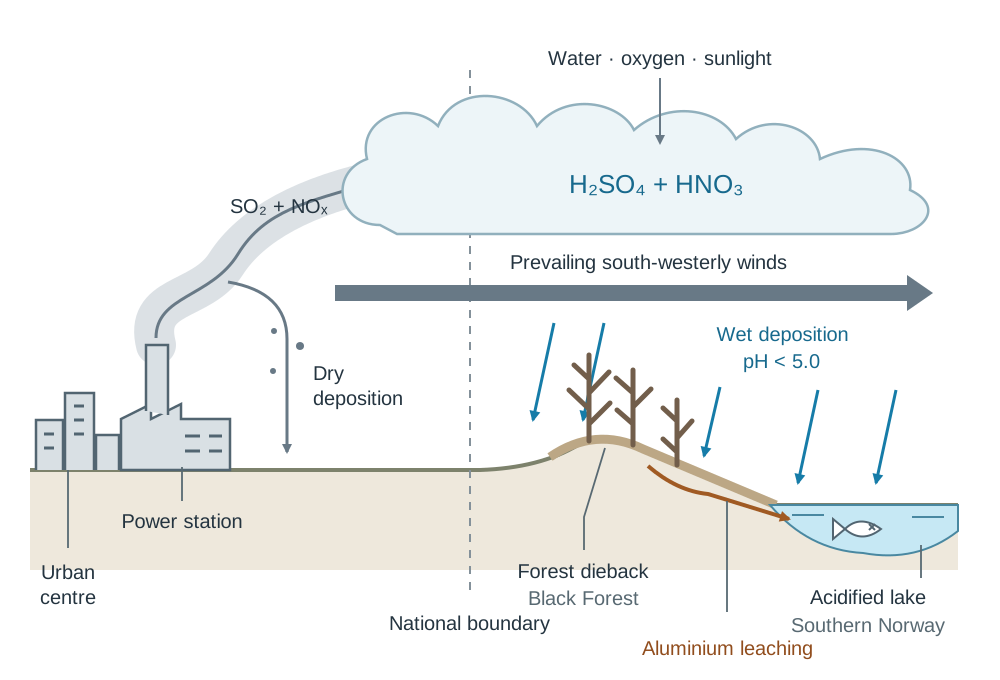
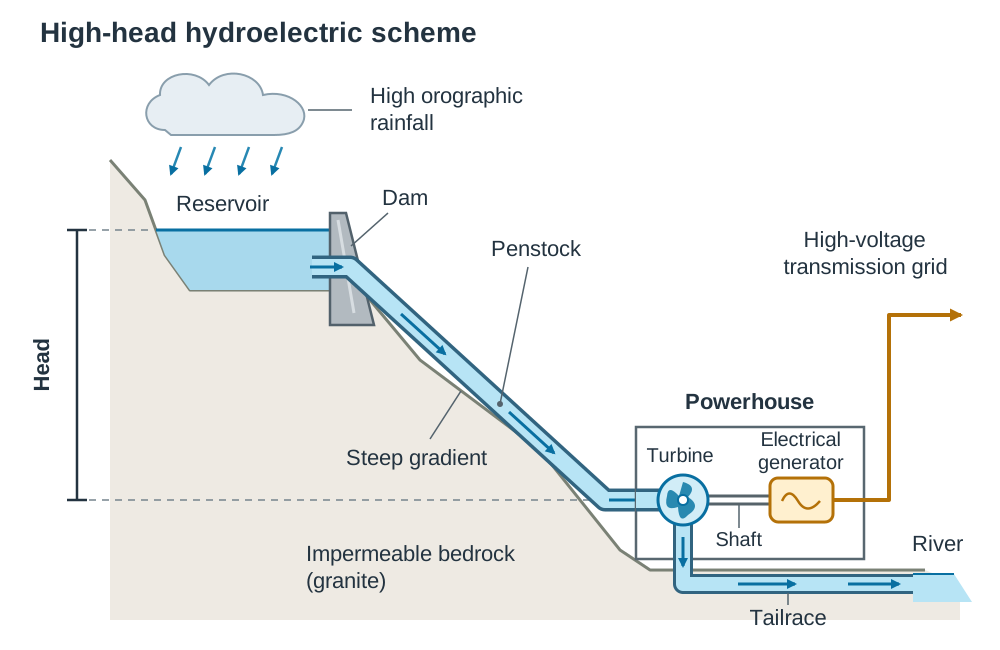
Diagram 2: High-Head Hydroelectric Scheme
Sketch a valley cross-section showing:
- An upland mountain reservoir held by a concrete dam, labelled High-altitude head of water.
- An inclined pipe running down the steep mountainside labelled Penstock.
- A powerhouse at the base containing a Turbine coupled to an Electrical Generator.
- Outflow back into the natural river channel labelled Tailrace, and power lines departing labelled High-voltage transmission grid.
- Labels showing the required physical geography: Impermeable bedrock (granite), high orographic rainfall, steep gradient, narrow glaciated valley.
Key terms
- Non-Renewable Resource
- A finite natural energy resource formed over millions of years by geological processes that cannot replenish within a human lifespan (e.g. coal, oil, natural gas, peat).
- Renewable Resource
- A continuous-flow natural resource that replenishes naturally over short timescales through physical Earth processes (e.g. wind, solar, moving water, biomass).
- Acid Rain
- Precipitation with a pH below 5.0, caused when industrial emissions of sulphur dioxide and nitrogen oxides react with water vapour to form dilute sulphuric and nitric acids.
- Transboundary Pollution
- Pollution originating in one country that crosses national borders through atmospheric or oceanic currents, causing environmental degradation in another state.
- Smoke-Free Zone
- A legally designated urban or administrative area where the sale, distribution, and combustion of smoky bituminous coal is banned to prevent particulate air pollution.
- Environmental Impact Assessment (EIA)
- A statutory planning procedure that surveys, predicts, and mitigates the likely environmental effects of a major proposed development before planning consent is decided.
- Just Transition
- A state policy framework offering retraining, financial aid, and green enterprise investment to workers and communities affected by the phase-out of high-carbon industries.
- Carbon Sink
- A natural reservoir that absorbs and stores more carbon dioxide from the atmosphere than it emits, such as healthy blanket bogs or tropical rainforests.
- Corrib Gas Field
- An offshore commercial natural gas field located 70 km off County Mayo that pipes unrefined natural gas ashore to a processing terminal at Bellanaboy Bridge.
- Interconnector
- A high-voltage subsea electrical cable connecting separate sovereign power grids, allowing cross-border export and import of surplus electricity (e.g. East–West, Celtic).
- Intermittency
- The operational variability of weather-dependent renewable energy sources like wind and solar, which generate power only when atmospheric conditions permit.
- Curtailment
- The deliberate shutting down or reduction of renewable electricity generation by the grid operator because transmission lines cannot carry the power or demand is too low.
- Shadow Flicker
- The visual strobing effect caused when rotating wind turbine blades cast moving shadows through windows of nearby residential properties when the sun is low.
- Flue-Gas Desulphurisation
- An industrial scrubbing technology installed on power station smokestacks that uses limestone slurry to remove sulphur dioxide from exhaust gases before release.
- Waldsterben
- The widespread dieback and destruction of forest ecosystems caused by acid rain stripping protective leaf cuticles and leaching toxic aluminium into root systems.
- Energiewende
- Germany's national energy policy aiming to decarbonise the economy by phasing out nuclear power and coal in favour of massive renewable energy development.
Check yourself
What is the official target for renewable electricity generation set out in Ireland's Climate Action Plan for 2030?
Generating 80% of Ireland's electricity from renewable sources by 2030.
Which two atmospheric pollutants are primarily responsible for the formation of acid rain?
Sulphur dioxide () and nitrogen oxides ().
What primary objection did the Rossport community raise regarding the onshore pipeline for the Corrib Gas project?
A high-pressure, unrefined gas pipeline was routed within 70 metres of residences across unstable blanket bog, far closer than international safety guidelines recommended.
How did Dublin tackle its severe winter smog crises in 1990?
By introducing a legal ban on the marketing, sale, and distribution of smoky bituminous coal, which reduced black smoke levels by roughly 70%.
Why is Norway capable of generating roughly 90% of its domestic electricity from hydroelectric power (HEP)?
Norway possesses steep glaciated relief, high orographic rainfall, and high-altitude plateau lakes that act as natural reservoirs, providing a great vertical drop (head of water) to drive turbines.
Why was the 2003 Derrybrien wind farm landslide in County Galway significant for Irish environmental planning?
Peat excavation on steep bogland destabilised the slope, sending roughly half a million cubic metres of peat into the Owendalulleegh River, killing 50,000 fish and leading to European Court of Justice rulings against Ireland for failing to carry out a proper EIA.
A country's wind electricity generation drops from 30% in year one to 24% in year two due to calm weather. Calculate the percentage-point change and the relative percentage decrease.
The percentage-point drop is 30% - 24% = 6 percentage points. The relative percentage decrease is ((30 - 24) / 30) 100 = (6 / 30) 100 = 20%.