

Elective Unit 4 examines the uneven spatial distribution of global economic activity, the structures of modern multinational companies, Ireland's role within the European Union, and the environmental consequences of economic growth. At Higher Level, you must analyse both developed and developing economies (using case studies of Ireland and India), trace the international production network of an Irish-based multinational (Intel), evaluate EU policy instruments such as the CAP and CFP, and assess the conflicts between economic development and environmental conservation.
4.1 Measuring Economic Development: GNP, GDP, GNI*, and the HDI
Economic development describes long-term improvements in a population's living standards, healthcare, education, and productive capacity. Because wealth and economic activities are distributed unevenly, geographers use specific economic and social metrics to benchmark and compare national progress.
Gross Domestic Product (GDP) and Gross National Product (GNP)
Gross Domestic Product (GDP) measures the total monetary value of all finished goods and services produced within a country's borders in a year. Dividing it by the total population gives GDP per capita:
Gross National Product (GNP) measures the total value of all goods and services produced by the permanent economic residents and domestic firms of a country, regardless of where they operate globally. GNP adjusts GDP by adding income earned by domestic residents from abroad and subtracting income earned within the domestic economy by foreign-owned firms:
Why Irish GDP Overstates Irish Wealth
In Ireland, foreign direct investment creates a wide gap between GDP and GNP. Global technology and pharmaceutical multinationals (such as Apple, Google, Pfizer, and Intel) generate vast export turnovers that heavily inflate GDP. However, a large share of those operating profits is repatriated abroad to foreign corporate headquarters. Because GNP subtracts outward profit flows, it reflects the income retained by Irish economic residents far more reliably than GDP.
In 2015, Irish GDP jumped by 26% in a single year, largely because multinationals relocated intellectual property patents and aircraft-leasing assets to Ireland on paper. Because this statistical surge did not represent a genuine 26% improvement in domestic living standards, Ireland's Central Statistics Office (CSO) introduced *Modified Gross National Income (GNI\)* in 2017. GNI strips out the depreciation of foreign-owned intellectual property and leased aircraft, giving policymakers a truer baseline for the domestic economy.
Limitations of Purely Economic Indicators
- Wealth Inequality: Both GDP and GNP per capita are arithmetic averages that hide internal inequality. In oil-rich Nigeria, high oil export revenues lift the national average while widespread poverty persists across rural states.
- Exclusion of the Informal Economy: Domestic caregiving, unpaid family labour, and subsistence farming are omitted from formal national accounts, understating true economic output in developing countries.
- Neglect of Environmental Depletion: Emergency spending to clean up an oil spill or repair flood damage increases GDP by stimulating construction and services, even though it merely restores destroyed assets.
The Human Development Index (HDI)
To overcome the shortcomings of monetary metrics, the United Nations Development Programme (UNDP) designed the Human Development Index (HDI) in 1990. It scores countries on a scale from 0.0 to 1.0 across three equal dimensions:
- Health: Measured by life expectancy at birth, reflecting healthcare quality, clean water access, and nutrition.
- Education: Measured by a combination of the mean years of schooling completed by adults aged 25 and older, and expected years of schooling for children.
- Standard of Living: Measured by Gross National Income (GNI) per capita adjusted for Purchasing Power Parity (PPP), accounting for differing national price levels.
Countries scoring 0.800 or higher (such as Ireland, Norway, and Germany) sit in the 'very high human development' band. Chad and Afghanistan score below 0.550, in the 'low human development' band, because life expectancy is short, children complete few years of schooling, and incomes are very low.
4.2 Variations in Development: Developed and Developing Case Studies
Levels of economic development show major spatial variations across the globe and evolve over time through the interaction of physical, social, cultural, and political factors.
Factors Shaping Development in a Developed Economy: Ireland
Examiners frequently ask you to explain how named factors have influenced development in a developed economy. Use these four headings:
- Physical Factors:
- Ireland has few indigenous fossil fuels or commercial metal ores, so heavy industry based on coal and iron never developed here as it did in Britain's Midlands or Germany's Ruhr valley.
- A mild, moist temperate climate and fertile brown earth soils in the east and south gave Ireland a comparative advantage in grass-based commercial dairying and beef production, which underpins major indigenous food exporters like Kerry Group and Glanbia.
- An island location on the western periphery of Europe adds transport costs and shipping times to physical exports. This encouraged Ireland to specialise in high-value, low-bulk footloose industry (microchips, pharmaceuticals, medical devices, and software) where transport costs form a negligible share of the final product price.
- A deep, sheltered, deep-water harbour at Cork Harbour attracted a major cluster of bulk chemical and pharmaceutical manufacturing plants at Ringaskiddy.
- Social Factors:
- Free second-level education (introduced in 1967) and the abolition of undergraduate tuition fees (1996) produced an educated, skilled, English-speaking workforce; roughly half of Irish 25–34 year olds now hold a third-level qualification.
- Rising female labour force participation from the 1970s onwards significantly expanded the national pool of skilled labour.
- Sustained net inward migration from the mid-1990s onward met labour shortages across technology, healthcare, and construction, reversing a century of outward emigration.
- Cultural Factors:
- English as the primary language of business made Ireland a natural European bridgehead for American corporations.
- Historical diaspora links with the United States opened doors in American boardrooms for IDA Ireland.
- A distinctive cultural heritage, natural scenery, and historic landscape support mass tourism as an indigenous, regionally dispersed economic driver (e.g. the Wild Atlantic Way, Cliffs of Moher, and Newgrange).
- Political Factors:
- Post-independence protectionism (1932 to the late 1950s) attempted import substitution behind high tariffs. The domestic market was too small, leaving the economy stagnant; by 1950 the United Kingdom took over 90% of Irish exports, the great majority of which were live cattle and agricultural produce.
- The policy shift began when the Industrial Development Authority (today IDA Ireland, established 1949) and Export Profits Tax Relief (1956) laid the groundwork for an outward-looking model. The First Programme for Economic Expansion (1958) dismantled protectionism and courted foreign direct investment, with the Industrial Development Act 1969 expanding the IDA's grant-giving powers.
- Accession to the European Economic Community (EEC) in 1973 granted tariff-free access to the vast European market and secured large inflows of agricultural supports and structural funds.
- A competitive 12.5% corporation tax rate on trading profits provided a powerful incentive for foreign multinationals.
- Evidence of Industrial Decline:
Older, labour-intensive, tariff-protected manufacturers could not survive open international competition: Ford and Dunlop closed their Cork plants in 1984, Fruit of the Loom closed its Donegal textile factories (which once employed 3,000 workers) by 2006, and Dell relocated personal computer assembly from Limerick to Poland in 2009 with the loss of 1,900 jobs.
Developing Economy: India
India's economy illustrates the enduring legacy of colonial exploitation alongside modern integration into global trade.
- Colonial Impact (1757–1947):
- Under British rule, India was turned into an exporter of cheap raw commodities and a captive market for British factory goods.
- Protective tariffs placed on Indian cloth entering Britain, combined with the duty-free import of cheap cotton cloth from Lancashire mills, systematically dismantled India's domestic handloom sector, causing severe deindustrialisation.
- Millions of peasant farmers were coerced into replacing subsistence grain crops with export-oriented cash crops (such as raw cotton, jute, tea, and indigo), leading to food insecurity and famines, such as the 1943 Bengal Famine.
- Colonial rail lines and ports were engineered to extract raw materials to coastal hubs (Mumbai, Kolkata) rather than integrate internal regional markets.
- At independence in 1947, India inherited an underdeveloped economy with an adult literacy rate below 10%.
- Post-Independence Adjustments (1947 to Present):
- From 1947 to 1991, India adopted a state-controlled, protectionist model. Heavy tariffs (averaging 72.5% in 1991) shielded domestic steel, coal, and heavy machinery firms.
- The Green Revolution from the 1960s introduced high-yielding seed varieties, synthetic fertilisers, and tube-well irrigation to Punjab and Haryana, making India self-sufficient in grain while depleting groundwater tables.
- A foreign-exchange crisis in 1991 forced radical economic liberalisation: tariffs were slashed, industrial licensing was dismantled, and foreign direct investment was welcomed into manufacturing and telecommunications.
- India used its large, English-speaking, university-educated graduate population to become a global capital for software development, IT services, and Business Process Outsourcing (BPO), with Bengaluru and Hyderabad housing firms such as Infosys, Wipro, and Tata Consultancy Services.
- Severe spatial divides persist: southern states like Kerala boast 94% literacy, whereas northern agricultural states like Bihar record roughly 62% literacy (2011 census).
Global Issues and a Justice Perspective
- Terms of Trade: Developing nations export raw primary commodities (cocoa, coffee, cotton, copper) whose market prices fluctuate widely and rise far more slowly than the manufactured equipment, fuel, and technology they must import. Over time, an agricultural exporter must ship a larger volume of produce just to buy the same tractor or computer.
- Value Added Abroad: Cocoa farmers in Ghana or Côte d'Ivoire receive only a tiny fraction of the retail price of a chocolate bar. Processing, packaging, branding, and retailing occur in core developed economies where the vast majority of the profit is retained.
- Tariff Escalation and Subsidies: Developed trading blocs charge minimal tariffs on raw agricultural commodities but impose steep tariffs on processed goods, stopping developing nations from moving up the value chain. Subsidised agricultural produce from the EU and US undercuts unsubsidised smallholders in developing countries.
- Debt and Exploitation: Many developing states spend a larger share of national revenue servicing foreign debt than on domestic healthcare or primary education. Low-cost outsourcing can lead to dangerous labour conditions, exposed tragically by the 2013 Rana Plaza garment factory collapse in Bangladesh, which killed over 1,100 workers.
- Responses: The Fairtrade movement guarantees certified primary producers a stable minimum floor price plus an additional social premium for community infrastructure. The UN Sustainable Development Goals (SDGs) target extreme poverty, while climate justice initiatives demand that developed states finance loss and damage in nations suffering from global warming they did not cause.
4.3 The Global Economy, Globalisation, and Multinational Companies
A single interdependent global economy has emerged, structured by an international division of labour and three dominant trading blocs: North America, Western Europe, and the Pacific Rim.
Globalisation and Patterns in World Trade
Globalisation is the process through which countries, businesses, and people have become increasingly interconnected, allowing goods, services, capital, labour, and information to flow across borders as if the world were a single market.
- Drivers of Globalisation: Containerisation slashed freight shipping costs after the 1960s; wide-bodied air cargo made it profitable to fly high-value goods globally; high-speed fibre-optic networks and satellite communications allow firms to coordinate design, fabrication, and sales in real time; and successive rounds of trade liberalisation through the World Trade Organization (WTO) lowered tariff barriers.
- Impacts on World Trade: Trade has expanded faster than world output. Modern trade consists heavily of components crossing multiple borders during assembly rather than finished goods. World trade remains heavily concentrated within the three core regions (North America, Europe, and the Pacific Rim), while peripheral economies that rely on raw commodity exports face worsening terms of trade.
The International Division of Labour and Core-Periphery Structure
The international division of labour means that different stages of making a single product are distributed across different countries based on comparative cost, skill, and infrastructure:
[CORE] --------> Corporate HQ, R&D, advanced fabrication, finance (USA, Germany, Japan)
   |
   v
[SEMI-PERIPHERY] > High-volume assembly, manufacturing, back-office IT (China, India, Mexico)
   |
   v
[PERIPHERY] ----> Extraction of raw materials, commercial cash crops (Chad, Mali, Bolivia)
Why Some Regions Are Excluded from World Manufacturing
Large parts of sub-Saharan Africa (such as Chad, Niger, and South Sudan) attract almost no foreign manufacturing investment because of:
- Inadequate transport and utilities: lack of paved roads, absence of deep-water ports, and frequent power blackouts.
- Political instability and armed conflict, which make capital investment too risky.
- Low adult literacy and a shortage of technical graduates, meaning employers would have to import skilled labour.
- Small, low-income domestic markets that cannot support large-scale consumer sales.
- Geographic remoteness and landlocked borders that increase freight transport costs.
Multinational Company Case Study: Intel
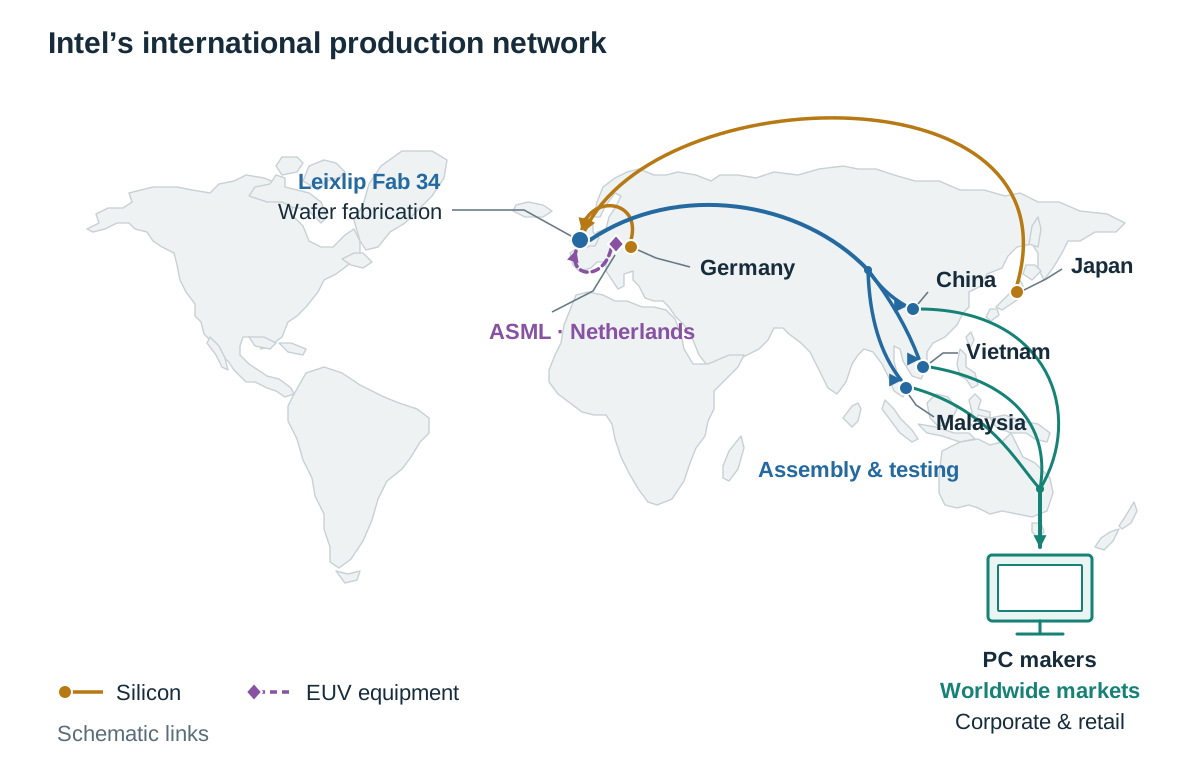
A multinational company (MNC) owns and manages production facilities across several nations. Intel, headquartered in Santa Clara, California, illustrates how an MNC organizes the global production of a single product: the microprocessor.
- Sourcing of Raw Materials and Components: High-purity electronic silicon is refined from quartz by specialist chemical firms in Japan and Germany. Advanced photolithography machines (including Extreme Ultraviolet / EUV systems) are manufactured by ASML in the Netherlands. Specialised chemicals and gases are sourced globally across Europe, the US, and East Asia.
- Location of Basic Processing Units: Advanced wafer fabrication takes place in capital-intensive, sterile 'cleanrooms' located in the US (Oregon, Arizona) and Ireland at Leixlip, County Kildare. Intel has invested over €30 billion in its Leixlip campus since 1989. Its Fab 34 facility, which opened in 2023, prints complex nanoscale circuits onto silicon wafers using EUV technology.
- Assembly and Testing: Once printed, the fragile wafers are flown to lower-cost, labour-intensive assembly and test plants in Penang and Kulim (Malaysia), Ho Chi Minh City (Vietnam), and Chengdu (China). There, wafers are sliced into individual chips, mounted onto protective substrate carriers, and tested under extreme temperatures.
- Location of Markets: Tested microprocessors are sold directly to original equipment manufacturers (OEMs such as Dell, HP, Lenovo, and Apple) whose PC and server assembly operations are located across Asia, Europe, and the US. Finished computers are distributed to businesses and consumers worldwide.
Industrial Mobility and the Product Life Cycle
High-tech manufacturing locations shift as products mature:
- Innovation Stage: Initial R&D and pilot runs occur in core regions near premier universities and tech clusters (Silicon Valley and Oregon).
- Growth Stage: High-volume fabrication expands to skilled, stable host countries offering tax incentives and access to wealthy markets (Intel in Leixlip, Ireland).
- Maturity Stage: Assembly techniques standardise and price competition tightens. Routine testing and packaging move to lower-wage economies in South-East Asia.
- Decline Stage: Demand falls as newer technology takes over. Headquarters rationalise production by closing older branch plant facilities, as when Dell closed its Limerick manufacturing plant in 2009 and shifted production to Poland.
Modern economic activity is shifting further towards services that can be delivered down a wire. Teleservices means work done remotely by phone or online — customer support, payments processing, technical helpdesks — which is why firms like Google, Meta and Stripe run large multilingual service operations in Dublin rather than factories. E-commerce means buying and selling online: goods are ordered from a website, picked in a large distribution warehouse beside a motorway, and delivered by courier, which reduces the need for high-street retail space but increases demand for warehousing, logistics jobs and the data centres that host the websites. Because these activities need broadband, electricity and skilled English-speaking staff rather than raw materials, they are highly footloose and can be moved between countries quickly.
Why Multinationals Locate in Ireland (Pull Factors)
- A 12.5% corporation tax rate on active trading profits.
- Guaranteed, tariff-free access to the European Single Market of over 440 million consumers.
- An educated, English-speaking, skilled graduate workforce in engineering, science, and business.
- State assistance via IDA Ireland, including advance factories, capital grants, and site development support.
- Agglomeration advantages: established industry clusters in medical devices (Galway), biopharmaceuticals (Cork and Dublin), and information technology (Dublin's Silicon Docks).
Impacts of Multinationals on Ireland
- Positive Impacts: Multinationals directly employ roughly 300,000 workers in high-income roles; generate substantial indirect employment through local sub-suppliers (catering, security, cleanroom maintenance, construction); contribute over €20 billion annually in corporation tax; and upgrade the domestic skills base.
- Negative Impacts: Heavy repatriation of profits to overseas parent firms means domestic wealth is lower than GDP suggests; foreign branch plants remain vulnerable to sudden head-office closure decisions; and heavy industrial electricity use (data centres alone used roughly 21% of Ireland's metered electricity in 2023, according to the CSO) places pressure on the national grid.
4.4 Ireland and the European Union
Ireland joined the European Economic Community (EEC) in 1973 alongside Britain and Denmark, transforming its economy from a dependent, British-focused agricultural exporter into an open European industrial trading hub.
EU Trading Patterns: Internal Single Market and External Trade
- The Single Market: Established in 1993, the Single Market guarantees the free movement of goods, services, capital, and labour across all member states. Irish firms export freely across the bloc without paying tariffs, clearing border checkpoints, or facing conflicting national regulations. Consequently, Ireland's trade diversified dramatically: whereas the UK took over 90% of Irish exports in 1950, by 2023 the UK accounted for roughly 11% of Irish merchandise exports, with continental EU partners (especially Germany, Belgium, and France) and the US purchasing the bulk of Irish pharmaceuticals and food products.
- External EU Trade: The EU functions as a customs union, applying a Common External Tariff to goods entering from outside the bloc and negotiating trade deals collectively. Following Brexit in 2020, customs checks on UK-Irish trade led Irish hauliers to establish direct roll-on/roll-off ferry links from Rosslare and Dublin to Cherbourg and Dunkirk, bypassing the UK transit landbridge.
Key EU Policies and Their Impact on Ireland
+------------------------------------------------------------------------------------------+
| EU POLICY INSTRUMENT       | DIRECT ECONOMIC IMPACT ON IRELAND                           |
+----------------------------+-------------------------------------------------------------+
| Common Agricultural Policy | - Replaced volatile UK prices with guaranteed intervention  |
| (CAP, established 1962)    | - Modernised farm machinery, dairying, and herd genetics    |
|                            | - Basic Payment Scheme supports rural farm household income |
|                            | - Environmental schemes (GLAS, ACRES) fund biodiversity     |
+----------------------------+-------------------------------------------------------------+
| Common Fisheries Policy    | - Shared European fishing waters under equal-access rules   |
| (CFP, established 1983)    | - Sets annual Total Allowable Catches (TACs) and quotas     |
|                            | - Irish fleet restricted to modest share of home EEZ catch  |
|                            | - Discards ban (landing obligation) enforces conservation   |
+----------------------------+-------------------------------------------------------------+
| European Regional          | - Co-financed inter-urban motorways (M1, M7, M8, M50)       |
| Development Fund (ERDF)    | - Upgraded urban water networks and sewage treatment plants |
|                            | - Funded Regional Technical Colleges (now Tech Universities)|
|                            | - BMW region held Objective 1 status from 1989 to 2006      |
+----------------------------+-------------------------------------------------------------+
| European Social Fund       | - Co-funded apprenticeships via SOLAS and Education Boards  |
| (ESF / ESF+)               | - Supported retraining for youth and long-term unemployed   |
|                            | - Financed EGF retraining for Dell workers in Limerick 2009 |
+----------------------------+-------------------------------------------------------------+- Common Agricultural Policy (CAP): By providing price supports and modern direct payments, CAP industrialised Irish agriculture, turning grass-fed dairying and beef into multi-billion euro export sectors. However, price incentives encouraged intensive farming, which increased national greenhouse gas emissions and nitrate runoff into rivers.
- Common Fisheries Policy (CFP): The CFP treats European marine waters as a common resource managed through Total Allowable Catches (TACs) divided into national quotas. Because quotas were fixed using historic catch records from the 1970s before Ireland built a modern fleet, Irish boats land only a small share of the fish caught in Ireland's own Exclusive Economic Zone (EEZ). The Brexit Trade and Cooperation Agreement transferred a further share of EU quotas to the UK, with Ireland bearing an estimated 15% cut in quota value, prompting state-funded vessel decommissioning schemes in ports like Killybegs.
4.5 Environmental Impacts of Economic Activity
Economic production, manufacturing, and energy consumption alter landscapes, produce emissions, and deplete finite natural resources across local, European, and global scales.
Energy Resources: Renewable and Non-Renewable
- Non-Renewable Fossil Fuels: Peat, coal, oil, and natural gas release carbon dioxide (CO₂) when burned. Ireland's state-owned peat power stations at Lanesborough and Shannonbridge were permanently closed by the ESB in 2020, and Bord na Móna ceased all commercial peat harvesting in 2021. ESB ended routine coal-fired electricity generation at Moneypoint, County Clare, in 2025, maintaining the site as an emergency back-up facility (running on heavy fuel oil) while redeveloping it as an offshore wind assembly and green hydrogen hub. Ireland relies heavily on natural gas for baseload electricity, piping it from the declining offshore Corrib field and via subsea interconnectors from Scotland.
- Alternative and Renewable Energy in Ireland:
- Onshore Wind: Ireland's primary renewable source; Galway Wind Park in Cloosh Valley (169 MW capacity) is the state's largest onshore installation. Wind supplied roughly one third of Ireland's electricity in 2023 (SEAI). Renewables accounted for only about 13–14% of Ireland's total final energy use, because transport and heating remain overwhelmingly powered by imported oil and gas.
- Offshore Wind: Higher, steadier wind speeds off the east and south coasts; Arklow Bank was Ireland's first offshore array.
- Hydroelectricity: Ardnacrusha on the Shannon (opened 1929) and Turlough Hill pumped-storage station in Wicklow, which pumps water uphill at night and releases it to generate power during peak daytime demand.
- Solar PV: Utility-scale solar farms across Wexford and Waterford take advantage of the sunnier south-east climate.
- Advantages: Cuts imported fossil-fuel bills; eliminates CO₂, sulphur dioxide, and particulate emissions during operation; provides rural jobs and commercial rates to county councils; and improves national energy security.
- Disadvantages: Intermittent generation requires gas back-up and expensive grid interconnectors; visual intrusion and noise create planning objections; and turbine construction on blanket bog can cause peat disturbance.
European Patterns of Energy Production and Consumption
- Energy Mixes Reflect Physical Geography: Norway generates over 90% of its electricity from hydro due to glaciated topography and high precipitation; Iceland uses geothermal energy; France relies on nuclear power for roughly two thirds of its electricity; while Poland remains heavily dependent on domestic coal in Silesia.
- Consumption and Geopolitics: Energy consumption is highest in the densely populated industrial core of north-west Europe. Following Russia's invasion of Ukraine in 2022, the EU moved under REPowerEU to replace Russian pipeline gas with imported liquefied natural gas (LNG) and accelerated renewable targets under the European Green Deal.
Pollution Across Three Geographic Scales
- Local / National Scale (Urban Smog and Smoky Coal Bans): In the 1980s, burning bituminous coal for domestic heating caused severe winter smog in Dublin. In 1990, the government prohibited the sale and distribution of smoky coal across Dublin. This produced an immediate drop in airborne fine particles (PM10), preventing an estimated 350 respiratory and cardiovascular deaths each year. The ban was extended nationwide in 2022.
- European Transboundary Scale (Acid Rain): Sulphur dioxide (SO₂) and nitrogen oxides (NOₓ) discharged from coal-fired power stations and heavy industry in Britain, Germany, and Poland's industrial 'Black Triangle' were carried north-east by prevailing winds. Dissolved in cloud water, they fell as acid rain in Norway and Sweden, acidifying thousands of lakes, leaching toxic aluminium from soils, and wiping out salmon runs. Resolving this required international treaties (the UNECE Gothenburg Protocol) and EU directives mandating catalytic converters and flue-gas scrubbers.
- Global Scale (Climate Change): Global greenhouse gas emissions trap heat in the troposphere. Ireland's Climate Action and Low Carbon Development Act commits the country to cutting greenhouse gas emissions by 51% by 2030 (relative to 2018 levels) and achieving net-zero emissions by 2050.
Sustainable Development, the EPA, and Environmental Impact Assessments
Sustainable development meets the needs of the present without compromising the ability of future generations to meet their own needs. It relies on three balanced pillars: ecological conservation, economic viability, and social equity (a 'just transition' retraining peat workers in the Midlands).
In Ireland, the Environmental Protection Agency (EPA), established in 1993, monitors water and air quality and issues Industrial Emissions Licences. Historical mining at Avoca, County Wicklow, caused acid mine drainage that contaminated the Avoca River because statutory environmental controls did not exist. By contrast, modern mines like Tara Mines in Navan operate under EPA licences requiring waste rock and tailings to be stored in lined containment ponds, and require the operator to post financial restoration bonds in advance.
A statutory Environmental Impact Assessment (EIA) must be submitted before major construction projects receive planning approval, ensuring developers examine environmental risks and explore alternatives before damage is done.
Conflicts Between Economic and Environmental Interests
You must be able to discuss two named conflict case studies:
+------------------------------------------------------------------------------------------+
| CONFLICT CASE STUDY        | ECONOMIC INTERESTS          | ENVIRONMENTAL INTERESTS       |
+----------------------------+-----------------------------+-------------------------------+
| Corrib Gas Project         | - Domestic gas supply       | - Pipeline explosion risks    |
| (Bellanaboy & Rossport,    | - Construction jobs         | - Peat stability & landslides |
| Co. Mayo)                  | - Commercial rates for Mayo | - Risk to Carrowmore drinking |
|                            |   County Council            |   water catchment             |
|                            |                             | - 4.9 km bay tunnel built     |
+----------------------------+-----------------------------+-------------------------------+
| Tourism vs Heritage        | - Essential income for boat | - Severe footpath erosion on  |
| (Skellig Michael,          |   operators, cafes, and     |   6th-century stone steps     |
| Co. Kerry)                 |   hotels in Portmagee       | - Disturbance to puffin and   |
|                            | - International film-driven |   shearwater seabird colonies |
|                            |   tourism demand            | - OPW daily visitor caps      |
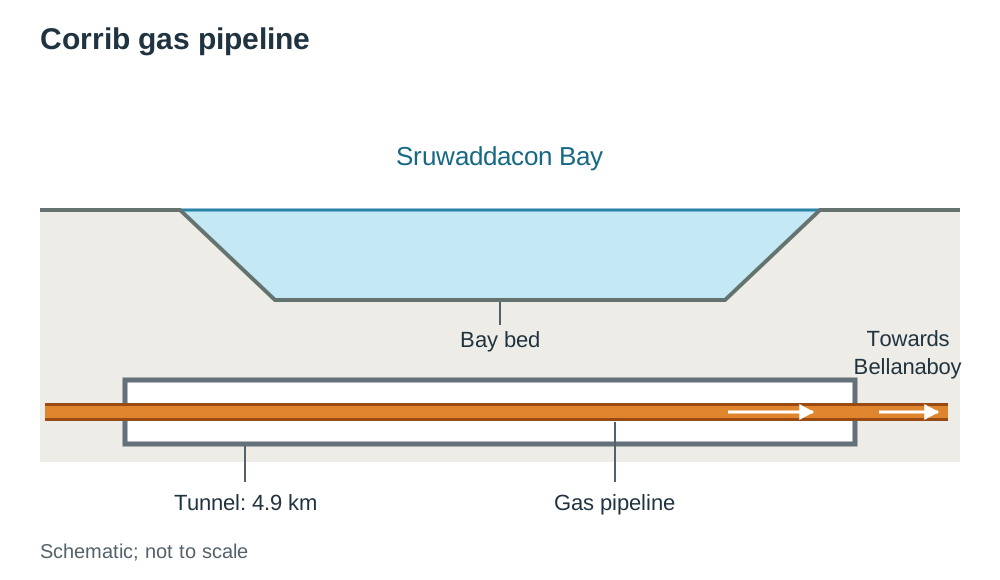
+----------------------------+-----------------------------+-------------------------------+- Corrib Gas (County Mayo): Shell and its partners sought to bring raw offshore natural gas inland to a refinery at Bellanaboy. Local residents in Rossport objected to a high-pressure raw gas pipeline running near homes and feared contamination of Carrowmore Lake. Following protests, the jailing of five local landowners in 2005, and planning refusals by An Bord Pleanála, the pipeline was re-routed through a 4.9 km tunnel beneath Sruwaddacon Bay. First gas was delayed until late 2015.
- Skellig Michael (County Kerry): Following its appearance in the Star Wars film franchise, tourist demand surged. Boat operators and accommodation providers in Portmagee rely on this seasonal business. However, thousands of visitors climbing the fragile sixth-century monastic drystone stairways threatened severe structural erosion and disturbed ground-nesting seabird colonies. In response, the Office of Public Works (OPW) strictly capped visitor numbers, licensed a limited boat fleet, and restricted the visitor season to protect the UNESCO World Heritage site.
4.6 Geographical Skills Applied to Economic Activities
Every question on the terminal paper includes stimulus material and tests your geographical skills.
Reading Economic Activity from an OS Map or Aerial Photograph
Always answer using a three-part formula: Name the economic activity + Give a precise six-figure grid reference or photographic location + State the specific map or photographic evidence.
- Primary Economic Activity: Look for commercial peat extraction (large tracts of flat bogland with drainage ditches), forestry (green coniferous woodland symbols), quarrying (the word 'Quarry' with cliff rock face symbols), or commercial farming (large, regular field patterns below 100 metres altitude).
- Secondary Economic Activity: Look for modern industrial estates on town outskirts, identifiable on aerial photographs as large, flat-roofed rectangular factory buildings with extensive car parks and articulated lorry loading bays located adjacent to national primary roads (e.g. N or M roads) or rail lines.
- Tertiary Economic Activity: Look for services in urban centres, such as schools, Garda stations, hospitals, and post offices. For tourism, identify camp sites, caravan parks, golf courses, marinas, sandy beaches, or National Monuments.
Presenting Data: Figure Drawing
- Pie Charts: To convert percentage data into degrees, multiply each percentage by 3.6 (for example: , rounded to ). Use a protractor starting from a vertical twelve o'clock baseline, plot each sector carefully, label each slice with its name and percentage, and write a clear, full title.
- Bar Charts: Use a clear, regular scale starting at zero, draw all bars with identical widths and equal spacing, label both axes with variables and units (e.g. 'Electricity Share (%)' and 'Fuel Source'), and add an informative title.
Linking Elective 4 to Regional Geography (Core Unit 2)
You can halve your revision workload by using the same regions across both units. The Greater Dublin Area serves as your Irish core region dominated by high-tech services, financial business (the IFSC), and transport infrastructure. The South-West (Cork) provides your biopharmaceutical and natural harbour hub. The Western Region illustrates peripheral challenges, wind energy, and rural tourism. For European regions, the Paris Basin illustrates an industrial and agricultural core, while the Italian Mezzogiorno illustrates peripheral agricultural dependence and industrial decline.
Key terms
- Gross Domestic Product (GDP)
- The total market value of all finished goods and services produced within a country's geographic borders during a single year.
- Gross National Product (GNP)
- The total monetary value of goods and services produced by the permanent economic residents and domestic enterprises of a nation, calculated by adjusting GDP for net factor income flows abroad.
- Modified Gross National Income (GNI*)
- An Irish economic metric developed by the CSO that strips out multinational balance-sheet distortions, including intellectual property patent redomiciling and leased aircraft depreciation.
- Human Development Index (HDI)
- A composite United Nations metric (scoring 0.0 to 1.0) evaluating human progress across three dimensions: life expectancy at birth, educational attainment, and GNI per capita at PPP.
- Footloose Industry
- An industry whose manufacturing or operational facilities are not tied to bulky raw materials or specific transport nodes, allowing location flexibility based on labour and taxation.
- Deindustrialisation
- The structural decline or deliberate dismantling of industrial and manufacturing capacity within a region or country, exemplified by India's textile sector under British colonial rule.
- Globalisation
- The growing interconnectedness and interdependence of the world's economies, cultures, and populations, driven by trade, technology, and cross-border investment flows.
- International Division of Labour
- The spatial separation of production tasks across different countries, where core regions retain R&D and high-value fabrication, while assembly and raw material extraction are shifted to peripheral or semi-peripheral regions.
- Multinational Company (MNC)
- A corporate enterprise that owns, controls, and coordinates industrial and commercial facilities across several different countries.
- Branch Plant
- A subsidiary factory owned by an overseas parent corporation, typically handling routine, standardised manufacturing and vulnerable to closure during economic downturns.
- Product Life Cycle
- The commercial stages through which a product passes (innovation, growth, maturity, and decline), influencing where manufacturing takes place globally.
- Single Market
- The European Union's internal economic area, established in 1993, guaranteeing the free movement of goods, services, capital, and labour without tariffs or border checks.
- Common Agricultural Policy (CAP)
- The EU system of agricultural supports established in 1962 that provides direct income payments to farmers, stabilises food markets, and enforces rural environmental standards.
- Common Fisheries Policy (CFP)
- The EU regulatory regime that manages shared European fishing waters through Total Allowable Catches (TACs) and national landing quotas.
- Total Allowable Catch (TAC)
- The scientifically calculated maximum catch limit set annually by the European Union for commercial fish stocks to prevent overfishing, divided into national quotas.
- Environmental Impact Assessment (EIA)
- A statutory planning study evaluating the ecological, hydrological, and social consequences of a proposed large-scale development prior to granting planning approval.
- Environmental Protection Agency (EPA)
- The Irish statutory body established in 1993 responsible for environmental monitoring, industrial emissions licensing, and ecological law enforcement.
- Acid Rain
- Rain, snow, or fog made acidic by dissolved sulphur dioxide and nitrogen oxide emissions from burning fossil fuels, causing soil leaching and aquatic acidification.
- Sustainable Development
- Development that meets the needs of the present without compromising the ability of future generations to meet their own needs.
Check yourself
Why did the Central Statistics Office (CSO) introduce Modified Gross National Income (GNI*) in 2017?
The CSO created GNI* to strip out multinational balance-sheet distortions—such as intellectual property patent relocations and leased aircraft depreciation—which caused Irish GDP to jump by 26% in 2015 without reflecting real domestic economic growth.
Give three reasons why an American multinational company would choose to locate in Ireland over an Eastern European country.
A competitive 12.5% corporation tax rate on active trading profits, English as the working language of business, guaranteed tariff-free access to the EU Single Market, and an established cluster of high-tech firms supported by IDA Ireland.
Define the international division of labour and give one concrete example.
The international division of labour is the geographic distribution of different production stages of one product across different countries. For example, Intel carries out circuit design in California, wafer fabrication in Leixlip, assembly and testing in Malaysia, and raw material sourcing globally.
What is the purpose of a Total Allowable Catch (TAC) under the Common Fisheries Policy?
A TAC sets an annual, scientifically determined limit on the total tonnage of a fish stock that can be caught across the EU, which is then divided into national quotas to prevent overfishing and stock collapse.
Name two disadvantages associated with wind energy in Ireland.
Intermittency of supply (requiring gas-fired back-up power plants and interconnectors) and visual/noise intrusion that frequently generates local planning objections.
How did the 1990 Dublin smoky coal ban demonstrate the success of a local environmental regulation?
Banning the marketing, sale, and distribution of bituminous coal across Dublin immediately lowered airborne particulate smoke (PM10), resulting in an estimated 350 fewer respiratory and cardiovascular deaths each year.
What three core dimensions comprise the United Nations Human Development Index (HDI)?
Health (measured by life expectancy at birth), education (mean and expected years of schooling), and standard of living (GNI per capita adjusted for Purchasing Power Parity).