

Elective Unit 4.3 examines how economic activities cross borders to build a single interdependent global economy. For Leaving Certificate Higher Level, this elective appears in Section 3 of Part Two (Questions 7, 8, and 9). You pick one 80-mark question. It starts with a 20-mark stimulus or data question in Part A, followed by two 30-mark multi-part questions in Parts B and C. These 30-mark answers are not long discursive essays. They are marked strictly on Significant Relevant Points (SRPs) and work best when written as structured paragraphs under clear headings.
Patterns of World Trade and the Global Triad
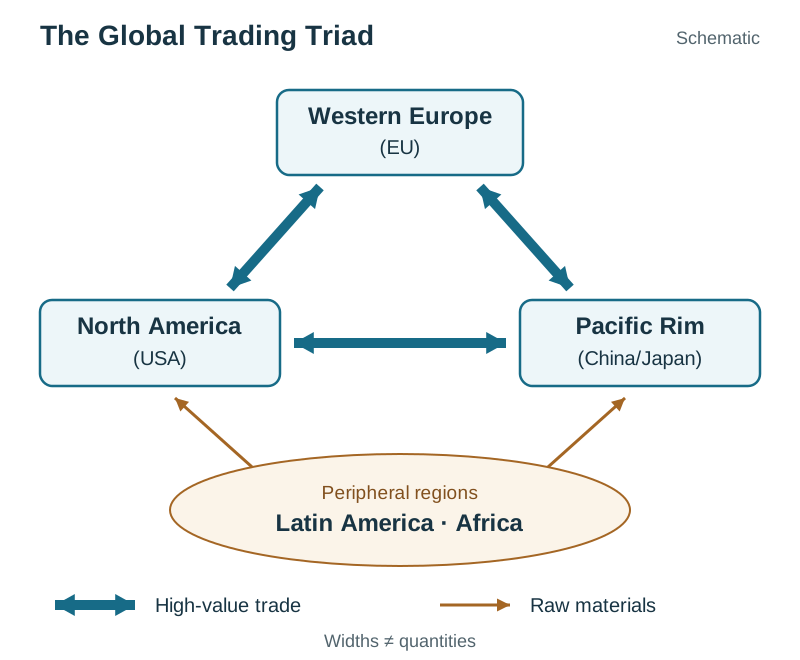
World trade does not spread evenly across the globe. Most international trade and investment flows through three dominant economic regions known as the Global Trading Triad: North America (centred on the United States), Western Europe (centred on the European Union), and the Pacific Rim (centred on East and Southeast Asia, including China, Japan, and South Korea). High-tech manufactured goods, corporate finance, and commercial services pass back and forth between these three hubs, while peripheral regions mainly supply low-value raw materials.
How Globalisation Has Changed World Trade
- Explosive trade growth: Global merchandise trade has expanded rapidly since the 1950s, easily outstripping world economic output. Modern supply chains mean a single finished product often crosses several borders as separate parts before reaching a shop shelf.
- Lower trade barriers: Successive rounds of the General Agreement on Tariffs and Trade (GATT) and the World Trade Organisation (WTO, set up in 1995) cut import tariffs worldwide. Even so, tariffs have not vanished completely. Governments still deploy them during economic arguments, such as recent disputes between the United States and China.
- Rise of trade blocs: A large share of global business takes place inside free-trade zones and single markets like the EU Single Market, USMCA in North America, and ASEAN in Southeast Asia, where internal tariffs are scrapped.
- New manufacturing giants: China grew into the world's leading exporter of manufactured goods over the last three decades. Semi-peripheral countries like Vietnam and Mexico now handle routine assembly work that once took place in Western Europe or the US.
- Growth of trade in services: Fast internet and undersea fibre-optic cables allow companies to export financial services, software, and tech support instantly. Ireland has become one of the world's biggest exporters of computer and financial services through this shift.
- Intra-firm trade: Roughly one-third of all global trade happens within different branches of the same company. For instance, Intel ships fabricated silicon wafers from its plant in Leixlip to its own packaging facility in Malaysia.
- Nearshoring and supply security: Major disruptions from the Covid-19 pandemic and regional conflicts pushed western governments to back nearshoring and reshoring. Through the 2023 EU Chips Act, the European Union provides funding to double its share of global semiconductor production to 20% by 2030.
The World-System and the International Division of Labour
To make sense of why economic activity is so uneven, geographers turn to Immanuel Wallerstein's core-periphery model, also called World-System Theory. This framework divides economies into three connected tiers based on their role in global production:
| Economic Tier | Characteristics | Typical Role in Global Production | Examples |
|---|---|---|---|
| Core | High wages, modern infrastructure, large capital reserves, and heavy research spending. | Headquarters, advanced research, high-tech manufacturing, and top consumer markets. | USA, Germany, Japan, Ireland. |
| Semi-Periphery | Rapidly industrialising, moderate labour costs, expanding transport, and growing domestic markets. | Routine factory assembly, secondary manufacturing, and outsourced digital operations. | China, India, Brazil, Vietnam, Bangladesh. |
| Periphery | Low capital investment, basic technology, weak infrastructure, and low wages. | Raw mineral extraction, unprocessed cash crop farming, and low-cost manual labour. | Ethiopia, Uganda, Chad, Niger. |
Countries can change their position over time. Vietnam and Bangladesh moved from the periphery into semi-peripheral manufacturing by attracting garment and electronics plants. Meanwhile, landlocked countries like Chad remain stuck exporting raw primary commodities.
The New International Division of Labour
During colonial times, European powers imported raw materials from their colonies, turned them into manufactured goods at home, and sold them back. That old pattern gave way to the New International Division of Labour (NIDL). Today, companies split production stages across different countries to cut operating costs:
- Headquarters management, patent research, and high-tech fabrication stay in wealthy core countries with highly skilled workers.
- Standardised, labour-intensive assembly moves to developing semi-peripheral nations where factory wages are far lower.
Four things drove this shift: big wage gaps between developed and developing nations; standardised container shipping, which slashed ocean freight costs after 1956; global fibre-optic networks that let managers run overseas plants in real time; and governments setting up free trade zones that offer tax holidays to foreign companies.
Why Multinationals Expand and Why They Choose Ireland
A multinational corporation (MNC) is a business that owns or runs operations, factories, or offices in more than one country, managed from a central headquarters. Selling goods abroad is not enough; the firm must directly control operations across borders.
Why Multinationals Set Up Overseas Plants
- Lower labour costs: Assembling consumer electronics in Vietnam or Poland costs a fraction of what it costs in Western Europe, bringing down total production bills.
- Getting around trade barriers: Opening a branch inside a trade bloc lets a business sell without paying import duties. This is why American tech and pharma firms set up inside the EU Single Market.
- Grants and tax incentives: State support, like capital grants from IDA Ireland or tax exemptions in Asian export processing zones, reduces the initial cost of building a factory.
- Closeness to consumer markets: Having a base inside a wealthy region cuts shipping times, reduces freight charges, and helps companies design products that match local tastes.
- Specialist skills: Multinationals choose locations where they can hire top university graduates, like software developers in Dublin or Bengaluru.
- Working across time zones: Running offices in Asia, Europe, and North America allows firms to keep software development, customer support, and financial trading moving 24 hours a day.
Why Multinationals Locate in Ireland
- Low corporation tax: Ireland has a long-standing 12.5% tax rate on active trading profits. Under the OECD global agreement introduced in 2024, a 15% minimum rate applies to large groups with global turnover above €750 million.
- Access to the EU Single Market: Goods and services produced in Ireland sell tariff-free to around 450 million European consumers. Since Brexit, Ireland is the only English-speaking member state in the single market.
- Educated, English-speaking workforce: Irish universities produce steady streams of science, engineering, and business graduates. English is also the working language of global business.
- State support through IDA Ireland: The Industrial Development Authority acts as a one-stop state partner, providing financial grants, ready-to-use business parks, and planning advice.
- Political and legal stability: Ireland offers a stable democracy, an English common-law legal system familiar to US firms, and predictable business regulations.
- Convenient time zone: Irish teams can coordinate with Asian offices in the morning and US east coast teams in the afternoon.
- Industry clustering (agglomeration): New firms prefer moving where rivals and suppliers already operate. Established hubs include medical technology in Galway, biopharma around Cork Harbour, and digital media in Dublin's Silicon Docks.
- Modern communications and logistics: Direct subsea fibre cables cross the Atlantic from Ireland, while international air freight flies out of Dublin and Shannon, supported by deep-water container ports in Cork and Dublin.
Irish-Based MNC Case Study: Intel
Intel Corporation is an American multinational founded in 1968, headquartered in Santa Clara, California. It is one of the world's biggest makers of microprocessors, the computer chips running personal computers, enterprise servers, and artificial intelligence systems.
Structure and Organisation of Intel
Intel operates as a top-down hierarchy directed from the United States:
- Global headquarters (Santa Clara, California): All top strategy happens here, including major investments, company acquisitions, and decisions to open or close production sites.
- Research and development: Advanced microprocessor architectures and manufacturing technologies are developed in major US facilities in Oregon and Arizona, close to top American engineering universities.
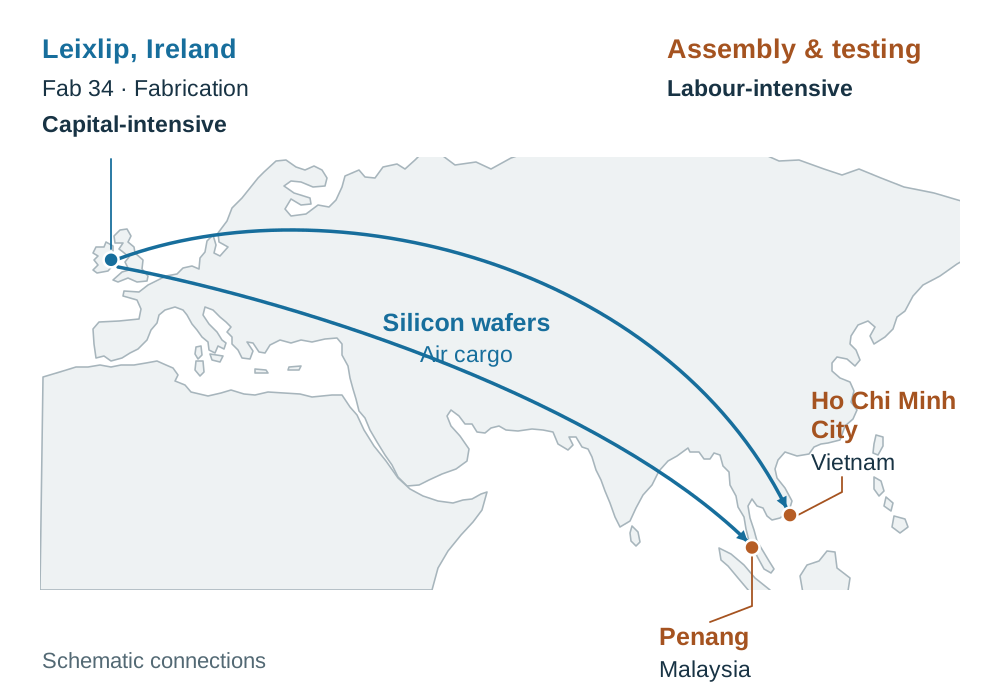
- Wafer fabrication ('front end'): Intel builds silicon circuits in capital-intensive, automated cleanroom factories called fabs. These run in Leixlip (Ireland), Oregon, Arizona, New Mexico, and Kiryat Gat (Israel).
- Assembly and testing ('back end'): Fabricated silicon wafers fly to lower-wage facilities in Penang and Kulim (Malaysia), Ho Chi Minh City (Vietnam), and Chengdu (China) for cutting, packaging, and testing.
- Workforce: Intel employed roughly 100,000 people worldwide in 2024, a total that has fallen sharply during recent restructuring, with around 5,000 based at the Leixlip campus in County Kildare (2024).
- Corporate structure: Unlike Nike, which hires contractors to make its shoes, Intel relies on vertical integration; it owns and manages its fabrication cleanrooms directly to protect its proprietary technology.
- Branch plant status: Strategic control stays in California, meaning the Leixlip site is a branch plant whose future depends on decisions made outside Ireland.
Product: Microprocessors
Intel bought the Leixlip site in County Kildare in 1989 and began turning out silicon wafers in the early 1990s. Total capital investment at Leixlip now exceeds €30 billion. In 2023, Intel opened Fab 34, a €17 billion facility using extreme ultraviolet (EUV) lithography to print circuits on the advanced 'Intel 4' process.
1. Sourcing of Raw Materials and Components
- Silicon wafers: Intel buys polished monocrystalline silicon discs from chemical specialists in Japan, Taiwan, and Germany. The silicon must be extraordinarily pure, so only a handful of global companies can produce it.
- Lithography machinery: The EUV scanners that print tiny circuit lines inside Fab 34 are made by ASML in Veldhoven, the Netherlands.
- Specialised gases and chemicals: High-purity nitrogen, argon, and etching acids run directly into cleanrooms. Industrial gas multinational Linde built a dedicated production facility right on the Leixlip site to supply them.
2. Location of Basic Processing Units
- Wafer fabrication (Fab 34, Leixlip): Circuit fabrication is automated and capital-intensive. Hundreds of microscopic circuit layers are built onto silicon wafers inside dust-free cleanrooms. Intel picked Ireland because of its skilled English-speaking engineers, access to the EU Single Market, IDA financial backing, and reliable water and electricity supplies.
- Assembly and testing (Penang, Malaysia; Ho Chi Minh City, Vietnam): Completed silicon wafers are light and valuable, so they travel by air cargo to Southeast Asia. There, workers slice the wafers into individual dies, attach them to circuit boards, add heat spreaders, and run electrical checks. Intel keeps this work in Malaysia and Vietnam because assembly needs far more manual labour, which costs much less there than in Ireland.
3. Location of Markets
- Original Equipment Manufacturers (OEMs): Intel does not sell most of its chips directly to ordinary shoppers. Its main customers are PC manufacturers like Dell, HP, and Lenovo, along with cloud providers like Microsoft and Amazon Web Services.
- Geographic sales distribution: Because personal computers and mobile devices are assembled in China, Taiwan, and Southeast Asia, most of Intel's physical processor shipments go straight to Asian factories. The completed devices are then shipped to retail markets across North America and Europe.
Economic Mobility, Branch Plants, and the Product Life Cycle
Modern high-tech and service businesses are largely footloose. They do not depend on heavy raw materials or local coalfields, so they can pack up and relocate when wage rates rise, taxes change, or better state grants appear elsewhere.
The Product Life Cycle Model
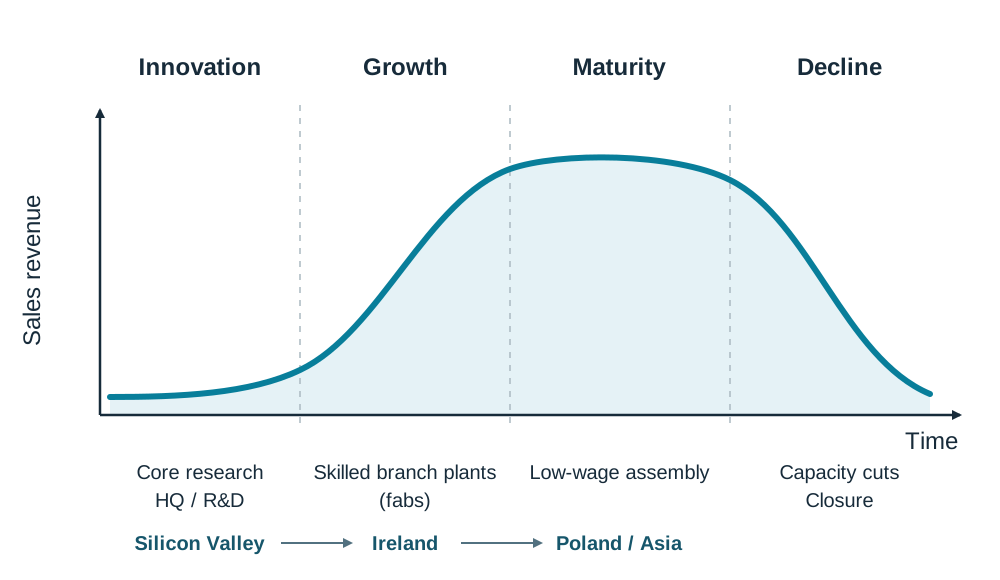
Raymond Vernon's product life cycle model explains why industrial manufacturing shifts geographically over time:
- Innovation and introduction: A new product is designed and tested. Production stays in core regions near research labs, venture capital, and elite universities, such as Silicon Valley in California.
- Growth: Market demand takes off and output expands rapidly. Multinationals open automated branch plants in skilled host countries inside large trading blocs, like Intel building fabs in Ireland to supply Europe.
- Maturity: The design becomes standardised and competing products look almost identical, so firms compete on price. Routine assembly moves to lower-wage semi-peripheral regions like Vietnam or Eastern Europe.
- Decline: Sales drop as newer technology takes over. Multinationals cut capacity and shut down redundant factories.
Branch Plant Vulnerability: Dell in Limerick
A branch plant is a factory set up in an overseas country while answering to corporate headquarters back home. Because top management sits abroad, branch plants always carry the risk of corporate closure.
The desktop computer followed Vernon's life cycle step for step. During the 1990s PC boom, Dell assembled computers at Raheen in Limerick for the European market. At its peak, the site was one of the largest factory employers in the Mid-West.
By the late 2000s, desktop computers were mature, low-margin products facing intense price competition. In January 2009, Dell announced it was shutting down Limerick manufacturing and moving European assembly to Łódź in Poland, where factory wages were roughly one-third of Irish rates. Poland had joined the EU in 2004, so Dell kept tariff-free access to the single market while slashing labour costs. About 1,900 assembly workers lost their jobs in Limerick. Dell kept its higher-value offices in Ireland, such as software development, sales, and supply chain coordination in Limerick and Dublin. The lesson is clear: routine factory jobs leave, but skilled office roles stay.
Nike: The Subcontracted Production Model
Nike runs on an outsourced production model. Unlike Intel, Nike owns almost none of the factories making its trainers. Instead, it employs designers and marketers at its headquarters in Beaverton, Oregon, and contracts independent factory owners across Asia to handle physical assembly.
In the 1970s, Nike contracted plants in Japan. As Japanese wages climbed, it shifted contracts to South Korea and Taiwan during the 1980s. When those economies grew richer, work moved to Indonesia, China, and Vietnam. Today, roughly half of Nike footwear is made in Vietnam. Because Nike does not own the factory bricks and mortar, management can switch suppliers quickly whenever wages rise or currencies shift.
The Multiplier Effect and Economic Impacts on Host Nations
When a multinational arrives or pulls out, the shock ripples through the entire regional economy.
The Multiplier Effect
The multiplier effect occurs when an initial investment sparks successive rounds of employment, spending, and income in the surrounding area. In a host town like Leixlip, the process works through five clear steps:
- Direct jobs: Intel employs around 5,000 staff on solid engineering and technical salaries.
- Indirect jobs: Those workers spend their pay on housing, food, transport, and childcare in Leixlip, Celbridge, and Maynooth, supporting local retail and service jobs.
- Local supplier contracts: The company contracts Irish firms for building maintenance, security, transport, and catering, while industrial partners like Linde run dedicated operations on site.
- Upgraded infrastructure: Concentrated industrial demand prompts state investment in better water plants, motorway upgrades, and power lines, which makes the area more attractive to other employers.
- Exchequer tax revenue: Taxes collected on profits, employee pay (PAYE), and local spending (VAT) give the government money to fund national public services.
The multiplier works in reverse when a plant shuts down. When Dell closed its Raheen assembly line in 2009, losing 1,900 direct manufacturing jobs wiped out thousands of indirect service and supplier jobs across the Mid-West, creating a harsh negative multiplier.
Impacts on Developed Host Economies: Ireland
- Employment and skills: Multinationals backed by IDA Ireland employ over 300,000 people directly in advanced hubs like pharmaceuticals in Cork and software in Dublin, lifting the skills of the national workforce.
- Tax base: Corporation tax from large multinationals pours billions into the Irish exchequer every year, helping fund public infrastructure.
- Profit repatriation: Foreign corporations send a large share of their profits back to parent headquarters abroad. This profit repatriation makes Ireland's Gross National Product (GNP) much smaller than its Gross Domestic Product (GDP).
- EU state-aid tensions: In September 2024, the European Court of Justice backed the European Commission's 2016 finding that Ireland had given Apple unlawful state aid, ordering the State to collect around €13 billion in back taxes. This put Ireland's corporate tax rules under sharp international scrutiny.
- Grid strain: Massive data centres demand vast amounts of power. By 2023, data centres used 21% of Ireland's total metered electricity, causing direct friction with national greenhouse gas reduction targets.
Impacts on Developing Economies: India
Facing a balance of payments crisis in 1991, India launched major economic reforms. The government cut import duties, relaxed the 'licence raj' system of industrial permits that had restricted new factories, and eased rules on foreign ownership of companies, opening the door to foreign direct investment (FDI):
- Economic growth: India's annual GDP growth jumped from around 3% in the 1970s to between 6% and 7% during the 2000s, driven by service exports.
- Global IT powerhouse: India turned into the world's primary hub for software engineering and Business Process Outsourcing (BPO). Indian firms like Infosys and Tata Consultancy Services (TCS) run back-office operations and software development for major European and American banks.
- Widening regional gaps: Booming southern and western cities like Bengaluru and Hyderabad captured most of the wealth, while rural states like Bihar saw little benefit and stayed dependent on farming.
- Working conditions: In low-cost garment and electronics manufacturing across developing Asia, factory staff often face long hours, poor pay, and weak safety enforcement. The dangers became obvious in 2013 when the Rana Plaza garment factory collapsed in Bangladesh, killing more than 1,100 workers.
Justice, Trade Terms, and Future Digital Trends
Is Global Trade Fair?
International trade creates great wealth for core nations, but it often locks peripheral countries into cycles of poverty:
- Unequal terms of trade: Developing nations export raw commodities like coffee, tea, and copper. Prices for these raw goods swing unpredictably on world markets, while the manufactured machines, chemicals, and fuel they must import climb steadily in price. Developing countries have to sell ever larger piles of crops just to afford the same imported equipment.
- Value-added gaps in commodity chains: In coffee farming, labourers in Ethiopia and Uganda pick beans for small wages. The high-value steps—roasting, packaging, marketing, and café retail—take place in core countries like Germany, Switzerland, and the United States. Multinationals in wealthy nations take over 80% of the final retail price, leaving farming communities vulnerable to market crashes.
- Tariff escalation: Wealthy trading blocs let raw crops enter with little or no customs duty, but slap steep tariffs on processed goods. Raw cocoa beans enter the EU duty-free, while processed chocolate bars face significant import taxes. This stops African countries from building their own chocolate factories to add value locally.
- Farm subsidies: Subsidies paid to farmers in the European Union and the United States lower production costs, allowing cheap imported food to undercut unsubsidised smallholders in developing countries.
- The Fairtrade alternative: The Fairtrade system guarantees farmer co-operatives a stable minimum price plus a social premium to invest in local schools, clinics, and clean water wells. Fairtrade coffee from Uganda and Ethiopia is sold in every Irish supermarket, although Fairtrade goods still account for only a small slice of global food trade.
Digital Trends: Teleservices and E-Commerce
Modern business relies less on shipping physical freight and more on digital networks, making services exceptionally mobile:
- Teleservices: Teleservices are administrative, technical, and customer-care operations handled over high-speed internet connections. Because data travels down fibre cables in milliseconds, back-office desks do not need to sit in the same country as the customer. Routine helpline support, invoice processing, and medical billing are routinely outsourced to shared-service centres in India and the Philippines.
- European tech headquarters: Dublin hosts the European headquarters of technology firms like Google, Meta, and Microsoft, bringing in billions in digital service exports. However, these jobs remain footloose and face competition as other countries build up their digital workforces.
- E-commerce platforms: Online retailers like Amazon bypass town-centre shops. Products are processed through automated regional distribution hubs set along motorways, reducing the need for high-street retail staff while allowing small suppliers to reach international customers directly.
Key terms
- Globalisation
- The growing integration and interdependence of world economies, cultures, and populations through cross-border trade, investment, technology, and migration.
- Multinational Corporation (MNC)
- A company that owns or controls operating facilities, factories, or offices in more than one country, directed from a central headquarters.
- Core-Periphery Model
- Wallerstein's world-system model dividing the globe into wealthy core nations, industrialising semi-peripheral nations, and resource-dependent peripheral nations.
- New International Division of Labour (NIDL)
- The spatial separation of production stages, where routine assembly moves to low-wage developing nations while strategic management, research, and design stay in core economies.
- Global Trading Triad
- The three dominant commercial hubs that control most world trade and investment: North America, Western Europe, and the Pacific Rim.
- Commodity Chain
- The series of stages a product goes through from harvesting raw materials, through processing and manufacturing, to final distribution and retail sale.
- Footloose Industry
- A business that is not tied to local raw materials or fixed power supplies, allowing it to move easily to take advantage of lower wages, lower taxes, or government grants.
- Product Life Cycle
- The four commercial stages of an industrial product (Introduction, Growth, Maturity, Decline), which cause its manufacturing location to shift over time.
- Branch Plant
- A secondary factory or operating unit set up by a multinational in an overseas country, directed by managers at corporate headquarters abroad.
- Multiplier Effect
- The process where an initial capital investment creates extra jobs, business spending, and income throughout the surrounding local economy.
- Profit Repatriation
- The transfer of profits earned by an overseas branch plant back to the multinational's parent company in its home nation.
- Foreign Direct Investment (FDI)
- Money invested by a company from one country to build factories, offices, or business operations in another nation.
- Tariff
- A tax placed on imported goods to make foreign products more expensive than items produced at home.
- Quota
- A government limit placed on the physical quantity of a particular product that can be imported over a specific time period.
- Subsidy
- A financial payment made by a government to domestic producers to lower their operating costs, helping them compete against foreign goods.
- Protectionism
- The policy of using tariffs, quotas, and government subsidies to protect domestic industries from foreign competition.
- Trade Bloc
- A group of countries that agree to reduce or remove tariffs between themselves while maintaining common barriers against non-member countries, such as the EU Single Market.
- Free Trade Zone
- A designated industrial park where materials can be imported, manufactured, and re-exported without customs duties, often backed by tax breaks.
- Teleservices
- Customer-support, administrative, or technical services carried out remotely using telecommunications and high-speed broadband.
- E-Commerce
- The buying and selling of goods, services, and digital information over the internet and electronic computer systems.
Check yourself
What three core regions make up the Global Trading Triad?
North America (centred on the USA), Western Europe (centred on the EU), and the Pacific Rim (centred on East and Southeast Asia, including China and Japan).
Outline the corporate structure of Intel, from its headquarters to its testing facilities.
Intel is organised as a hierarchy: strategic corporate decisions occur at headquarters in Santa Clara, California; research and development is based in Oregon and Arizona; automated wafer fabrication takes place in capital-intensive fabs like Leixlip in Ireland; and labour-intensive assembly and testing take place in lower-wage plants in Malaysia and Vietnam.
Name three factors that attract multinational companies to locate in Ireland, giving a specific detail or place name for each.
A 12.5% corporation tax rate on trading profits; full tariff-free access to the EU Single Market of roughly 450 million consumers; and industrial clustering beside existing operations, such as biopharmaceuticals in Cork Harbour or medical devices in Galway.
Explain the difference between a tariff and an import quota.
A tariff is a customs tax placed on imported goods to make them more expensive than domestic products, whereas a quota is a physical limit on the quantity of a specific item that may be imported into a country over a given time period.
How did the product life cycle influence Dell's decision to close its manufacturing plant in Limerick in 2009?
As desktop computers reached the maturity stage of their life cycle, competition shifted to retail price. Dell relocated assembly to Łódź in Poland to cut labour costs by roughly two-thirds, while retaining tariff-free access to the EU Single Market.
Define the multiplier effect and give one example of a negative multiplier.
The multiplier effect is the process whereby an initial investment generates successive rounds of employment and spending in the local economy. A negative multiplier occurred when Dell closed computer assembly in Raheen in 2009: losing 1,900 direct jobs caused the loss of several thousand indirect service and supplier jobs across the Mid-West.
A pie chart showing Irish goods exports displays: Chemicals 58%, Machinery 14%, Food 9%, Other X. Calculate X.
X = 19%. Working: 100 - (58 + 14 + 9) = 100 - 81 = 19%.