

Counting lets you find the total number of outcomes or arrangements without having to write down every possibility by hand. In the Junior Cycle exam, you will use multiplication rules, systematic tables, and tree diagrams to count outcomes and calculate probabilities.
The Fundamental Principle of Counting
The Fundamental Principle of Counting states that if there are first choices and second choices for each first choice, there are outcomes.
This multiplication rule applies across any number of steps:
- Multiply the choices at each step, provided each stage's count applies after every allowed earlier selection. Choosing between shirts, trousers, and pairs of shoes gives outfits.
- When the number of options is the same at every step, use index form. Tossing a coin times gives possible outcomes.
- Multiply when choices happen in sequence ('and'). Add counts for separate cases only when no outcome belongs to more than one case.
Systematic Sample Spaces
A sample space is the set of all possible outcomes of an experiment. Listing outcomes systematically prevents you from missing any.
Two main visual layouts help you organise outcomes:
- A two-way table is ideal for combining two independent events, such as flipping a coin and spinning a red/blue spinner:
| Coin \ Spinner | Red () | Blue () |
|---|---|---|
| Heads () | ||
| Tails () |
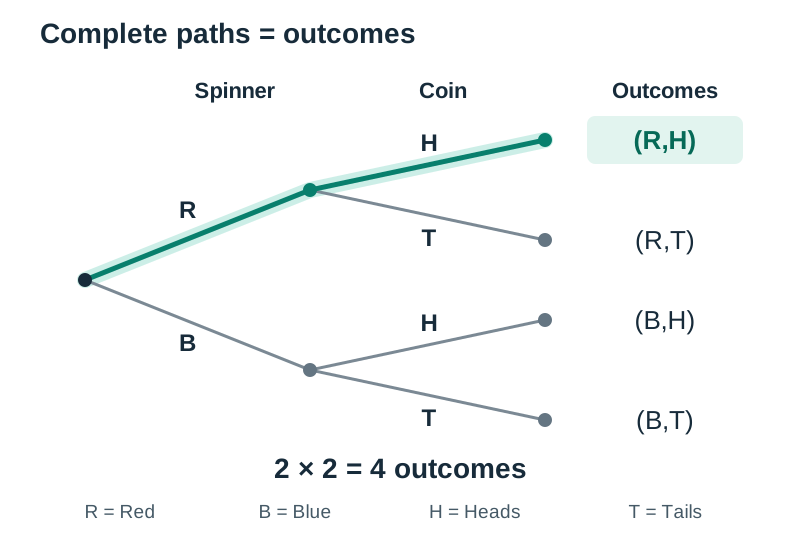
- A tree diagram works best for successive stages. Each branch represents an option, and each path from root to leaf represents one complete outcome. For example, spinning Red or Blue followed by flipping a coin gives branch endpoints: , , , and .
Permutations and the Box Method
A permutation is an arrangement of items where the order matters. Drawing boxes for each position makes it easy to track your choices.
- With repetition: options remain constant for every slot. A -digit passcode using digits to gives codes.
- Without repetition: options decrease by after each pick. Line up runners across lanes in ways.
- Restricted positions: it often helps to count the restricted position first; check the remaining choices carefully. To form a -digit even number from without repeats, fill the units slot first ( choices: or ), then the first slot ( digits left), and the middle slot ( digits left): numbers.
Linking Counting to Probability
Counting gives you the exact values needed to work out theoretical probabilities. For equally likely outcomes:
- Use counting rules to find both the top and bottom values. For two dice, there are total outcomes. Getting two odd numbers gives outcomes, so .
- Solve 'at least one' problems by subtracting from : . Assuming results of different matches are independent (one result does not affect another match's probabilities), if a team has a chance of not winning each match, the chance of no wins in games is , so .
Key terms
- Fundamental Principle of Counting
- If there are m first choices and n second choices for each first choice, there are m × n outcomes.
- Sample Space
- The complete set of all possible outcomes of an experiment.
- Permutation
- An ordered arrangement of a group of items where the sequence matters.
- Two-Way Table
- A grid display used to list all combined outcomes of two separate events.
- Tree Diagram
- A branching diagram that displays all possible outcomes across successive stages.
- Outcome
- A single possible result of an experiment.
Check yourself
A lunch deal offers 4 sandwiches, 3 drinks, and 2 snacks. How many different meal combinations are possible?
combinations.
A fair coin is tossed 4 times. What is the total number of outcomes in the sample space?
outcomes.
How many 3-digit odd numbers can you form from {1, 2, 3, 4, 5} without repetition?
The units place has 3 choices (1, 3, 5), leaving 4 then 3 choices: numbers.
A team plays 3 matches where win, draw, and lose are equally likely, and results of different matches are independent (one result does not affect another match's probabilities). What is the probability that they win none of the 3 matches?
The chance of no win per match is 2/3, so .