

Factorising rewrites an expanded algebraic expression as a multiplication of its factors. For Junior Cycle Higher Level, the exam tests your ability to spot common factors, group terms in pairs, factorise quadratic trinomials, and apply the difference of two squares.
Highest Common Factor
Always check for a common factor before trying any other method.
- Find the largest whole number that divides into every coefficient.
- Pick each shared letter at its lowest power.
- Place this highest common factor outside a single bracket.
- Divide every original term by this factor to find what stays inside.
| Expression | Highest Common Factor | Factorised Form |
|---|---|---|
When a term divides out completely, write in the bracket as its placeholder. For example, factors as rather than leaving a gap.
Grouping in Pairs
For suitable four-term expressions, grouping can reveal a shared factor.
- Group terms into two pairs that each contain a common factor.
- Take the highest common factor out of the first pair.
- Factorise the second pair so its bracket matches the first exactly.
- Pull that identical bracket out to finish the factorisation.
Watch your signs when pulling out a negative number: becomes .
Difference of Two Squares
Spot this pattern whenever two square terms are separated by a minus sign: .
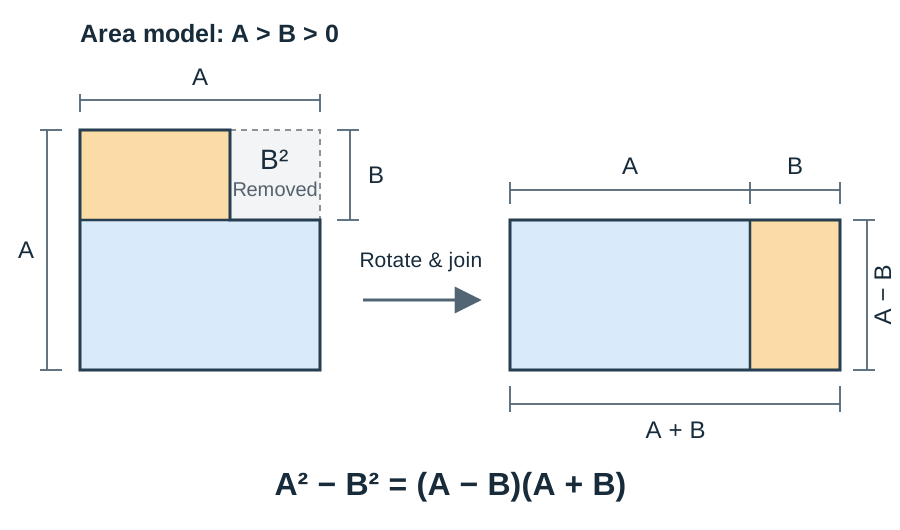
- Write each term as a square to identify and .
- Write the factors into two brackets, using a minus in one and a plus in the other.
- At Higher Level, questions often include coefficients on both terms, like .
For example, and , so . An expression with a plus sign, like , is not a difference and cannot be factorised using real numbers.
Quadratic Trinomials
Trinomials take the form , where the value of decides your approach.
- For monic quadratics where , find two integers that multiply to give and add to give .
- For , the numbers and work, giving .
- When , calculate the product first.
- Find two integers that multiply to and add to the middle coefficient .
- Split the middle term into these two values and factorise by grouping.
See the worked example below for a step-by-step walkthrough of factorising when .
Key terms
- Factor
- A number or algebraic expression that divides evenly into another without leaving a remainder.
- Highest Common Factor (HCF)
- The greatest term consisting of numbers and variables that divides into every term of an expression.
- Factorising by Grouping
- A method for four-term expressions that pairs terms to pull out a shared binomial bracket.
- Difference of Two Squares
- A binomial pattern which splits into the product .
- Quadratic Trinomial
- A three-term expression of the form , where .
Check yourself
What is the completely factorised form of ?
Factorise the difference of squares .
Factorise .
, since and .
Factorise using grouping.
, since .