

Solving an equation means finding the unknown values that make both sides of a mathematical statement equal. In Junior Cycle Higher Level, the exam tests your ability to solve linear, simultaneous, and quadratic equations algebraically and graphically, represent inequalities, and rearrange formulae.
Linear Equations and Fractions
A linear equation in one unknown simplifies to ax + b = 0, where a ≠ 0. You solve it by keeping both sides balanced until the unknown stands alone.
- Clear fractions early by multiplying every term across by the lowest common denominator (LCD).
- Group letters on one side and numbers on the other, using inverse operations to move them.
- Keep exact fractions unless the question requests rounding; then use the stated accuracy.
- Always substitute your final answer back into the original equation to check that both sides match.
Simultaneous Equations
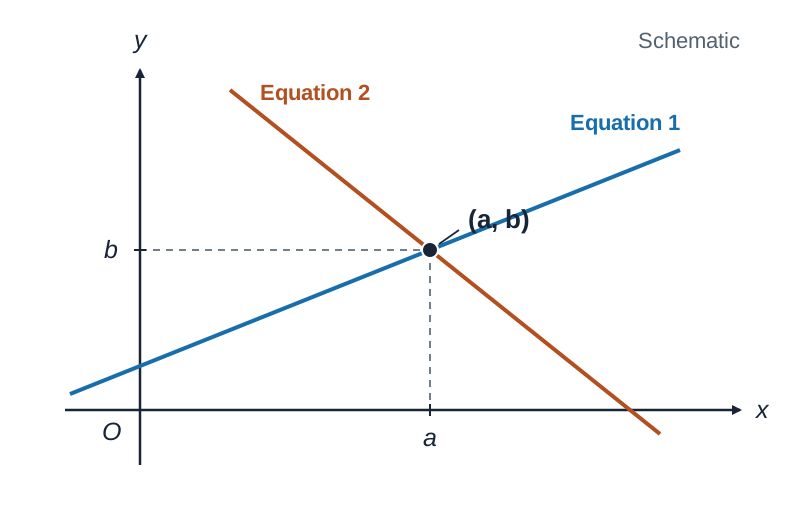
Simultaneous equations pair two linear statements with two unknowns. Their shared algebraic solution gives the exact point where the two straight lines intersect on a coordinate plane.
- Elimination: Multiply one or both equations so one variable has opposite coefficients; add to eliminate it.
- Substitution: If an equation already isolates a variable, swap that whole expression into the second line.
- Solve the remaining single-variable equation, then plug that value back into an original line to find the other unknown.
- Write coordinate geometry intersection answers as an ordered pair: .
Inequalities and Graphical Solutions
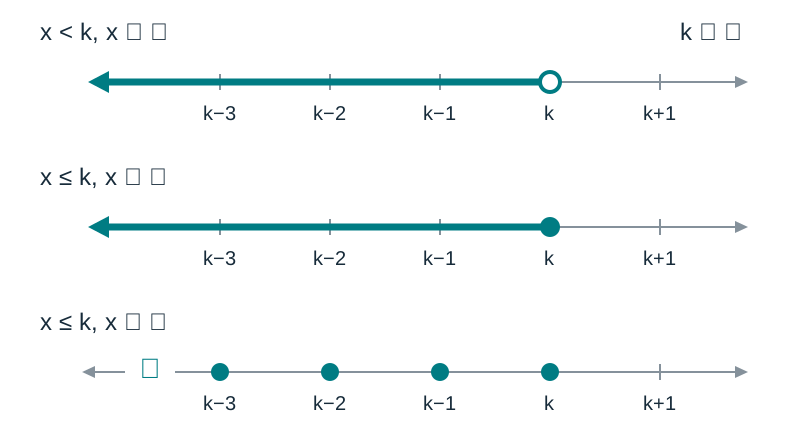
Inequalities compare quantities using , , , or . Solve them just like linear equations, but remember one critical rule: flip the inequality sign whenever you multiply or divide across by a negative number.
- On number lines, use dots for and , and a continuous bar for .
- On real number lines, mark strict bounds () with open circles and inclusive bounds () with filled dots.
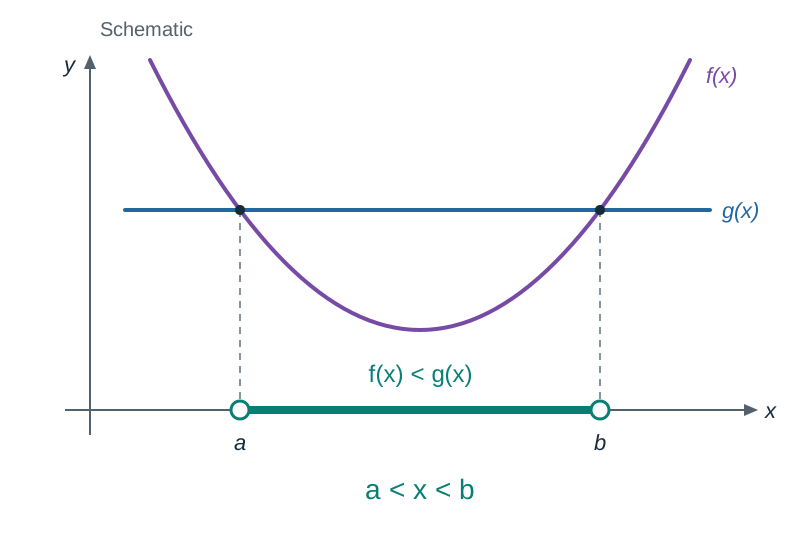
- Read approximate solutions of f(x) = g(x) where the graphs meet, including where they only touch.
- For f(x) < g(x), give the x-values where f’s graph lies below g’s graph; graph readings may be approximate.
Quadratics and Changing the Subject
A quadratic equation has highest power 2 and standard form ax² + bx + c = 0, with a ≠ 0. Use this form for factorising or the quadratic formula.
- Solve by factorising into double brackets when the terms break down cleanly.
- If an equation does not factorise, use , placing negative numbers in brackets.
- To build a quadratic from integer roots, multiply factors: roots and give .
- When changing the subject of a formula, isolate the target variable using inverse operations in reverse order.
Key terms
- Root
- A value of an unknown variable that satisfies an equation when substituted.
- Coefficient
- The numerical multiplier written directly before an algebraic variable.
- Lowest Common Denominator
- The smallest common multiple of all denominators in a fractional equation.
- Elimination
- Adding or subtracting two simultaneous lines to cancel one variable.
- Subject of a Formula
- The single variable isolated on one side of an equals sign.
- Quadratic Formula
- The formula used to find roots of any quadratic equation.
Check yourself
Solve the simultaneous equations and .
Rearrange the first to ; substitute into the second to find and .
What quadratic equation has integer roots and ?
Expand to get .
For a cylinder with positive volume and height, rearrange to make radius the subject.
Divide by and take the positive square root because is a radius to get .
How do you show on a number line if versus ?
For , place an open circle at and shade right; for , draw solid dots on only.