

An inequality compares quantities and can describe the values a variable is allowed to take. For Junior Cycle Higher Level, you need to solve linear inequalities algebraically, graph solution sets on the number line across , , and , and find approximate solution sets of using graphs.
Inequality Symbols and Real-World Constraints
An inequality uses symbols to show how quantities compare:
- means strictly less than; means strictly greater than.
- means less than or equal to; means greater than or equal to.
- For and , the pointed end always faces the smaller value.
- Strict inequalities ( and ) exclude the boundary; and include it.
Translating Words into Inequalities
- "At least" and "a minimum of" mean ; "at most" and "no more than" mean .
- "More than" means ; "less than" and "fewer than" mean .
- Physical counts cannot be negative, so an expression like gives .
- If €5 plus €3 per visit is capped at €20, then allows at most 5 visits.
Solving Linear and Double Inequalities
You solve inequalities using standard equation balance steps, with one golden rule: whenever you multiply or divide both sides by a negative number, reverse the inequality symbol.
- Gather variable terms on one side first: .
- For , dividing by reverses the symbol to give .
- Clear algebraic fractions early by multiplying every term across by the lowest common denominator.
Double Inequalities
A double inequality bounds an expression between two values. Apply every operation to all three parts simultaneously to isolate the variable.
Graphing on the Number Line
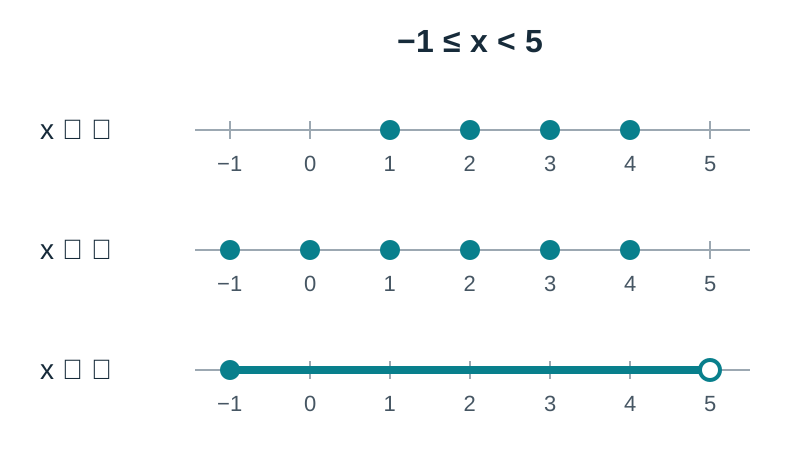
The number set specified for the variable dictates how you plot the solution set on the number line.
| Number Set | Elements Included | Number Line Representation |
|---|---|---|
| Natural numbers | Positive whole numbers starting at () | Distinct, solid dots on whole numbers only |
| Integers | Positive and negative whole numbers, including zero () | Distinct, solid dots on individual integer tick marks |
| Real numbers | Every number on the line: fractions, decimals, surds () | Continuous shaded line between endpoints; add an arrow only if it extends indefinitely |
For real numbers ():
- Use an open circle () at an excluded boundary ( or ).
- Use a closed dot () at an included boundary ( or ).
- For , place an open circle at and shade right with an arrow.
- For , shade between a closed dot at and open circle at .
Inequalities from Graphs: f(x) < g(x)
At Higher Level, you must interpret approximate solution sets of inequalities directly from given function plots.
- Intersection points show where .
- The inequality holds where the graph of lies strictly below .
- Check every domain region to see where sits below .
- State solution sets as -intervals, such as .
- If solutions form disconnected branches, write them as separate ranges, such as or .
Key terms
- Inequality
- A statement comparing two quantities using , , , or .
- Solution Set
- The collection of all values that make an inequality true when substituted for the variable.
- Double Inequality
- A three-part mathematical statement where an algebraic expression is bounded between two boundary values.
- Open Circle
- An unfilled circle plotted on a number line to show that a boundary value is excluded from the solution set.
- Closed Dot
- A solid, filled dot plotted on a number line to indicate that a boundary value is included in the solution set.
Check yourself
What happens to the inequality symbol in when divided by -5?
The symbol reverses direction, giving .
A club bus carries at most 45 students. Write this constraint as an inequality for n in N.
, where .
What type of mark is placed at x = 3 when graphing -2 <= x < 3 for x in R?
An open circle (), because is strictly excluded.
What feature of two graphs f(x) and g(x) shows the solution set of f(x) < g(x)?
The set of -values where the curve or line of lies vertically below .
Solve 4 - 2x >= 10 for x in Z, and state the largest possible value of x.
; the largest value is .