

A set is a well-defined collection of elements. Questions can ask you to describe sets, use notation, carry out operations, investigate properties, and solve Venn diagram problems.
Describing Sets and Set Notation
A set is a well-defined collection of elements, meaning there is no ambiguity about whether an item belongs to it. For example, 'tall students' is not a set, but 'students over 170 cm' is.
- Listing elements: Members are written inside curly brackets: .
- Defining by a rule: State a rule identifying the elements: .
- Set equality: Two sets are equal if they have identical elements, regardless of order: .
- The symbol means 'is an element of' (), while means 'is not an element of' ().
- The cardinal number, , is the count of distinct elements in set .
- The null set (empty set), or , contains no elements.
- A subset () means every element of is in .
Set Operations and Brackets
The universal set, , contains all elements under discussion. Four primary operations combine or modify sets:
| Operation | Meaning | Example with , , |
|---|---|---|
| Union () | Elements in , in , or in both | |
| Intersection () | Elements in both and | |
| Set difference () | Elements in that are not in | |
| Complement () | Elements in that are outside |
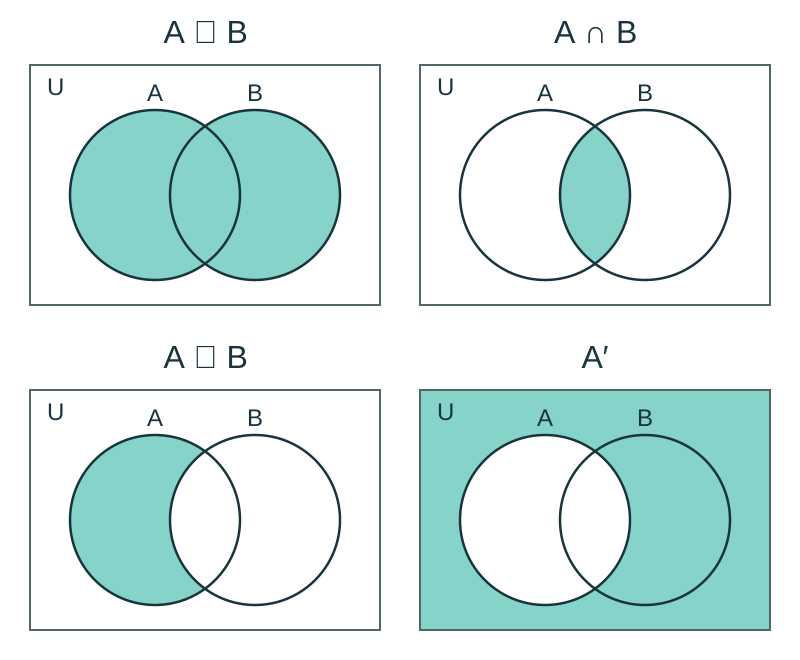
Work out brackets first. With , , , and :
- , so
Standard Number Sets
Standard letters denote the core number sets:
- : Natural numbers (positive integers, ).
- : Integers (positive and negative whole numbers, and zero, ).
- : Rational numbers (numbers writable as , where and ).
- : Real numbers (all numbers on the number line).
- : Irrational numbers (real numbers that cannot be written as fractions, such as and ).
These sets nest inside one another: . For example, and , but .
Commutative and Associative Properties
An operation is commutative if swapping the order gives the same result. An operation is associative if changing grouping brackets gives the same result.
| Operation | Commutative? | Associative? |
|---|---|---|
| Union () | Yes: | Yes: |
| Intersection () | Yes: | Yes: |
| Difference () | No — not true in general: and can differ | No — not true in general: and can differ |
Use a single counterexample to disprove a property. For , , and :
- Order matters: , but .
- Grouping matters: , but .
Solving Venn Diagram Problems
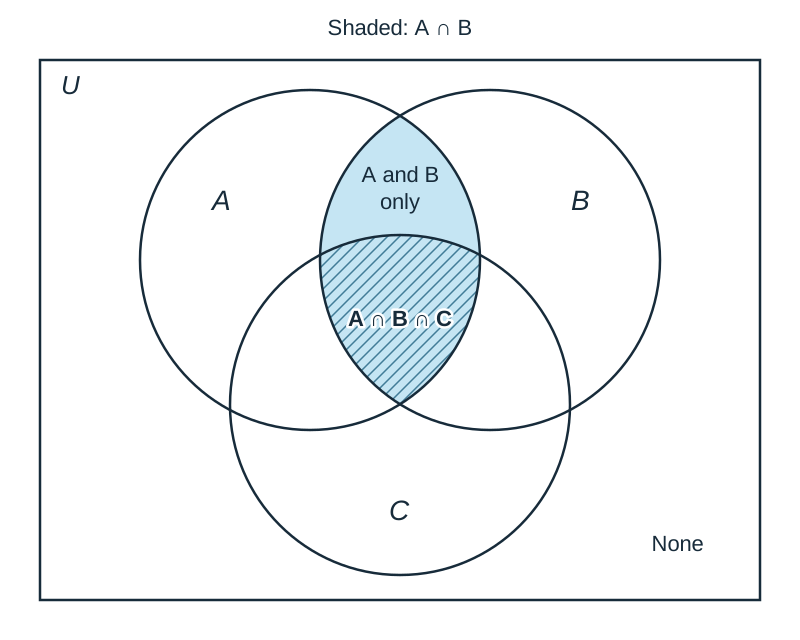
A Venn diagram displays sets as circles inside a rectangle for .
- Start with the central intersection of all three sets ().
- Subtract the centre from inclusive intersection totals. Counts labelled 'only' already exclude the centre.
- Add the counts in every separate region, including the outside region, and set the total equal to .
Key terms
- Set
- A well-defined collection of distinct elements.
- Universal Set (U)
- The complete set of all elements under consideration in a problem.
- Cardinal Number (#A)
- The total number of distinct elements contained in set A.
- Null Set (∅)
- A set that contains no elements, also written as {}.
- Subset (⊆)
- A relationship where every element of one set is also in another set.
- Intersection (∩)
- The set of elements shared in common between two or more sets.
- Union (∪)
- The set of all elements belonging to either set or to both sets.
- Set Difference (\)
- A \ B is the set of elements in A that are not in B.
Check yourself
If A is the set of positive factors of 12 and B contains the positive multiples of 3 below 15, find A ∩ B.
A = {1, 2, 3, 4, 6, 12} and B = {3, 6, 9, 12}, so A ∩ B = {3, 6, 12}.
For U = {1, 2, 3, 4, 5, 6, 7, 8} and P = {2, 3, 5, 7}, list the elements of P'.
P' = {1, 4, 6, 8}.
Which standard number set contains -7 and 0, but does not contain 3/4?
The set of integers, ℤ.
Is set difference associative? Give a counterexample.
No. For A = B = C = {1}, (A \ B) \ C = ∅, but A \ (B \ C) = {1}.
If #(A ∩ B) = 11 and #(A ∩ B ∩ C) = 4, how many elements belong to A and B only?
11 - 4 = 7 elements.