

Financial maths applies arithmetic to personal and business money matters, including tax, interest, profit, bills, and currency exchange. In the Junior Cycle Higher Level exam, questions can ask you to solve multi-step problems with two-tier tax bands, percentage deductions, compound interest, mark-up, margin, and best-buy comparisons.
Profit, Loss, Mark-up, and Margin
Profit is how much more you sell an item for than it cost you, while a loss means it sold for less than it cost:
- Profit = Selling Price − Cost Price
- Loss = Cost Price − Selling Price
- Percentage profit or loss is always calculated on the cost price:
At Higher Level, distinguish carefully between mark-up and margin:
- Mark-up is profit as a percentage of the cost price:
- Margin is profit as a percentage of the selling price:
For example, buy for €40 and sell for €50 (profit €10). The mark-up is , but the margin is .
To find the cost price backwards, treat the selling price as a percentage. A selling price with 25% profit is 125% of cost price, so divide by 1.25.
VAT, Utility Bills, Currency, and Value for Money
VAT is a tax added on to the price of goods and services:
- Adding VAT: multiply the pre-VAT price by , where is the VAT rate as a decimal (e.g. for 23% VAT).
- Taking VAT off: divide the inclusive price by (e.g. €738 including 23% VAT gives ).
For utility bills, units used = new reading − old reading. Multiply units used by the unit price, add the standing charge, then add VAT.
For a rate written €1 = k units of another currency, multiply euro by k; divide to convert back. Apply commission as the question specifies.
For value for money, find the cost per common unit (e.g. per 100 g or per litre), compare, and write a sentence stating which is better value and why.
Income Tax, Deductions, and Net Pay
Gross income is your total pay before any deductions. Net pay is what you take home after all deductions are removed:
Follow these steps to calculate income tax:
- Tax income up to the Standard Rate Cut-Off Point at the standard rate (e.g. 20%).
- Subtract the cut-off point from gross income. Tax this remaining balance at the higher rate (e.g. 40%). If gross income is below the cut-off, tax the entire income at the standard rate.
- Add the two tax amounts to find gross tax.
- Subtract tax credits from gross tax; tax payable cannot fall below zero.
Calculate each percentage deduction using the income amount and rate specified. Total deductions include income tax payable and all other deductions given.
Compound Interest and Depreciation
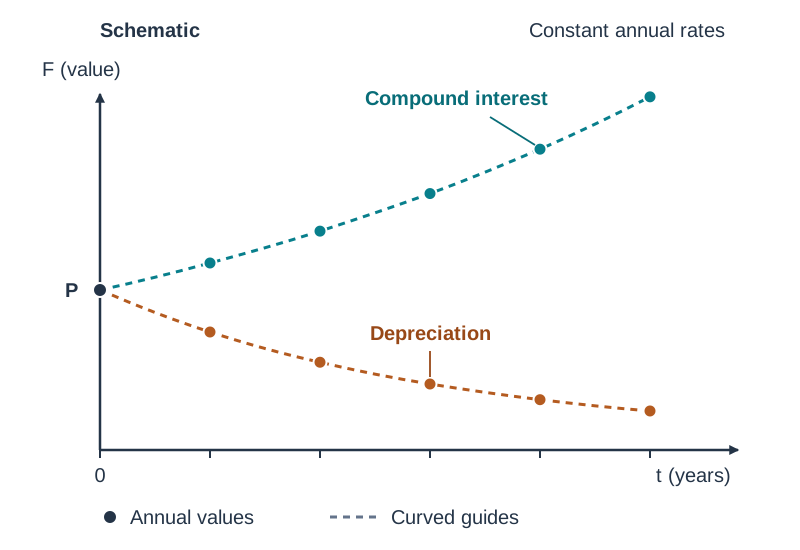
Compound interest adds interest each period to the growing total balance. Depreciation reduces an asset's value by a percentage each year. Both formulae are in the Formulae and Tables booklet:
- Compound interest:
- Depreciation:
Here is the principal or starting value, is the annual rate as a decimal, is time in years, and is the final value.
To find total interest earned, subtract the principal: .
If the interest rate changes from year to year, or if money is added or withdrawn, do not use the power formula; calculate the balance year by year instead.
Key terms
- Standard Rate Cut-Off Point
- The maximum amount of income taxed at the standard rate; any income above this is taxed at the higher rate.
- Tax Credit
- A sum that is subtracted directly from gross tax to determine the income tax payable; tax payable cannot fall below zero.
- Gross Tax
- The total tax calculated across all tax bands before subtracting tax credits.
- Net Pay
- Take-home pay left after income tax and all other deductions are subtracted from gross income.
- Mark-up
- Profit expressed as a percentage of the cost price.
- Margin
- Profit expressed as a percentage of the selling price.
- VAT
- Value Added Tax, a government tax added to the price of goods and services.
- Standing Charge
- A fixed charge on a utility bill that you pay regardless of how much energy or water you use.
Check yourself
An item bought for €80 sells for €100. Find the percentage mark-up and percentage margin.
Profit = €20. Mark-up = (20 ÷ 80) × 100 = 25%. Margin = (20 ÷ 100) × 100 = 20%.
Convert €600 to US dollars at an exchange rate of €1 = $1.08.
$648 (600 × 1.08).
Pack A has 500 g of cereal for €3.20. Pack B has 750 g for €4.35. Which is better value?
Pack B is better value. Pack A costs €0.64 per 100 g (3.20 ÷ 5) and Pack B costs €0.58 per 100 g (4.35 ÷ 7.5).
A laptop bought for €800 depreciates by 15% per year. Find its value after 2 years.
€578, using F = 800(1 − 0.15)^2 = 800 × 0.85^2.