

Number Systems classifies natural, integer, rational, and real numbers and examines operations on them. The exam tests number classifications, simplifying surds and indices, rounding, scientific notation, and working with sets.
Number Sets and Arithmetic Operations
Numbers belong to nested sets: .
- : Positive counting numbers , excluding .
- : Integers .
- : Fractions (); terminating or recurring decimals.
- : Irrational numbers with infinite, non-repeating decimals (e.g. ).
- : All rational and irrational numbers.
Represent operations using models:
- Number line: shows addition and subtraction as directed shifts ().
- Decomposition and equal groups: split numbers () or accumulate groups ().
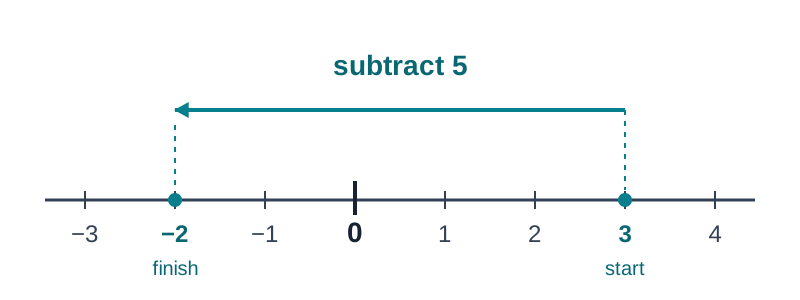
Fractions require common denominators to add (), multiply across (), and invert to divide ().
Convert forms via decimals: . To order numbers, compare decimals: .
Addition and multiplication are commutative: order does not matter. They are associative: grouping does not matter. Multiplication distributes over addition: a(b+c)=ab+ac. Subtraction and division are neither commutative nor associative.
Surds
A surd is a root of a rational number whose value is irrational, such as . Leaving an answer as a surd keeps it in exact form without rounding.
- Simplifying: extract square factors: .
- Multiplication and division for non-negative radicands (, and to avoid division by zero):
Examples: , and .
- Addition and subtraction: combine like roots only: , but .
Index Laws and Order of Operations
A positive whole-number index counts repeated factors: . Fractional indices represent roots. For positive bases and rational powers, these index laws apply:
- and
- ()
- (e.g. )
- (e.g. )
- and
Equating powers: for , if , then .
Order of operations follows BIMDAS: Brackets, Indices, Multiplication/Division (left to right), Addition/Subtraction (left to right).
Factors, Accuracy, and Scientific Notation
- Prime factorisation writes a number as prime powers: and .
- HCF takes the lowest power of shared primes ().
- LCM takes the highest power of every prime ().
- Rounding: round up if the next digit is or more; otherwise leave unchanged ( to d.p.).
- Significant figures start at the first non-zero digit: to significant figures.
- Scientific notation has form , with and (; ).
Sets and Venn Diagrams
A set is a well-defined collection of elements. Equal sets contain exactly the same elements. For example, A={2,4,6} can also be defined by A={x∈ℕ: x is even and x<8}.
- Universal set (): all items; null set (): empty.
- Element (): belongs to; subset (): contained within.
- Cardinal number (): count of elements in .
- Union (): in , , or both.
- Intersection (): in both and .
- Set difference (): in but not .
- Complement (): outside within .
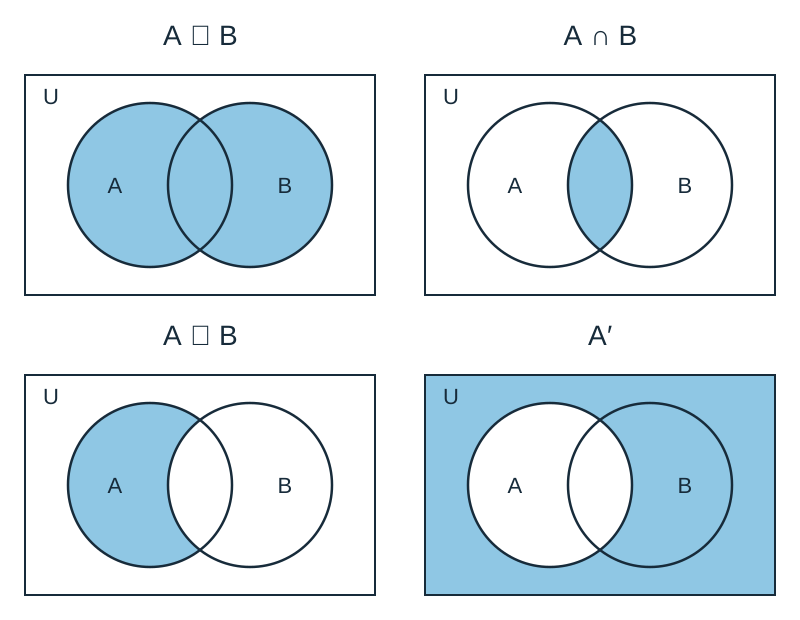
Union and intersection are commutative and associative; set difference is neither. For example, .
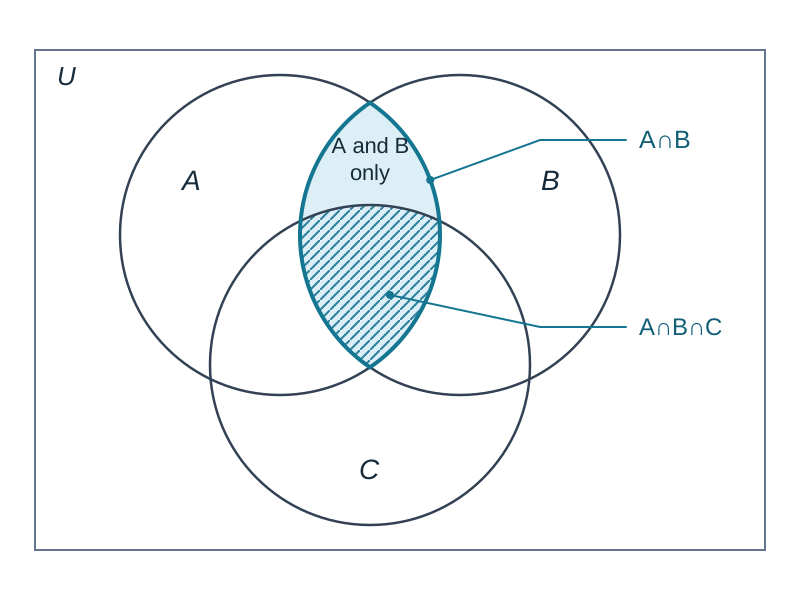
In a 3-set Venn diagram:
- Centre: triple intersection ; full combined area: .
- Working from the centre: subtract the triple count from pairwise intersections to find elements in exactly two sets.
Key terms
- Rational Number ()
- A number that can be written as a fraction , where and .
- Irrational Number ()
- A real number that cannot be written as a fraction of integers; its decimal form is infinite and non-repeating.
- Surd
- A root of a rational number whose value is irrational, such as .
- Scientific Notation
- A number written in the form , where and .
- Cardinal Number ()
- The total number of distinct elements in a set .
- HCF and LCM
- The Highest Common Factor is the largest integer dividing each value; the Lowest Common Multiple is the smallest positive shared multiple.
Check yourself
Order the following numbers from smallest to biggest: , , , .
In decimal form: , , , , so the order is .
Evaluate without a calculator.
.
Simplify into the form .
.
If , , and , find .
, so .