

Speed tells us how far something travels in a given time. Exam questions involve calculating distance, speed, and time, converting units, and drawing or interpreting journey graphs.
Core Formulas and Rearranging
Speed measures how quickly an object covers distance. All calculations connect through the formula , where is distance, is speed, and is time.
At Higher Level, change the subject of the formula using algebra rather than relying on formula triangles:
- To find distance:
- To find speed: divide both sides by to get
- To find time: divide both sides by to get
Proportionality connects these variables directly:
- At a constant speed, distance is directly proportional to time: double the time means double the distance.
- For a fixed distance, speed and time are inversely proportional: double the speed means half the time.
Units, Conversions, and Accuracy
Units must match before substituting values into any formula. Standard pairs are kilometres with hours () and metres with seconds ().
To convert units:
- Hours and minutes to hours: divide the minutes by . For example, . Keep awkward decimals as fractions so you do not lose accuracy.
- to : multiply by and divide by (or divide by ). For example, .
- to : multiply by and divide by (or multiply by ). For example, .
- Speed per second to speed per minute: multiply by .
Keep full calculator accuracy during working, write the required unit, and round only at the end to the requested accuracy or scientific notation .
Average Speed for Multi-Stage Journeys
For any multi-stage journey, average speed is calculated using overall totals:
Averaging stage speeds generally gives the wrong answer. If you travel two stages of equal distance at different speeds, you spend longer travelling at the slower speed, so the slow part counts for more of the total journey time.
For example, driving at takes , and driving another at takes . The total distance is and the total time is . The average speed is , not the arithmetic mean of .
Drawing and Interpreting Distance–Time Graphs
Always check axis labels and units first. With time horizontally and total distance travelled vertically, slope gives speed: change in distance ÷ change in time.
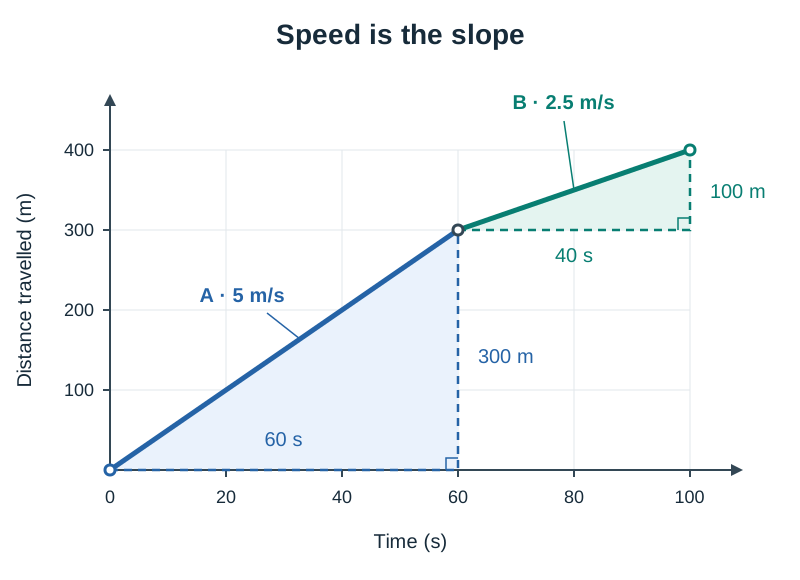
Key graph rules:
- A steeper line means a faster speed.
- A flat, horizontal segment means the object is stationary (speed is zero).
- Distance travelled can never decrease. On a distance-from-home graph, a downward segment shows returning home. For travel along a straight route towards or away from home, speed is the positive size of the slope.
- On a distance-from-home graph, the intercept shows starting distance, the highest point shows greatest distance, and zero means home.
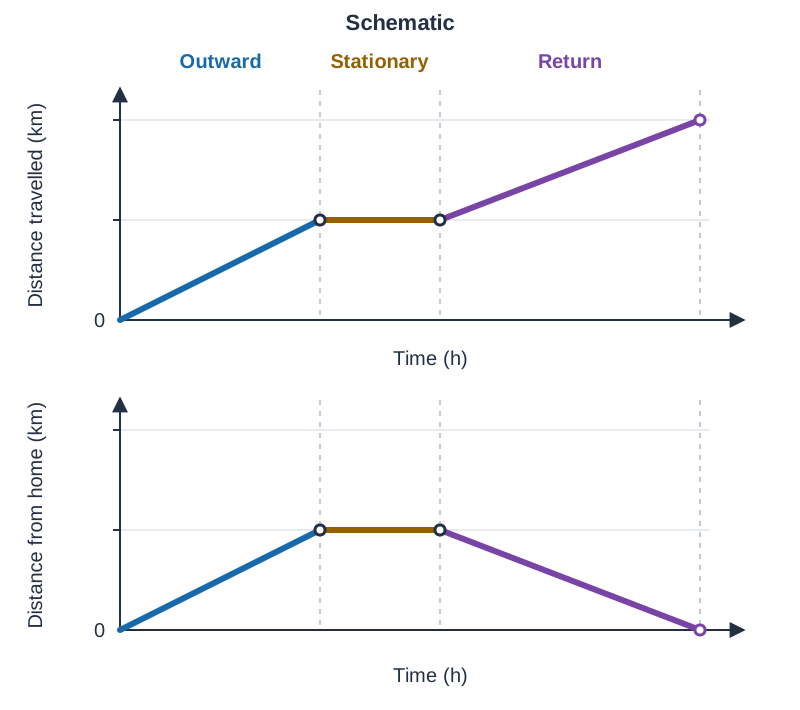
To draw a graph:
- Label axes with quantities and units, using an even scale.
- Plot the coordinates for each time–distance pair.
- Join points with straight segments for periods of constant speed.
Key terms
- Speed
- The distance travelled per unit of time, calculated as and measured in units such as or .
- Average Speed
- The total distance travelled divided by the total elapsed time for an entire journey, including any stops.
- Constant Speed
- Motion where the rate of travel does not change, shown by a straight line segment on a distance–time graph.
- Stationary
- The state of being at rest, represented on a distance–time graph by a horizontal line segment with a slope of zero.
- Slope (rate of change)
- Vertical change ÷ horizontal change; with time horizontally and total distance travelled vertically, slope gives speed.
Check yourself
Rearrange d = st to express time t in terms of d and s.
Divide both sides by s to get t = d/s.
Convert a speed of 25 m/s into km/h.
25 × 3.6 = 90 km/h.
For a fixed journey distance, how does tripling the speed affect the travel time?
Travel time is divided by 3 (one-third as long) because speed and time are inversely proportional.
A distance–time graph has points plotted at (0, 0), (10, 1), and (15, 1), with time in minutes and distance in km. Describe the motion.
The traveller covers 1 km in the first 10 minutes, then remains stationary for 5 minutes.
A runner covers 60 m in 30 s and then 150 m in 20 s. What is their average speed?
Total distance is 210 m and total time is 50 s, giving an average speed of 210 / 50 = 4.2 m/s.