

Trigonometry links the acute angles and side lengths of right-angled triangles using the sine, cosine, and tangent ratios. In the Junior Cycle Higher Level exam, you will calculate missing sides and angles, work with decimal angles, find exact surd ratios, and solve applied elevation and depression problems.
Right-Angled Triangles and Pythagoras' Theorem
Trigonometric ratios apply strictly to right-angled triangles, where one angle is .
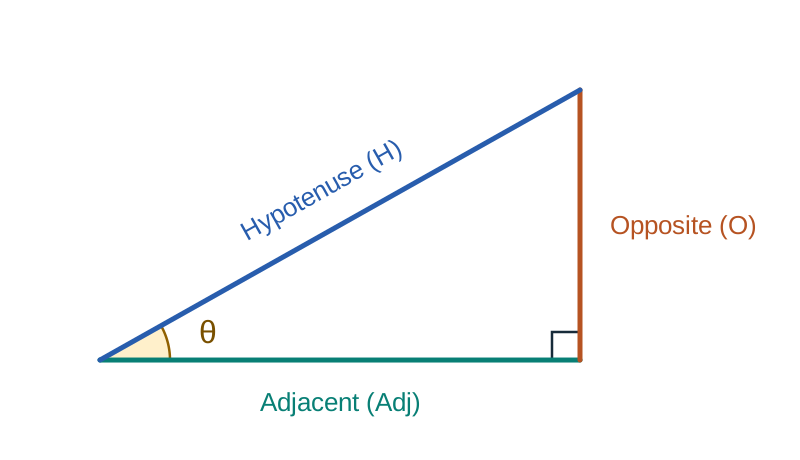
Before calculating, label all three sides relative to your chosen acute angle, :
- Hypotenuse (H): opposite the right angle.
- Opposite (O): opposite reference angle .
- Adjacent (Adj): between and the right angle.
When a problem involves side lengths without reference to acute angles, use Pythagoras' Theorem (, Theorem 14):
- To find the hypotenuse:
- To find a shorter side:
The Three Trigonometric Ratios
Similar right-angled triangles have proportional sides (Theorem 13), so each ratio stays constant when the triangle changes size.
The ratios have no units because they divide one length by another.
Calculating Side Lengths and Non-Right Triangles
Pick the ratio connecting your known side and unknown side. Rearranging depends on where the unknown sits:
- Unknown on top – multiply: .
- Unknown on the bottom – divide: .
Triangles with no right angle
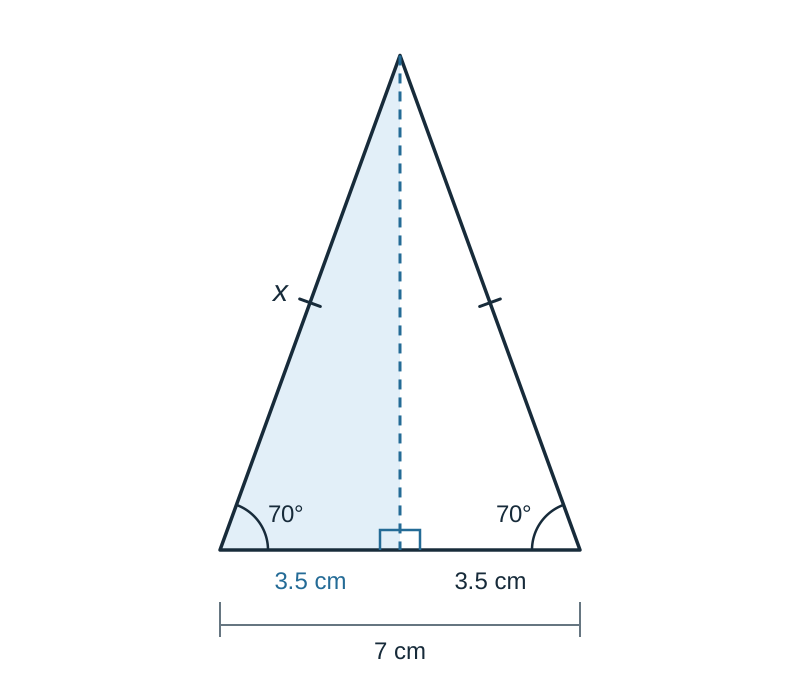
When given an isosceles or equilateral triangle, drop a perpendicular line from the apex to the base to make two identical right-angled triangles. The perpendicular bisects the base.
For example, in an isosceles triangle with base and base angles of , the half-base is . The sloped side satisfies , giving .
Inverse Functions and Finding Angles
When two sides are known, use an inverse trigonometric function (, , or ) to find the acute angle :
- Known opposite and hypotenuse:
- Known adjacent and hypotenuse:
- Known opposite and adjacent:
For example, if an adjacent side is and the hypotenuse is :
The smallest angle in a right-angled triangle is always opposite the shortest side, and the two acute angles always sum to .
Angles of Elevation and Depression
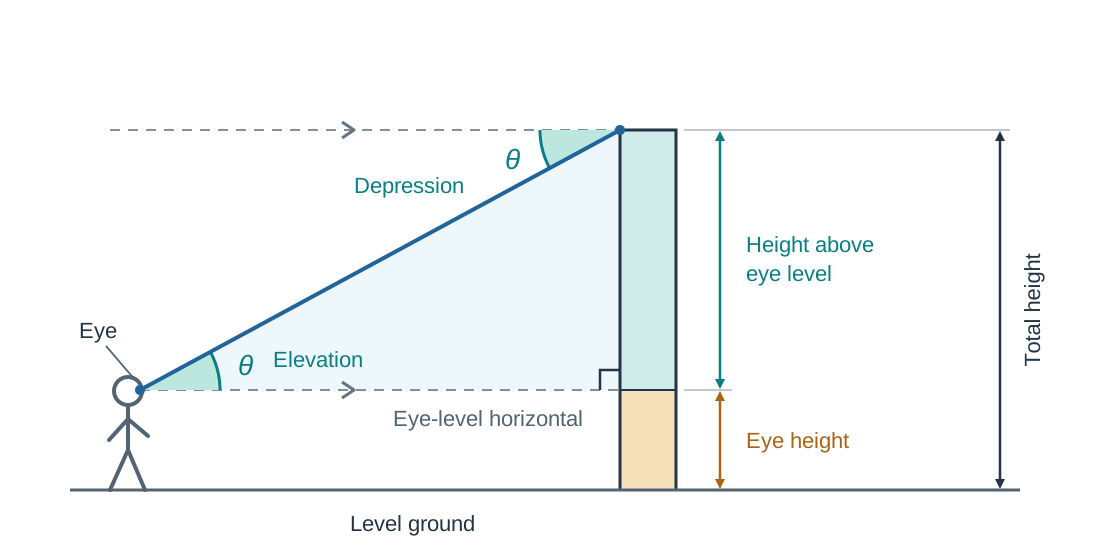
Always start by drawing a clear sketch showing the horizontal baseline, the observer's position, the angle, and the unknown height.
- Angle of elevation: looking upwards from the horizontal.
- Angle of depression: looking downwards from the horizontal.
The two horizontal lines are parallel, so the angle of depression looking down equals the angle of elevation looking up (alternate angles).
If a question gives an observer's eye height, calculate the vertical height above eye level first, then add the eye height to find the total height above ground.
Key terms
- Hypotenuse
- The longest side in a right-angled triangle, located directly opposite the 90° right angle.
- Sine (sin)
- The trigonometric ratio of the length of the opposite side to the length of the hypotenuse.
- Cosine (cos)
- The trigonometric ratio of the length of the adjacent side to the length of the hypotenuse.
- Tangent (tan)
- The trigonometric ratio of the length of the opposite side to the length of the adjacent side.
- Angle of elevation
- The angle formed between a horizontal baseline and an observer's upward line of sight.
- Angle of depression
- The angle formed between a horizontal baseline and an observer's downward line of sight.
Check yourself
Which trigonometric ratio connects the adjacent side and the hypotenuse?
Cosine: cos θ = Adjacent ÷ Hypotenuse.
A 4 m ladder leans against a wall at an angle of 65° to the ground. How high up the wall does it reach?
4 × sin 65° ≈ 3.63 m.
An equilateral triangle has sides of length 10 cm. What is its perpendicular height?
The perpendicular bisects the base into 5 cm, so h = 10 × sin 60° = √75 ≈ 8.66 cm (or by Pythagoras: √(10² - 5²)).
If tan θ = 9/12, how do you find the measure of angle θ?
Use inverse tan: θ = tan⁻¹(9/12) ≈ 36.87°.