

Transformation geometry is the study of how shapes move across a plane by sliding, reflecting, or turning while keeping their size and shape intact. In the Junior Cycle Higher Level exam, you need to recognise and draw images under translations, axial symmetry, central symmetry, and rotations, and find all axes of symmetry in 2D shapes.
The Four Transformations
A transformation maps an original shape, called the object, onto a new shape, called the image. The four transformations on the Junior Cycle course are isometries: lengths, angles, and area stay the same, so the image is congruent to the object.
| Transformation | What happens to the shape | Everyday picture |
|---|---|---|
| Translation | Slides every point the same distance and direction | Sliding a book |
| Axial symmetry | Flips over a mirror line (axis of symmetry) | Looking in a mirror |
| Central symmetry | Half-turn () through a fixed centre point | Spinning a card halfway |
| Rotation | Turns around a fixed centre by a set angle | Turning clock hands |
Identifying Transformations
To identify an unknown transformation, link corresponding points on the object and image to test for a translation vector, an axis of reflection, a centre of symmetry, or an angle of rotation.
Axial and Central Symmetry
In axial symmetry, a shape is reflected across a mirror line. For a point off the mirror line, the line crosses its joining segment halfway, at right angles. Points on the mirror line stay fixed.
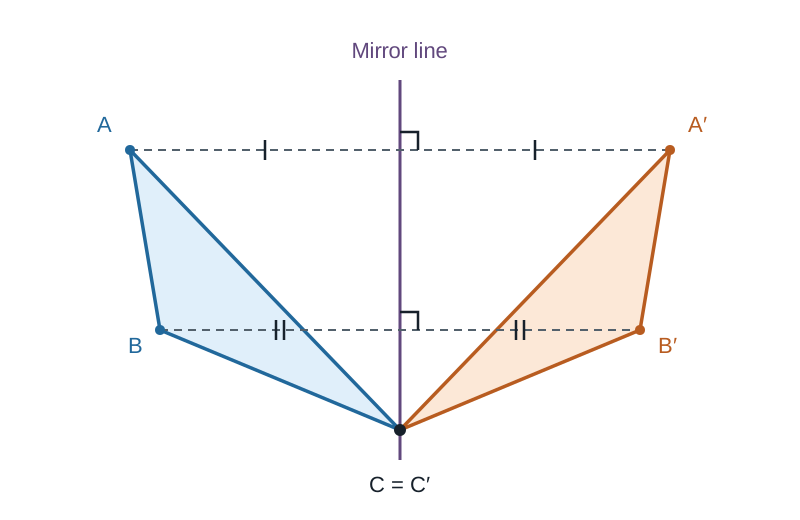
- Reflection in a line: draw a perpendicular from each vertex to the mirror line; measure and continue equally far beyond it.
- Axial symmetry in the -axis: keep , change the sign of : .
- Axial symmetry in the -axis: change the sign of , keep : .
Central Symmetry
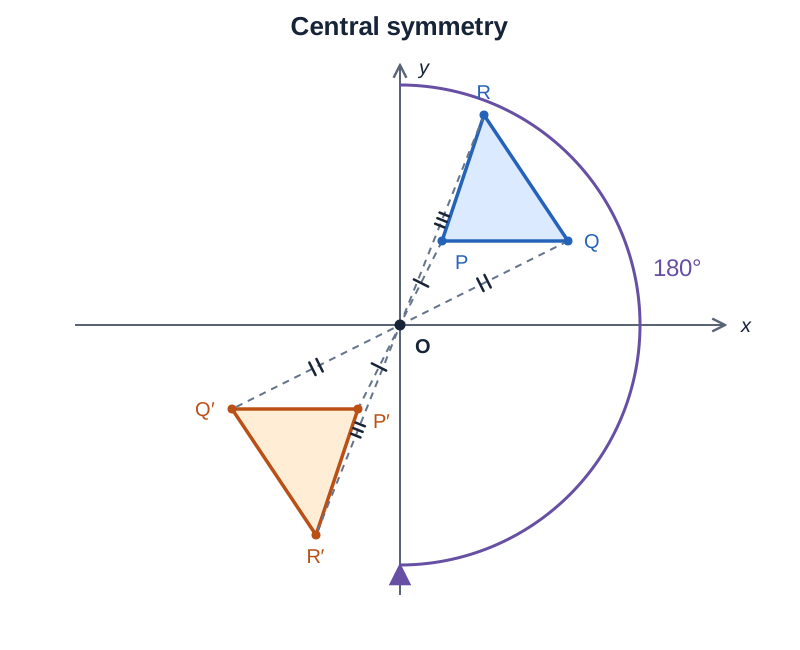
In central symmetry, the centre point is the midpoint of the line segment connecting each point to its image. Connect each vertex to the centre and extend the line the same distance beyond it.
- Central symmetry in the origin : change both signs: .
Translations and Rotations
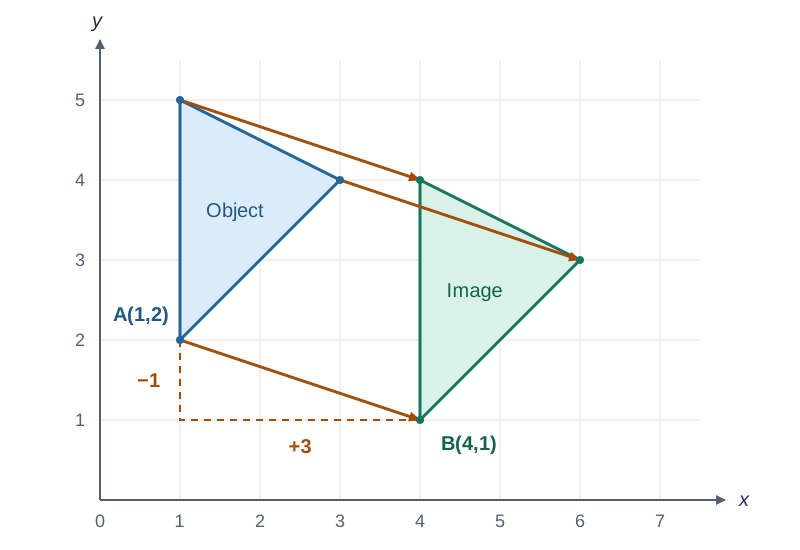
A translation slides every point of a shape by a fixed distance and direction. The translation moves every point by the vector from to .
- If moves to , the shift is horizontally and vertically. Every point transforms as .
Rotations
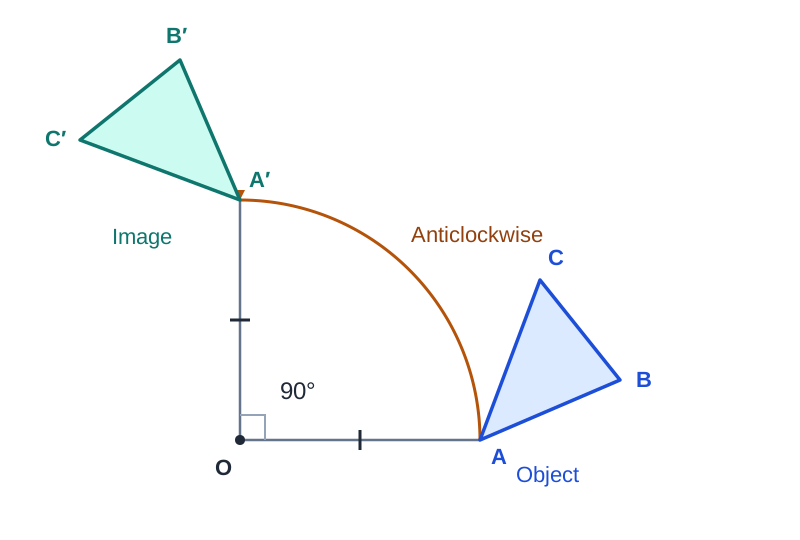
A rotation requires three details: a centre of rotation, an angle of turn (such as or ), and a direction (clockwise or anticlockwise).
To draw a rotation:
- Draw a straight line from the centre to a vertex.
- Measure the required angle from this line using a protractor in the given direction.
- Mark the image vertex at the exact same distance from the centre.
- A rotation of about any point produces the same image as central symmetry in that point.
Axes of Symmetry in 2D Shapes
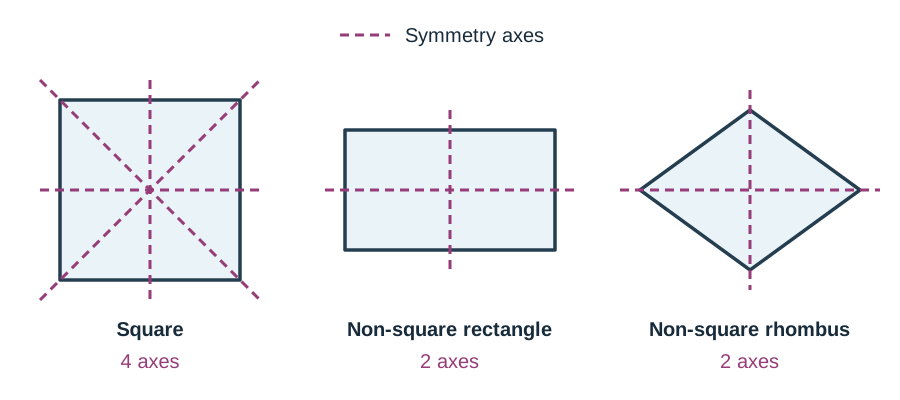
An axis of symmetry is a line dividing a shape into two mirror-image halves that match exactly when folded. Halving the area alone is not enough; the outer edges must coincide.
| Shape | Number of Axes | Position of Axes |
|---|---|---|
| Equilateral triangle | From each vertex to the midpoint of the opposite side | |
| Isosceles triangle (not equilateral) | Bisects the angle between the two equal sides | |
| Scalene triangle | None | |
| Square | Two midlines and two corner diagonals | |
| Non-square rectangle | Two midlines through opposite sides (not diagonals) | |
| Rhombus (not a square) | The two corner diagonals | |
| Kite | The main diagonal between the unequal angles | |
| Parallelogram (not rectangle/rhombus) | Has central symmetry, but no axis of symmetry | |
| Regular -sided polygon | Regular pentagon has , regular hexagon has | |
| Circle | Infinite | Any straight line passing through the centre |
Key terms
- Object
- The original geometric shape or point before any transformation is applied.
- Image
- The resulting position of a point or shape after undergoing a transformation, typically written with prime marks (such as A').
- Translation
- Sliding an object a specific distance in a given direction without turning or flipping it.
- Axial Symmetry
- Reflecting a shape across a mirror line: points on the line stay fixed, while for points off the line, the line perpendicularly bisects the segment to its image.
- Central Symmetry
- A transformation through a point where the centre is the exact midpoint between each point and its corresponding image point.
- Rotation
- Turning an object about a fixed centre point through a specified angle and direction.
- Axis of Symmetry
- A line dividing a 2D shape into two mirror-image halves that match perfectly when folded.
- Centre of Rotation
- The fixed point about which every point of an object turns during a rotation.
Check yourself
What is the image of under axial symmetry in the -axis?
, because reflection in the -axis changes only the sign of the -coordinate.
How many axes of symmetry does a regular hexagon have?
Six, because every regular polygon with sides has exactly axes of symmetry.
How many axes of symmetry does a parallelogram have if it is neither a rectangle nor a rhombus?
Zero, although it has central symmetry in the point where its diagonals intersect.
Which single transformation produces the exact same image as a rotation of about the origin?
Central symmetry in the origin .