

Geometric constructions use instruments to draw shapes, lines, and angles accurately. In the Junior Cycle Higher Level exam, you must carry out constructions 1 to 15 accurately, and sometimes name the theorem that makes the construction work.
The Five Allowed Instruments
To construct means to draw accurately using only the approved tools, rather than sketching freehand.
- Straight-edge: rules a straight line through two points without measuring length.
- Compass: draws circles or arcs and marks off equal lengths.
- Ruler: measures lengths in centimetres and millimetres, and marks a point at a given distance along a ray.
- Protractor: measures an angle, and marks a ray making a given number of degrees with another ray.
- Set-squares: draw 90°, 45°, 30°, and 60° angles, or slide along a ruler to draw parallel lines.
Always use a sharp pencil.
Lines, Bisectors, and Perpendiculars (Constructions 1–5)
These constructions create right angles, bisect angles and segments, or draw parallel lines.
| No. | Construction | Tools for this method | Key Step |
|---|---|---|---|
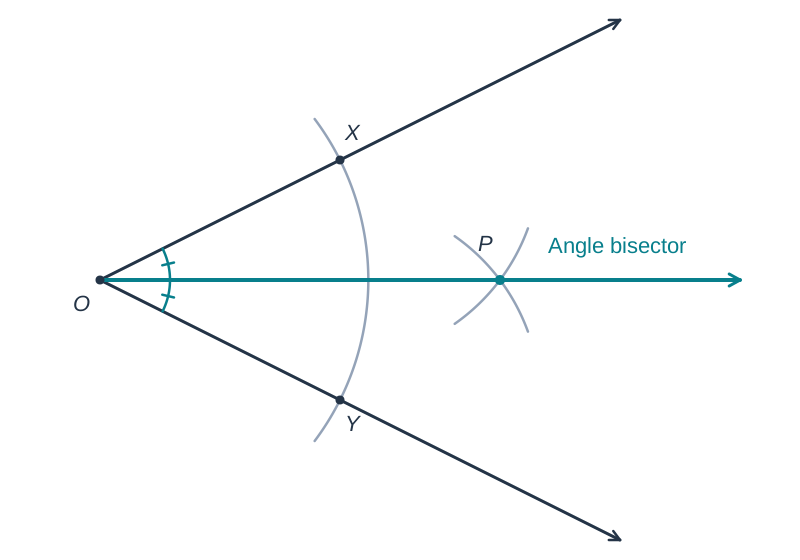
| 1 | Angle bisector | Compass and straight-edge only | Draw an arc across both arms; from crossings, draw equal intersecting arcs; rule ray. |
| 2 | Perpendicular bisector of [AB] | Compass and straight-edge only | Keep the same radius, greater than half AB; draw arcs from both ends and join their two crossings. |
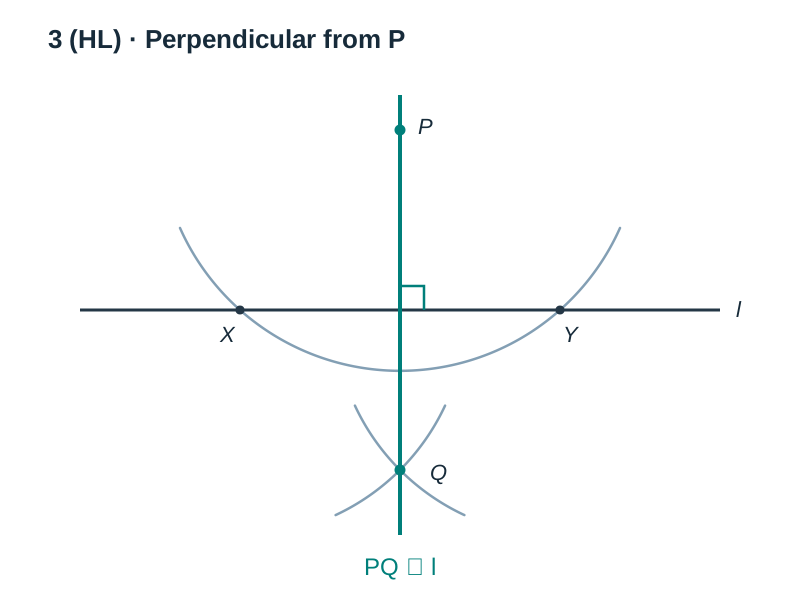
| 3 (HL) | Perpendicular to line through external point | Compass, straight-edge | Arc from point cuts line twice; draw equal arcs from crossings; join intersections through point. |
| 4 | Perpendicular to line through point on line | Compass, straight-edge | Mark equal arcs either side of point; construct perpendicular bisector of that segment. |
| 5 | Line parallel to line through given point | Ruler, set-square | Align set-square to line, place ruler on edge, slide set-square to point, rule line. |
Dividing Segments, Rays, and Angles (Constructions 6–9)
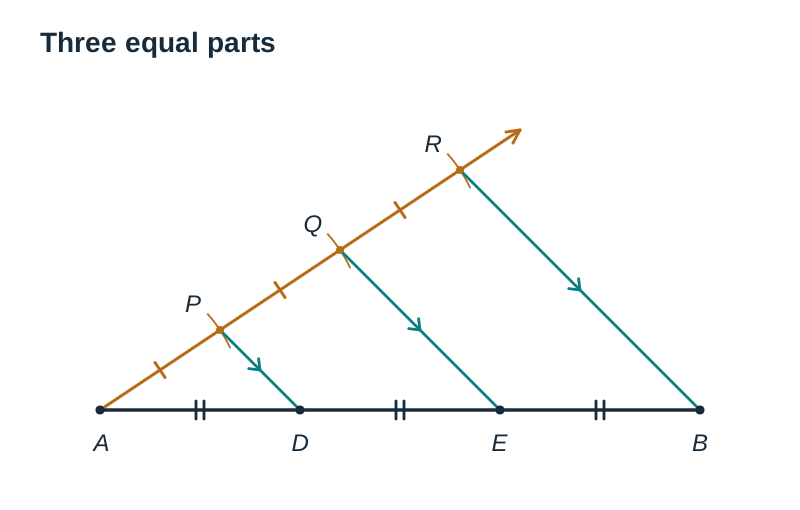
Constructions 6 and 7 divide a segment into equal parts without measuring with a ruler.
- Draw a ray from one end of the segment at an acute angle.
- For Construction 6, use a compass to mark 2 or 3 equal steps along the ray.
- For Construction 7 (HL only), mark any required number n of equal steps.
- Join the last step mark to the other end of the segment.
- Using a sliding set-square, draw lines parallel to this join through each step mark.
This method works because parallel lines that cut off equal segments on one transversal line cut off equal segments on any other transversal line (Theorem 11).
For Construction 8, measure a given length along a ray. For Construction 9, centre a protractor at the vertex, align the zero line, mark the required angle, and draw a ray from the vertex through the mark.
Triangles and Rectangles (Constructions 10–15)
Triangles and rectangles are constructed from given sides, angles, or right angles.
| No. | Given | Method |
|---|---|---|
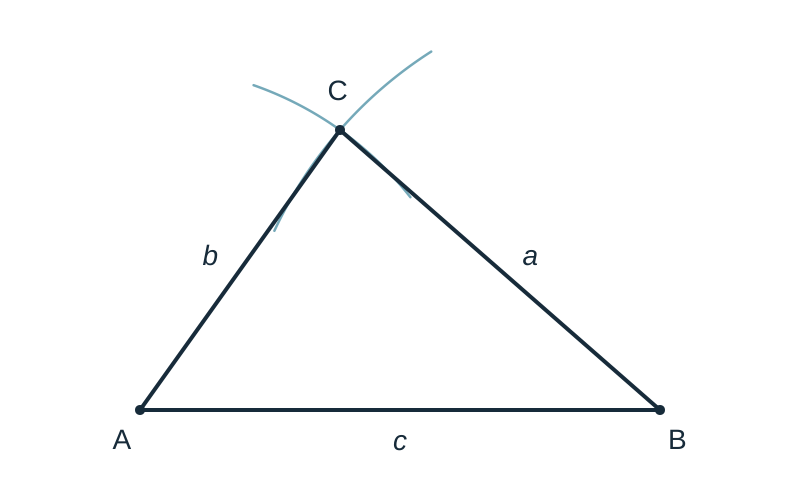
| 10 | SSS: three sides | Shorter sides must total more than longest. Draw base; remaining lengths set endpoint arcs. Join crossing to endpoints. |
| 11 | SAS: two sides, angle between | Draw angle; mark lengths on arms; join. |
| 12 | ASA: two angles, side between | Draw side; construct endpoint angles on same side; rays meet. |
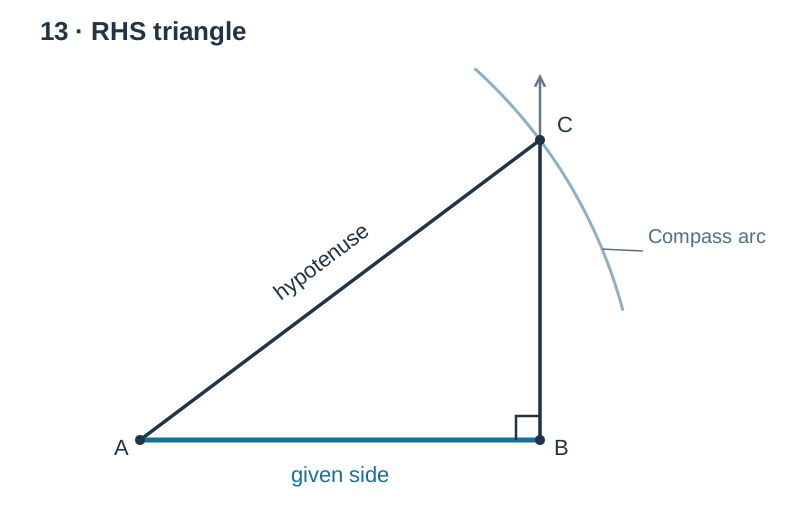
| 13 | RHS: right angle, hypotenuse, side | Draw leg AB; perpendicular at B. Arc centred A, hypotenuse radius, locates C; join AC. |
| 14 | ∠A=α, ∠B=90° | AB given: perpendicular at B meets α ray from A. BC given: perpendicular at B meets (90°−α) ray from C. AC given: α and (90°−α) rays at A and C meet on same side. |
| 15 | Rectangle: side lengths | Draw base; perpendicular sides of required length on same side; join tops. |
Key terms
- Construct
- To use properties of shapes and geometric results to draw accurately, using only the prescribed geometrical tools.
- Sketch
- To draw a rough diagram or graph without using geometrical tools.
- Straight-edge
- An ungraduated instrument used solely with a pencil to draw a straight line passing through two marked points.
- Angle bisector
- A ray that divides an angle into two angles of equal measure.
- Perpendicular bisector
- The straight line through the midpoint of a segment that is perpendicular to that segment.
- Hypotenuse
- The side opposite the right angle in a right-angled triangle.
- Transversal
- A line that intersects two or more other lines.
Check yourself
Which two constructions from 1 to 15 are examinable at Higher Level only?
Construction 3 (perpendicular to a line through an external point) and Construction 7 (dividing a segment into any number of equal parts without measuring).
An angle bisector divides an angle measuring 74°. What is the measure of each resulting angle?
37°, because 74° ÷ 2 = 37°.
Which theorem explains why dividing a line segment using a helper ray and parallel lines works?
Theorem 11: if three parallel lines cut off equal segments on some transversal line, then they will cut off equal segments on any other transversal.
Why can a triangle not be constructed with side lengths 3 cm, 4 cm, and 8 cm?
Because 3 cm + 4 cm = 7 cm, which is less than 8 cm; the two shorter sides together are not longer than the third side, so the arcs cannot cross.