

Geometry investigates the properties, measurements, and spatial relationships of shapes, lines, and solids. The Junior Cycle Higher Level exam tests synthetic proofs and angle calculations, 2D area and perimeter, 3D volume and surface area, coordinate geometry of the line, and transformations.
Deductive Reasoning and Triangles
Geometry justifies conclusions through logical steps. Five axioms are accepted without proof: exactly one line passes through two distinct points; distances are non-negative. If C lies between A and B, ; adjacent angles forming a straight angle total ; triangles are congruent by SAS, ASA, or SSS; and exactly one line parallel to a given line passes through an external point.
Key angle and triangle rules:
- Vertically opposite angles are equal.
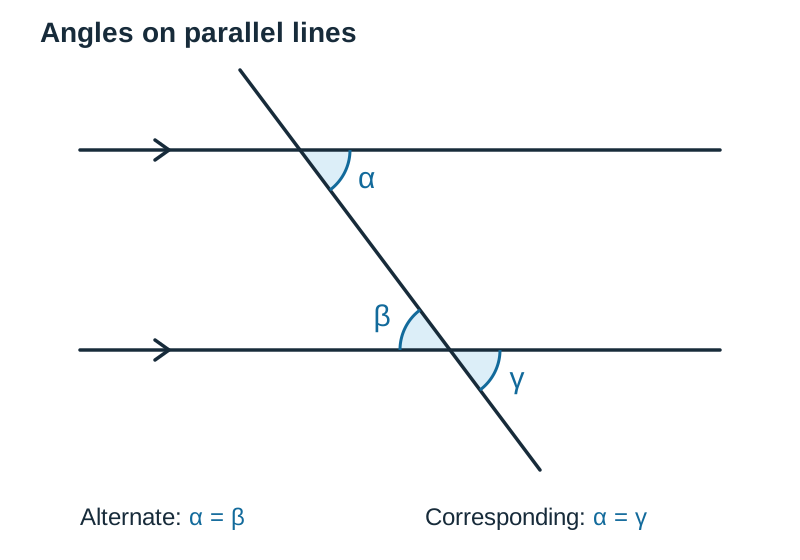
- Alternate and corresponding angles on parallel lines are equal; their converses prove lines are parallel.
- Angles in a triangle sum to ; an exterior angle equals the sum of opposite interior angles.
- In an isosceles triangle, angles opposite equal sides are equal; the converse also holds.
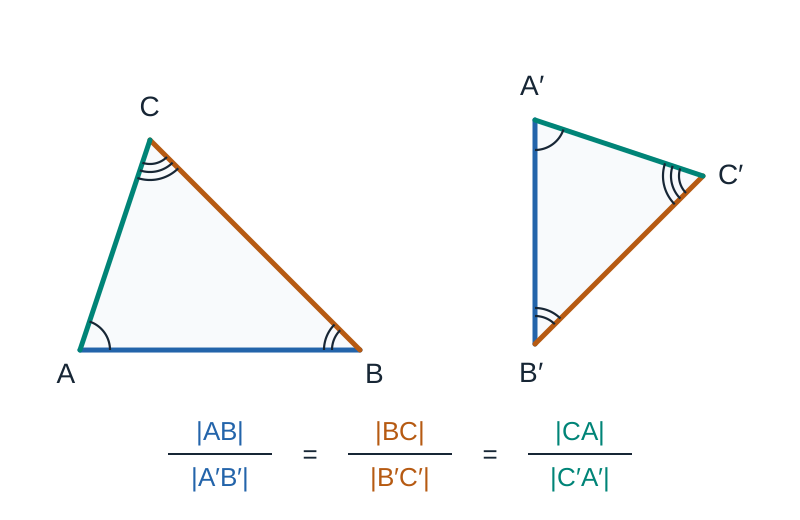
- Triangles are similar if angles are equal, which implies corresponding sides are proportional.
- In a right-angled triangle, is the hypotenuse, opposite the right angle: .
Polygons, Circles, and Constructions
- Parallelograms have equal opposite sides and angles; diagonals bisect each other and divide the shape into congruent triangles.
- If three parallel lines cut equal segments on one transversal, they cut equal segments on any transversal.
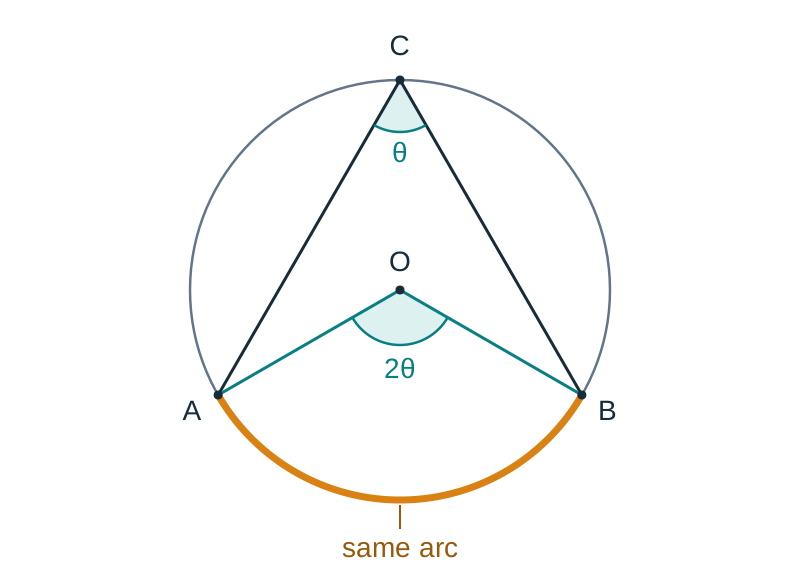
- The angle at the centre of a circle is twice the angle at the circumference on the same arc.
- Angles on the same arc are equal; the angle in a semicircle is .
- Conversely, a chord standing opposite a right angle at the circumference is a diameter.
- In a cyclic quadrilateral, opposite angles sum to ; the converse also holds.
- A tangent touches a circle at one point; lines meeting at one point are concurrent.
- Use the tools permitted for each construction, including a protractor where appropriate; constructions 1–2 require only compass and straightedge.
- Higher Level adds constructions 3 (perpendicular through external point) and 7 (dividing a segment into equal parts without measuring).
2D Measurement, Perimeter, and Area
Always convert all measurements to matching units before calculating (, ). On a scaled diagram of , represents in reality.
- Rectangle: ; .
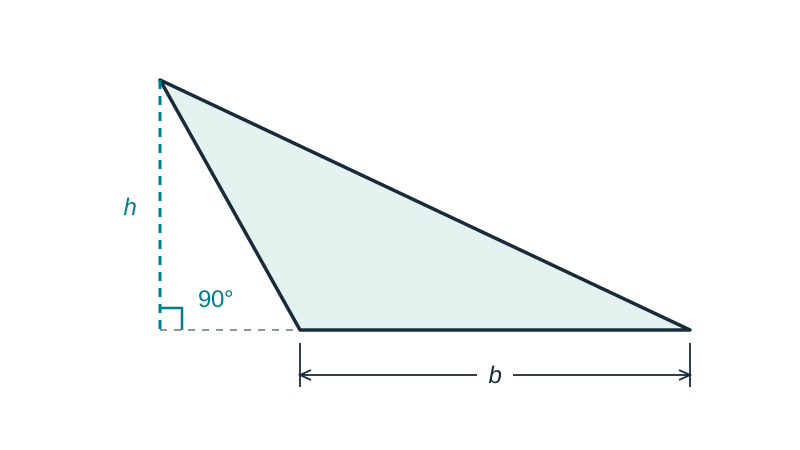
- Triangle: , where is the perpendicular height.
- Disc: ; circumference .
- Compound figures: split the shape into rectangles, triangles, and discs, then add the separate areas, or subtract cut-out sections.
- Perimeter is the total distance around the outer boundary only; do not include internal dividing lines.
3D Solids, Surface Area, and Nets
Volume measures the space a solid occupies; capacity measures how much a container holds (, ).
- Rectangular solid (cuboid): ; .
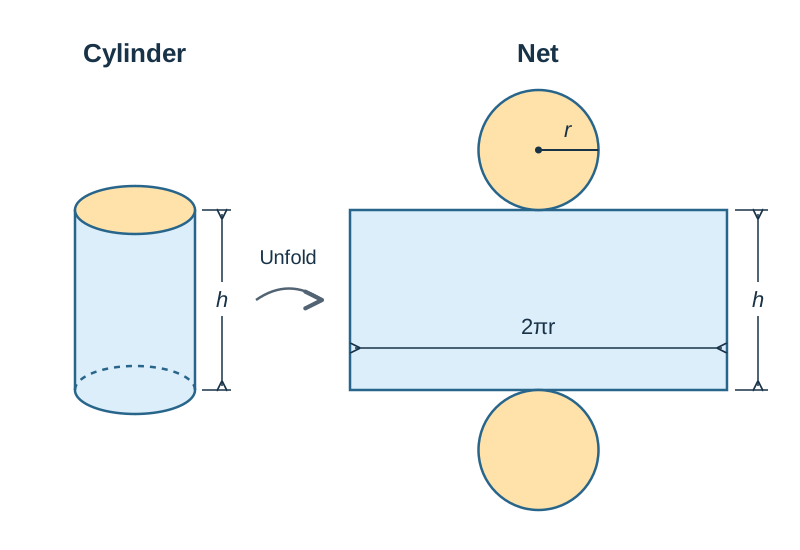
- Cylinder: ; curved surface area ; closed cylinder total surface area .
- Triangular-based prism: ; surface area , where is the triangle's perimeter and is length.
- Sphere: ; surface area .
- For composite solids, add or subtract volumes, but for surface area count only exposed external faces.
- Nets show unfolded shapes: a cuboid has six rectangles; a cylinder net has two discs and a rectangle.
Coordinate Geometry and Transformations
Coordinate formulas link geometry with algebra:
- Distance: ; midpoint: .
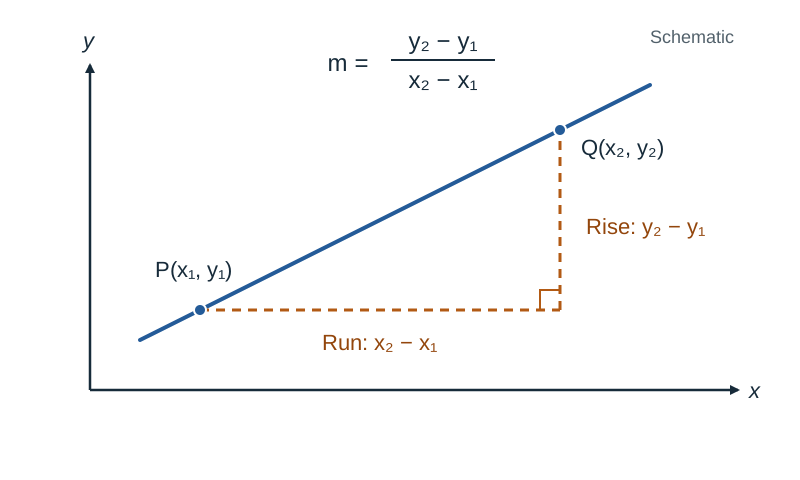
- Slope . On real-world graphs, slope represents the rate of change and the -intercept is the starting value.
- Parallel non-vertical lines have equal slopes (). Perpendicular lines with defined slopes satisfy .
- Line equations: , , and general form . Solve simultaneous equations to find points of intersection.
- Transformations preserve lengths and angles: translation (slide), axial symmetry (reflection in a line), central symmetry (half-turn through a point), and rotation (turn about a centre).
- An axis of symmetry folds a shape into matching reflected halves.
Key terms
- Axiom
- A foundational statement accepted as true without proof, used as a starting rule for deduction.
- Theorem
- A mathematical statement proved to be true by a chain of logical deduction from axioms and established results.
- Corollary
- A mathematical result that follows directly and easily from an established theorem.
- Converse
- A statement formed by swapping the 'if' and 'then' parts of a proposition.
- Congruent Triangles
- Triangles with equal corresponding sides and equal corresponding angles.
- Similar Triangles
- Triangles with equal corresponding angles and proportional corresponding sides.
- Cyclic Quadrilateral
- A four-sided polygon whose four vertices all lie on a circle.
- Tangent
- A straight line that touches a circle at exactly one point, called the point of contact.
Check yourself
If an angle at the centre of a circle standing on an arc is 116°, what is the angle standing on the same arc at the circumference?
58°, because the angle at the centre is twice the angle at the circumference on the same arc.
A right-angled triangle has perpendicular sides 7 cm and 24 cm. Find its hypotenuse.
c = √(7² + 24²) = √625 = 25 cm.
What is the area of a disc of radius 6 cm, written in terms of π?
36π cm², calculated using Area = πr² = π(6²).
What is the slope of any line perpendicular to a line with slope -3/4?
4/3, because (-3/4) × (4/3) = -1.