

Area measures flat surface coverage, while volume measures the three-dimensional space inside a solid. In the Junior Cycle Higher Level exam, you will calculate boundaries, composite areas, surface areas, and volumes for cylinders, prisms, spheres, and combined shapes.
1. Units of Measure, Conversions, and Scale
Always check your units before starting any calculation. If dimensions are mixed, convert them all to the requested unit first.
| Quantity | Conversions |
|---|---|
| Length | , |
| Area | |
| Volume | |
| Capacity | , |
Remember that area scale factors square the linear factor, while volume factors cube it. On a scaled drawing with a ratio of , each unit on paper represents units in real life. Divide the real length by to find the drawing length.
2. Perimeter and Area of Plane Figures
Perimeter is the total boundary distance around a shape, while area measures the flat space inside.
- Rectangle: ;
- Triangle: , where height must meet base at
- Disc (Circle): ;
When working with a semicircle, its perimeter includes both the curved arc and the flat diameter: . For any sector with angle , the arc length is and its sector area is . For composite 2D shapes, split the diagram into familiar triangles, rectangles, or discs, then add or subtract their individual areas.
3. Nets of Prisms and Cylinders
A net is a flat two-dimensional pattern that folds up to make a three-dimensional solid without any overlapping faces.
- Cuboid: Unfolds into six rectangles, made of three matching pairs.
- Right polygonal prism: Has two matching polygon bases joined by rectangular sides perpendicular to the bases. A triangular prism has two triangles and three rectangles, while a hexagonal prism has two hexagons and six rectangles.
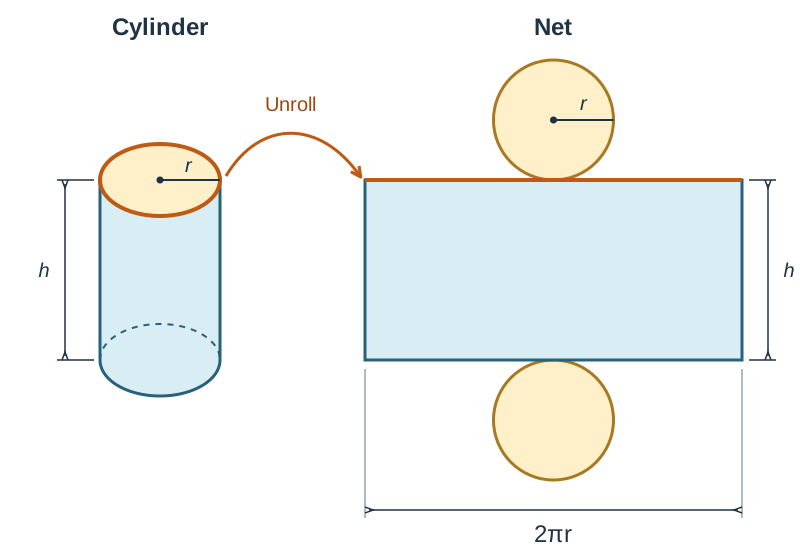
- Cylinder: Unfolds into two matching circular bases and one large rectangle.
The cylinder's curved wall becomes the body of the rectangle. Its height is the cylinder height , and its width matches the circumference of the circular base, .
4. Volume of Solids and Combinations
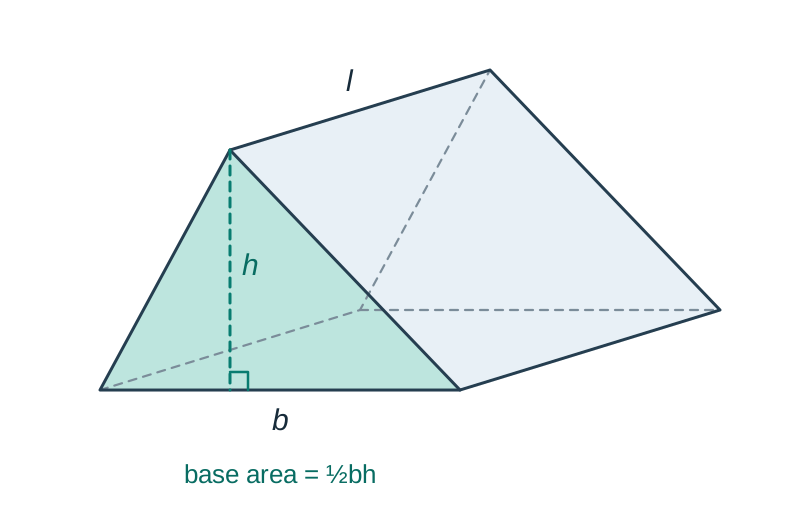
Prism volume = base area × perpendicular distance between bases. In V = ½bhl, h is the triangle’s perpendicular height; l is the distance between triangular ends.
- Cuboid:
- Cylinder:
- Triangular Prism:
- Sphere:
- Hemisphere: Halve the sphere formula to get .
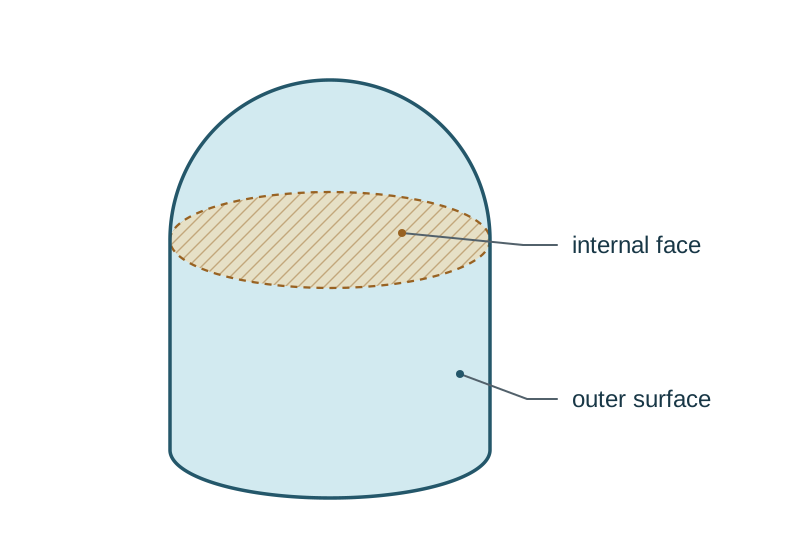
For composite solids, calculate each component separately. For example, a silo made of a cylinder with a hemispherical cap has volume . If an object has a hole drilled out, subtract the missing volume from the main solid.
5. Curved and Total Surface Area
Take care to distinguish between curved surface area and total surface area.
| Solid | Curved Surface Area (CSA) | Total Surface Area (TSA) |
|---|---|---|
| Cylinder | ||
| Sphere | ||
| Solid Hemisphere | ||
| Triangular Prism | None — all faces are flat. |
A cylinder’s outside curved area is 2πrh. An ideal open-top cylinder, ignoring thickness, has area 2πrh + πr². When shapes are joined together into a composite solid, ignore touching interior faces because they are no longer on the outside.
Key terms
- Perimeter
- The total outer boundary length enclosing a two-dimensional shape.
- Cross-Section
- The two-dimensional shape formed by a flat cut through a solid.
- Prism
- A solid with matching, parallel polygonal ends and the same cross-section along its length.
- Net
- A 2D pattern of connected faces that folds along edges to build a 3D solid.
- Curved Surface Area
- The area of the curved exterior surfaces of a shape, excluding its flat ends.
- Total Surface Area
- The complete exterior area of all faces of a solid combined, both flat and curved.
Check yourself
Convert an area of 0.4 m² into cm².
.
What is the total boundary perimeter of a semicircle with radius 7 cm, using π = 22/7?
.
Find the volume of a sphere of radius 3 cm in terms of π.
.
A cylinder has radius 4 cm and height 10 cm. Find its curved surface area in terms of π.
.