

Co-ordinate geometry links algebra and shapes by using number pairs to pinpoint positions on a grid. In the Junior Cycle Higher Level exam, you will calculate distances, midpoints, and slopes, find line equations in multiple forms, work out points of intersection, and interpret real-world graphs.
Points, Distance, and Midpoint
A point on the co-ordinate plane is written as , where gives horizontal position and gives vertical position relative to the origin . Two standard formulas describe the segment between and :
- Distance formula:
- Midpoint formula:
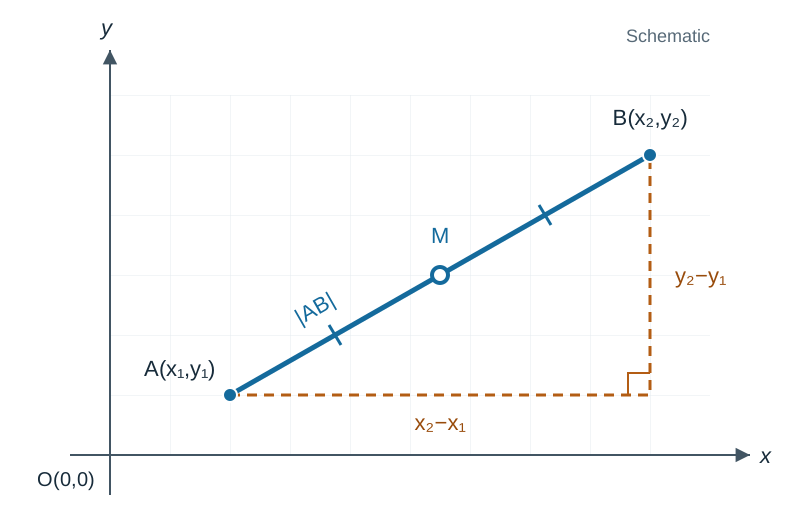
Always use brackets when substituting negative values. For instance, if and , then . The midpoint is just the average of the -values paired with the average of the -values.
When graphing a segment, plot the endpoints on the scaled axes and join them with a ruler.
Slope and Real-World Rate of Change
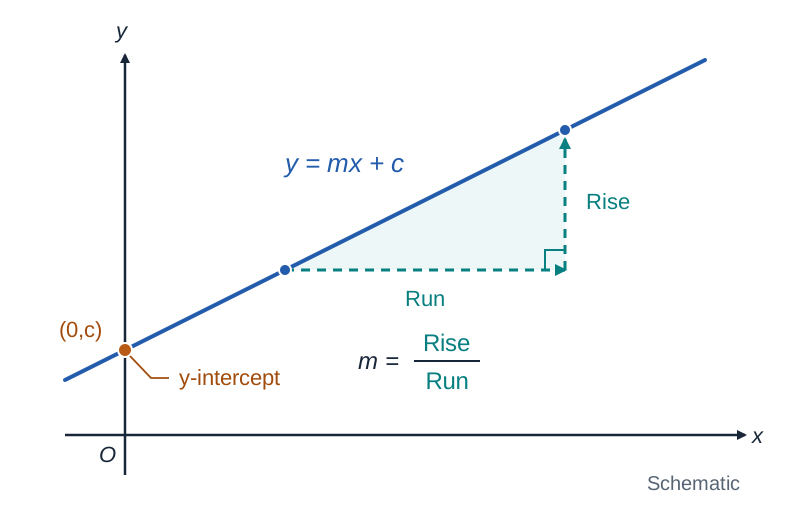
The slope measures how steep a line is and which way it slants. You calculate it using vertical change divided by horizontal change:
- A positive slope climbs from left to right, while a negative slope falls.
- A horizontal line has a slope of .
- A vertical line has an undefined slope because dividing by zero is impossible.
On applied graphs, slope represents the rate of change. It tells you how much the vertical quantity shifts for every single unit increase along the horizontal axis. The -intercept gives the starting quantity when the horizontal variable equals zero.
Parallel and Perpendicular Lines
Parallel lines run in the exact same direction and never cross. When their slopes exist, they are equal (). Distinct vertical lines are also parallel to each other.
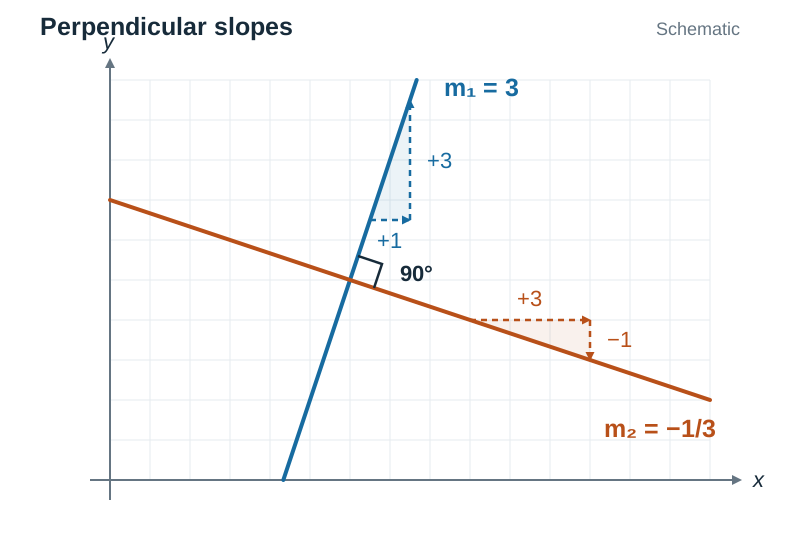
Perpendicular lines meet at right angles (). If neither line is vertical, their slopes multiply to give :
To find a perpendicular slope, flip the fraction upside down and switch the sign. For example, if a line has a slope of , any line perpendicular to it has a slope of . A slope of becomes . Horizontal lines (slope ) and vertical lines (undefined slope) are always perpendicular.
Line Equations and Points of Intersection
Every line equation sets a rule that all points on that line satisfy. You will encounter three main formats:
- Slope-intercept form: , where is the slope and is the -intercept.
- Point-slope form: , used when you know the slope and one point .
- General form: , where . When exam questions ask for integers, multiply across by the common denominator to eliminate fractions.
Plot two distinct points satisfying the equation and join them with a ruler. For a non-vertical line, choose x-values and calculate y. For x = k, choose two y-values. Non-parallel lines cross at one point of intersection, which you find algebraically by solving their equations simultaneously.
Key terms
- Co-ordinate plane
- A two-dimensional surface formed by a horizontal -axis and a vertical -axis intersecting at the origin .
- Midpoint
- The exact centre point of a line segment, calculated by averaging the -coordinates and averaging the -coordinates.
- Slope ()
- A measure of steepness and direction, calculated as vertical change divided by horizontal change.
- Rate of change
- The slope of a line on a practical graph, showing how fast the dependent variable changes relative to the independent variable.
- Parallel lines
- Lines in the same plane that never meet.
- Perpendicular lines
- Lines that meet at 90°.
- -intercept
- The co-ordinate where a line crosses the vertical axis, found by setting .
- Point of intersection
- The single point shared by two lines, found by solving their linear equations simultaneously.
Check yourself
What is the distance between and ?
units, since .
Find the midpoint of the line segment joining and .
, found by calculating .
If a line has a slope of , what is the slope of any line perpendicular to it?
, which is the negative reciprocal of .
Where does the line cross the -axis?
, found by letting so .