

Number patterns are ordered sequences of numbers or shapes that follow a consistent mathematical rule. In Junior Cycle Higher Level, you must identify and continue linear, quadratic, doubling and tripling patterns, use tables and graphs, and express linear and quadratic rules in words and algebra.
Categorising Sequences: Differences and Ratios
To identify how a pattern behaves, calculate the differences or ratios between consecutive terms:
- Non-linear patterns are any patterns without a constant first difference; quadratic and exponential patterns are both non-linear.
| Pattern Type | Defining Feature | Graphical Shape |
|---|---|---|
| Linear | Constant first difference | Points on a straight line |
| Quadratic | Constant non-zero second difference | Points on a parabola |
| Exponential | Constant multiplier, called a common ratio | Points on a curve; check that terms double or triple |
Linear Patterns and the General Term
A linear sequence changes by adding or subtracting the same value, , at each step.
When counting starts at term 1 (), the general term is:
- is the first term ().
- is the common difference ().
- is the term position ().
For , and :
In a real-world linear pattern, the starting amount is the Stage 0 value and the fixed change each step is :
Saving €15 at the start and €6 a week gives after weeks. To find when the total is €81, solve weeks.
Quadratic Patterns and Finding Tn
A quadratic pattern has a constant, non-zero second difference and general term:
To find the coefficients:
- Find : The second difference equals , so .
- Form equations: Substitute and into using the given values of and .
- Solve for and : Subtract the two equations to eliminate , find , and substitute back to find .
A negative second difference gives a negative , so the terms eventually fall and the curve turns downwards. Finish by checking your formula gives the correct , and be ready to state the rule in words.
Visual Patterns and Discrete Graphs
Exam questions often present spatial patterns, such as tile grids or matchsticks.
For joined matchstick squares, count the shared sides: an initial square needs sticks, and each extra square adds sticks:
For a linear pattern beginning at Stage 0, use . Here, working backwards gives a Stage 0 base of stick, leading directly to .
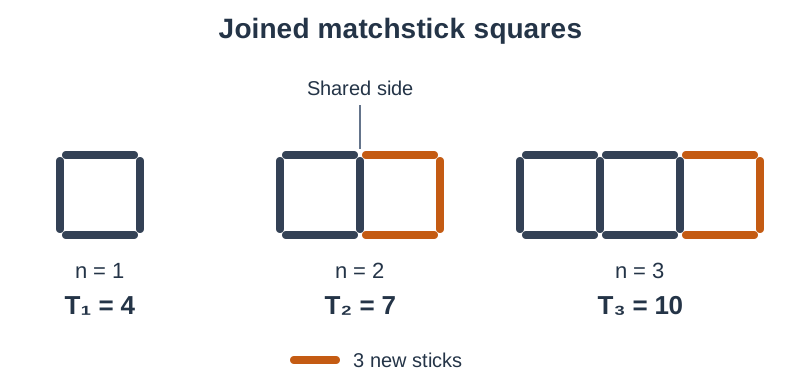
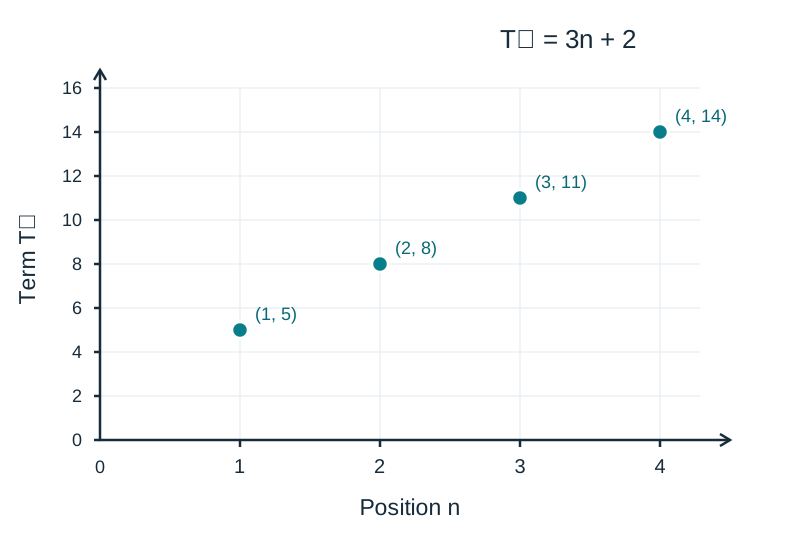
When graphing sequences, plot position on the horizontal axis and term value on the vertical axis as discrete, unconnected points. Do not join the points with a line, because term positions are whole numbers.
Key terms
- Term
- An individual number or member at a specific position in a sequence, written as .
- Common Difference (d)
- The constant amount added to or subtracted from each term to get the next term in a linear sequence.
- Second Difference
- The difference between consecutive first differences; it is always constant and non-zero in a quadratic sequence.
- Common Ratio
- The constant factor by which each term is multiplied to produce the next term in an exponential sequence.
- General Term (Tn)
- An algebraic expression that produces the value of any term in a sequence from its position number .
Check yourself
What type of sequence has a constant non-zero second difference?
A quadratic sequence.
Find the general term of the linear sequence
(multiply position by 3 and add 1).
If a quadratic pattern has a constant second difference of , what is the coefficient ?
, because .
A matchstick pattern starts at Stage 0 with 4 sticks and adds 3 sticks each stage. What is the formula for Stage S?
.
Categorise the sequence and state its next term.
Exponential tripling pattern (common ratio ); the next term is .