

Algebra word problems turn written information into equations. You may need to form and solve linear, simultaneous or quadratic equations, then explain your answer in context.
Turning Words into Equations
Translating a worded scenario into algebra is called to mathematise the situation. Use these four steps to organise your solution:
- Define variables: assign a clear letter to each unknown quantity, stating units explicitly (e.g. let be the cost of an adult ticket in euro).
- Translate relationships: convert written clues into algebraic expressions and link them using an equals sign ().
- Solve: solve the equation or equations using the method that suits their form.
- Check and answer: put your value back into the original story, give the units, and reject any answer that cannot happen in real life.
Always re-read the final line of the question to confirm whether it asks for one variable, both variables, or a combined total.
Linear Equations in One Variable
When a problem contains only one unknown quantity, describe every part of the story in terms of a single variable.
- Let represent the base quantity, and express related amounts in terms of (for example, three consecutive integers are , , and ).
- For perimeter problems, add the expressions for every side before setting the sum equal to the given total.
- Collect variable terms on one side and constant numbers on the other.
- Rational answers can be written as fractions of integers. Keep fractional answers exact unless rounding is requested.
Define your variable clearly, set up an equation from the given information, and solve for the unknown.
Translating Words to Simultaneous Systems
When two unknowns are linked by two linear relationships, write an equation for each relationship:
| Written Phrase | Algebraic Expression |
|---|---|
| "Five years older than twice Sarah's age " | |
| "Five less than a quantity " | |
| "The total cost of 3 coffees and 2 teas is €16.50" | |
| "The length is 4 m greater than the width " | |
| "The sum of two numbers is 45" |
Solve simultaneous equations using elimination or substitution. At Higher Level, the answers need not be whole numbers; solutions can be fractions or decimals. Substitute your first value back into an original equation to calculate the second variable, and check both in the original story.
Quadratic Problems and Rejecting Impossible Answers
Word problems can lead to quadratic equations that must be solved and checked in context.
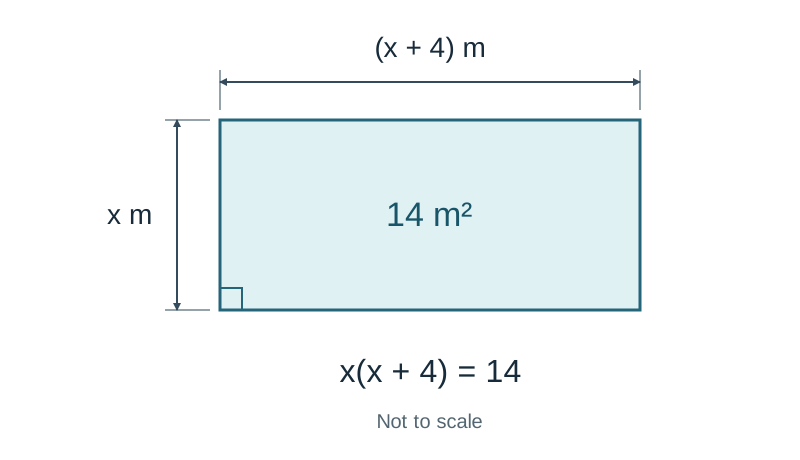
- Multiplying two unknown lengths or numbers can produce a quadratic equation, such as .
- If an area is given as an expression, set it equal to the stated total.
- Solve by factorising or by using the quadratic formula: .
- At Higher Level, answers often involve surds. Keep exact roots during working and round only on the final line to the requested accuracy.
- Check each real solution against the original conditions: lengths, times, and prices cannot be negative. You must explicitly reject an impossible root with a short reason.
Key terms
- Mathematise
- To generate a mathematical representation (such as an equation, expression, or diagram) to describe a real-world scenario.
- Variable
- A letter used to represent an unknown quantity that can change or needs to be calculated.
- Linear Equation
- An equation that can be written using only constant multiples of variables and constant terms, without products of variables, for example or .
- Simultaneous Equations
- A pair of equations with shared variables that must both be satisfied at the same time.
- Quadratic Equation
- An equation that can be written in the standard form , where .
Check yourself
What is the algebraic expression for 'six less than three times a number n'?
If a rectangle has a perimeter of 28 cm and its length is x cm, what is the expression for its width?
(because the semi-perimeter is ).
Why must the mathematical root x = -4 be rejected if x represents the radius of a circular flowerbed?
A physical measurement of length or radius cannot be negative.
State the two linear equations represented by: 'Two coffees and three scones cost €11.50, while one coffee and four scones cost €12.00'.
and , where is the coffee price and is the scone price in euro.