
Technology in Society explores human responsibility in technical decision-making: how the choices engineers and designers make affect everyday users, wider communities, and the natural environment. In Leaving Certificate Technology this is not a separate theory chapter. It turns up in every design decision you make: which material you choose, who will use the product, how much energy it uses, and what happens to it at the end of its life. At Higher Level, you are expected to evaluate modern developments across seven core areas of daily life, apply ergonomic and anthropometric data to Universal Design, calculate operating energy and battery runtime, understand workplace safety and consumer law, and assess products across their environmental and commercial life cycles. This topic underpins the 2027 Higher Level coursework brief on supporting an ageing society and appears regularly across Section A, Section B, and Section C of the written examination.
Technological Change across Society: The Seven Core Areas
Technological activity occurs when humans use knowledge, tools, and systems to solve problems and meet needs. Every development brings a balance of benefits, costs, and societal trade-offs. The syllabus examines these changes across seven core areas of daily life:
Industry
Automation, Computer-Aided Manufacturing (CAM), and robotics deliver high precision, consistent tolerances, and remove workers from hazardous tasks such as spray painting or heavy lifting. However, automation displaces repetitive manual labour, requiring workforces to retrain in systems maintenance, programming, and quality control.
Transport
Electric vehicles and autonomous transit systems eliminate roadside tailpipe emissions and reduce driver error. Autonomous vehicles combine LIDAR (Light Detection and Ranging), which pulses laser light to build a real-time 3D map of immediate hazards and pedestrians, with GPS (Global Positioning System) satellite signals for macro route planning and navigation. The trade-offs include the intensive extraction of battery minerals like lithium and cobalt, alongside complex legal liability when collisions occur.
Health
Remote medical telemetry, smart insulin pumps, and wearable monitors allow patients to manage long-term conditions from home, freeing hospital beds. However, transmitting diagnostic telemetry across networks creates strict privacy duties, and high equipment costs risk creating digital divides between patients.
Communications
High-speed broadband, video conferencing, and mobile networks allow instant worldwide collaboration and remote working. Conversely, they can foster digital exclusion for communities without reliable infrastructure, while exposing citizens to online scams and misinformation.
Lifestyle
Smart home automation and connected appliances reduce domestic physical effort and monitor heating efficiency. These form part of the Internet of Things (IoT) — a network of everyday physical devices fitted with sensors, software, and network connectivity so they can exchange data over the internet, for example a heating controller that reports room temperature to a phone app. The trade-off is an increasing household dependence on uninterrupted electrical power and internet connectivity.
Work
Cloud platforms, CAD, and remote networking allow flexible working hours and cut commuter travel. The disadvantage is the blurring of boundaries between work and home life, together with the risk of deskilling when automated software replaces traditional manual drafting and calculating skills.
Leisure
Streaming media, digital gaming, and interactive simulations provide accessible global entertainment, but they can encourage sedentary habits and generate massive volumes of electronic waste through rapid consumer upgrades.
Designs do not emerge in isolation; they reflect their historical and cultural settings. Early domestic appliances were built from heavy cast iron and clockwork mechanisms because small electric motors were not yet commercially viable. Cultural settings also shape everyday standards, from mains plug configurations to the side of the road on which vehicles travel.
Immersive Technologies and Additive Manufacturing
Two modern technologies regularly examined in societal contexts are:
- Virtual Reality (VR) – a fully immersive computer-generated environment that replaces the user's view of the physical world, viewed through a headset. Applications include surgical simulation and safe industrial training for high-voltage or hazardous environments.
- Augmented Reality (AR) – digital information, graphics, or sensor data overlaid onto the user's live view of the physical world through a screen or smart glasses. Applications include machinery maintenance instructions superimposed onto an engine bay, or surgical navigation.
- Additive manufacturing (3D printing) – builds a physical component layer upon layer from a digital 3D CAD model, adding material only where required. This contrasts with subtractive manufacturing (turning, milling, sawing), where material is cut away from a solid block as waste swarf. Additive manufacturing enables rapid prototyping, custom one-off prosthetics, and local production of spare parts, though it is generally slower than injection moulding for large production volumes.
Energy Choices and Environmental Implications
Technological activity consumes energy at every stage. The syllabus requires you to develop critical faculties regarding the energy and resource implications of technical developments. Energy sources divide into renewable sources, which replenish naturally on a human timescale, and non-renewable fossil fuels (coal, oil, gas, peat), which exist in finite reserves and emit carbon dioxide and particulates when burned.
| Energy Source | Operating Principle | Major Benefit | Critical Challenge |
|---|---|---|---|
| Wind (onshore and offshore) | Moving air rotates aerodynamic blades connected to an electrical generator | No fuel costs and zero greenhouse gas emissions during generation | Intermittent output; offshore construction and maintenance are costly in corrosive marine conditions; visual impact and disruption to shipping and fishing routes |
| Solar Photovoltaic (PV) | Semiconductor cells convert daylight directly into DC electricity via the photovoltaic effect | Silent operation, no moving parts, easily retrofitted to building roofs | Generation drops significantly during Irish winter months; requires inverter systems and battery storage; panels carry high embodied energy from manufacture |
| Hydroelectric | Falling water under gravity drives a turbine coupled to a generator | Highly predictable, controllable, and responsive to peak grid demands | Extremely few viable geographic sites; dam construction floods river valleys and disrupts fish migration |
| Biomass | Organic matter (wood pellets, agricultural residues, biogas) is combusted for heat or power | Utilises organic waste streams; near carbon-neutral if replanting equals harvesting rate | Combustion still releases atmospheric particulates; intensive energy crops compete with agricultural food production |
| Wave and Tidal | Kinetic energy of waves or gravitational tidal movements drives submerged turbines | Ocean tides are entirely predictable years in advance | Harsh marine environments cause mechanical fatigue and saltwater corrosion; high capital installation costs |
| Geothermal and Heat Pumps | Electrically driven heat pumps transfer ambient thermal energy from the ground or air into buildings | Delivers 3 to 4 kW of thermal heat for every 1 kW of electrical energy consumed | High initial installation and ground-loop trenching costs; requires highly insulated buildings to work effectively |
When exam questions ask you to outline two challenges or benefits of an energy technology, give two distinct, fully developed points that name the specific issue and state why it matters.
Human Factors, Ergonomics, and Universal Design
Good technological design centres on the physical, sensory, and cognitive capacities of the person using the product. When designers overlook human factors, products become frustrating, inefficient, or dangerous to operate.
- Ergonomics is the study of how products, workstations, and environments are designed to fit the people who use them, prioritising user safety, comfort, and operational efficiency.
- Anthropometrics is the study and measurement of human physical dimensions, such as grip diameter, forward reach, sitting shoulder height, and eye level. Designers use statistical anthropometric data tables and size products to accommodate the 5th to 95th percentile of the target population. Sizing between these boundaries accommodates 90% of all users. The lowest 5% and highest 5% are excluded from standard mass sizing because catering for extreme bodily limits makes everyday products excessively bulky, complicated, or unaffordable for the general population.
- Universal Design is the practice of designing products and environments so they can be accessed, understood, and used to the greatest extent possible by all people, regardless of age, size, ability, or disability, without needing specialised adaptation.
The Seven Principles of Universal Design
Use these principles as specification and evaluation headings in your design folio:
- Equitable use – identical means of use for everyone, avoiding segregating or stigmatising any group.
- Flexibility in use – accommodates left- and right-handed users, varying paces, and seated or standing operation.
- Simple and intuitive use – operating mode is immediately obvious, regardless of the user's experience, language skills, or concentration level.
- Perceptible information – communicates essential data through multi-modal feedback (sight, sound, touch).
- Tolerance for error – minimises hazards and unintended actions by shielding hazardous controls and providing undo functions.
- Low physical effort – operates comfortably with minimal user force and without requiring sustained grip strength.
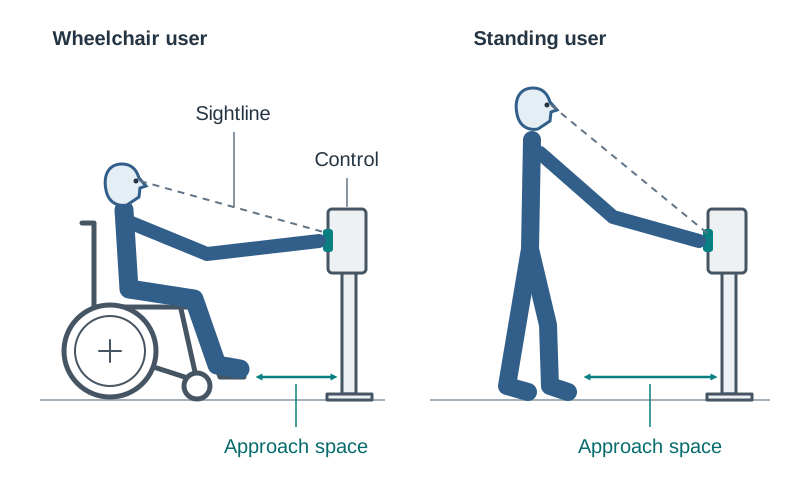
- Size and space for approach and use – provides clear sightlines and reach clearances for both seated wheelchair users and standing individuals.
Practical Applications for an Ageing Population
When designing assistive devices for older adults or individuals with physical limitations:
- Mechanical actuation: Replace small rotary dials or child-resistant pinch caps with wide lever handles, push paddles, or large push-buttons. These operate with a flat palm or light forearm pressure, assisting users with reduced grip strength or arthritis.
- Multi-modal sensory feedback: Pair visual warning lights with an audible signal having a low-pitched tone. Age-related hearing loss affects high frequencies first, so a lower-frequency sounder is detected when a high-pitched beep is missed. Adding tactile detents to switches gives positive confirmation to users with diminished eyesight.
- Visual contrast: Apply high-contrast colours, such as matte white sans-serif text on a dark charcoal background. Matte finishes prevent lighting glare, which causes problems for people with cataracts.
Product Life Cycles: Environmental Assessment vs Commercial Market Stages
In Leaving Certificate Technology, you must keep two distinct life cycles clearly separated: the environmental Life Cycle Assessment, which measures physical sustainability from extraction to disposal, and the commercial product life cycle, which tracks market sales over time.
The Five Stages of an Environmental Life Cycle Assessment (LCA)
An LCA tracks the total environmental burden of a product across its entire physical existence:
- Raw Material Extraction: Mining ores, harvesting timber, or refining crude oil. This depletes finite resources and causes habitat destruction. Developed societies carry moral responsibilities regarding how they exploit world resources, particularly when mining minerals in developing economies.
- Manufacturing: Converting raw materials into finished parts using energy-intensive operations like casting, machining, and moulding. This produces process emissions, contaminated coolants, and material scrap.
- Packaging and Transport: Protecting the product during freight. Burning diesel and aviation fuel emits carbon dioxide and oxides of nitrogen. Bulky packaging increases transport volume and ends up in landfill.
- Use: Operating the product over its service life. For energy-consuming domestic appliances (such as kettles, washing machines, or laptops), the use stage almost always accounts for the largest proportion of total lifetime energy use and carbon emissions.
- Disposal / End-of-Life: Discarding the product. Sending mixed assemblies to landfill wastes embodied materials and risks heavy metals leaching into groundwater.
Key Environmental Metrics
- Embodied energy – the total primary energy consumed to extract, process, manufacture, and transport a material or product to the point of sale, measured in megajoules per kilogram (MJ/kg). Virgin aluminium has a high embodied energy (around 150 to 200 MJ/kg), whereas recycled aluminium requires roughly 5% of that energy.
- Carbon footprint – the total quantity of greenhouse gas emissions generated across a product's lifecycle, expressed as kilograms of carbon dioxide equivalent (kg CO2e).
- Cradle-to-grave – a linear assessment tracking a product from raw material extraction straight to final disposal in landfill.
- Cradle-to-cradle – a closed-loop design approach where all end-of-life materials are separated and fed back as raw materials for new products, completely eliminating waste.
Design for Environment (DfE)
- Design for Disassembly (DfD): Join casings with accessible standard screws or snap-fit clips instead of permanent adhesives or ultrasonic welding. This allows fast, non-destructive servicing, component replacement, and separation of polymers from metals at end-of-life.
- Dematerialisation: Reduce the wall thickness of mouldings by incorporating stiffening ribs, using less material while maintaining structural rigidity.
- Mono-Material Construction: Mould housings from a single polymer type (such as polypropylene) and stamp international polymer identification codes on parts, simplifying sorting and recycling without manual separation.
- The Waste Hierarchy: Prioritise waste decisions in strict order: Prevent/Reduce (minimise material use and avoid scrap at source) -> Reuse (clean and reuse parts or repair modular units) -> Recycle (reprocess material into raw stock) -> Recover (extract energy from non-recyclable fractions through incineration or anaerobic digestion) -> Dispose (landfill as the absolute last resort).
Obsolescence and Electronic Waste
Obsolescence describes a product ceasing to be useful or wanted even though its physical parts may still function:
- Planned obsolescence – the manufacturer deliberately limits service life, such as using non-replaceable glued batteries or proprietary screws to make repair uneconomic.
- Technological/functional obsolescence – rapid advances in hardware or withdrawn operating system updates make an existing device incompatible with current software.
- Style obsolescence – changes in fashion, styling, or marketing persuade consumers to discard working products.
Obsolescence drives the rapid accumulation of hazardous e-waste (electronic waste). The design response is to provide modular components, published repair guides, long-term software patches, and take-back schemes under WEEE (Waste Electrical and Electronic Equipment) regulations.
The Commercial (Market) Product Life Cycle
When plotted as sales volume against time, a product follows four commercial stages:
- Introduction: The product launches. Sales are low, customer awareness is growing, and development and marketing costs mean profit is often negative.
- Growth: Rapid market acceptance. Sales rise sharply, economies of scale reduce manufacturing unit costs, and competitors begin launching rival models.
- Maturity: Sales reach their peak and level off as the market becomes saturated. Price competition is intense, and manufacturers rely on product differentiators, quality, and promotional offers.
- Decline: Sales fall steadily as technology advances, customer preferences change, or superior alternatives emerge. The product is phased out or heavily discounted.
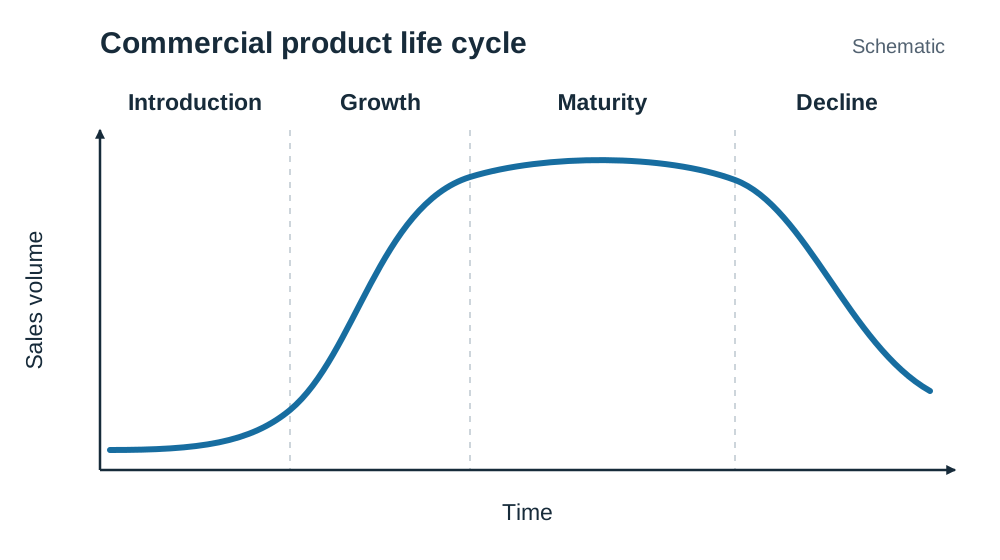
A product with critical functional flaws, such as unreliable battery life, suffers shortened growth and maturity phases, entering premature decline because poor reviews stop repeat purchases.
Conflicting Interests, Waste Management, and Workshop Safety
Technological projects inevitably produce conflicting interests between three distinct groups:
- The individual seeks low purchase prices, convenience, performance, and personal independence.
- Society requires employment, economic activity, and essential services, but must manage noise pollution, traffic congestion, and community health.
- The environment demands minimal resource extraction, clean air and water, preserved biodiversity, and reduced carbon emissions.
Resolving these conflicts requires legislation, environmental impact planning, and proper waste management rather than simply halting technological work.
Safe Disposal of Factory and Workshop Waste
- Metal swarf and offcuts: Segregate ferrous and non-ferrous metals into dedicated bins for scrap collection and remelting.
- Polymer offcuts: Granulate and re-melt thermoplastics; collect thermosetting plastics separately for authorised specialist disposal, as they cannot be remelted.
- Used cutting fluids, oils, and chemical solvents: Never pour chemicals down municipal drains; store them in sealed, labelled drums for collection by licensed hazardous waste disposal contractors.
- Timber dust: Extract dust at source using local exhaust ventilation systems and bag it securely. Fine wood dust represents both a respiratory health hazard and a serious fire and explosion risk.
- Electronic components: Handled under WEEE regulations; retailers and local civic amenity sites provide take-back channels for electronic assemblies.
- Batteries: Contain hazardous heavy metals and lithium compounds; return them to designated recycling points to prevent groundwater contamination from landfill leachate.
Workshop Safety Equipment and Fire Extinguishers
Under Leaving Certificate safety guidelines, workshops must have clearly identified and maintained safety equipment: machine guards, interlocks, emergency stop palm-buttons, an emergency electrical isolator switch, eye-wash stations, first-aid kits, marked emergency exits, and clear evacuation routes.
Fire extinguishers are identified by standard colour-coded bands:
- Water (Red band): Class A fires involving wood, paper, and textiles. Never use on electrical equipment or burning liquids.
- Carbon Dioxide / CO2 (Black band): Class B liquid fires and electrical fires. Leaves no chemical residue and does not conduct electricity.
- Foam (Cream band): Class A materials and Class B flammable liquids (paints, solvents, oils). Smothers the fire by excluding oxygen.
- Dry Powder (Blue band): Multi-purpose extinguisher suitable for Class A, B, C (flammable gases), and electrical hazards.
- Fire blanket: Smothers small, localised benchtop fires or clothing fires by cutting off oxygen supply.
Accidents that prevent an individual from performing normal work for more than three consecutive days (excluding the day of the incident), as well as any fatal injury, must be formally reported to the Health and Safety Authority (HSA). All workshop incidents and near misses must be recorded in the official accident logbook.
Legislation, Safety Responsibilities, and ICT Security
Technological and industrial activities are governed by statutory legislation to protect workers, consumers, and data privacy:
Health and Safety Responsibilities
Under the Safety, Health and Welfare at Work Act 2005, the employer holds the primary statutory duty to ensure, so far as is reasonably practicable, a safe place of work, safe machinery, competent systems of work, and appropriate staff training.
- A Safety Officer is appointed by the employer (or school authority) to manage day-to-day safety: drafting and updating the safety statement, conducting risk assessments, checking emergency stop buttons and interlocks, coordinating safety training, issuing Personal Protective Equipment (PPE), and investigating accidents.
- A Safety Representative is an employee selected by workers to represent them in safety consultations. Under the 2005 Act, the safety representative has legal rights to inspect the workplace, investigate employee complaints, make formal safety representations to the employer, and accompany an inspector from the Health and Safety Authority (HSA).
The Hierarchy of Controls
When controlling identified hazards, work through the hierarchy in order:
- Elimination: Design out the hazard entirely (such as using pre-formed parts rather than cutting on a saw).
- Substitution: Replace the hazardous material or process with a safer alternative (such as using water-based acrylic paint instead of solvent-based cellulose paint).
- Engineering controls: Isolate people from the hazard through physical barriers (such as fixed blade guards, magnetic safety interlocks, and local exhaust ventilation).
- Administrative controls: Alter work procedures and provide instructions (such as safety signs, certified machine training, and standard operating procedures).
- Personal Protective Equipment (PPE): Safety spectacles marked to standard EN 166, leather safety footwear, and ear defenders. This is always the last line of defence.
Consumer Law and Equal Opportunities
- Consumer Rights Act 2022: Goods sold must conform to the sales contract: they must be of satisfactory quality, fit for their intended purpose, and match their description. If goods fail, statutory remedies follow a set order: repair or replacement first, followed by a price reduction or a full refund. This law is enforced by the Competition and Consumer Protection Commission (CCPC).
- Equal Opportunities: The Employment Equality Acts and Equal Status Acts prohibit discrimination across nine protected grounds: gender, civil status, family status, sexual orientation, religion, age, disability, race, and membership of the Traveller community. In engineering, this mandates level entrances, accessibility ramps, accessible website standards, and inclusive transport systems.
Data Protection and ICT Security
- Data Protection (GDPR and Data Protection Act 2018): Personal data must be processed lawfully, fairly, and transparently for a specific stated purpose. Organisations must enforce data minimisation, maintain data accuracy, keep data secure, and retain it no longer than necessary. Individuals have the right to access their data, rectify errors, and request data erasure. The regulatory supervisory body in Ireland is the Data Protection Commission (DPC).
- Malware: Any malicious software designed to compromise or damage a system, including trojans, worms, and spyware.
- Virus: Malicious software that inserts its own code into legitimate applications, replicating itself and corrupting stored files.
- Phishing: Broad fraudulent emails sent to thousands of users, impersonating trusted institutions (such as banks) to steal logins or payment details.
- Spear phishing: A highly targeted cyberattack directed at a specific individual or company department, using researched personal details to make the fraudulent communication convincing.
- Whaling: A specialised category of spear phishing aimed directly at senior executives (such as managing directors or financial controllers) to authorise large fraudulent payments or extract confidential proprietary designs.
- Ransomware: Malicious software that encrypts user data and operating system files, demanding an extortion fee to restore access.
- 3-2-1 Backup Strategy: Keep three copies of critical data, on two different media types (such as an internal drive and an external solid-state drive), with one copy stored securely off-site or on an encrypted cloud service.
- Academic Integrity: Copying text, CAD drawings, or uncredited AI-generated output into your project folio and presenting it as your own work is plagiarism. Material copied directly receives no marks, and suspected plagiarism is thoroughly investigated by the State Examinations Commission.
Structured Product Appraisal and the 2027 Assessment Parameters
The Syllabus Product Appraisal Headings
When an examination question or your design folio asks you to appraise, analyse, or evaluate an existing or proposed design, structure your response using the five syllabus headings:
- Form: Overall profile, geometric shape, dimensions, ergonomics, colour, styling, and visual proportion. Does it look appropriate for its intended setting and user?
- Function: Operational performance, ease of use, stability, safety mechanisms, reliability, and clear feedback to the user.
- Materials: Suitability of selected materials for mechanical loads, operational wear, hygiene, environmental exposure, and unit manufacturing costs.
- Technologies: Mechanisms, electronic sensors, microcontrollers, control circuits, and manufacturing techniques used, and whether they suit the intended production volume.
- Environment: Operating energy consumption, embodied energy of the materials, ease of non-destructive disassembly, and end-of-life recyclability.
For broader critical reflection, evaluate the product through the four syllabus viewpoints: aesthetic (appearance and styling), technical (manufacturing quality and engineering performance), functional (practical usability), and ethical (fairness to users, worker conditions, and planetary resources).
The 2027 Examination and Coursework Structure
Assessment is split equally between the terminal written examination (50%, 200 marks) and the coursework project (50%, 200 marks).
- Written Examination (Higher Level, 2.5 hours, 200 marks):
- Section A (Core, compulsory): Answer 12 of 15 short questions covering all core areas of the syllabus.
- Section B (Core, compulsory): Answer two longer structured questions based on the core syllabus.
- Section C (Optional topics): For the 2027 examination, you answer one of the five option questions (reduced from the original two-question requirement). Check the mark allocation on the examination paper on the day and divide your writing time accordingly.
- Coursework Project (200 marks):
- Coursework must be completed in school under the supervision of your class teacher, must never be removed from the school, and must be available for assessment by Friday 19 March 2027.
- Coursework consists of an artefact (100 marks) and a design folio (100 marks).
- 2027 Higher Level Thematic Brief: Design and manufacture a working model of a device, system, or technical aid aimed at supporting independent living, wellbeing, or social participation in an ageing society. Your solution must focus on modern materials and processes, include an electro-mechanical element, and be well presented.
- Key Artefact Rules: The maximum dimension must not exceed 500 mm. If powered electrically, it must run on a low-voltage supply. All operating features must be clearly visible and accessible without dismantling the model.
- Key Folio Rules: Digital drawings must appear in hardcopy format in the folio. Where CAM (such as laser cutting or 3D printing) is used, supporting CAD drawings must be included to authenticate your own individual work. Multimedia submissions are limited to a maximum of 3 minutes duration.
- Folio Environmental Section: For the 10-mark folio section on environmental impact, explicitly document the materials evaluated, explain why you selected sustainable or recyclable options, state your model's electrical power consumption, explain how the model can be disassembled using mechanical fasteners, and detail end-of-life recycling paths.
Key terms
- Ergonomics
- The study of designing products, systems, and environments to match human physical dimensions, sensory abilities, and cognitive capabilities safely and comfortably.
- Anthropometrics
- The measurement of human bodily dimensions (such as reach, grip diameter, and eye height), used to size products and adjust clearances.
- Universal Design
- Designing products and built environments so they can be accessed, understood, and used to the greatest extent possible by all people, without needing specialised adaptation.
- Life Cycle Assessment (LCA)
- A systematic investigation of the environmental impacts of a product across five stages: raw material extraction, manufacturing, packaging/transport, use, and disposal.
- Design for Environment (DfE)
- A proactive design approach that integrates environmental safeguards into product development from the start to minimise lifetime ecological harm.
- Design for Disassembly (DfD)
- Designing products with accessible mechanical joints and labelled materials so they can be easily taken apart for repair, servicing, or recycling.
- Embodied Energy
- The total primary energy consumed to extract, process, manufacture, and transport a material or product to the point of sale, measured in MJ/kg.
- Planned Obsolescence
- A design strategy where a product is deliberately engineered with a limited service life or non-replaceable parts so that the consumer must buy a replacement.
- Safety Officer
- A person appointed by an employer to manage operational health and safety, prepare safety statements, carry out risk assessments, and investigate accidents.
- Safety Representative
- A worker selected by employees under the Safety, Health and Welfare at Work Act 2005 with statutory rights to represent staff on safety, inspect workplaces, and liaise with the HSA.
- Hazard
- Anything with the potential to cause harm, injury, illness, or physical damage.
- Risk
- The likelihood of a hazard causing harm, combined with the potential severity of that harm.
- Hierarchy of Controls
- The legal sequence for managing risk: Elimination, Substitution, Engineering controls, Administrative controls, and Personal Protective Equipment (PPE).
- Phishing
- Fraudulent electronic communications sent to a broad audience, impersonating trusted organisations to trick users into revealing sensitive credentials.
- Spear Phishing
- A targeted cyberattack tailored with researched personal or professional details aimed at a specific individual or organisation.
- Whaling
- A specialised form of spear phishing directed specifically at high-profile senior executives to execute financial fraud or extract sensitive corporate data.
- Ransomware
- Malicious software that encrypts user data or system drives, demanding an extortion payment before decrypting the files.
- Trade-off
- A design compromise where improving one functional feature (such as durability or speed) causes a disadvantage in another area (such as weight, cost, or recyclability).
Check yourself
What are the seven areas of society where technological developments have brought significant change according to the syllabus?
Industry, transport, health, communications, lifestyle, work, and leisure.
Why do anthropometric data tables size products to fit between the 5th and 95th percentiles rather than 0 to 100% of the population?
Designing for the extreme ends of the population makes mass-produced items awkward, excessively bulky, or unaffordable for general use; sizing from the 5th to 95th percentile comfortably accommodates 90% of the target group.
What are the five sequential stages of an environmental Life Cycle Assessment (LCA)?
1. Raw material extraction, 2. Manufacturing, 3. Packaging and transport, 4. Product use, 5. Disposal (end of life).
Name the four stages of the commercial product life cycle plotted as sales over time.
Introduction, Growth, Maturity, and Decline.
A wall-mounted assistive night light draws 1.5 W continuously. Calculate the electrical energy it uses in one full year (8760 hours) in kilowatt-hours (kWh).
Energy E = Power x Time = 1.5 W x 8760 h = 13,140 Wh = 13.14 kWh.
Give one social benefit and one social cost of installing continuous motion sensors in an older person's home.
Benefit: unobserved falls trigger automated alerts, allowing faster emergency response so the individual can live at home independently. Cost: movement tracking constitutes sensitive personal data that must be secured under GDPR, and some individuals feel automated monitoring infringes on their personal privacy and dignity.
What colour band identifies a Carbon Dioxide (CO2) fire extinguisher, and on what types of fire should it be used?
A black band; it is used on electrical fires and flammable liquid fires because it leaves no residue and does not conduct electricity.
What adjustment applies to Section C of the Leaving Certificate Higher Level Technology examination paper in 2027?
Candidates answer only one of the five option questions, rather than answering two.