

A Process of Design is the central problem-solving framework in Leaving Certificate Technology. Designing is not a straight line you walk through once. You work in stages, and when testing or research shows a problem, you go back a stage, change something, and carry on. This is called an iterative systems approach. You identify genuine human needs, establish measurable specifications, research existing products, model concepts, plan production, fabricate safely, and critically evaluate the finished artefact. For the 2027 Leaving Certificate examination, this core topic is assessed through the 2½-hour written paper (Section A short core questions, Section B long core questions, and Section C option questions — answering one of five in 2027) and the 200-mark coursework project (100 marks for the design folio and 100 marks for the artefact, completed in school under teacher supervision by 19 March 2027). At Higher Level, you are expected to provide deep, analytical justification, balance complex design trade-offs, apply anthropometric data, and describe concrete improvements rather than merely listing them.
The Iterative Design Process and Syllabus Stages
A design process is a structured sequence combining creative thinking with workshop execution. The syllabus models design on a systems approach, moving from an identified human need through logical stages to a functional, tested solution.
The eleven syllabus stages and the coursework marks they directly inform are:
- Design Brief: Stating the need, problem, or opportunity (feeds folio heading 1, 7 marks).
- Identification and Analysis of Problems: Establishing the root problem and user requirements (feeds folio heading 1, 7 marks).
- Recognition of Constraints: Identifying practical boundaries such as safety, environment, and resources (feeds folio headings 2 and 3, 15 marks).
- Investigation and Research: Appraising existing solutions and gathering anthropometric data (feeds folio heading 4, 7 marks).
- Generation of Ideas: Brainstorming and sketching a broad range of creative solutions (feeds folio heading 5, 18 marks).
- Presentation of Ideas: Communicating concepts through 2D and 3D sketches, CAD models, mock-ups, and schematics (feeds folio headings 5 and 6, 36 marks).
- Selection and Development of Optimum Solution: Objectively scoring concepts and developing mechanical and electronic details (feeds folio heading 5, 18 marks).
- Production Planning: Formulating step-by-step schedules, Gantt charts, critical path diagrams, and cutting lists (feeds folio heading 7, 10 marks).
- Making and Testing: Fabricating the physical artefact to high standards and gathering quantitative test data (feeds folio heading 8, 10 marks, and artefact heading 3, 30 marks).
- Evaluation: Reflecting on specification conformance, trade-offs, social and environmental costs and benefits, and described modifications (feeds folio heading 9, 10 marks).
- Presentation of Design Folio: Compiling a concise, accurate, and comprehensive project record (feeds folio heading 10, 5 marks).
Designing is not a straight line you walk through once. When physical testing reveals that a joint deflects under load or a mechanical linkage binds, you loop back to the development or modelling stage to adjust the geometry before resuming manufacture. Health and safety, societal impact, and environmental responsibility must permeate every single stage.
Interpreting Design Briefs and Writing Measurable Specifications
Every design project originates with an identified need or challenge, introduced as a design brief. A brief may be presented as a theme, as an open brief, as a closed brief, or as a mixture of these.
- An open brief sets a broad theme or desired outcome without dictating the mechanism or form (such as 'Design a system that assists independent living for an ageing population'). You have the freedom to identify user needs, set your own parameters, and explore different technical solutions.
- A closed brief imposes tight constraints and specific parameters (such as 'Design an automated ramp for a city bus that extends within 5 seconds and alerts the driver'), significantly narrowing the range of solutions.
- The SEC Higher Level coursework brief is a thematic brief: a broad theme (an ageing society) with a few fixed parameters (electro-mechanical element, 500 mm maximum dimension, completion deadline) and everything else left to you.
To interpret a brief, question it: who is the user, what do they need to do, why does the present solution fail them, where and when will it be used, and how will you know it works? Once the true need is established, rewrite the brief into a final concise statement and produce a design specification — a checklist of measurable requirements against which the design will be selected and tested.
Avoid writing vague aspirations like 'must be light and strong'. Use numerical targets with units:
- Function: The mechanism must reliably dispense one 10 mm tablet per activation without jamming.
- Size: Overall dimensions must fit within a 200 mm × 150 mm × 100 mm desktop footprint.
- User / Ergonomics: Operating buttons must feature an activation surface area of at least 35 mm diameter and require an actuation force of less than 4 N.
- Safety: The control circuit must operate from a DC voltage not exceeding 9 V, with all external casing edges filleted to a minimum 3 mm radius.
- Cost: Total expenditure on raw materials and electronic components must not exceed €30.00.
Problem Analysis, Historical Settings, and Everyday Technologies
Rushing into sketches before dissecting the root problem is a common pitfall. Designers distinguish between a visible symptom and the underlying cause. The dropped key is the symptom. Watching the user shows the cause: reduced grip strength or arthritis makes a small brass key hard to hold and turn. Design for the cause — a larger moulded key grip — not the symptom.
Gathering user requirements requires direct engagement through user interviews, questionnaires, observing people performing tasks, and testing existing products. Every design must centre on a clearly defined user group: when designing for an older person, you must address reduced grip strength, arthritis, and visual clarity, whereas designing for a child demands non-toxic finishes, high impact resistance, and the total elimination of small detachable parts.
Existing designs reflect their historical and cultural settings:
Historical Influences
Product evolution is driven by new materials (lightweight plastics and composites replacing cast iron and timber), new technologies (microcontrollers, sensors, and solid-state electronics replacing bulky clockwork mechanisms), and shifting societal patterns. In the exam, answer in three parts: what changed (a new material, a new technology, a change in how people live), what that changed about the product, and how that affected the people using it.
Cultural Influences
Customs, local materials, and traditions dictate product form. In design, colours and symbols carry varying regional meanings; a colour associated with celebration in one culture can signify mourning in another.
Everyday Technologies
Domestic appliances like washing machines and refrigerators eliminated hours of laborious manual work, altering household routines and lifestyle. Digital communication devices enable immediate contact across distances, though usability depends heavily on interface clarity.
Recognising Constraints and Appraising Existing Products
Constraints are the boundaries within which a design must function. Rather than preventing innovation, constraints channel creativity into realistic, workable solutions.
The Three Key Constraint Areas
- Safety constraints: hazards must be identified and the risk reduced as far as possible, in making the artefact and in using it. Guard moving parts, remove nip and shear points, round sharp edges and corners, keep electrical supplies to low voltage, and choose materials and finishes that give off no toxic fumes in use.
- Environmental constraints: consider the full product lifecycle: sourcing sustainable materials, minimising processing waste, reducing operational power consumption, and design for disassembly so parts can be sorted for recycling.
- Resource constraints: the four syllabus resource limits are:
- Cost: the financial budget allocated for materials, fasteners, and circuitry.
- Time: the project calendar, milestones, and final deadlines. For 2027, the coursework briefs were released early in September 2026 and must be available for assessment by 19 March 2027. Folio design and planning should be completed before Christmas, leaving the spring term for realisation and testing.
- Skills: the practical techniques the maker can execute to a high standard.
- Equipment: the tools, machines, and test instruments accessible in the school workshop.
Appraising Existing Solutions
When investigating existing products or sub-systems, appraise them using the five syllabus headings:
| Heading | Appraisal Focus |
|---|---|
| Form | Visual geometry, proportion, styling, balance, and aesthetic appeal. |
| Function | How reliably and effectively the product executes its primary and secondary tasks. |
| Materials | Suitability of physical and working properties (strength, mass, corrosion resistance, durability). |
| Technologies | Mechanisms, microcontrollers, sensor integration, software, and power supplies. |
| Environment | Resource consumption, manufacturing waste, energy efficiency, and ease of end-of-life recycling. |
Identifying design shortcomings during appraisal highlights the exact weaknesses your new design should eliminate.
Environmental Impact and Safe Processing of Materials
Think across the whole life cycle of your artefact:
- Materials: choose materials with low embodied energy (the total energy used to extract, process, and transport a material), from renewable or recycled sources where possible — FSC-certified birch plywood instead of unsustainably harvested timber, or recycled PET filament instead of virgin ABS.
- Manufacture: nest parts on stock sheets to minimise offcut waste, keep offcuts for prototyping, and avoid processes that demand high heating energy where a cold mechanical joint will do.
- Use: minimise operating energy demand by using a low-voltage DC power supply, incorporating sleep modes into microcontroller code, and specifying rechargeable lithium-ion cells over single-use alkaline batteries.
- End of life: apply design for disassembly by using machine screws or threaded inserts rather than permanent chemical adhesives, allowing distinct polymers and metals to be separated; mark plastics with their resin identification code; keep material variety low.
The 6Rs provide an effective revision framework: Rethink, Refuse, Reduce, Reuse, Repair, Recycle.
Two terms recurring in Leaving Certificate examination papers:
- Design for Environment (DfE): a comprehensive design methodology that sets out to reduce the overall environmental and human-health impact of a product across its entire life cycle — from raw material extraction, through manufacturing and distribution, to consumer use, maintenance, and eventual disposal, reuse, or recycling.
- Upcycling: creatively repurposing discarded products or waste materials to fabricate a new product of higher value or quality than the original. Raw material expenditure is significantly reduced, but because shaping and finishing are typically manual, processing and labour costs increase, yielding unique products.
Safety Implications of Material Processing
Safe workshop execution requires identifying the hazard and establishing the control:
| Process | Hazard | Workshop Control |
|---|---|---|
| Sanding MDF or hardwood | Fine airborne dust, respiratory tract irritation | Local exhaust ventilation, fit-for-purpose particulate dust mask |
| Laser cutting or strip-bending acrylic | Toxic or irritating thermal decomposition fumes | Enclosed extraction unit vented outdoors, well-ventilated bay |
| Soldering electrical joints | Lead exposure, rosin flux fumes, contact burns | Fume extractor, soldering iron stand, hand washing after handling |
| Solvent welding (Tensol) or spray painting | Volatile organic compound fumes, fire hazard | Dedicated fume cabinet, avoid ignition sources, correct respirator |
| Drilling sheet metal | Sharp spinning swarf, workpiece rotation | Safety glasses, clamp workpiece securely in machine vice, swarf brush |
Human Factors: Ergonomics and Anthropometrics
Products must fit the physical, biomechanical, and sensory characteristics of the people using them. Human factors divide into two complementary disciplines:
- Anthropometrics: The scientific collection and statistical analysis of human physical body measurements (such as stature, forward reach, sitting elbow height, and hand breadth), compiled into data charts.
- Ergonomics: The study of how people interact with products, tasks, and environments to maximise safety, efficiency, and comfort. Ergonomics applies anthropometric measurements alongside biomechanical principles to determine handle profiles, switch layouts, sight lines, and operating forces.
Designing for the 5th to 95th Percentile Range
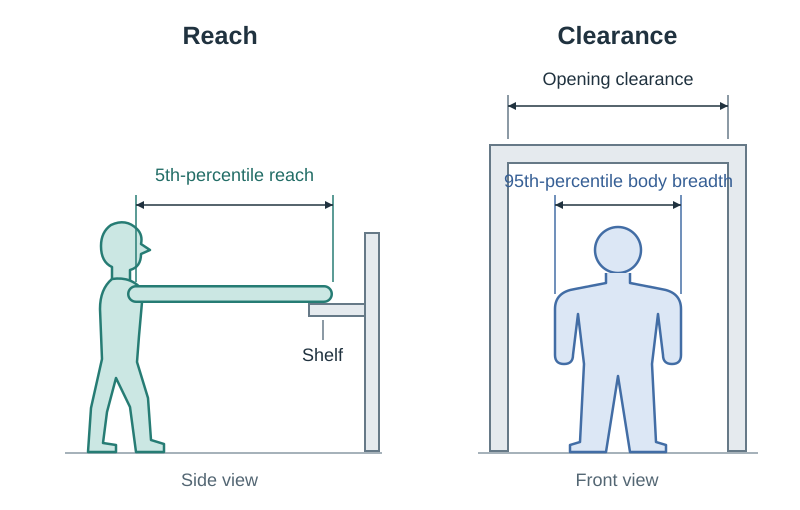
Designing for the 'average' (50th percentile) user is bad practice because a person of average stature may have wider-than-average hands. Standard practice designs for the 5th to 95th percentile range, accommodating 90% of the target population:
- 5th Percentile: Only 5% of users are smaller. Use 5th-percentile figures for minimum reach boundaries, shelf heights, and operating force limits so that smaller or weaker users can still operate the device.
- 95th Percentile: 95% of users are smaller (5% are larger). Use 95th-percentile figures for clearances, openings, doorway widths, and handle grips so that larger users do not become trapped or pinched.
- Adjustability: Where one static dimension cannot accommodate the 5th to 95th percentile spectrum (such as desk heights or task chair seating), incorporate adjustment mechanisms like gas struts, ratchets, or telescopic locking pins.
Idea Generation, Headings 5 and 6, and the Evaluation Matrix
Idea generation requires divergent thinking: prioritise quantity over quality at the outset without premature criticism. Techniques include brainstorming, spider diagrams, mood boards, and adapting features from existing mechanisms.
Folio Headings 5 and 6 Requirements
Coursework headings 5 and 6 represent 36 of the folio's 100 marks and demand two distinct types of visual communication:
- Heading 5 — Design ideas and selection of optimum solution (18 marks): You must present three distinct possible solutions as original annotated freehand sketches, each linked to your specification, then identify and justify the optimum one. Three different concepts are required — not three views of the same idea. Annotate each sketch with materials, key dimensions, how it moves or works, the input and output of the electro-mechanical part, and which specification point it satisfies.
- Heading 6 — Sketches and drawings for manufacture (18 marks): These are technical drawings someone could build from. Include orthographic working drawings with dimensions and the scale stated, an exploded or assembly view, sectional detail showing internal assembly, the circuit diagram for your control circuit, a flowchart or program listing if a microcontroller is used, and photographs of card models or prototypes.
Digital drawings or CAD models presented for assessment must be included in hardcopy format in your design folio. Where computer aided manufacture (CAM) is used, the supporting CAD files must be printed in the folio to authenticate the work as your own.
The Electro-Mechanical Element
The 2027 Higher Level thematic brief explicitly requires an electro-mechanical element: any sub-system where an electrical signal produces controlled mechanical movement. Structure it as a clear system:
For example: a PIR sensor detects an older person approaching a bedside unit (Input) a microcontroller pauses for 2 seconds (Process) a geared servo rotates a tablet drum by 30° (Output Actuator) a limit switch signals that the pocket is aligned and halts the servo (Feedback).
Avoid the commercial-components trap: buying an off-the-shelf dispenser, alarm, or motorised unit and building a decorative box around it loses marks under Functionality (20 marks) and Originality (15 marks). Buying individual standard components (a servo motor, gears, microswitches, or sensor modules) and designing your own linkages, chassis, and electronic control around them is expected.
Selecting the Optimum Solution: The Evaluation Matrix
The optimum solution is the design that achieves the best overall compromise against your specification criteria and constraints. To select it objectively and eliminate bias, construct an evaluation matrix before committing to manufacture:
The scores are simply ratings out of 5, so they have no units — do not write units after them. Only the specification figures they are judging (mm, N, V, g, €) carry units. Weightings must reflect user priorities (such as multiplying reliability and safety by 3, but aesthetics by 1) so that a concept that is cheap or attractive cannot outscore an idea that functions safely.
Choosing and Justifying Materials and Processes
A material property listed on its own scores minimal marks in written exams and folios. High marks require the explanatory chain: property functional consequence for the product or user.
Working properties you must be able to apply and justify:
- Strength: ability of a material to withstand applied forces without breaking.
- Toughness: ability of a material to absorb sudden shock or impact without fracturing.
- Hardness: resistance of a material to surface scratching, abrasion, and indentation.
- Ductility: ability of a material to be drawn out or stretched into thin wire under tension.
- Malleability: ability of a material to be hammered, rolled, or pressed into shape without cracking.
- Elasticity: ability of a material to return to its original shape once deforming forces are removed.
- Durability and corrosion resistance: ability to resist environmental degradation, moisture, or chemical wear over time.
- Thermal and electrical conductivity, machinability, and density (mass per unit volume).
Understand the primary distinction in polymers:
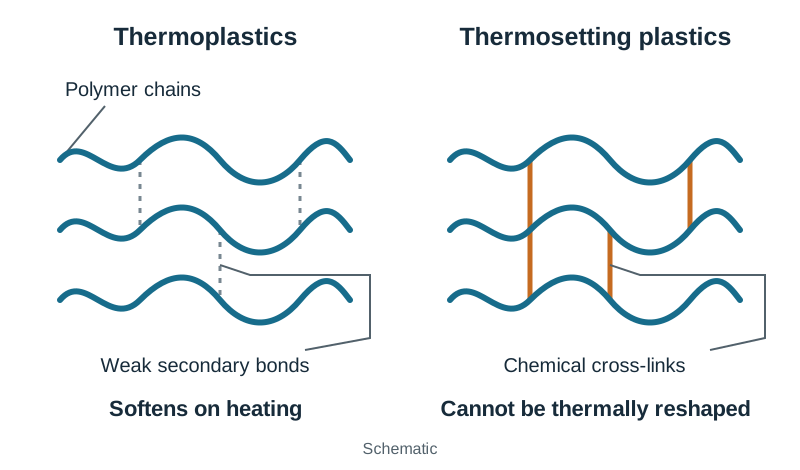
- Thermoplastics (such as acrylic, ABS, PLA, HIPS) are composed of linear polymer chains with weak secondary bonds. They soften when heated and can be repeatedly reshaped, making them suitable for line bending, vacuum forming, injection moulding, and 3D printing.
- Thermosetting plastics (such as polyester resin, epoxy resin, melamine formaldehyde) form cross-linked chemical bonds during curing. They set permanently and will char rather than soften if reheated, making them heat-resistant and rigid but impossible to reshape thermally.
Model justification answer: 'The housing handle is fabricated from ABS because ABS has high impact toughness, ensuring it will not shatter if dropped on a tiled floor by an older user. As a thermoplastic, it can be injection-moulded with a smooth 4 mm radiused profile that prevents pressure sores on hands with reduced skin elasticity.'
Production Planning, Schedules, and Industrial Scaling
Realisation is the phase where drawings and materials are turned into a physical artefact. Diving into machining without planning causes wasted materials, dimensional inaccuracies, and safety hazards.
Manufacturing Feasibility
A design is feasible only if it can be realised within your available time, allocated budget, personal skill level, and workshop equipment capabilities. If a feasibility check fails, modifying the design (by simplifying a component or substituting a material) is sensible engineering practice.
Production Scheduling: Gantt Charts and Critical Path
Develop a sequential production plan using the 'thinking backwards' technique: start with the completed artefact and trace backwards through surface finishing, permanent assembly, trial assembly, cutting, shaping, and marking out. Schedules must account for inactive waiting periods, including adhesive curing, paint drying, or 3D printing runtimes.
- Gantt Chart: A horizontal bar schedule mapping planned task durations against actual durations. Draw the planned bar and, underneath in a second colour, the actual bar to show schedule variations.
- Critical Path: The unbroken chain of dependent tasks that dictates the absolute minimum time required to finish the project. Any delay on a critical-path task delays project completion, whereas non-critical tasks contain float or slack time.
From a School One-Off Prototype to Industrial Production
When an examination question asks how a prototype would be adapted for commercial production (such as 10,000 units), answer under structured headings:
- Production method: Shift from one-off jobbing in a school workshop to automated batch or mass production.
- Processes: Replace hand-cut sheet and 3D-printed parts with injection moulding, die casting, CNC punching, or automated press forming. High initial tooling and mould costs are offset because they are amortised across thousands of units.
- Materials: Standardise on commercial-grade polymers or metal alloys available in consistent sheets, pellets, or extrusions.
- Design changes: Incorporate draft angles (1° to 2°) and uniform wall thickness to facilitate clean mould release; apply design for assembly (DFA) by reducing part count and replacing loose screws with snap-fit joints; specify standard bought-in components (fasteners, bearings, motor modules) rather than bespoke parts.
- Quality and consistency: State engineering tolerances on production drawings, employ dedicated machining jigs and assembly fixtures to eliminate manual marking errors, and introduce automated inspection stages.
Testing, Critical Evaluation, and 2027 Assessment Regulations
Evaluation is an objective critique assessing product performance, analysing trade-offs, and describing concrete modifications. Testing provides the factual evidence required for evaluation.
Specification Compliance and Testing
Systematically test every specification point under controlled conditions and record the result clearly as met, partly met, or not met, with the measured evidence beside it:
- Met: The artefact fully satisfies the quantitative benchmark (e.g. operates at 6 V DC, holds 500 g load).
- Partly met: Operates within specific limits but falls slightly outside desired parameters.
- Not met: Fails the test entirely.
Analysing Trade-offs
A trade-off is an intentional compromise where one benefit is gained by accepting a disadvantage elsewhere. For example, selecting birch plywood instead of 3 mm aluminium alloy reduces material cost and eases cutting with workshop hand tools, but a thicker 6 mm plywood section is needed to match the stiffness of the aluminium, increasing bulk, and the plywood is less resistant to moisture.
Social and Environmental Costs and Benefits
When evaluating, use the words cost and benefit directly, tied to your specific artefact:
- Social benefits: Preserves user independence, reduces anxiety for family members, speeds up assistance response.
- Social costs: Risk of user feeling monitored, family visiting less frequently under false security, user reluctance to adopt new digital interfaces.
- Environmental benefits: Rechargeable low-voltage cell reduces battery waste, modular assembly with machine screws enables component repair.
- Environmental costs: Printed circuit boards and lithium cells are difficult to recycle, polymer casing is derived from petrochemical feedstock.
Higher Level Differentiation: Describe Modifications
At Ordinary level, students list modifications; at Higher level, you must describe and justify them. Never write 'improve the hopper'. Write: 'Enlarge the hopper throat diameter from 12 mm to 16 mm and introduce a 15° chamfer at the throat so that a 10 mm tablet cannot bridge across the opening, eliminating the three jams recorded in ten dispensing trials.'
Official Coursework Regulations for 2027
- Coursework consists of two components: a design folio (100 marks) and an artefact (100 marks), totaling 200 marks (50% of the subject). It must be available for assessment by Friday 19 March 2027 and is marked in school in June.
- It must be your own individual work, completed in school under your teacher's supervision, and each student must submit a separate and distinct project. It must not be removed from the school under any circumstances.
- Identify all work with your examination number, and state on the folder the two options you are studying.
- You must reference and acknowledge all research sources (publications, websites, media, specialist organisations, and any material generated using artificial-intelligence software). Unreferenced material is plagiarism, and unreferenced or copied text receives zero marks.
- Operating features of the artefact must be visible and accessible without dismantling. Where an electrical supply is used, it should be of low voltage. The maximum dimension must not exceed 500 mm.
- Multimedia presentations must not exceed 3 minutes, supplied as a digital file ready to view on a school computer.
- If either component (written examination or coursework) is submitted at Ordinary level, the entire subject is graded at Ordinary level.
Design Folio Headings — Higher Level (100 Marks):
- Analysis of thematic brief (7 marks)
- Overall management of the project (5 marks)
- Environmental impact of the project (10 marks)
- Research, investigation and specifications of brief (7 marks)
- Design ideas and selection of optimum solution (18 marks)
- Sketches and drawings for manufacture (18 marks)
- Production planning (10 marks)
- Product realisation (10 marks)
- Testing, evaluation and critical reflection (10 marks)
- Presentation and ICT (5 marks)
Artefact Headings — Higher Level (100 Marks):
- Artefact meets theme and specifications (10 marks)
- Originality and creativity (15 marks)
- Production skills (30 marks)
- Functionality (20 marks)
- Quality and finish (15 marks)
- Presentation (10 marks)
(Note: while general headings and marks largely remain the same, breakdowns may vary depending on the brief for any given year.)
Key terms
- Design Brief
- A concise statement defining an identified problem, need, or opportunity to be solved, setting operational parameters without dictating a specific outcome.
- Design Specification
- An explicit list of measurable, testable criteria and boundaries that the finished product must satisfy to be deemed successful.
- Anthropometrics
- The scientific study and collection of human body measurement data used by designers to size products to fit user populations.
- Ergonomics
- The study of human interactions with products, systems, and environments to optimise safety, comfort, efficiency, and ease of use.
- Percentile Range (5th to 95th)
- The statistical spread of body measurements encompassing the central 90% of a population, used to ensure designs fit almost all users rather than an average.
- Optimum Solution
- The design concept that achieves the most effective overall balance across all specification criteria and practical constraints.
- Evaluation Matrix
- A structured decision-making table where design concepts are scored against weighted specification criteria to objectively justify the selected solution.
- Manufacturing Feasibility
- The practical evaluation of whether a design can realistically be fabricated within available time, budget, skills, equipment, and safety provisions.
- Trade-off
- An intentional design compromise where one desirable quality is balanced against or sacrificed for another (such as strength versus weight, or cost versus durability).
- Realisation
- The physical manufacturing phase where working drawings, tools, materials, and processes are combined to produce the working artefact.
- Prototype
- A trial working model or sub-assembly constructed to test, prove, and refine mechanisms, circuits, or proportions prior to final manufacture.
- Critical Path
- The unbroken chain of dependent tasks in a project schedule that determines the minimum total time required to achieve project completion.
- Iterative Process
- A cyclical problem-solving methodology where design stages are repeatedly revisited based on testing, analysis, and evaluation feedback.
- Electro-mechanical
- A system where an electrical control signal actuates a mechanical component to produce physical movement or work.
- Embodied Energy
- The cumulative energy consumed during all stages of raw material extraction, processing, refining, and transportation.
- Design for Disassembly
- An engineering approach where products are assembled using non-permanent fasteners so parts can be easily separated for repair, reuse, or recycling.
- Design for Environment (DfE)
- A design methodology that systematically reduces human-health and environmental impacts across the entire life cycle of a product.
- Upcycling
- The creative reuse of discarded products or waste materials to manufacture a new product possessing higher quality or value than the original.
Check yourself
What is the primary operational difference between an open design brief and a closed design brief?
An open brief states a broad theme or problem, leaving specific user parameters and mechanisms to the designer; a closed brief provides strict, predetermined boundaries such as exact dimensions, materials, or mechanisms.
Which anthropometric percentile (5th or 95th) should dictate the clearance of a doorway or the opening width of a carry handle, and why?
The 95th percentile. Clearances must accommodate larger users so that 95% of the population can pass through or fit their hands without becoming stuck or pinched.
Name the five standard syllabus headings used to appraise an existing commercial product.
Form, Function, Materials, Technologies, and Environment.
Rewrite these two vague specification lines so that they are measurable: 'the casing must be strong' and 'the alarm must be loud enough'.
'The casing must support a 40 N vertical load with less than 2 mm deflection' and 'The alarm must produce at least 70 dB of sound measured at a distance of 1 m'.
Name two environmental costs and one environmental benefit of using a 3D-printed PLA casing compared to a laser-cut birch plywood casing.
Costs: energy-intensive print runs lasting several hours; failed prints and support scaffolding become non-biodegradable waste in school settings. Benefit: PLA is derived from renewable corn starch, and complex geometries can be printed as a single component without chemical adhesives.
What is the critical path in production planning, and what happens if a task on this path is delayed by 2 hours?
The critical path is the longest sequence of dependent tasks that dictates the minimum time required to complete the project; any 2-hour delay on this path delays the final completion of the project by exactly 2 hours.