

A hazard is anything with the potential to cause harm, such as a spinning drill bit, a hot soldering iron, or solvent fumes. A risk is the likelihood of that hazard causing actual harm, combined with how severe the injury could be. Managing safety simply means identifying hazards, assessing the risks they pose, and applying practical control measures to eliminate or reduce them. In Leaving Certificate Technology, safety is an assessed principle rather than an isolated set of rules. You will encounter it across the written examination — in the short questions of Section A, the core questions of Section B, and often within option questions in Section C — as well as in your coursework project, where the physical artefact is marked under Quality and Finish for due regard for health and safety.
Statutory Framework and Safety Legislation
Workplace and workshop safety in Ireland is governed primarily by the Safety, Health and Welfare at Work Act 2005. Under this legislation, a school technology room is a workplace, and the same legal duties apply there as in industry.
Employers and school authorities are required to provide a safe working environment, properly maintained machinery, adequate extraction, personal protective equipment, and competent instruction and supervision. Employers must prepare and maintain a written Safety Statement, which details workplace hazards, evaluates risks, and sets out the specific controls used to safeguard everyone in the room. Employees and students have an equal duty to take reasonable care of their own safety and that of others, to wear and use supplied safety equipment correctly, to report defects and near misses immediately, and never to tamper with machine guards or safety interlocks.
The Health and Safety Authority (HSA) is the national statutory body that enforces safety legislation. It carries out routine and unannounced inspections, investigates serious accidents, issues legally binding improvement or prohibition notices, and publishes codes of practice. Within an organisation, an appointed safety officer monitors day-to-day safety compliance, coordinates regular equipment audits, checks fire facilities, and investigates accidents and near misses so that risk assessments can be updated.
Wider Legislation Affecting Designers and Consumers
The syllabus requires designers to understand four key legislative areas:
- Health and safety legislation: Regulates workplace duties, safety statements, machine guarding, and safe operating procedures.
- Consumer law: Requires goods to be of merchantable quality, fit for purpose, and as described. This places a legal duty on designers to make products that remain safe and reliable throughout their intended life.
- Equal opportunities legislation: Prohibits discrimination and mandates that public environments, services, and products accommodate individuals with disabilities or mobility needs, underpinning inclusive design.
- Data protection legislation: Governs devices that record, store, or transmit personal information, requiring user consent and secure storage.
Risk Assessment and the Hierarchy of Control
Risk assessment questions are normally set around the three steps used by the HSA:
- Identify the hazards: Inspect the equipment, materials, processes, and environment to locate anything capable of causing harm (such as rotating spindles, heated surfaces, toxic flux vapours, or damaged insulation).
- Assess the risks: Evaluate the likelihood of an incident occurring combined with the severity of the resulting injury. Machine guards and secure clamping reduce the likelihood of contact; personal protective equipment reduces the severity of the injury when something goes wrong.
- Put control measures in place: Implement measures that eliminate or reduce the risk, prioritising higher-level controls over personal protection.
The Hierarchy of Control
When selecting control measures, engineers apply the hierarchy of control, working from the most reliable solution down to the least effective:
- Elimination: Completely remove the hazard. For example, buying pre-cut sheet components rather than carrying out difficult cutting operations on awkward stock.
- Substitution: Replace the dangerous substance or process with a safer one. For example, swapping solvent-based impact adhesives for non-toxic PVA glue, or using water-based acrylic lacquer instead of cellulose spray paint.
- Engineering controls: Isolate the operator mechanically through physical machine guards, an interlock guard that cuts power when a door is opened, or local exhaust ventilation (LEV) to capture dust and fumes directly at the source.
- Administrative controls: Modify work patterns using standard operating procedures, training, safety signage, and rules such as one person per machine.
- Personal protective equipment (PPE): The last line of defence. PPE only shields the wearer, does not remove the hazard, relies on correct fitting and maintenance, and can occasionally create hazards of its own.
European Safety Signage
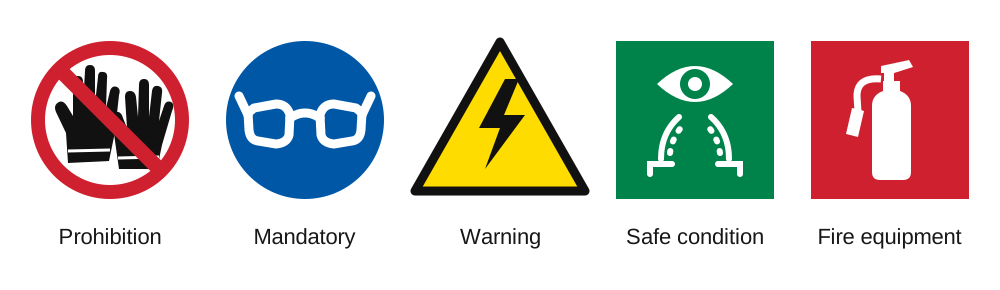
Standardised geometric shapes and colours convey immediate safety messages across the EU:
| Sign Category | Geometric Shape | Colour Scheme | Meaning | Workshop Example |
|---|---|---|---|---|
| Prohibition | Circular | White background, red circular border and diagonal crossbar | Must not do; dangerous behaviour | No gloves on rotating machinery; no unauthorized entry |
| Mandatory | Circular | Solid blue background, white pictogram | Must do; specific action required | Safety spectacles must be worn; ear defenders required |
| Warning | Triangular | Yellow background, black border and pictogram | Caution; hazard or danger | Caution: high voltage; warning: toxic fumes |
| Safe Condition | Rectangular or square | Green background, white pictogram | Emergency escape, first aid, safe condition | Emergency exit route; eyewash station |
| Fire Equipment | Rectangular or square | Red background, white pictogram | Fire-fighting equipment | Fire extinguisher; fire blanket station |
Workshop Housekeeping, PPE, and Hand Tools
Good housekeeping prevents slips, trips, and handling injuries, which represent the majority of real-world workshop accidents. Floors must be kept free of offcuts and metal swarf, and any liquid spills must be cleaned immediately. Trailing leads must never cross walkways; overhead reels or perimeter bench trunking should be used instead. Gangways and access routes to emergency exits and fire extinguishers must remain completely unobstructed at all times. The technology room must have a first-aid box with a named first-aider, an eyewash station, a fire blanket near heat processing, clearly marked emergency stops, and an accident book in which accidents and near misses are recorded so risk assessments can be updated.
Manual Handling
Manual handling involves lifting, putting down, pushing, pulling, or carrying a load by hand. Poor lifting technique causes long-term spinal and muscular injuries. When lifting:
- Assess the load for weight, sharp edges, and balance. Get assistance or use a trolley if it is too heavy.
- Plan and clear the route before lifting.
- Position feet apart with one foot slightly forward beside the load for a stable base.
- Bend the knees while keeping the back straight, lifting with the strong leg muscles rather than the spine.
- Keep the load close to the body, turning by moving the feet rather than twisting the torso.
- Lower the load by bending the knees, keeping the back straight.
Personal Protective Equipment (PPE)
Different workshop tasks require specific protective gear:
- Safety spectacles or goggles: Protect the eyes against flying swarf, shattered acrylic, and liquid splashes during drilling, grinding, and chemical mixing.
- Face shield (visor): Provides full-face protection against high-velocity sparks and wheel fragments at the bench grinder or buffing wheel.
- Ear defenders: Protect against noise-induced hearing loss from continuous machinery like planers, routers, and scroll saws.
- Dust mask (respirator): Prevents inhalation of fine timber, resin, or MDF dust during sanding.
- Apron or workshop coat: Shields the body from hot chips, prevents loose clothing from snagging, and protects against chemical splashes.
- Leather or heat-resistant gloves: Protect hands when handling rough sheet metal edges or hot vacuum-formed plastics. Gloves must never be worn while operating rotating machinery.
Safe Use of Hand Tools
Hand tools can inflict severe puncture wounds and lacerations if misused:
- Keep cutting edges sharp. A blunt chisel, knife, or saw requires excessive force, causing it to slip off the workpiece.
- Always clamp the workpiece in a vice or with G-cramps. Never hold work in one hand while cutting towards it with the other.
- Cut away from your body, ensuring both hands remain behind the cutting edge at all times.
- Use the correct tool for the job. Never use a chisel as a lever or a file without a handle, as the bare tang can pierce the palm.
- Inspect tools before use. Take tools with loose hammer heads, cracked handles, or mushroomed chisel striking faces out of service, as mushroomed metal can fragment and fly off when struck.
- Carry tools with sharp points facing downward towards the floor, never in pockets, and return them to shadow boards or racks immediately after use.
Power Machinery: Drilling and Bench Grinding
Power machinery works with high torque and speed, operating far faster than human reaction times.
Workshop Preparation and Dress Code
Before operating any machine, tie long hair securely behind the neck, roll sleeves above the elbow, and remove all rings, watches, and lanyards. Loose hair or fabric can wrap around a spinning shaft and pull the operator into the mechanism. Never wear gloves near rotating spindles, chucks, or grinding wheels, as the fabric snags easily.
Switching Off versus Electrical Isolation
Examiners frequently test this distinction:
- Switching off: Stops the motor using the standard stop switch. The control circuit remains live, meaning a bumped switch or faulty relay could restart the machine unexpectedly.
- Electrical isolation: Physically disconnects the machine from all electrical sources, either by pulling the plug or switching the wall-mounted rotary isolator to OFF and locking it. You must always isolate equipment before changing drill bits, replacing bandsaw blades, fitting abrasive wheels, or clearing jams.
The Pillar Drill
- Workholding: Secure small workpieces in a machine vice, and clamp the vice to the drilling table. If thin sheet metal or acrylic is held by hand, the drill bit will bind as it breaks through the underside, causing the sheet to snatch and spin round on the table like a propeller, resulting in severe hand lacerations.
- Chuck key: Remove the chuck key immediately after tightening the bit. A key left in the chuck becomes a high-velocity projectile the instant the motor starts.
- Guard: Adjust the transparent telescopic chuck guard downward so it encloses the rotating chuck and the upper shank of the bit without impeding feed travel.
The Bench Grinder
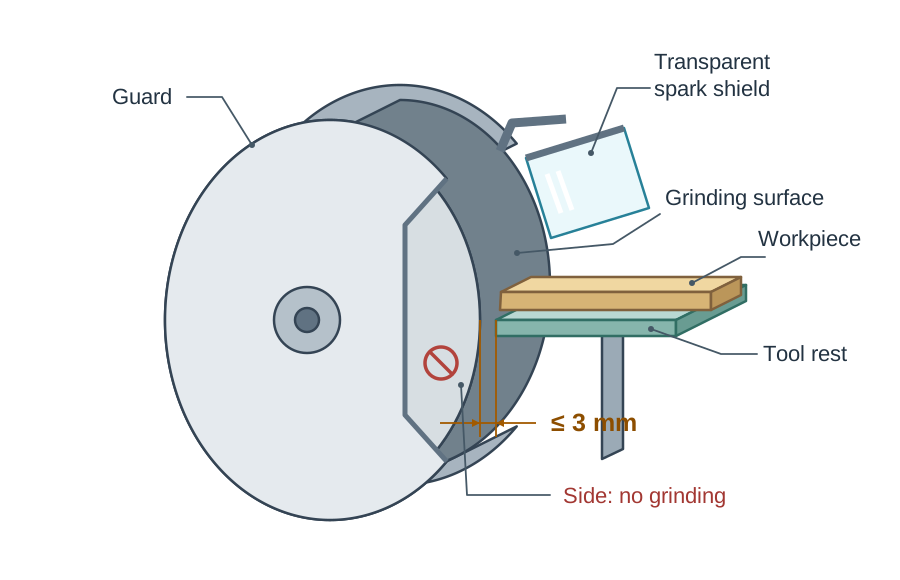
The bench grinder presents high rotational speeds and shattering hazards:
- Eye and face protection: Wear a full face shield or safety spectacles, and adjust the transparent spark shield close to the wheel.
- Tool rest adjustment: Set the tool rest no more than 3 mm from the grinding wheel. If the gap exceeds 3 mm, the workpiece can be dragged down between the rest and the wheel, jamming it and causing the wheel to burst.
- Wheel integrity: Ring-test wheels before fitting; a cracked wheel can explode under centrifugal force. Grinding wheels must only be fitted by a competent person and must never run above their rated maximum speed.
- Materials restriction: Grind only on the face of the wheel, never the side. Never grind aluminium, brass, copper, or timber on a standard bench grinder wheel. Soft materials clog and load the porous abrasive surface, overheating the wheel and causing it to crack and shatter.
Thermal, Chemical, and Electrical Safety
Thermal and chemical processes generate burn hazards, harmful airborne vapours, and fire risks.
Electrical Protection Devices
- Correctly rated fuse: Contains a thin wire that melts when current exceeds its rating, disconnecting the circuit before cables overheat and cause an electrical fire.
- Earth wire (green/yellow): Provides a low-resistance path to ground. If an internal fault connects a live conductor to a metal chassis, the fault current flows to earth and instantly blows the fuse, preventing the casing from remaining live.
- Double insulation: Marked with a double-square symbol, meaning the tool has two independent layers of electrical insulation and requires no earth wire.
- RCD (residual current device): Monitors the balance between live and neutral currents. If a fault causes current to leak to earth (for instance, through a person touching a damaged lead), the RCD trips within milliseconds, cutting power before a fatal electric shock occurs.
- Defective lead procedure: If a power cord is cut, cracked, or frayed, take the tool out of service immediately, isolate it, and tag it for repair by a qualified person. While a fuse or RCD protects against severe overcurrent or earth leakage, it does not prevent direct contact with exposed conductors.
Soldering, Plastics, and Fumes
- Soldering hazards: Soldering iron tips run at 300 °C to 400 °C. Park the iron in a weighted, spring-shielded stand and keep the power cable clear of the barrel. Colophony rosin flux inside solder wire emits fumes that cause respiratory irritation and occupational asthma. Lead-free solder still uses rosin flux, so benchtop local exhaust ventilation (LEV) must be used to draw fumes away from the breathing zone.
- Vacuum forming: Radiant heater elements pose burn hazards. Use heat-resistant gloves when handling hot sheet plastic, ensure machine interlocks are operational, and vent heated plastic vapours.
- Solvents and adhesives: Acrylic solvent cements (such as Tensol cement) and contact adhesives give off volatile organic compounds (VOCs). Consult the Safety Data Sheet (SDS), work in well-ventilated areas, keep containers capped, avoid open sparks, and wear nitrile gloves.
Waste Disposal and Fire Safety
A fire requires three components: fuel, heat, and oxygen (the fire triangle). Removing any one extinguishes the fire. On discovering a fire, raise the alarm immediately; only tackle a small fire with the correct extinguisher if trained, standing between the fire and your escape route; otherwise evacuate. On hearing the alarm, stop work and switch off or isolate machines if it is safe to do so, leave by the nearest emergency exit without collecting bags, walk rather than run, go to the designated assembly point for the roll call, and do not re-enter until told it is safe.
| Waste / Hazard | Risk | Control and Disposal Method |
|---|---|---|
| Oil-soaked finishing rags | Oxidation generates trapped heat, leading to spontaneous combustion | Store in airtight, heavy-gauge steel bins with raised bases; never discard in paper bins |
| Spent thinners and solvents | Flammable; toxic to waterways | Seal in labelled, chemical-resistant containers for specialist hazardous waste collection |
| Swarf and wood dust | Inhalation hazard; fine airborne dust fire | Vacuum extraction into sealed bags; sweep with brushes, never compressed air |
Fire Extinguisher Selection
| Extinguisher Type | Colour Band | Suitable For | Dangers / Restrictions |
|---|---|---|---|
| Water | Red | Class A (wood, paper, textiles) | Never use on electrical fires; conducts electricity and causes fatal shock |
| Foam | Cream | Class A and Class B (flammable liquids) | Do not direct into deep electrical equipment |
| Carbon Dioxide (CO2) | Black | Electrical equipment and Class B liquids | Leaves no residue and does not harm circuitry; ventilate area after discharge |
| Dry Powder | Blue | Class A, B, C (flammable gases) and electrical | Can impair breathing and visibility indoors; leaves corrosive residue |
Coursework Project Safety and Ergonomics
Health and safety is assessed directly in the Leaving Certificate coursework brief (50% of the total subject marks).
The Coursework Safety Regulations
The State Examinations Commission coursework instructions specify that where an electrical supply is used to operate the artefact, it should be of low voltage output — such as a battery pack, 5 V USB, or a 12 V DC plug-top adapter. Mains 230 V wiring must not be installed inside a student model. In addition, all operating features must be clearly visible and accessible without dismantling the model, and any specialised test equipment must be set up with clear operating instructions.
In the coursework marking scheme, Quality and finish carries 15 marks and explicitly evaluates due regard for health and safety. The examiner inspects the physical model for deburred metal edges, radiused timber and acrylic corners, fully insulated wiring connections protected with heat-shrink tubing, cable strain relief at casing entry points, and physical guards around moving gears, pulleys, or linkage pinch-points.
Ergonomics and Anthropometrics
The syllabus requires students to integrate ergonomics and anthropometric data into their designs:
- Ergonomics is the study of how people interact with products and environments, designing systems so they are safe, comfortable, and efficient to use.
- Anthropometric data consists of measurements of human physical dimensions (such as reach, grip diameter, hand breadth, and eye height), typically gathered across the 5th to 95th percentiles to accommodate the vast majority of users.
Applying ergonomic principles reduces operator fatigue, prevents repetitive strain injury (RSI), and minimises operational errors. In your design folio, record the anthropometric measurements that determined handle diameters, switch placements, and viewing angles, proving that your product is safe and functional for the intended user.
Key terms
- Safety, Health and Welfare at Work Act 2005
- The primary Irish statute establishing the legal duties of employers, employees, and educational institutions to maintain a safe working environment.
- Health and Safety Authority (HSA)
- The national statutory agency in Ireland responsible for workplace inspections, enforcing safety law, investigating serious incidents, and publishing safety codes.
- Safety Statement
- A mandatory written document prepared by an employer identifying workplace hazards, detailing risk assessments, and setting out protective control measures.
- Safety Officer
- A designated person within an organisation responsible for auditing equipment, checking emergency provisions, updating safety documentation, and investigating incidents.
- Hazard
- Any source, situation, or substance with the potential to cause harm, injury, ill-health, or damage.
- Risk
- The likelihood that a hazard will cause harm, combined with the severity of the potential injury or damage.
- Control Measure
- An action, engineering device, or procedural rule put in place to eliminate a hazard or reduce its risk to an acceptable level.
- Hierarchy of Control
- The sequential order of risk management strategies, ranking from most effective (elimination and substitution) to least effective (personal protective equipment).
- Local Exhaust Ventilation (LEV)
- An engineering extraction system that captures airborne dusts, chemical vapours, or rosin flux fumes directly at the point of generation.
- Interlock Guard
- A safety guard fitted with an electrical switch that automatically disconnects power to a machine if the guard is opened or removed.
- Electrical Isolation
- The physical disconnection of a machine from all electrical sources (via plug or locked isolator) so it cannot restart unexpectedly during maintenance.
- Personal Protective Equipment (PPE)
- Gear worn by an individual (such as goggles or ear defenders) that acts as a final barrier to reduce the severity of injury if an accident occurs.
- Residual Current Device (RCD)
- An electrical safety device that rapidly disconnects power when it detects current leaking to earth, protecting operators from fatal electric shock.
- Safety Data Sheet (SDS)
- A manufacturer document outlining a chemical's physical properties, health hazards, safe handling, PPE requirements, and disposal methods.
- Spontaneous Combustion
- A fire caused by the internal accumulation of heat from the chemical oxidation of oil-soaked rags without an external ignition source.
- Fire Triangle
- The three components required to sustain a fire: fuel, heat, and oxygen. Removing any one component extinguishes the flame.
- Ergonomics
- The discipline of designing products, tools, and environments to fit human physical and psychological capabilities for comfort, safety, and efficiency.
- Anthropometric Data
- Comprehensive measurements of human physical dimensions and body proportions used to determine the sizing and layout of products.
Check yourself
What primary Irish statute governs safety in school technology rooms, and what written document must employers produce under it?
The Safety, Health and Welfare at Work Act 2005; employers must produce and maintain a written Safety Statement.
What are the three steps in carrying out a risk assessment according to the HSA?
1. Identify the hazards; 2. Assess the risks (likelihood and severity); 3. Put control measures in place.
What does a circular safety sign with a solid blue background and a white pictogram signify?
A mandatory requirement indicating an action that must be taken, such as wearing safety spectacles.
Which fire extinguisher should be used on an electrical equipment fire, and why must water never be used?
Use a Carbon Dioxide (CO2) or dry powder extinguisher; water must never be used because it conducts electricity and can deliver a fatal shock to the operator.
Name three items of PPE suitable for use at a bench grinder and state what each protects against.
Face shield (protects face and eyes from high-velocity sparks and abrasive fragments), ear defenders (protects hearing against machine noise), and an apron (protects clothing and body from hot particles).
Outline the correct procedure for manual lifting.
Assess the load and plan the path; place feet shoulder-width apart; bend the knees keeping the back straight; lift with the leg muscles; keep the load close to the body without twisting; and lower by bending the knees.
What is the maximum recommended gap between a bench grinder wheel and its tool rest, and why is this critical?
No more than 3 mm; a wider gap allows the workpiece to be drawn down between the wheel and the rest, which can jam the machine and shatter the abrasive wheel.
What electrical voltage instruction applies to artefacts submitted for Leaving Certificate Technology project assessment?
The artefact should operate on a low-voltage electrical output (such as a battery, 5 V USB, or 12 V DC adapter); mains 230 V wiring must not be installed in the model.