

Energy is the ability to do work, measured in joules (J). In Leaving Certificate Technology, energy links mechanical drives, electrical circuits, and automated systems. You need to understand where energy comes from, how it transforms between forms, and how to calculate work, power, conversion efficiency, and running costs. Energy questions appear in Section A short questions and Section B compulsory core questions, and they directly shape the environmental assessment and electromechanical design of your coursework project.
Work, Power, Physical Units, and Calculation Layout
Energy is the ability to do work. Work is done when an applied force moves an object through a distance in the direction of the force:
Here is the force in newtons (N) and is the distance moved in the direction of the force, in metres (m). When lifting an object vertically against gravity, the lifting force equals the object's weight (), where unless specified otherwise in the question.
Doing work transfers energy, so work done and energy share the same SI unit, the joule (J). One joule equals one newton-metre ().
Power is the rate of doing work or transferring energy per second. It is measured in watts (W), where one watt equals one joule per second ():
In electrical circuits, power depends on supply voltage and current flow:
Layout Checklist for Calculations
To earn full marks in numerical questions, follow this sequence every time:
- State the formula before substituting any numbers.
- Convert all values to base SI units first: millimetres to metres (), grams to kilograms (), minutes to seconds () or hours (), and watts to kilowatts ().
- Substitute values with units shown.
- Write the final answer with its correct unit symbol.
- Keep full precision in your calculator and round only on the final line.
- Use standard form for very large or small numbers (, ).
SI Units and Standard Prefixes
You are expected to recognise and use these quantities and prefixes:
- Quantities: length (m), mass (kg), time (s), force (N), work (J), energy (J), power (W), current (A), potential difference (V), resistance (), frequency (Hz).
- Prefixes: giga (G, ), mega (M, ), kilo (k, ), centi (c, ), milli (m, ), micro (, ), nano (n, ), pico (p, ).
Quick example: A workshop winch pulls a trolley 15 m with a steady force of 400 N in 12 s.
- Work done:
- Power output:
Forms of Energy and Conservation Calculations
Energy comes in several different forms. You need to be able to name them and tell them apart:
- Gravitational potential energy (): Stored energy due to height ().
- Kinetic energy (): Energy of an object in motion (). Because speed is squared, doubling speed quadruples kinetic energy.
- Chemical energy: Stored in chemical bonds, released by combustion or battery reactions.
- Electrical energy: Carried by moving charges driven by a potential difference.
- Thermal (heat) energy: Internal energy in hot substances, such as steam in a turbine boiler.
- Light energy: Given out by lamps, LEDs, and the sun.
- Sound energy: Carried by vibrations travelling through air or another medium.
Potential and Kinetic Energy Calculations
- Raising a 50 kg mass onto a 1.8 m bench:
- An 800 kg car travelling at 15 m/s:
The Principle of Conservation of Energy
The principle of conservation of energy states that energy cannot be created or destroyed; it can only be changed from one form into another. The total energy in an isolated system remains constant.
Take the 800 kg car calculated above. When it brakes to a halt, its 90 kJ of kinetic energy is not destroyed. Friction converts it to heat in the brake pads and discs, which spreads into the surrounding air.
Applying Conservation of Energy in Calculations
If air resistance and friction can be neglected, the potential energy an object loses as it falls converts entirely into kinetic energy:
Because mass cancels from both sides, . The speed reached depends only on the fall height and gravity, not on the mass of the object.
Quick example: A 0.6 kg component falls from a bench 1.25 m high ().
- By conservation of energy, at floor
If air resistance is considered, some potential energy becomes heat and sound, so the actual impact speed is slightly lower.
Energy Transformations and System Efficiency
The syllabus requires you to describe and analyse energy transformations in common devices. In exam answers, write conversion chains using arrows from input to useful output, and name waste forms separately.
| Device | Energy conversion chain |
|---|---|
| Torch / LED on batteries | Chemical electrical light (+ heat) |
| Electric kettle | Electrical thermal (heat) |
| Electric hoist | Electrical kinetic gravitational potential (+ heat, sound) |
| Loudspeaker or buzzer | Electrical kinetic (vibration) sound |
| Solar PV panel | Light electrical |
| Wind turbine | Kinetic (wind) kinetic (shaft) electrical |
| Petrol engine | Chemical thermal kinetic (+ heat, sound) |
| Battery on charge | Electrical chemical |
| Hydroelectric station | Gravitational potential kinetic electrical |
| Microphone | Sound kinetic electrical |
Thermal Power Station Transformation Chain
- Chemical or nuclear energy in fuel (coal, gas, uranium) is released by combustion or fission.
- Heat energy turns boiler water into high-pressure steam.
- Kinetic energy of expanding steam spins the turbine blades and main shaft.
- Electrical energy is produced by an alternator spinning in a magnetic field.
- Transformers step up the voltage (110 kV, 220 kV, 400 kV) for transmission. Higher voltage means smaller current for the same power (), which reduces cable heating and energy waste on the National Grid.
Efficiency Calculations
Because friction and resistance always turn some energy into unwanted heat, no real machine is 100% efficient. Efficiency expresses useful output as a percentage of total input:
To rearrange the formula:
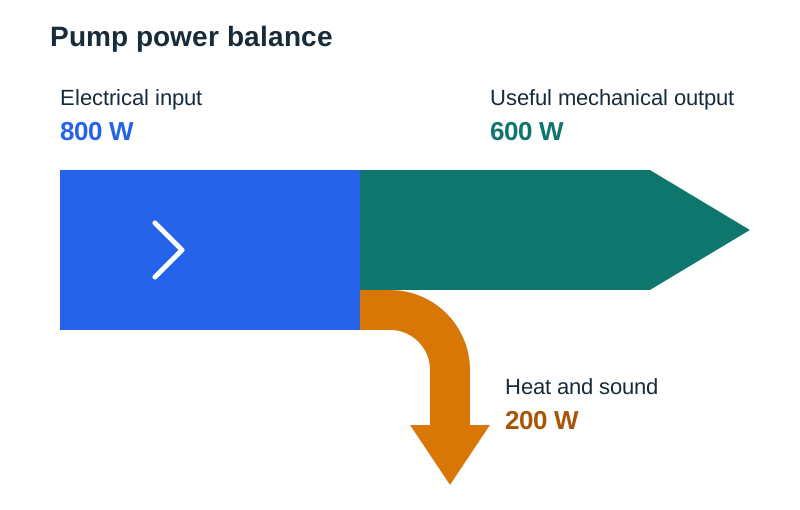
Quick example: A pump must deliver 600 W of useful mechanical power and is 75% efficient.
The remaining 200 W is converted into heat and sound.
Typical Conversion Efficiencies
- Filament lamp: about 5% to light (95% wasted as heat)
- LED lamp: far more efficient than a filament lamp — roughly 30–50% of the electrical energy becomes light, so an LED gives the same brightness for about a tenth of the power
- Electric motor: about 80–90% to kinetic motion
- Coal-fired power station: about 35–40%
- Combined-cycle gas turbine (CCGT): about 55–60% (waste heat runs a second steam turbine)
- Solar PV panel: about 15–20% of sunlight converted to electricity
- Petrol car engine: about 25–30%
Machine Efficiency: Mechanical Advantage and Velocity Ratio
For simple machines such as pulley blocks, levers, winches, and gear trains, efficiency can be calculated either from work or from mechanical forces and movement distances:
On the official formula sheet, this links directly to mechanical advantage (MA) and velocity ratio (VR):
Quick example: A pulley system lifts a 90 kg load through 0.5 m (500 mm). The applied effort is 250 N and moves 2.5 m. Take .
- Cross-check using MA and VR:
The missing 183.55 J is converted to heat in the pulleys and rope and to sound.
Energy Sources, Storage, and Grid Balancing
Energy sources are grouped into two categories based on whether nature replenishes them within a human timeframe.
Renewable Sources
A renewable energy source replenishes naturally and will not run out through continuous use.
- Wind: Turbines convert moving air into electricity. Zero emissions during operation, but output is intermittent and depends on wind speed. Irish example: Large onshore wind farms in the west and midlands; planned offshore projects off the east coast.
- Solar PV: Semiconductor cells convert light directly into d.c. electricity. Silent, but output drops in overcast weather and is zero at night. An inverter is required to convert d.c. to mains a.c. (230 V, 50 Hz). Irish example: Domestic rooftop installations and commercial solar farms.
- Hydroelectric: Elevated water drives water turbines. Reliable and fast-starting, but requires suitable upland valleys. Irish example: Ardnacrusha on the River Shannon.
- Biomass: Wood chip, pellet, or crop waste burned for heat or power. Carbon absorbed during growth balances carbon released, but combustion still produces particulates and carbon dioxide. Irish example: Wood-pellet boilers and agricultural anaerobic digesters.
- Geothermal: Deep underground heat used directly or for power. High-temperature generation requires volcanic geology (e.g. Iceland). In Ireland, low-temperature geothermal energy is used via ground-source heat pumps for building heating.
Non-Renewable Sources
A non-renewable energy source exists in finite reserves that cannot regenerate on a human timescale.
- Coal: Burned to generate steam. Inexpensive and easy to stockpile, but produces high carbon dioxide and sulphur dioxide (), which causes acid rain. Irish example: Moneypoint, Co. Clare (being phased off coal).
- Oil: Refined into transport and heating fuels. High energy density, but emits carbon dioxide and carries spill risks.
- Natural gas: Cleanest-burning fossil fuel; starts quickly to meet grid peaks. Finite and releases carbon dioxide. Irish example: Corrib gas field and gas-fired power stations.
- Nuclear fission: Splitting uranium atoms releases heat for steam turbines. Produces large power output with zero operational greenhouse gases, but uranium is a finite mined ore and produces long-lived hazardous radioactive waste.
Intermittency and Energy Storage
Because wind and solar vary with the weather, supply must be matched to consumer demand through energy storage:
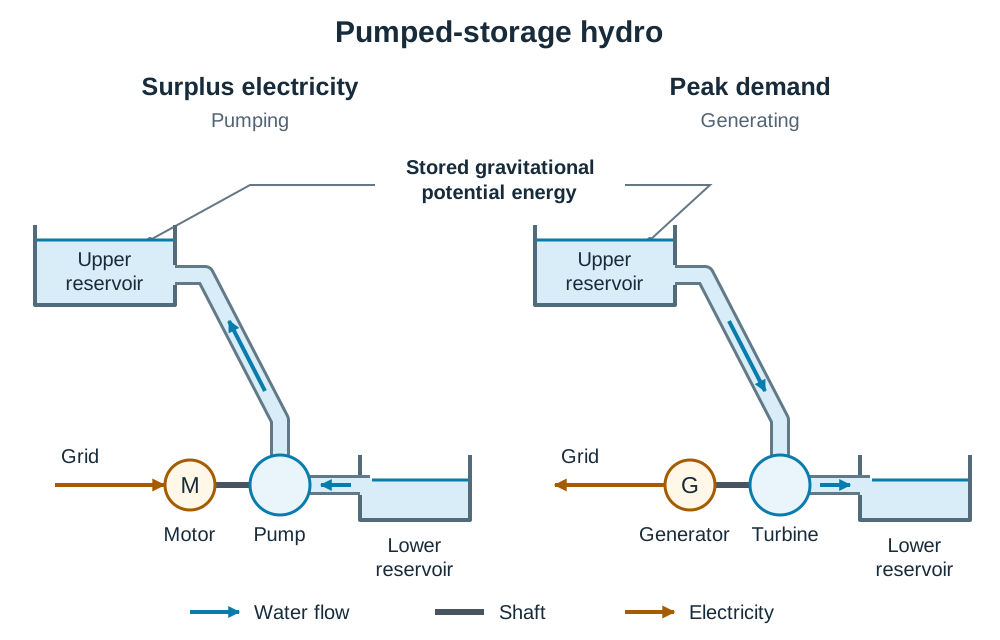
- Pumped-storage hydro: Surplus grid power pumps water to a high reservoir; during peak demand, water flows back through turbines (Turlough Hill, Co. Wicklow).
- Battery storage: Chemical batteries respond in milliseconds to stabilize grid frequency.
- Thermal storage: Excess electricity heats domestic water cylinders or thermal bricks.
- Flywheels: Store kinetic energy in heavy spinning rotors for short-term grid stability.
- Hydrogen: Electrolysis splits water into hydrogen during periods of surplus power; the gas is stored for fuel cells or combustion later.
EirGrid operates the Irish transmission grid and must balance generation and demand second by second.
Electrical Energy Consumption and Running Costs
Because the joule is very small ( for ), utility suppliers bill electricity in kilowatt-hours (kWh), commonly called units of electricity.
Step-by-Step Costing Procedure
- Calculate total energy in kilowatt-hours:
Divide watts by 1000 to get kilowatts. Divide minutes by 60 to get hours.
- Multiply energy by unit tariff price:
Divide cent totals by 100 to present the final answer in euro.
Quick example: An 80 kW industrial machine runs at full load for 2.5 hours. Electricity costs 22 cent per kWh.
- Energy used:
- Total cost:
Reducing Energy Consumption
In exam questions asking for ways to conserve energy, state the specific action and the reason:
- Insulation (attic, walls, pipework): Slows heat loss so heating systems run for less time.
- Double/triple glazing and draught exclusion: Cuts conductive and convective heat losses through openings.
- Thermostats, timers, and zone valves: Ensures rooms are only heated when occupied.
- A-rated appliances and LED lighting: Delivers the required output using far less electrical input power.
- Switching off standby loads: Prevents continuous power drain when devices are not performing useful work.
- Smart meters: Displays real-time consumption data to motivate behavioural changes.
Energy Application in Design Projects and Coursework
Energy principles are assessed in the terminal written paper and in the leaving certificate coursework project (200 marks total: 100 marks for the design folio, 100 marks for the artefact).
2027 Coursework Context
For 2027 Higher Level, the thematic brief focuses on supporting independent living, wellbeing, or social participation in an ageing society. The project brief requires an electromechanical element (such as a motor-driven dispenser, mechanical hoist, or motorized adjustment linkage), where your energy and power calculations belong. Coursework must be completed by Friday 19 March 2027, and the maximum artefact dimension must not exceed 500 mm.
The SEC instructions to candidates state that where an electrical supply is used to operate the artefact, it should be of low-voltage output. In practice, design your electromechanical system around dry cells, rechargeable battery packs, or a regulated bench power supply.
Folio Section 3: Environmental Impact (10 Marks)
(Note: Folio headings remain standard, though mark distributions may vary with the annual brief.) To achieve top marks, justify your component selection with actual calculations rather than general statements:
- LED versus Filament Bulb: A 6 V filament bulb drawing 0.3 A consumes . An indicator LED drawing 20 mA at 6 V consumes . Switching to the LED cuts power dissipation by 93%, reducing battery replacements and chemical waste.
- Battery Runtime Sizing: A 6 V circuit draws 120 mA during operation. A rechargeable battery pack rated at 1800 mAh will operate the device for:
- Friction and Mass Reduction: Fitting nylon bushes or miniature ball bearings to drive shafts and lightening moving arms reduces the torque and work () required from the drive motor.
- Automatic Shutdown: Using limit switches, LDRs, or microcontroller sleep modes cuts battery drain when the mechanism reaches its end of travel.
Key terms
- Energy
- The ability to do work, measured in joules (J).
- Work Done
- The energy transferred when a force moves an object through a distance in the direction of the force: W = F × d.
- Power
- The rate at which work is done or energy is converted per second, measured in watts (W), where 1 W = 1 J/s.
- Principle of Conservation of Energy
- The scientific law stating that energy cannot be created or destroyed; it can only be changed from one form into another.
- Gravitational Potential Energy
- Stored energy possessed by an object due to its vertical height: PE = mgh.
- Kinetic Energy
- Energy possessed by an object due to its motion: KE = ½mv².
- Efficiency
- The percentage of total input energy or power that is converted into useful output: Efficiency (%) = (useful output ÷ total input) × 100.
- Kilowatt-Hour (kWh)
- The commercial billing unit of electrical energy, representing 1000 watts of power used continuously for one hour (equal to 3.6 MJ).
- Renewable Energy Source
- An energy resource that replenishes naturally on a human timescale and will not run out through continuous use, such as wind, solar, or hydro.
- Non-Renewable Energy Source
- An energy resource that exists in finite supply and cannot regenerate on a human timescale once consumed, such as coal, oil, gas, or uranium.
- Intermittent Source
- An energy source whose output varies with weather and environmental conditions, such as wind or solar power.
- Mechanical Advantage (MA)
- The ratio of load force overcome to the effort force applied in a machine: MA = Load ÷ Effort.
- Velocity Ratio (VR)
- The ratio of distance moved by the effort to the distance moved by the load: VR = distance moved by effort ÷ distance moved by load.
- Low-Voltage Supply
- An electrical power source of low output voltage (such as batteries or a regulated plug-in adapter) specified for operating candidate coursework artefacts safely.
Check yourself
State the principle of conservation of energy.
Energy cannot be created or destroyed; it can only be changed from one form into another.
State the energy conversions that occur when boiling water in an electric kettle.
Electrical energy is converted into thermal (heat) energy in the heating element, which transfers heat to the water; a small amount of energy is converted into sound.
A 2 kg mass is dropped from a height of 1.5 m. Calculate its speed just before hitting the ground. (Take g = 9.81 m/s²).
PE lost = mgh = 2 × 9.81 × 1.5 = 29.43 J. By conservation of energy, KE gained = ½mv² = 29.43 J. Therefore, 0.5 × 2 × v² = 29.43, giving v² = 29.43 and v = √29.43 = 5.42 m/s.
A 2.5 kW appliance runs continuously for 90 minutes. If electricity costs 24 cent per kWh, calculate the operating cost.
Time = 90 / 60 = 1.5 hours. Energy = 2.5 kW × 1.5 h = 3.75 kWh. Cost = 3.75 kWh × 24c = 90 cent (€0.90).
A motor is 40% efficient and is supplied with 250 W of electrical power. What useful mechanical power does it deliver?
Useful power = Input × (Efficiency / 100) = 250 W × 0.40 = 100 W.
What power supply condition applies to candidate coursework artefacts under the SEC instructions?
Where an electrical supply is used to operate the artefact, it should be of low-voltage output (such as dry cells, battery packs, or a regulated bench power supply).