

In Leaving Certificate Technology at Higher Level, coursework accounts for 50% of your total examination mark (200 marks). This is divided equally between the physical artefact (100 marks) and the design folio (100 marks). The folio records and justifies your entire design journey, from initial problem analysis to physical realisation and testing. The State Examinations Commission (SEC) assesses the Higher Level folio against ten strict headings with fixed mark allocations. For the 2027 examination, candidates must respond to the national thematic brief centred on an ageing society, producing a working model that incorporates an electro-mechanical element within a 500 mm maximum dimension limit.
Coursework Structure, SEC Rules, and 2027 Assessment Parameters
Your Technology grade combines a terminal written paper (50%) and coursework (50%, or 200 marks). At Higher Level, coursework divides right down the middle:
- Artefact: 100 marks (50% of coursework)
- Design folio: 100 marks (50% of coursework)
Because the folio carries half the coursework marks, a high-quality physical model cannot achieve a top grade without an equally thorough design folder. Under the Instructions to Candidates issued with the brief, coursework must be your own individual work, completed in school under the supervision of your class teacher, and never removed from the school setting—removing it may make it invalid. The accompanying notice to schools (circular S58/26) adds that each candidate must submit a separate and distinct project, that the coursework must be available for assessment by Friday 19 March 2027, and that the finished folio and artefact are then kept under lock and key in the school until marking and appeals conclude in June.
One level, both components
You must answer the brief for the level you intend to sit. If either component—the written examination or the coursework—is submitted at Ordinary Level, the whole subject is graded at Ordinary Level. A Higher Level candidate must therefore respond to the Higher Level thematic brief, not the Ordinary Level active-travel brief, and must sit the Higher Level written paper.
The 2027 Higher Level thematic brief
The 2027 Higher Level brief asks you to design and manufacture a working model of a device, system, or technical aid that demonstrates a solution aimed at supporting independent living, wellbeing, or social participation in an ageing society. The brief states that the maximum dimension of the artefact should not exceed 500 mm, and that your solution should include an electro-mechanical element. Treat both as requirements—an examiner has no way to credit a solution that ignores them.
Where an electrical supply is used to operate the artefact, it should be of low voltage output—for example, a battery pack or a bench low-voltage supply, never a mains-voltage connection made by you. If your artefact needs specialised equipment to run, you must set it up yourself, provide clear operating instructions, and have it ready to use on the day of assessment. All important operating features of the artefact must remain visible and easily accessible without dismantling.
The artefact side of the coursework (100 marks)
The folio is only half the coursework mark. The artefact is marked separately under six headings, and your folio must show the examiner where each mark was earned:
| No. | Heading | What is being marked | Marks |
|---|---|---|---|
| 1 | Artefact meets theme and specifications | Solution fulfils the thematic brief and your own written specifications | 10 |
| 2 | Originality and creativity | Design originality, aesthetics, ergonomics, and creative use of materials | 15 |
| 3 | Production skills | Processing of materials, assembly, and range and depth of workshop skills | 30 |
| 4 | Functionality | Artefact works well; appropriate/limited use of commercial components | 20 |
| 5 | Quality and finish | High quality manufacture, clean finish, due regard for health and safety | 15 |
| 6 | Presentation | Well presented display; parts well integrated and labelled where appropriate | 10 |
Production skills carries 30 marks—the largest single block in the whole project. Buying a ready-made mechanism and screwing it to a base destroys this mark and damages your functionality mark, because examiners are instructed to reward only 'appropriate/limited use of commercial components/solutions'. Use bought-in parts only for items you could not reasonably make yourself (such as a motor, microcontroller, bearings, or standard fasteners) and fabricate the rest in the school workshop.
Headings 1 to 4: Brief Analysis, Management, Environment, and Specification
The SEC assesses the folio across ten mandatory headings, which must appear in exact numerical order:
Page budget and mark allocation
Allocate your folio pages in proportion to marks rather than writing equal amounts for every heading:
| Heading | Title | Marks | Recommended pages |
|---|---|---|---|
| 1 | Analysis of thematic brief | 7 | 1–2 pages |
| 2 | Overall management of the project | 5 | 1–2 pages |
| 3 | Environmental impact of the project | 10 | 2–3 pages |
| 4 | Research, investigation and specifications | 7 | 2–3 pages |
| 5 | Design ideas and selection of optimum solution | 18 | 5–6 pages |
| 6 | Sketches and drawings for manufacture | 18 | 5–6 pages |
| 7 | Production planning | 10 | 2–3 pages |
| 8 | Product realisation | 10 | 3–4 pages |
| 9 | Testing, evaluation and critical reflection | 10 | 2–3 pages |
| 10 | Presentation and ICT | 5 | Earned across whole folio |
Heading 1: Analysis of Thematic Brief (7 marks)
Begin with the broad 2027 theme and funnel it down to one clear problem in four moves:
- The theme: across many countries including Ireland, people are living longer and remaining active for longer periods.
- The broad challenges: reduced fine motor dexterity, visual impairment, reduced physical mobility, memory retention, or social isolation.
- The specific problem: for example, older adults with arthritis or reduced pinch grip strength often find child-resistant medicine containers impossible to open unaided, leading to missed doses or spilled medication.
- Chosen parameters: identify the primary user (an older adult living independently), the setting (a bedside table or kitchen counter), and the required sub-systems (timed alerts, motorised dispensing, and simple push-button controls).
Heading 2: Overall Management of the Project (5 marks)
Set out how you will manage the whole project from September to March. Detail your resource constraints, including an itemised budget limit (for example, keeping raw material costs under €35.00), machine booking availability, and skill requirements. Present an overarching timeline or Gantt chart scheduling the primary phases: brief analysis, research, conceptual sketching, working drawings, workshop realisation, and testing.
Heading 3: Environmental Impact of the Project (10 marks)
Evaluate the environmental footprint across the complete lifecycle of your product:
| Lifecycle stage | Folio evidence and design considerations |
|---|---|
| Material selection | Compare materials: plant-based PLA filament, which is made from a renewable feedstock and is industrially compostable (it will not break down in a household bin), compared with oil-based high-impact polystyrene; sustainably sourced hardwood compared with manufactured board. |
| Manufacture | Plan nested cutting layouts for sheet stock to minimise workshop waste. Record safe extraction and disposal routes for acrylic dust or solvent adhesives. |
| Operation (use) | Optimise energy consumption by designing low-voltage circuits with sleep modes or momentary push switches rather than continuous current draw. |
| Maintenance and end of life | Design the unit so it can be taken apart again (design for disassembly). Use threaded fasteners rather than permanent adhesive bonds so electrical components can be salvaged and plastics recycled. |
Note: do not confuse this environmental life cycle with the commercial product life cycle (Introduction, Growth, Maturity, Decline) taught in quality management.
Showing modern materials and processes
The 2027 brief specifically asks for a solution developed with a focus on modern materials and processes. In Heading 3 and Heading 5, explain which modern materials and processes you chose and why:
- Polymers and composites: acrylic (PMMA) sheet, polycarbonate for impact resistance, ABS, PLA and PETG filament, aluminium extrusion sections.
- Processes: laser cutting and engraving, 3D printing (fused deposition modelling), vacuum forming, CNC routing, line bending, and solvent welding.
- Electronic and control technologies: microcontroller boards, servo, stepper and geared DC motors, solenoids, and sensors such as LDRs, thermistors, ultrasonic, infrared, and reed switches.
For each material, justify it with a specific property: for example, 'polycarbonate was chosen over acrylic for the handle guard because it has superior impact resistance and will not shatter if knocked off a bedside table by an older user.'
Heading 4: Research, Investigation and Specifications of Brief (7 marks)
Investigate existing market solutions and examine their shortcomings. Break each existing product down into its sub-systems—the input (sensors or switches), the process (microcontroller or logic), the output (motor, solenoid, buzzer, display), and the housing—and explain what each does well or badly. Incorporate relevant anthropometric data (such as average palm width, finger clearance, or pinch grip strength) to justify sizes and button placements.
Conclude with a numbered list of measurable design specifications. Every specification must be checkable with a rule, a multimeter, a stopwatch, or a physical trial:
- Function: the unit shall dispense one measured dose and sound an audible alert at three preset times per day.
- Size: overall dimensions shall not exceed 280 mm × 220 mm × 180 mm, and no dimension shall exceed 500 mm.
- Power: the unit shall operate from a 5 V low-voltage supply and draw no more than 400 mA with the motor under full load.
- Ergonomics: all controls shall be operable with one hand; push buttons shall be at least 20 mm across, based on anthropometric data for adult finger pad width.
- Reliability: the mechanism shall complete 20 consecutive dispense cycles without jamming.
- Safety: there shall be no exposed mains voltage, no sharp edges (all corners radiused to R5 min), and no mechanical finger pinch points.
- Environment: at least 80% by mass of the enclosure shall be recyclable polymer, assembled with threaded machine screws for disassembly.
- Cost: total material and component expenditure shall not exceed €35.00.
Headings 5 and 6: Design Ideas and Drawings for Manufacture (36 Marks Combined)
Headings 5 and 6 carry 36 of the 100 folio marks. Spend enough time on them: writing pages of background research will not make up for weak concept sketches or missing working drawings.
Heading 5: Design Ideas and Selection of Optimum Solution (18 marks)
Produce original, annotated freehand sketches illustrating three distinctly different solutions. Do not present three minor cosmetic variations of the same box. Explore fundamentally different mechanical principles—for example, a motorised rotary carousel, a linear lead-screw slider, and a gravity-fed solenoid gate. Use 2D and 3D sketching enhanced with light, shade, texture, and colour rendering.
Evaluate each concept against your Heading 4 specifications using an objective, weighted decision matrix. Select your optimum design and write a paragraph justifying why this solution was selected and why the alternatives were set aside.
Heading 6: Sketches and Drawings for Manufacture (18 marks)
Heading 6 provides the complete technical blueprints required to manufacture the artefact from scratch:
- Orthographic working drawings: produce fully dimensioned orthographic projections (front elevation, end view, and plan view) in first- or third-angle projection. Follow standard drawing conventions: include a title block with your examination number, state the scale used, draw the standard projection symbol, express dimensions in millimetres with the unit stated once, place dimension lines outside the component outline with arrowheads, show hidden detail in dashed lines, and show centre lines in chain-dotted lines.
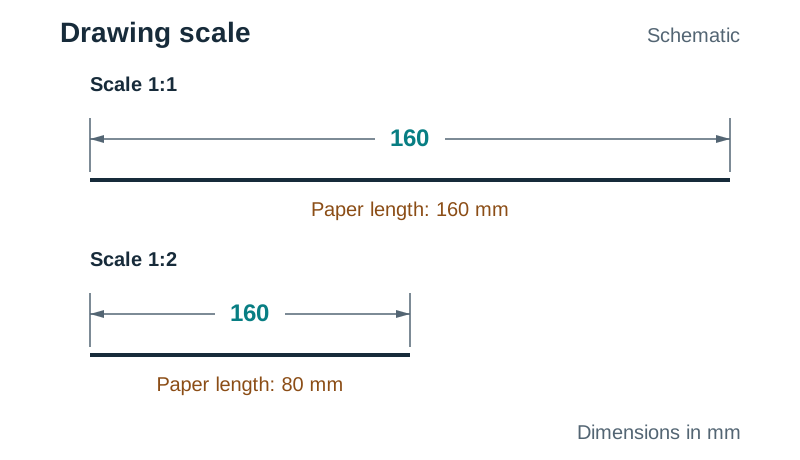
- Drawing scale rule: drawing scale alters the drawn size on paper, but never changes the written dimension callout. At a scale of 1:2, a 160 mm panel is drawn 80 mm long, but its dimension callout remains 160 mm.
- Assembly and sectional views: include 3D pictorials, exploded views, or sectional cuts hatched at 45° to reveal internal drive shafts, gear meshes, and fastener locations.
- Electronic circuit schematics: draw complete circuit schematics using standard electronic symbols. Mark supply rails, pinouts, and protective resistor values calculated from Ohm's law.
- Flowcharts: document control software using standard logic symbols (terminators, input/output parallelograms, process rectangles, and decision diamonds).
- CAD/CAM hardcopies: where Computer-Aided Manufacture (CAM) like 3D printing or laser cutting is used, supporting Computer-Aided Design (CAD) drawings must be included in your design folio in hardcopy format to authenticate your own individual work.
Heading 7: Production Planning, WBS, Gantt Charts, and CPA
Heading 7 (10 marks) details the operational management of the workshop build. The planning tools you use here—WBS, Gantt charts, and Critical Path Analysis—are tested twice in Leaving Certificate Technology: once in your folio, and regularly as long questions on the written examination paper.
1. Work Breakdown Structure (WBS)
The Work Breakdown Structure (WBS) breaks down the entire project into a logical hierarchy:
- Level 1: Final artefact (Automated Medication Reminder Unit)
- Level 2: Major project phases (Research and design, Electronics, Fabrication, Assembly, Testing)
- Level 3: Discrete work packages (under Fabrication: 3D print carousel chassis, laser cut base and panels, turn drive shaft)
- Level 4: Specific workshop tasks (drill mounting holes, countersink M3 holes, deburr edges)
2. Bill of Materials (BOM) and costing
Present an itemised table tracking quantities, material types, supplier references, unit costs, and total expenditure. Convert units accurately (for example, 120 g of PLA filament from a €22.00/kg spool costs ).
3. Setting out the network diagram
In Critical Path Analysis (CPA), each activity is drawn as a box (a node) split into six cells, with arrows showing which activity must finish before the next can begin:
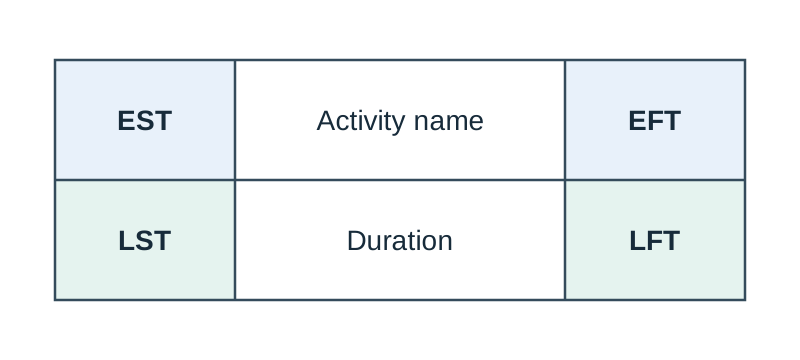
- Earliest Start Time (EST) and Earliest Finish Time (EFT): found using a forward pass (left to right). The first activity starts at 0. . Where two or more arrows enter an activity, take the largest incoming EFT as its EST. The EFT of the final activity is the minimum project duration.
- Latest Finish Time (LFT) and Latest Start Time (LST): found using a backward pass (right to left). Set the LFT of the last activity equal to the minimum project duration. . Where an activity feeds into two or more later activities, take the smallest succeeding LST as its LFT.
- Total float: the spare time an activity can slip without delaying the final project finish date: $$
- Critical path: the unbroken chain of dependent tasks where . Any delay to an activity on this path immediately delays the whole project.
4. Drawing the Gantt chart
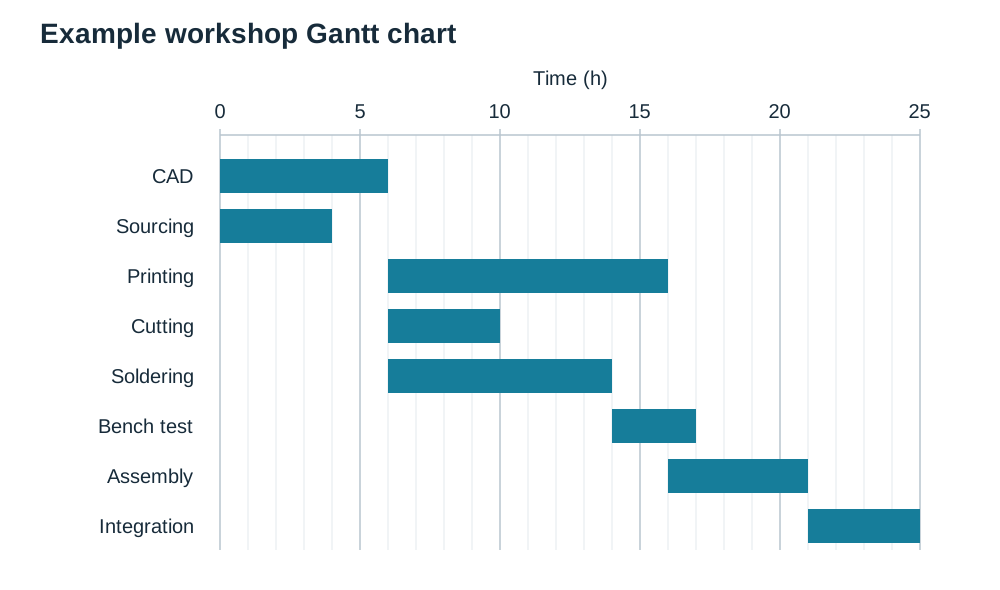
A Gantt chart is a bar chart of time used to plan, schedule, and track tasks. Draw it systematically:
- List tasks down the left-hand column in the order they start.
- Put time in hours or days across the top, evenly spaced.
- Draw one horizontal bar per task, starting at its EST and running for its duration.
- Show parallel tasks (tasks running at the same time) as bars sitting directly under each other across the same time columns.
- Tasks with float can have their spare time indicated with dashed or shaded extensions.
Headings 8 and 9: Product Realisation, Testing, and Critical Reflection
Heading 8: Product Realisation (10 marks)
Product realisation is the chronological, photographic record of manufacture. Present clear, dated photographs showing your own hands carrying out marking out, cutting, drilling, milling, 3D printing, circuit soldering, assembly, and surface finishing.
Every photograph must include a detailed caption explaining:
- The tool, machine, or software setting used.
- The technical reason for that processing choice.
- The health and safety precautions observed.
Safety caption template: 'Pillar drill operated at 650 RPM for a 6 mm HSS drill bit in acrylic sheet. Material securely clamped in a machine vice with a sacrificial MDF backing board to prevent breakout. Safety goggles worn, hair tied back, and emergency stop checked.'
Document mistakes and problems as they happen. If an acrylic bracket cracks during drilling, photograph the damaged part, explain the cause (such as excessive feed pressure or an unbacked workpiece), and show the redesigned replacement.
Heading 9: Testing, Evaluation and Critical Reflection (10 marks)
Heading 9 is marked on five things, and you should give each one its own sub-heading in the folio:
- Testing against specifications: systematically test the completed artefact against every numbered target from Heading 4. Tabulate your target values, testing procedures, measured results, and pass/fail verdicts.
- Evaluation of final artefact: evaluate build quality, structural rigidity, mechanism performance, and ease of use for an older adult.
- Schedule comparison: place your original Heading 2/7 Gantt chart beside your actual workshop log. Calculate time variances in hours and percentage overruns, and compare where delays happened with your critical path.
- Suggested modifications with justification: describe specific engineering modifications to improve reliability, reduce assembly time, or cut material costs. Base every modification on evidence from testing.
- Critical reflection on entire process: reflect on your personal time management, skills gained, trade-offs between competing requirements, and how well the final product answers the ageing-society theme.
Diagnosing a fault: the cause-and-effect diagram
When an artefact fails a test, diagnose it using a cause-and-effect diagram (fishbone or Ishikawa diagram). Draw a horizontal spine pointing to the problem statement in a box (e.g. 'carousel jams after 18 cycles'). Group potential causes under angled ribs: Materials, Machines, Methods, Measurement, and Environment. Identify specific factors on sub-branches (such as thermal expansion of PLA, 0.1 mm shaft clearance, unlubricated contact surface), circle the root cause, and specify the engineering fix.
Heading 10: Presentation, ICT, and SEC Academic Integrity Rules (5 Marks)
Heading 10 is assessed on four distinct criteria: correct sequence of presentation, quality of material presented, acknowledgement of sources, and ICT skills in production and presentation.
Correct sequence and quality
Present your folio in the exact numerical sequence from Heading 1 to Heading 10. Bind pages securely with a clear title sheet showing your examination number and your two chosen option modules. Use consistent typography, clear sub-headings, and neatly bordered drawings.
ICT skills
Show evidence of using software tools across the project: 2D vector drawing for laser cutting, 3D parametric CAD for solids and 3D printing, circuit simulation software, word processors for folio presentation, and spreadsheets for bill of materials costings and schedule data. If you submit a multimedia presentation to enhance your project display, it must be no longer than 3 minutes in duration, set up by you, and ready for immediate viewing on a school PC or laptop.
Referencing, plagiarism, and academic integrity
Under SEC regulations, all research sources must be acknowledged in a formal bibliography. This includes books, journals, websites, component datasheets, and any material generated using artificial intelligence (AI) applications. Using external material without citing the source is plagiarism. Submitting work copied directly from external sources, or presenting work prepared by someone else, receives zero marks and is investigated by the State Examinations Commission.
Key terms
- design folio
- The formal 100-mark documentation folder submitted with the physical artefact that records, justifies, and evaluates every stage of the design and make process across ten SEC headings.
- artefact
- The physical working model designed and manufactured by the candidate in response to the thematic brief, assessed out of 100 marks across six criteria.
- thematic brief
- The national design challenge issued by the State Examinations Commission from which candidates identify a specific problem, establish parameters, and develop a working solution.
- electro-mechanical element
- An integrated mechanism where an electrical or electronic circuit controls or powers a moving mechanical system, required in the 2027 Higher Level project.
- design specification
- A numbered list of measurable criteria and constraints covering function, dimensions, safety, ergonomics, cost, and environment that the artefact must satisfy.
- anthropometric data
- Standardised measurements of the human body and physical capabilities used to ensure products match the physical dimensions of the intended user.
- Work Breakdown Structure (WBS)
- A hierarchical project management tool that decomposes a complete project into manageable phases, work packages, and workshop tasks.
- Earliest Start Time (EST)
- The earliest calendar time an activity can commence in a network diagram, determined by the forward pass as the largest EFT of all preceding tasks.
- Latest Finish Time (LFT)
- The latest calendar time an activity can be completed without delaying the overall project finish date, determined by the backward pass as the smallest LST of following tasks.
- total float
- The amount of spare time an activity can slip without delaying project completion, calculated as LFT - EST - duration.
- critical path
- The longest continuous sequence of dependent tasks through a project network, where every task has zero total float and any delay extends total project duration.
- Gantt chart
- A bar chart that schedules project tasks against a timeline, showing task durations, sequences, dependencies, and parallel operations.
- cause-and-effect diagram
- A structured quality problem-solving tool (also called a fishbone or Ishikawa diagram) that categorises potential root causes of a fault under headings such as materials, machines, methods, and measurement.
- CAD
- Computer-Aided Design; 2D vector or 3D parametric modelling software used to create engineering drawings and models.
- CAM
- Computer-Aided Manufacture; computer-controlled machines (such as 3D printers, laser cutters, or CNC routers) that produce physical components from CAD files.
- plagiarism
- Submitting another person's work, unreferenced source material, or uncredited AI-generated output as your own, resulting in zero marks and SEC investigation.
Check yourself
What proportion of the total Leaving Certificate Technology marks is awarded to the Design Folio at Higher Level?
25% of the overall subject mark (the folio represents 100 marks of the 200-mark coursework component, which accounts for 50% of the subject grade).
The 2027 Higher Level brief sets two technical requirements for the artefact itself. What are they?
It should include an electro-mechanical element, and its maximum dimension should not exceed 500 mm. (The theme itself—supporting independent living, wellbeing, or social participation in an ageing society—is the context, not a technical constraint.)
Which two folio headings carry the highest mark allocations, and how many marks do they carry?
Heading 5 (Design ideas and selection of optimum solution) and Heading 6 (Sketches and drawings for manufacture), each carrying 18 marks (36 marks combined).
How is Total Float calculated in Critical Path Analysis, and what is its value on the critical path?
Total Float = LFT - EST - duration. On the critical path, Total Float is always zero.
What must you include in your folio if you fabricate parts using Computer-Aided Manufacture (CAM)?
You must include supporting CAD drawings in hardcopy format in your design folio to authenticate your own individual work.
A component has a true length of 240 mm and is drawn at a scale of 1:2. What is the drawn length and what is the dimension callout?
The drawn length on paper is 120 mm (240 / 2), but the dimension callout written on the drawing remains 240 mm.
By what date must the 2027 coursework be available for assessment, and where must it be stored?
It must be available for assessment by Friday 19 March 2027 and must remain securely locked in the school setting at all times until marking and appeals conclude.
Compile a three-level Work Breakdown Structure (WBS) for the manufacture of a tilting kettle-pouring aid.
Level 1: Kettle-pouring aid. Level 2: 1. Research and design, 2. Select materials, 3. Manufacture, 4. Assemble and test. Level 3 (under Manufacture): 3.1 Bend aluminium cradle, 3.2 Laser cut acrylic base, 3.3 3D print handle grip, 3.4 Fit pivot pin and counterweight.