

Materials Technology examines why materials behave the way they do and how engineers select, test, shape, join, protect, and evaluate them. This Leaving Certificate Higher Level option covers the six primary material families: metals, polymers, woods, ceramics, composites, and fabrics. You will connect macroscopic behaviour to internal crystal and molecular structures, interpret quantitative test data including stress-strain curves, Young's modulus, shear stress, and impact energy, and master workshop and industrial processing methods ranging from heat treatment and sand casting to polymer moulding and composite lay-up. The syllabus also emphasises safety, quality assurance standards, life cycle assessment, and sustainable resource management.
1. Classification of Engineering Materials
Engineering materials divide into six main families based on their origin, structure, and functional performance:
Metals
Metals are lustrous, crystalline elements and alloys that conduct heat and electricity efficiently.
- Ferrous metals: Contain iron as the base element. They are usually magnetic and will rust (hydrated iron oxide) when exposed to oxygen and moisture together. Examples include mild steel, cast iron, and high-carbon tool steel.
- Non-ferrous metals: Contain no iron, are non-magnetic, and do not rust. Examples include aluminium, copper, zinc, and lead.
- Alloys: Mixtures of two or more elements where at least one is a metal, engineered to achieve superior properties. Brass is an alloy of copper and zinc (stronger than copper, machines easily). Stainless steel is iron alloyed with at least 10.5% chromium, which reacts with atmospheric oxygen to form an invisible, self-healing chromium oxide film that prevents corrosion. Many grades (such as 304 and 316) also contain nickel, which improves corrosion resistance and makes the steel non-magnetic.
Polymers (Plastics)
Polymers consist of long macromolecular chains formed from smaller monomer units during polymerisation:
- Thermoplastics: Linear or branched chains held together only by weak secondary intermolecular forces (Van der Waals forces). Heating frees the chains to slip past one another, softening the plastic. It solidifies upon cooling and can be repeatedly reheated, reshaped, and recycled. Examples include acrylic (PMMA); polyethylene—HDPE (rigid, e.g. bottle crates) and LDPE (flexible, e.g. film bags); polypropylene (PP); PVC; and PET (polyethylene terephthalate), the polyester thermoplastic widely used for drinks bottles.
- Thermosetting plastics: During moulding they cure: strong permanent covalent cross-links form between the chains, locking them into a rigid three-dimensional network. Reheating cannot break these cross-links without causing chemical decomposition and charring. They cannot be melted or reshaped. Examples include epoxy resin, melamine formaldehyde, urea formaldehyde, and polyester resin.
Woods
Natural cellular materials divided by botanical origin:
- Hardwoods: Broad-leaved, deciduous trees (such as oak, beech, ash, and mahogany). They feature dense cellular structures and grow slowly.
- Softwoods: Coniferous, evergreen trees with needles and cones (such as Scots pine, spruce, and cedar). They grow rapidly and have simpler cell structures. (Note: Balsa is botanically a hardwood, but is mechanically very soft).
- Manufactured boards: Engineered timber products including plywood (cross-laminated veneers glued at 90° grain offsets) and Medium Density Fibreboard (MDF, compressed wood fibres bonded with synthetic resin). These provide uniform strength across large sheets without knots or natural grain defects.
Ceramics, Composites, and Fabrics
- Ceramics: Inorganic, non-metallic materials shaped cold and fired at high temperatures. They exhibit exceptional hardness, high compressive strength, high melting points, and chemical inertness, but are inherently brittle (e.g. porcelain, alumina, tungsten carbide, brick).
- Composites: Materials formed by combining two chemically distinct constituents—a reinforcement phase embedded in a binder or matrix phase. The composite delivers mechanical performance superior to either constituent alone. The reinforcement provides tensile strength and stiffness; the matrix holds the fibres in place, protects them, and distributes the applied load. Examples include Glass Reinforced Plastic (GRP, glass fibres in polyester resin) and Carbon Fibre Reinforced Polymer (CFRP, carbon fibres in epoxy resin).
- Fabrics: Flexible textiles made by weaving, knitting, or bonding fibres. Natural fibres (cotton, wool) offer comfort and breathability; synthetic fibres (nylon, polyester, Kevlar) provide high tensile strength, abrasion resistance, and low moisture absorption.
2. Mechanical and Physical Properties & Testing
Selecting materials requires matching quantifiable properties to the operating loads and service environment.
Mechanical Property Contrasts
| Mechanical Property | Definition | Key Contrast / Common Confusion |
|---|---|---|
| Hardness | Ability of a material to resist surface indentation, scratching, and abrasive wear. | Hardness vs Toughness: Glass is hard (resists scratching) but brittle. Rubber is tough (absorbs impact) but soft. |
| Toughness | Capacity of a material to absorb sudden shock energy or impact loads without fracturing. | Tough materials deform plastically before breaking; brittle materials snap with little or no plastic deformation. |
| Strength | Capacity of a material to withstand applied external loads without rupture or permanent yielding. | Strength vs Stiffness: A fishing rod is strong (supports high tensile loads without breaking) but flexible (low stiffness). |
| Stiffness | Resistance of a material to elastic deflection or bending under load (governed by Young's modulus, ). | Stiff components deflect minimally; flexible components bend easily under modest forces. |
| Elasticity | Capacity of a material to deform under load and return completely to its original dimensions when unloaded. | Elasticity vs Plasticity: Elastic deformation is fully reversible (e.g. steel spring); plastic deformation is permanent (e.g. bent lead sheet). |
| Plasticity | Ability of a material to undergo permanent, irreversible deformation under load without fracture. | Plasticity is essential for cold-forming operations like stamping, rolling, and drawing. |
| Ductility | Capacity of a material to undergo significant plastic elongation under tensile stress (drawn into wire). | Ductility vs Malleability: Ductility involves pulling forces (drawing wire); malleability involves compressive squeezing (hammering sheet). |
| Malleability | Capacity of a material to deform plastically under compressive force without cracking (hammered into sheets). | Lead, gold, and red-hot mild steel display high malleability. |
Internal Structure, Grains, and Defect Behaviour
Observable properties relate directly to internal structure. You are not asked for atomic or molecular detail here. What you need is the link between what you can observe—how hard, tough, or flexible a material is—and how it is built internally:
- Metals: Solidify from molten liquid at multiple nucleation sites. Expanding crystal lattices collide to form grains separated by grain boundaries. Fast cooling produces fine grains with higher strength and toughness because grain boundaries resist dislocation slip. Slow cooling yields large, softer grains.
- Wood: Composed of tubular cellulose cells running parallel to the trunk. Wood is anisotropic—its properties vary with grain direction. It offers high tensile and compressive strength along the grain, but splits easily across the grain. Wood is also hygroscopic—it takes in and gives out moisture from the air—so it swells, shrinks, warps, and twists as humidity changes.
- Defects and Stress Concentrations: Real materials contain internal flaws (voids, micro-cracks, inclusions, knots). Applied stress concentrates at flaw tips, which can initiate crack propagation. Designers account for this by incorporating a Factor of Safety (FoS).
Standardised Material Testing
- Brinell and Vickers Hardness: Press a hardened ball or diamond pyramid indenter into the surface under a known static load. The rule for all indentation tests is simple: the smaller the indentation left behind, the harder the material.
- Deflection Testing: A beam of span is loaded centrally with weight . Lower deflection () indicates a stiffer material (higher Young's modulus, ).
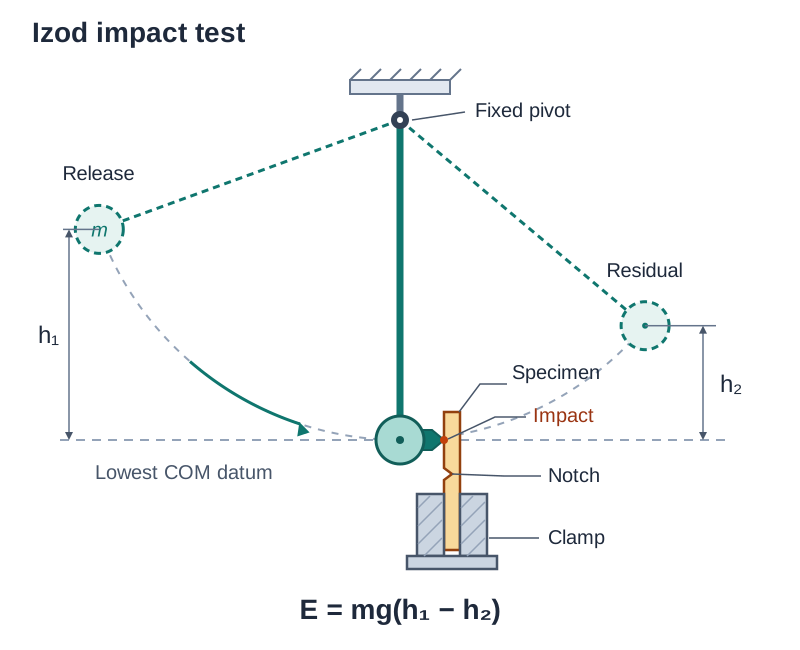
- Izod Impact Test: A swinging pendulum of mass drops from height , strikes a vertically clamped notched specimen, and swings through to residual height . The energy absorbed is in Joules. Tough materials absorb high energy; brittle materials snap cleanly, leaving the pendulum to swing high.
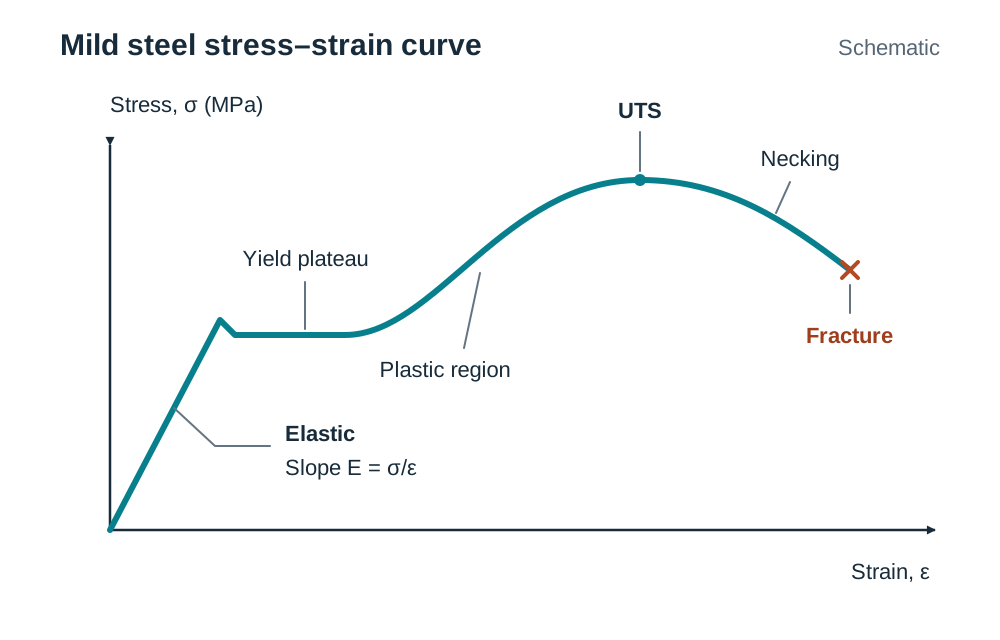
- Tensile Testing & Stress-Strain Curve: A specimen is pulled axially until fracture. Direct stress is ( or MPa), and strain is (dimensionless). On a mild steel stress-strain curve, the straight initial section represents elastic behaviour where Hooke's law applies; its slope is Young's modulus (). At the yield point, plastic deformation begins. The curve rises to a peak at the Ultimate Tensile Strength (UTS) before localized necking and ductile 'cup and cone' fracture. Brittle materials show a steep, near-linear line that ends abruptly without a yield plateau.
- Shear and Compressive Testing: Shear stress is , where is the area being cut across (for a round pin in single shear; in double shear two areas resist the load, so the stress halves). Compressive stress uses the same formula with a squeezing load (concrete, brick, cast iron columns).
- Torsion Testing: Torsion data shows how much a shaft twists under an applied torque, so a shaft is chosen to keep the twist small.
3. Heat Treatment and Metallurgy of Metals
Heat treatment means heating and cooling a metal in a controlled way to change its properties without changing its shape. The five processes you must be able to describe are:
1. Annealing (to soften)
Heat the steel to bright cherry red (around 750–800 °C), hold it at that temperature to allow full heat soak, then cool it very slowly (inside the switched-off furnace or buried in dry sand or lime). Slow cooling allows large, stress-free grains to form, relieving internal stresses and restoring full ductility so the metal can be bent, hammered, or drawn again without cracking.
2. Hardening (to harden right through)
Heat high-carbon steel to cherry red (around 780–820 °C), then quench it immediately by plunging it vertically into cold water, brine, or oil and agitating it. The sudden cooling traps the carbon within the crystalline structure, producing a needle-like structure that is exceptionally hard but very brittle. Hardening only works on steel with sufficient carbon content (about 0.4% carbon upward); plain mild steel will not harden by quenching.
3. Tempering (to remove brittleness)
Clean and polish the hardened steel with emery cloth so the bare metal is bright. Heat the component gently away from the working edge and watch the temper colours (oxide films) creep toward the tip: pale straw (approx. 230 °C), dark straw, brown, purple, and blue (approx. 300 °C). Quench the tool in water the instant the required colour reaches the cutting edge. Tempering trades a small amount of hardness for a large gain in toughness, preventing the edge from chipping or snapping. For example, a wood chisel edge is quenched at pale straw (retains high hardness), whereas a screwdriver tip is tempered to purple/blue (tougher, resists torsional shock).
4. Case Hardening (hard skin, tough core)
Used where mild steel must resist surface abrasive wear while retaining a shock-absorbing interior (such as gear teeth, spanner jaws, or hinge pins). Mild steel cannot be through-hardened because it lacks carbon. The steel part is heated to bright red, submerged in a carbon-rich carburising compound, reheated to allow the carbon to diffuse into the outer surface, and quenched. This produces a thin, hard high-carbon outer skin over a ductile, tough low-carbon core.
5. Normalising
Heat the steel to just above its critical transformation temperature and cool it in still air. This refines irregular grain structures caused by heavy forging, rolling, or welding, leaving a uniform, stress-relieved component with dependable mechanical properties.
4. Materials Processing: Casting, Forming, Moulding, and 3D Printing
Processing transforms stock materials into finished shapes through hand, machine, thermal, or chemical techniques.
Process Selection Matrix
| Process | Material it suits | Suitable quantity | Setting / Feasibility |
|---|---|---|---|
| Injection moulding | Thermoplastics (ABS, PP, Nylon) | High mass production (10,000+) | Industrial only (extreme tooling costs) |
| Blow moulding | Thermoplastics (HDPE, PET, PP) | Continuous mass production | Industrial only (dedicated mould tools) |
| Extrusion | Thermoplastics (PVC, PE, acrylic) | Continuous lengths (tubes, trim) | Industrial only (expensive die setups) |
| Compression moulding | Thermosets (Urea/Melamine formaldehyde) | Medium to high volume | Industrial (classroom press variants exist) |
| Rotational moulding | Thermoplastics (polyethylene powder) | Low to medium batches | Industrial (specialised heating arm) |
| Vacuum forming | Thermoplastic sheet (HIPS, acrylic) | Once-off to small batch | School workshop and industry |
| Line bending | Thermoplastic sheet (acrylic, PVC) | Once-off to small batch | School workshop and industry |
| 3D printing (FDM) | Thermoplastic filament (PLA, PETG, ABS) | Once-off prototypes, custom aids | School workshop and industry |
| Sand casting | Non-ferrous & ferrous metals (Al, brass, iron) | Once-off to small batch | School foundry and industrial foundry |
| Die casting | Low-melting non-ferrous alloys (zinc, Al) | High mass production | Industrial only (expensive tool-steel dies) |
| GRP hand lay-up | Thermoset polyester resin + glass fibres | Once-off to medium batch | School workshop and industry |
Sand Casting (Ordered Process)
Sand casting pours molten metal into a compacted sand mould to make shaped metal components:
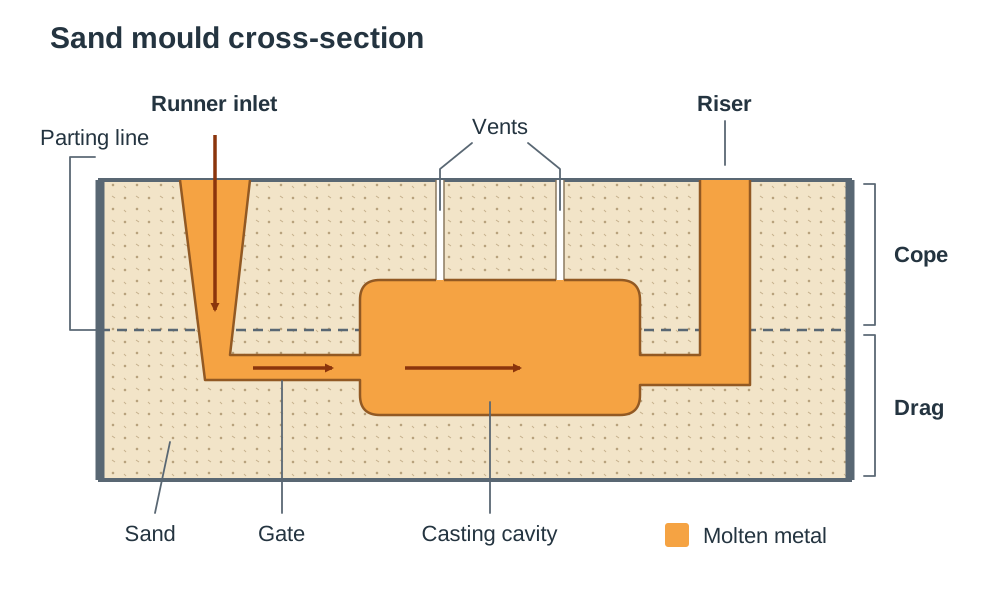
- Make a pattern of the part in wood or resin, slightly oversize to allow for shrinkage, with draft (taper) on the sides so it can be withdrawn without crumbling the sand cavity.
- Place the pattern in the drag (bottom moulding box), ram damp moulding sand tightly around it, invert the box, position the cope (top moulding box), and add parting powder.
- Position tapered pegs to form the runner (where molten metal enters) and the riser (which allows air and gas to escape and feeds molten metal back as the casting shrinks).
- Separate the boxes, withdraw the pattern, cut the gate connecting the runner to the cavity, and prick vent holes through the sand to let steam escape.
- Reassemble the boxes, clamp them securely, and pour molten metal steadily into the runner until it appears in the riser. Allow it to solidify.
- Break open the sand mould, cut off the runner and riser, and fettle the casting by grinding away flash and parting lines.
Industrial Polymer Processing
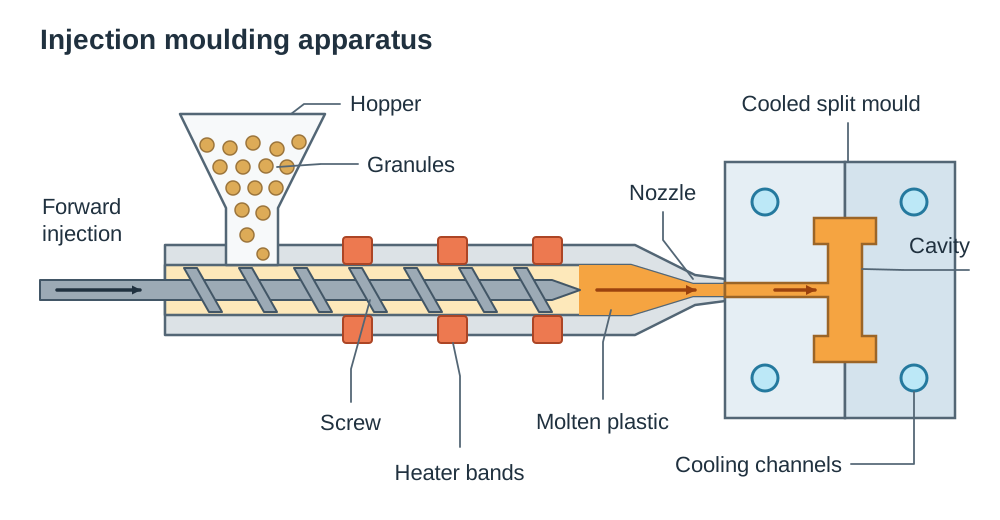
- Injection moulding: Granules feed from a hopper into a barrel. Electric heater bands along the barrel, together with the friction of a rotating screw, melt the granules and push the molten plastic forward. Once a shot collects, the screw is driven forward like a plunger, injecting the molten plastic under high pressure into a cooled, split steel mould. The part solidifies, ejector pins push it out, and the cycle repeats.
- Extrusion: Granules are melted in a heated barrel by a continuous rotating screw and forced through a shaped die to produce continuous profiles of constant cross-section (pipes, window trims, electrical trunking). The profile is cooled in water and cut to length.
- Compression moulding: The standard method for thermosetting plastics (e.g. electrical plug tops or saucepan handles in urea formaldehyde). A measured slug of moulding powder is placed into the heated lower mould cavity. The heated upper punch descends under high force, causing the plastic to flow into the cavity and cure by cross-linking. The mould opens while hot, and the rigid part is ejected.
- Rotational moulding: Measured polymer powder is placed inside a thin-walled split mould. The mould is heated in an oven while rotating simultaneously on two perpendicular axes. Centrifugal force and gravity coat the inside walls evenly. The mould is cooled and opened to yield large, stress-free hollow products (water storage tanks, traffic cones, wheelie bins).
Additive vs Subtractive Manufacturing
In 3D printing (additive manufacturing), a 3D CAD model is sliced into horizontal layers. The printer builds the component layer upon layer (e.g. FDM extrudes melted PLA filament through a nozzle onto a heated bed). Additive methods add material only where required, eliminating expensive tooling dies and allowing complex internal cavities. In contrast, subtractive manufacturing (lathe turning, CNC milling, drilling) starts with a solid billet and cuts away waste swarf to reveal the shape.
5. Processing Timber and Composites
Forming curved timber and composite materials requires distinct workshop procedures.
Timber Forming Techniques
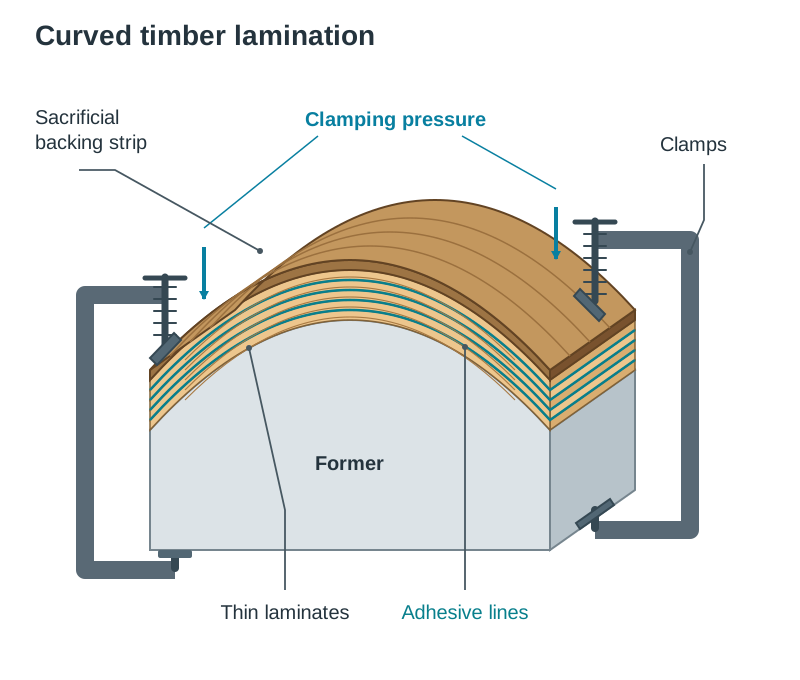
- Lamination: Building up a curved or structural timber component from multiple thin layers (laminates) bonded with adhesive. Steps:
- Cut thin strips of timber thin enough to bend without snapping.
- Apply adhesive (PVA or urea formaldehyde) evenly to all mating faces.
- Clamp the laminated pack tightly into a shaped former or jig, using a sacrificial backing strip to distribute clamping pressure.
- Allow the adhesive to cure completely before releasing clamps, then plane and sand the profile.
- Advantages: The adhesive lines hold the curvature permanently with minimal spring-back; grain defects are distributed across layers, making the part stronger than solid timber; and curves can be formed without short-grain weakness.
- Kerfing: Cutting a series of closely spaced, parallel saw kerfs part-way through the thickness of a timber board, allowing the remaining wood skin to bend around a curve. The kerfs are then backed with veneer or filled with adhesive.
- Steam bending: Solid timber is placed in a steam box until steam softens the natural lignin binding the wood cells. The softened wood is bent rapidly around a former, clamped, and allowed to cool and dry thoroughly so the bent shape sets.
Composite Manufacture
- Hand Lay-Up of GRP (Glass Reinforced Plastic):
- Clean the mould surface and apply a release agent (wax or PVA) so the finished part will separate cleanly.
- Brush on an unreinforced gel coat of pigmented polyester resin to form a smooth, coloured, waterproof outer skin.
- Mix liquid polyester resin with a catalyst/hardener in the exact specified ratio (initiating an exothermic curing reaction).
- Place chopped strand glass mat into the mould, stipple resin through the fibres with a stiff brush, and consolidate using a roller to work out trapped air bubbles (air voids cause severe weakness).
- Add successive layers of mat and resin to reach design thickness, allow the resin to cure chemically, demould, and trim excess flash with a rotary cutter.
- Carbon Fibre (CFRP): Woven carbon cloth pre-impregnated with epoxy resin (pre-preg) is laid into precision moulds, sealed inside a vacuum bag to extract air, and cured in a heated autoclave under pressure. Compared to a welded steel tubular frame, a carbon fibre structure is produced as a single seamless piece with no welds; mounting bosses and ergonomic curves are moulded straight into the shape; the finish is smooth and tactile; and it provides an exceptional strength-to-weight ratio. The trade-offs are higher material costs and complex recycling.
6. Joining Processes: Metallurgical, Mechanical, and Adhesive
Joining methods divide into permanent joints (cannot be separated without destroying components) and semi-permanent joints (can be dismantled for servicing, battery replacement, or recycling):
1. Metallurgical Joining (All Permanent)
The key distinction to state in an exam: the parent metal is not melted in soldering or brazing, whereas in welding the parent metal itself is melted and fused.
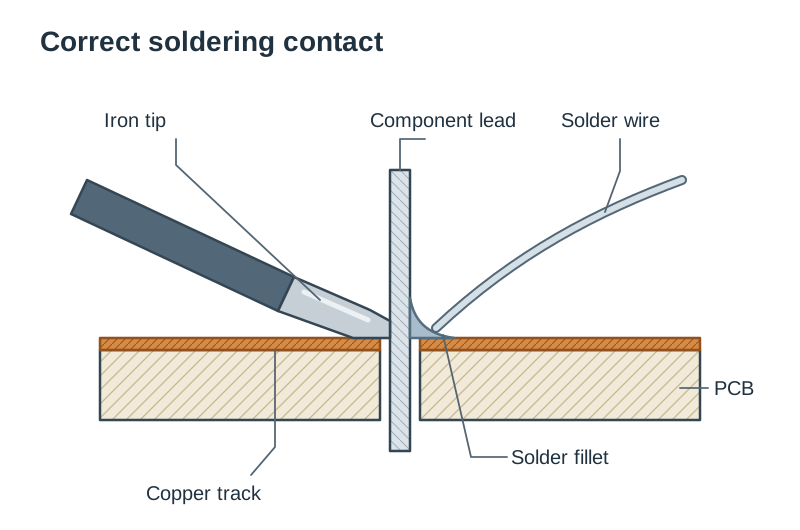
- Soft Soldering: Uses a low-melting-point tin alloy filler (melts ) to create electrically conductive joints. Steps: 1. Clean copper leads and tracks mechanically. 2. Apply the hot soldering iron tip simultaneously to the component lead and the PCB track for 2–3 seconds. 3. Feed flux-cored solder wire onto the joint from the opposite side (the heated joint must melt the solder, not the iron tip). 4. Remove solder, then remove the iron, and let it cool undisturbed to prevent a high-resistance 'cold joint'.
- Brazing: Joins metals using a brass/spelter filler rod (melts ) on a brazing hearth using an oxy-gas torch and borax flux. Forms high-strength joints in steel frames without melting the base steel.
- Welding (MIG, TIG, MMA): Uses an electric arc or gas flame to melt the parent metal edges directly, fusing them into a continuous joint with a compatible filler rod. Welding produces the strongest metallurgical bond.
2. Mechanical Joining
- Semi-Permanent Fasteners: Machine screws, bolts with locking nuts, woodscrews, and knock-down (KD) cam fittings. Always fit washers under bolt heads and nuts to spread clamping loads over a wider area and protect soft surfaces.
- Permanent Mechanical Joints: Pop rivets and solid snap-head rivets clamp sheet metal together through plastic expansion of the rivet shank (removal requires drilling out the core). Folded sheet metal seams permanently interlock formed edges.
3. Adhesive and Chemical Bonding (All Permanent)
- PVA (Polyvinyl Acetate): Water-based emulsion for porous timbers; cures as water absorbs into wood cells.
- Two-Part Epoxy Resin: Resin and hardener mix in equal parts to undergo an exothermic cross-linking cure. It bridges gaps, does not shrink, and bonds metals, ceramics, and rigid plastics.
- Cyanoacrylate ('Superglue'): Single-part monomer that polymerises in seconds when triggered by moisture on smooth surfaces.
- Solvent Welding (Tensol / Dichloromethane): Chemically dissolves mating surfaces of compatible thermoplastics (acrylic, PVC); polymer chains intermingle and fuse into a seamless solid joint as solvent evaporates.
7. Environmental Degradation, Surface Treatments, and Finishing
Surface finishes serve two purposes: protection against environmental breakdown and decoration (aesthetic colour and ergonomic feel).
Degradation Mechanisms
- Physical Degradation: Surface wear and abrasion from rubbing or repeated contact; swelling, shrinking, warping, and splitting in timber as moisture content changes; and cracking or loosening caused by repeated heating and cooling (thermal expansion cycling, freeze–thaw on porous materials).
- Oxidation and Rusting: Iron and steel corrode into hydrated iron oxide (rust). Rusting needs both oxygen and moisture present together. The resulting rust is porous and flakes away, exposing fresh metal so attack continues indefinitely. Remove either oxygen or moisture, and rusting stops.
- Galvanic Corrosion: Occurs when two dissimilar metals make electrical contact in the presence of an electrolyte (rainwater, salt spray). The metal higher on the galvanic series (the anode) corrodes preferentially, protecting the less reactive cathode. For example, an aluminium bracket fastened with a mild steel bolt in coastal air will suffer accelerated corrosion around the aluminium hole because aluminium is more anodic than iron.
- Polymer UV Degradation: Ultraviolet radiation breaks backbone bonds, causing chain scission, discolouration, chalking, and embrittlement.
- Biological Attack on Wood: Fungal decay (wet and dry rot) cannot establish unless wood moisture content exceeds approximately 20%.
Protective Treatments
- Sacrificial Protection (Galvanising): Steel dipped in molten zinc at 450 °C forms a protective zinc layer. Zinc provides a physical barrier and sacrificial cathodic protection: if scratched, the more reactive zinc corrodes preferentially, sacrificing itself to preserve the underlying steel.
- Anodising: Aluminium is made the anode in an acid electrolyte bath. An electric current thickens its natural oxide skin into a durable, porous oxide layer () that absorbs dye before being sealed in boiling water.
- Barrier Coatings: Primer, undercoat, and topcoat paints isolate steel from oxygen and moisture. Powder coating sprays charged polymer powder onto metal, which melts in an oven to form an even, chip-resistant skin.
- Safety in Processing: Always tie safety precautions to specific processes: use local dust extraction and a dust mask when cutting or sanding MDF (resin binder dust is a respiratory irritant); wear safety glasses, tie back hair, and clamp work securely in a machine vice when drilling; ensure dry tools and preheated moulds during casting (moisture causes molten metal to spit violently); use fume extraction when soldering; and consult safety data sheets for solvent adhesives.
8. Sustainable Design, Quality Assurance, and Assessment Context
Modern technology links responsible material choices with production controls.
Life Cycle Assessment and Industrial Ecology
- Life Cycle Assessment (LCA): Evaluates environmental impact across five stages: raw material extraction processing and manufacture distribution and packaging use and maintenance end-of-life disposal.
- Embodied Energy: The total energy used to extract, process, and transport a material. Virgin aluminium has very high embodied energy due to bauxite electrolysis; recycled aluminium requires only about 5% of that energy, making closed-loop recycling critical. Certified timber stores carbon and has low embodied energy.
- The 6 Rs: Rethink, Refuse, Reduce, Re-use, Repair, Recycle.
- Industrial Ecology: Manufacturing networks modelled on natural ecosystems, where waste outputs from one facility become raw inputs for another. A classic example is Kalundborg, Denmark, where an oil refinery, power station, and plasterboard factory exchange waste steam, cooling water, and synthetic gypsum.
- Single-Use Plastics: Products designed to be used once and discarded (e.g. PET bottles, plastic straws). They rely on fossil crude oil, resist natural biodegradation, and accumulate in ecosystems.
Quality Assurance, Quality Control, and Tolerances
- Quality Control (QC): Inspecting and testing parts during or after manufacture to intercept defects.
- Quality Assurance (QA): The systematic, planned procedures (approved drawings, operator training, tool calibration, quality standards) implemented to ensure faults do not occur.
- Standards: ISO 9001 (quality management systems), CE marking (mandatory declaration that products meet EU health, safety, and environmental standards—vital for medical and assistive devices), and NSAI Irish Standard Mark / Q Mark.
- Tolerance: Permissible dimensional variation (e.g. ). Check parts using vernier callipers, micrometers, or go/no-go gauges.
- Production Techniques and Constraints: Once-off (craft) production makes a single item using general-purpose tools — flexible and ideal for prototypes and school projects, but slow, costly per item, and dependent on the maker's skill, so identical repeats are hard to guarantee. Batch production makes a set quantity using jigs, templates, and repeatable setups — faster and more consistent per item and cheaper per unit, but it needs planning and investment in tooling first and is less flexible once set up. Quantity, required consistency, cost, and available resources decide which method to use.
Written Examination and Project Context
The Higher Level written paper is 2½ hours long and carries 50% of total subject marks. Under current arrangements:
- Section A (Core): Answer 12 of 15 short questions.
- Section B (Core): Answer two long structured questions from the core options offered.
- Section C (Options): Answer one long question from the five options. The exact mark allocations appear on the examination paper.
Coursework Project Connection: The project carries 200 marks (50% of the overall subject marks, split into 100 marks for the design folio and 100 marks for the artefact). Coursework must be completed in school and available for assessment by Friday 19 March 2027. The Higher Level brief focuses on designing and manufacturing a working model of a device, system, or technical aid to support independent living, wellbeing, or social participation in an ageing society, incorporating modern materials and an electro-mechanical element. In your folio, address the 10-mark 'Environmental impact of the project' heading using life cycle assessment principles, and base the 'Testing, evaluation and critical reflection' heading on measured test data against tolerances rather than subjective impressions. You must demonstrate practical competence working with at least two materials, at least one of which must be rigid.
Key terms
- Thermoplastic
- A polymer consisting of linear or branched chains held by weak Van der Waals forces that softens upon heating and hardens on cooling, permitting repeated remoulding and recycling.
- Thermosetting Plastic
- A polymer that forms permanent, rigid covalent cross-links between chains during curing; it cannot be melted or reshaped upon reheating.
- Ferrous Metal
- A metal or alloy containing iron as its primary constituent; typically magnetic and prone to rusting when exposed to moisture and oxygen.
- Non-ferrous Metal
- A metal or alloy containing no iron; non-magnetic and naturally resistant to rusting.
- Alloy
- A mixture of two or more elements where at least one is a metal, engineered to achieve improved mechanical or chemical properties.
- Composite
- A material created by bonding a reinforcement phase within a matrix phase to produce properties superior to either constituent alone.
- Anisotropic
- Exhibiting different physical or mechanical properties when measured in different directions (such as timber along versus across the grain).
- Grain
- An individual crystal region within a solidified metal, with a specific crystallographic orientation.
- Grain Boundary
- The interface where two adjacent crystal grains of different orientations meet in a solid metal.
- Work Hardening
- The increase in hardness and tensile strength, accompanied by loss of ductility, that occurs when a metal is plastically deformed at room temperature.
- Annealing
- A heat treatment process in which metal is heated to a specified temperature and cooled slowly to relieve internal stresses, soften it, and restore ductility.
- Hardening
- Heating high-carbon steel to cherry red and quenching it rapidly in water or oil, trapping carbon to produce high hardness and brittleness.
- Tempering
- Reheating a hardened steel tool to a specific temperature (indicated by temper colours) and quenching, trading a little hardness for increased toughness.
- Case Hardening
- Diffusing carbon into the surface of low-carbon mild steel at high temperature followed by quenching, yielding a wear-resistant skin over a tough, shock-absorbing core.
- Young's Modulus
- The ratio of tensile stress to tensile strain within the elastic limit (E = σ / ε), quantifying a material's inherent stiffness.
- Factor of Safety
- The ratio of ultimate failure stress to allowable working stress, ensuring components safely handle unexpected overloads and internal defects.
- Creep
- The slow, progressive, permanent deformation of a material subjected to constant mechanical load over time, accelerated at higher temperatures.
- Parison
- A hollow tube of extruded molten thermoplastic that is clamped into a mould and inflated with compressed air during blow moulding.
- Sacrificial Protection
- Attaching or coating a more chemically active metal (such as zinc on steel) that corrodes preferentially, protecting the base metal.
- Galvanic Corrosion
- Electrochemical corrosion occurring when two dissimilar metals are in electrical contact within an electrolyte, accelerating attack on the more anodic metal.
- Jig
- A custom workshop device that holds and locates a workpiece while guiding a cutting or drilling tool for repeatable batch manufacture.
- Tolerance
- The total permissible variation in a specified dimension that still allows correct assembly and function.
- Industrial Ecology
- A closed-loop manufacturing approach modelled on natural ecosystems, where waste or by-products from one industrial process serve as raw inputs for another.
Check yourself
What structural difference allows thermoplastics to be repeatedly remoulded while thermosetting plastics char upon reheating?
Thermoplastics have separate polymer chains held only by weak Van der Waals forces that soften when heated. Thermosets have permanent covalent cross-links bonding the chains into a rigid 3D framework that cannot melt.
A 5 mm diameter rivet joins two plates in single shear and carries a load of 2.4 kN. Calculate the shear stress.
Area A = π(5)² / 4 = 19.63 mm²; Shear stress τ = F / A = 2400 N / 19.63 mm² = 122.3 N/mm² (or 122.3 MPa).
In Brinell and Vickers hardness testing, what does a smaller indentation diameter indicate?
A smaller indentation indicates that the material offered higher resistance to penetration, meaning it has greater hardness.
Name a suitable process for moulding an electrical plug top in urea formaldehyde and state why it is chosen.
Compression moulding, because urea formaldehyde is a thermosetting plastic that cures permanently under heat and pressure within the mould cavity and cannot be melted and injected.
What is the primary role of a sacrificial zinc coating on galvanised steel?
Zinc provides a physical barrier and is more electrochemically active than iron; if scratched, it corrodes preferentially, sacrificing itself to protect the underlying steel.
Why is wood described as an anisotropic material?
Wood consists of longitudinal cellular fibres running parallel to the trunk, making its strength and stiffness significantly greater along the grain than across it.
Why must the soldering iron tip heat the copper lead and PCB track before solder wire is applied?
The parent metals must be heated directly so the hot joint melts the solder, ensuring proper capillary wetting and preventing an unreliable, high-resistance cold joint.
What is the critical moisture content threshold above which timber becomes vulnerable to fungal decay?
Timber becomes susceptible to fungal attack when its moisture content rises above approximately 20%.
What role does a jig perform in batch production?
A jig securely clamps and locates the workpiece while positively guiding the cutting or drilling tool, guaranteeing repeatable, identical components.
How does additive manufacturing differ fundamentally from subtractive manufacturing?
Additive manufacturing (3D printing) builds parts layer upon layer directly from a CAD file with minimal waste, whereas subtractive manufacturing cuts away waste material from a solid block.