

Wood is a primary rigid organic material studied across the mandatory Core and the Materials Technology option in Leaving Certificate Technology. Understanding timber requires mastering its anisotropic cellular structure, the botanical classification of hardwoods and softwoods, the engineered construction of manufactured boards, and the physical influence of moisture content. Designers must accurately mark components from established datums, select suitable wasting and deforming processes, apply mechanical joints and adhesives, and protect finished artefacts from biological and environmental degradation. Under the 2027 Assessment Arrangements, the Higher Level written examination requires candidates to answer 12 of 15 short questions in Section A. Section B is on the core and must be attempted — you answer two long questions (follow any choice printed on the paper). In Section C, candidates answer one of five elective questions. In addition, the 2027 coursework project (weighted equally at 50% design folio and 50% artefact, totalling 200 marks) must be available for assessment by 19 March 2027.
Classification and Timber Categories
Wood is a natural composite made of hollow cellulose fibres aligned parallel to the tree trunk and glued together by a natural polymer called lignin. Think of a dense bundle of parallel drinking straws glued side-by-side. This arrangement makes timber anisotropic: it has great mechanical strength parallel to the grain, but splits and crushes easily perpendicular to it. The open cell ends also suck up moisture rapidly, making end grain extremely porous.
In the workshop and in written examination questions, timber is grouped into three distinct categories:
| Type | How you recognise it | Two named examples | Typical use | Main limitation |
|---|---|---|---|---|
| Hardwood | Broadleaf, mostly deciduous trees; broad leaves that drop in autumn; slow growing | Oak, ash (also beech, balsa) | Quality furniture, tool handles, sports equipment | Expensive, slower growing, harder to source sustainably |
| Softwood | Coniferous gymnosperm trees; evergreen with needles and cones; fast growing | Scots pine, Sitka spruce (also larch, Douglas fir) | Structural carcassing, roof trusses, general framing | Prone to knots and resin pockets, rots easily outdoors if untreated |
| Manufactured board | Large, flat factory-made sheets; engineered from wood fibres, chips, or veneers | Plywood, Medium Density Fibreboard (MDF) | Cabinet carcasses, flat-pack furniture, large panels | Standard grades swell irreversibly in damp conditions; poor screw-holding on edges |
The classification of hardwoods and softwoods is botanical, based on tree reproduction, not physical hardness. Balsa is botanically a hardwood because it comes from a broad-leaved angiosperm tree, yet it is softer and lighter than almost every softwood. Conversely, yew is a coniferous softwood that is dense, heavy, and extremely hard to dent.
Inside the Log: Structure, Conversion, and Defects
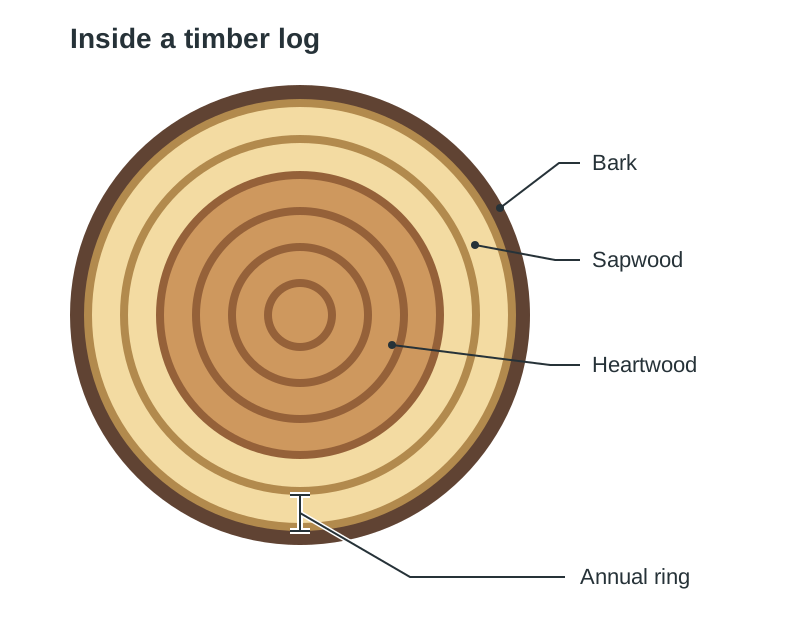
Looking at the cross-section of a felled log reveals how the living tree grew and how its internal parts behave during processing:
- Bark: The tough outer layer that shields the living trunk from physical damage, insects, and fungal infection.
- Sapwood: The outer, lighter rings of active growth that transport sap up the tree. Sapwood is soft, holds high moisture, and is very prone to rot and beetle attack.
- Heartwood: The older inner core of inactive cells filled with natural resins and tannins. Heartwood is darker, denser, and far more durable than sapwood, making it the proper choice for structural framing and outdoor components.
- Growth (annual) rings: Bands of wood formed during each growing season. A wide, light-coloured ring represents rapid spring growth with thin cell walls, while a narrower, darker band represents slower summer growth with dense, thick cell walls. Closely spaced rings indicate slow-grown, strong, dense timber.
Conversion of Timber
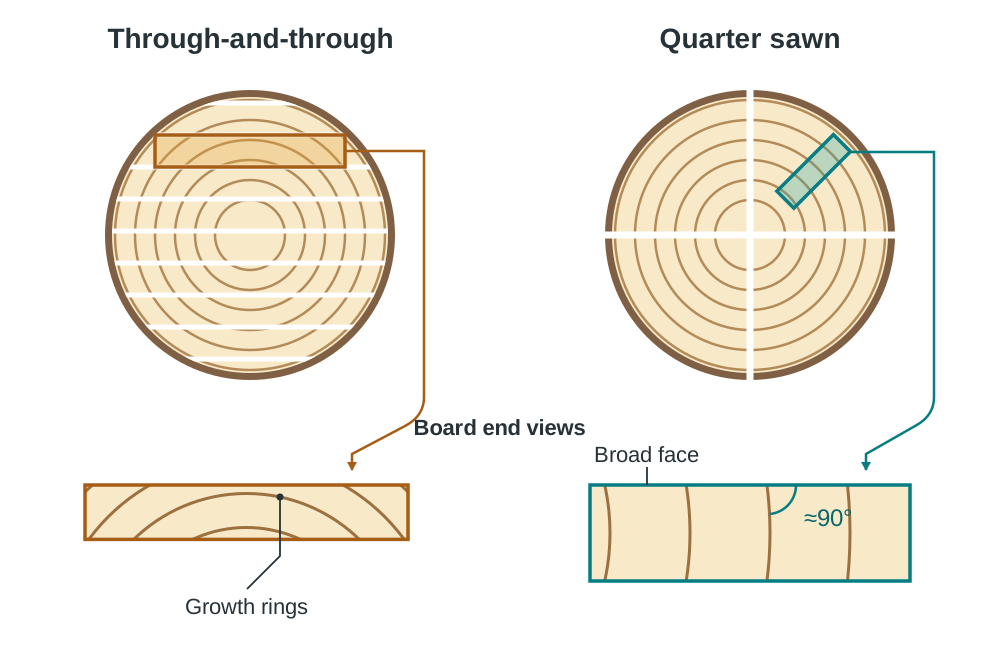
Conversion is the industrial sawing of round logs into usable square-edged boards. The method chosen directly affects both the stability of the timber and the price of the plank:
- Through-and-through (plain/slab sawn): The log is cut with parallel passes straight through. It is fast, cheap, and produces very little saw waste. However, because growth rings run across the width of outer planks, plain-sawn boards cup severely as they dry.
- Quarter sawn (radial sawn): The log is first quartered and then cut radially towards the centre so that the growth rings meet the board face at roughly 90°. It produces boards that stay flat, shrink very little in width, and show an attractive figure (such as medullary rays in oak). The drawback is that quarter-sawing is slower, creates more off-cut waste, and costs significantly more. It is specified for wide table tops, acoustic instruments, and entrance doors where movement cannot be tolerated.
Inconsistencies and Defects in Timber
A defect is any physical imperfection that reduces timber strength, appearance, or machine workability. Exam questions frequently require you to name a defect, identify its cause, and state its practical effect:
- Knot: The embedded base of a branch within the trunk. Growth causes the surrounding fibres to divert around it, creating a weak zone in tension and a hard patch that dulls chisels and plane irons. Dead or loose knots fall out, leaving empty holes.
- Shakes and checks: Lengthwise splits along the grain. Shakes usually develop from natural growth stresses in living trees, while checks occur when timber dries too quickly from its end grain. Both reduce bending and shear strength.
- Warping (cup, bow, twist): Distortion caused by uneven drying shrinkage across different board faces. Warped timber rocks on the bench, binds during sawing, and forces glued joints apart.
- Waney edge: An edge showing bark or rounded corners where the log surface was sliced into the board. This reduces the usable width of stock.
- Insect attack and fungal staining: Flight holes bored by woodworm larvae or discoloured patches caused by damp mould. Both cause structural weakening and spoil surface appearance.
Moisture Content, Seasoning, and Dimensional Stability
Freshly cut green timber holds free water inside its cell cavities (lumens) and bound water absorbed within the cellulose cell walls. As timber dries, free water evaporates first until the wood reaches its fibre saturation point (roughly 28% to 30% moisture content). No dimensional shrinkage occurs until moisture drops below this point. Once bound water begins to leave the cell walls, the cellulose fibres pull closer together and shrinkage begins.
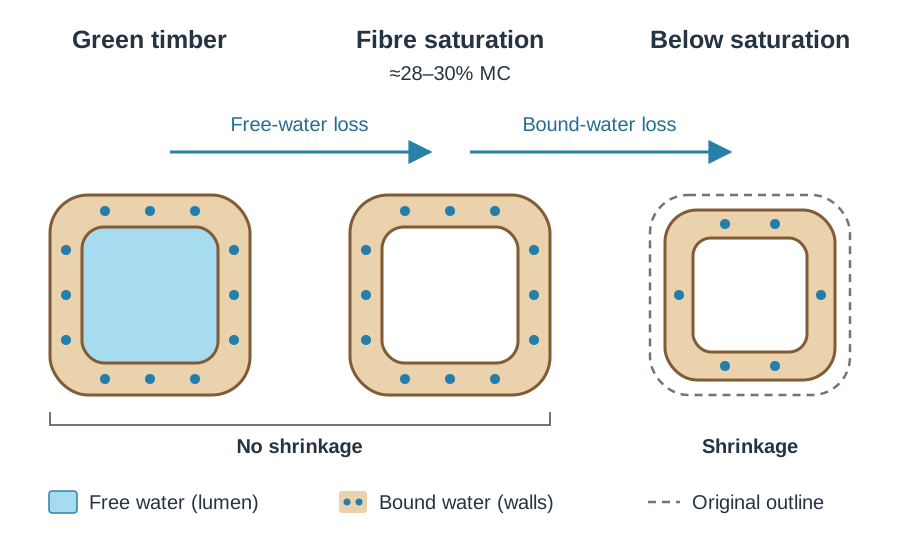
Shrinkage is anisotropic and uneven. Shrinkage along the growth rings (tangential) is roughly double the shrinkage across the rings (radial), while shrinkage along the grain length (longitudinal) is negligible. This imbalance causes plain-sawn boards to cup away from the heart as the outer rings pull harder than the inner rings.
Seasoning is the controlled drying of timber to bring its moisture content down to the equilibrium moisture content (EMC) of its final working environment:
- Air seasoning: Planks are stacked on level foundations under an open-sided roof, separated by small timber stickers to allow continuous airflow. It requires no fuel or electricity, but it is slow (as a rule of thumb, roughly one year per 25 mm of board thickness) and cannot reduce moisture below outdoor ambient levels (15% to 18% moisture content).
- Kiln seasoning: Timber is sealed in a heated, insulated chamber where temperature, humidity, and airflow are computer-controlled with steam sprays and fans. It dries boards in days or weeks, kills wood-boring insects, and achieves the 8% to 12% moisture content required for indoor heated rooms, though it consumes substantial energy.
Moisture content is always calculated as a percentage of the completely dry timber mass:
Because dried timber remains hygroscopic, finished furniture still expands in damp weather and contracts in dry, heated rooms. Tabletops must be secured to rails with buttons or slotted brackets rather than glued solidly, allowing seasonal cross-grain movement without cracking.
Mechanical Properties, Forces, and Testing (Materials Option)
(Note: Mechanical testing, degradation analysis, and batch production sit within the Materials Technology Option, examinable in Section C, while basic properties and joining appear across the mandatory Core in Sections A and B.)
Forces Acting on Timber Components
Every timber part must resist specific applied forces. In exam questions, make sure to define the mechanical force clearly before explaining the joint design:
- Tension: A pulling force that attempts to stretch or elongate the component. Timber has high tensile strength parallel to the grain because the cell fibres act like cables. It has poor tensile strength across the grain, where tension simply pulls the cell walls apart.
- Compression: A squeezing or crushing force that attempts to shorten the component. Example: a vertical leg supporting a loaded bench.
- Shear: Opposing forces acting across parallel planes, trying to slide one layer of material over another. Example: the adhesive film in a lap joint, or cross-grain shear across a wooden dowel pin.
- Torsion: A twisting force applied around the longitudinal axis of a member. Example: a structural rail twisting when a user puts weight on an extended lever.
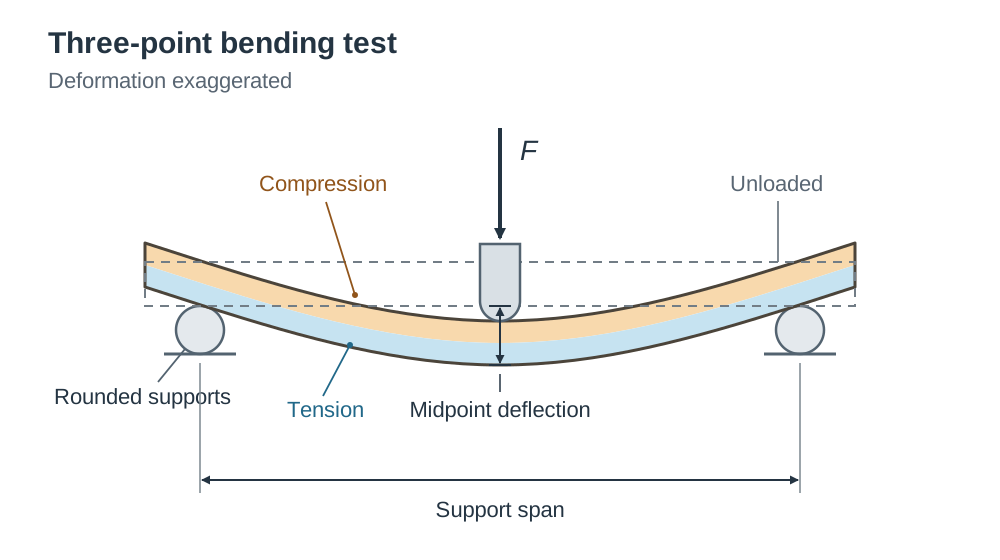
- Bending: A transverse load applied across a supported beam, causing the upper surface to experience compression while the bottom surface stretches in tension. Example: a loaded bookshelf sagging under weight.
Design rule: arrange grain direction parallel to the primary working load, and design joints so adhesives operate in shear rather than direct tension. Glues resist sliding forces far better than peeling forces.
Material Testing
To compare timbers fairly in a school workshop, test specimens must share identical dimensions, spans, moisture contents, and loading speeds:
- Three-point bending test: A square timber strip is rested across two rounded supports at a set span and loaded in the centre. Deflection is recorded at fixed load intervals to compare stiffness, and loaded to failure to find the ultimate bending strength.
- Tensile test: A straight specimen with continuous grain running end-to-end is held in serrated mechanical jaws and pulled axially until it snaps. Tensile strength is calculated using force over cross-sectional area: . In school workshops, tensile testing of timber is difficult because mechanical jaws crush the soft end-grain fibres before the gauge length yields; three-point bending is the preferred practical test.
- Compression test: Crushing short timber cubes along the grain versus across the grain proves that timber supports 5 to 8 times more compressive force parallel to its fibres than across them.
Manufactured Boards and Composite Alternatives
Manufactured boards are engineered wood products that solve the main limitations of solid timber: natural knots, narrow widths, splitting, and directional shrinkage.
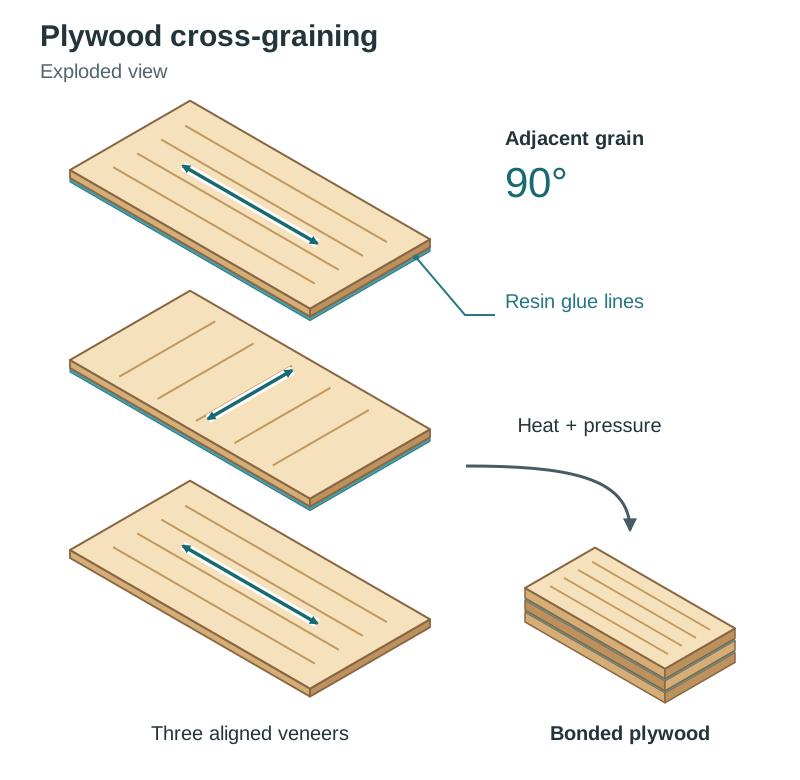
- Plywood: Manufactured by rotating a steamed log against a knife to peel off a continuous sheet of veneer. These veneers are bonded with synthetic thermosetting resins (like phenol-formaldehyde) under heat and pressure. Crucially, the grain direction of each layer runs at 90° to the adjacent layer (cross-graining), and an odd number of plies (3, 5, 7) is always used. This construction distributes tensile strength across both directions, prevents splitting when screws are placed near edges, and cancels out internal warping stresses.
- Medium Density Fibreboard (MDF): Made by reducing softwood chips into individual wood fibres, mixing them with urea-formaldehyde adhesive, and pressing them into boards between hot rollers. MDF has an even, grainless structure throughout. It cuts cleanly without breakout, routs smoothly on edges, and accepts paint finishes. However, standard MDF swells permanently when wet, holds screws poorly in its edges, and gives off fine respirable dust when machined.
- Chipboard (Particleboard): Formed by pressing wood chips and flakes with synthetic resin. It is cheap and stable, making it the standard core for melamine flat-pack furniture, but it has low bending strength and crumbles easily along exposed edges.
Solid Timber versus Wood-Plastic Composite (WPC)
Modern design briefs often ask candidates to contrast natural timber with wood-plastic composite (WPC), such as in outdoor decking or garden seats:
- Advantages of WPC: WPC blends wood flour with recycled thermoplastic polymers (polyethylene or polypropylene). The polymer encapsulates the wood fibres, making the material completely resistant to fungal decay, wet rot, and insect attack without needing paints or stains. It will not splinter, warp, or cup in wet weather.
- Advantages of solid timber: Solid timber has higher structural stiffness and strength-to-weight ratio than WPC, which tends to sag under prolonged loads if not closely supported. Natural timber is a renewable, carbon-storing material that can be shaped, planed, and repaired with standard workshop hand tools. Furthermore, clean timber scrap can be burned for heat or composted, whereas composite boards are difficult to separate and recycle at end-of-life.
Workshop Processing: Datums, Shaping, and Machine Tools
Timber shaping processes fall into three manufacturing families:
- Wasting (subtractive): Cutting away material to produce the required form. Sawing, planing, chiselling, drilling, routing, and sanding all produce waste sawdust and off-cuts.
- Deforming: Changing material shape without cutting fibres away. Steam bending solid timber and cold lamination over a former bend fibres to shape.
- Fabricating (assembling): Joining separate parts together into an assembly using wood joints, screws, dowels, knock-down fittings, and glues.
Accurate Marking and Datums
Accurate fabrication depends on establishing a datum face (the best face planed perfectly flat) and a datum edge (an adjoining edge planed straight and true at 90° to the datum face). Both are marked with standard pencil datum marks. Every line scribed with a try square or marking gauge must be referenced directly against these two surfaces to prevent compounding measurement errors.
Marking across the grain should always be done with a marking knife rather than a pencil. The knife blade severs surface fibres cleanly, preventing tear-out when the saw blade cuts through.
Hand Tools and Proper Chisel Selection
- Tenon saw: Features a rigid brass or steel back spine that stops the thin blade from bending, allowing straight, accurate cuts across joint shoulders.
- Coping saw: Holds a narrow, flexible blade in a steel C-frame. The blade can be turned to cut tight curves and fretwork.
- Bevel-edged chisel: Has bevelled long edges that let the blade reach into acute internal corners. It is intended for light paring and trimming joint housings, not heavy chopping.
- Mortise chisel: Has a thick, heavy, square-sided blade and an impact-resistant handle. It is built to be struck firmly with a wooden mallet and lever waste out of deep mortise slots without bending or snapping.
Machine Processing and CAM Routing
- Pillar drill: Drills holes with twist drills, flat spade bits, or Forstner bits for clean, flat-bottomed holes. Workpieces must be clamped to the table, backed with a sacrificial wooden block to stop tear-out as the bit exits.
- CNC router (Computer Aided Manufacture): Follows digital toolpaths created in 2D or 3D CAM software. A high-speed rotating cutter cuts pockets, profiles complex curved outlines, and drills holes with repeatable accuracy. It is ideal for batch production where every piece must match the design file exactly. Note that internal corners cut by a CNC router will always carry a small radius equal to the cutter radius.
- CNC routing versus 3D printing: CNC routing is a subtractive wasting process (it cuts material away from a solid sheet, leaving dust and off-cuts). 3D printing is an additive process that deposits filament layer-by-layer from a digital model with almost no waste. Timber can only be CNC routed; it cannot be 3D printed directly.
Workshop safety note: When cutting or routing MDF, operators must wear an FFP3 dust mask and ensure local exhaust ventilation (LEV) is running to extract carcinogenic urea-formaldehyde dust particles.
Joining, Assembly, and Quality Standards
Wood Adhesives
- Polyvinyl Acetate (PVA): A water-based adhesive that soaks into porous timber cells. As water evaporates into the wood, vinyl polymer chains lock mechanically around the cell walls. Joints must be clamped under even pressure for at least one hour while the bond sets, and then left for 24 hours to reach full cure before undergoing heavy machining. Standard PVA softens in damp air; exterior grades (water-resistant PVA) must be chosen for outdoor assemblies.
- Epoxy resin: A two-part synthetic thermosetting resin mixed with a chemical hardener. It cures via an exothermic reaction with very little shrinkage. Because it does not rely on solvent evaporation, epoxy can bridge small joint gaps and successfully bond timber to metals, glass, or plastics.
Mechanical Fasteners and Knock-Down Fittings
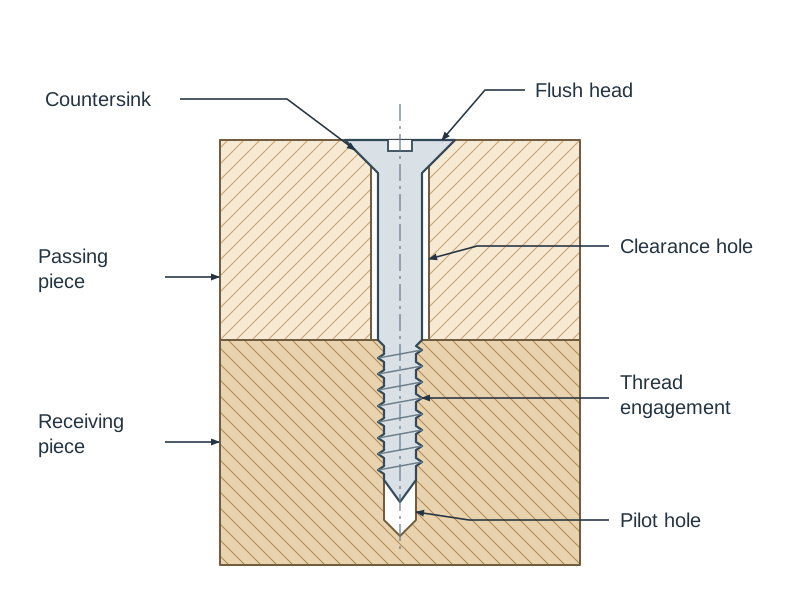
When joining timber with wood screws, three drilling operations are mandatory to prevent splitting:
- Clearance hole: Drilled through the passing timber piece slightly larger than the screw shank, so threads do not bite into it.
- Pilot hole: Drilled into the receiving timber piece with a diameter equal to the screw core (the solid shaft between threads), guiding the screw centrally without splitting the grain.
- Countersink: Bevelled at the mouth of the clearance hole so the screw head pulls down completely flush with the timber face.
Knock-down (KD) fittings (such as cam locks and barrel nuts) allow flat-pack furniture to be assembled, dismantled, and rebuilt repeatedly without damaging low-density manufactured boards like chipboard or MDF.
Cold Lamination
Cold lamination bends wood by bonding thin veneers (1.5 mm to 2 mm thick) over a rigid former with wood glue under sash clamps. Because each individual veneer slips along the curve and is then held by the cured glue lines, springback is dramatically reduced compared to steam-bent solid wood. Even so, formers are typically built slightly tighter than the finished profile to accommodate minor elastic relaxation.
Quality Checks and Finished Tolerances
In Section B, Section C, and coursework folios, quality must be evaluated against clear, measurable workshop standards rather than vague opinions:
| Quality attribute | Workshop test / measurement | Pass standard |
|---|---|---|
| Component dimensions | Check with steel rule or vernier calliper against cutting list | Within ±1.0 mm; matched pairs within 0.5 mm of each other |
| Assembly squareness | Try square on inside datum faces; check corner-to-corner diagonals | Both diagonals equal to within 1.0 mm |
| Joint fit | Dry assembly inspection before gluing | Closed joint line; no gaps visible at shoulders |
| Surface preparation | Low-angle inspection light and fingertip touch | No cross-grain scratches, no glue squeeze-out, arrises lightly eased |
Degradation, Finishing, and Environmental Responsibility
Biological Degradation: Fungal Decay and Insects
Timber rot is biological, caused by microscopic fungi feeding on cellulose and lignin. Spores cannot germinate unless four specific conditions are met simultaneously:
- Moisture: Timber moisture content must remain above 20%.
- Oxygen: Air must be present in the cell lumens (completely submerged waterlogged timber does not rot).
- Warmth: Temperatures must generally sit between 10°C and 35°C.
- Food source: Accessible cellulose and lignin.
Dry rot (Serpula lacrymans) is a destructive fungus that spreads through brickwork and masonry via root-like strands to reach and digest dry timber. Wet rot requires continuous direct water leaks to survive.
Wood-boring beetles (such as common furniture beetle or woodworm) lay eggs in small cracks. The larvae tunnel through the sapwood for up to three years before emerging as adult beetles, leaving exit flight holes and fine wood dust (frass).
Selecting Finishes Responsibly
Examiners differentiate between finishes protecting wood from the environment and the finish's own impact on human health and the environment:
- Exterior protection: Outdoor timber requires finishes that resist moisture and block ultraviolet (UV) sunlight. Clear varnishes with UV inhibitors or opaque exterior paints prevent sunlight from breaking down surface lignin. Pressure-treated timber (tanalised) forces copper-based preservative salts deep into the wood cells under vacuum inside an industrial autoclave, protecting fence posts from soil-level fungal attack.
- Interior finishing: Indoor timber can be finished with Danish oil, beeswax, or clear polyurethane varnish to highlight the natural grain while resisting grease, moisture, and everyday handling marks.
- Environmental safety and VOCs: Solvent-based varnishes and paints release high levels of Volatile Organic Compounds (VOCs), which irritate lungs, smell strongly, and add to air pollution. Water-based acrylic varnishes release far fewer VOCs, wash clean in water, dry rapidly, and provide a safer working environment in school workshops.
Workshop safety precautions: Always apply finishes in well-ventilated areas or paint booths. Never dispose of solvents or liquid finishes down drains. Lay oily rags out completely flat to dry on concrete; crumpled, oil-soaked rags left in heaps generate internal heat as drying oils oxidise, posing a serious spontaneous combustion fire hazard.
Resource Management and Coursework Connections
Sustainable Forestry and Timber Sourcing
While timber is a renewable, carbon-storing material, harvesting must be managed responsibly. Commercial timber should carry certification from organisations such as the Forest Stewardship Council (FSC) or PEFC. These bodies certify that felled trees are replaced with new plantings, local habitats and waterways are protected, and logging does not destroy old-growth rainforests.
Efficient Workshop Stock Usage
Timber is purchased by nominal size (the rough-sawn dimension straight from the mill). When timber is planed all round (PAR), roughly 3 mm to 5 mm is lost from thickness and width. A rough-sawn 50 mm × 25 mm batten finishes out at approximately 45 mm × 21 mm. Costings and cutting lists in project folios must account for nominal stock purchase sizes.
To minimise raw material waste, apply the three Rs:
- Reduce: Group and nest parts on sheet materials before cutting, allowing for the saw blade kerf (the 2 mm to 3 mm width of wood removed as sawdust by each saw cut).
- Reuse: Store clean timber off-cuts in sorting racks for use as corner reinforcing cleats, internal test pieces, or turning stock.
- Recycle: Untreated solid wood off-cuts can be chipped into garden mulch or compressed into fuel pellets. Manufactured boards bonded with synthetic glues cannot be easily recycled and must be disposed of responsibly.
The 2027 Coursework Brief (Ageing Society Theme)
For the 2027 Leaving Certificate thematic brief (designing a technical aid or system supporting independent living and wellbeing in an ageing society), timber and manufactured boards offer clear functional advantages:
- Where wood works well: Handles, support grips, housings, and structural enclosures. Timber has low thermal conductivity (warm and reassuring to the touch for older users), a comfortable tactile texture, low density, and can be shaped and altered easily in the school workshop as designs develop.
- Where wood fails: Transparent inspection covers, low-friction bearing surfaces, and assemblies exposed to frequent chemical sanitisation or running water.
- Electro-mechanical integration: The 2027 brief states that your solution should include an electro-mechanical element. Plan mounting cavities, cable channels, and sensor brackets in timber frames before glue-up to prevent awkward routing into finished cabinets.
Key terms
- Anisotropic
- Having physical and mechanical properties that differ depending on the direction of measurement (for example, wood is strong along the grain but splits easily across it).
- Hardwood
- Timber harvested from broad-leaved, flowering angiosperm trees (mostly deciduous, such as oak, ash, and beech, but also including balsa).
- Softwood
- Timber harvested from evergreen, cone-bearing coniferous gymnosperm trees with needles (such as Scots pine and Sitka spruce).
- Cross-Graining
- The manufacturing arrangement in plywood where alternating veneer layers are glued with their grain running at 90° to eliminate directional splitting and balance strength.
- Datum Edge
- A reference edge planed completely straight and square, from which all further layout markings and measurements originate to prevent compounding errors.
- Kerf
- The width of the slot cut away by the set teeth of a saw blade during a cutting operation, turned into waste sawdust.
- Fibre Saturation Point
- The moisture level (roughly 28% to 30% MC) where all free water in cell cavities has evaporated, leaving only bound water in the cell walls before shrinkage begins.
- Volatile Organic Compounds (VOCs)
- Organic chemical solvents in traditional paints and varnishes that evaporate into the air during drying, presenting respiratory and fire risks.
- Wasting
- A subtractive manufacturing process that creates shape by cutting, sawing, planing, or filing away unwanted material.
- Deforming
- A shaping method that alters a material's form through bending, laminating, or pressing without removing any waste material.
- Knock-Down (KD) Fittings
- Standardised mechanical fittings (such as cam locks and barrel nuts) used in flat-pack assemblies to join panels securely and allow repeated dismantling.
- Wood-Plastic Composite (WPC)
- An engineered material combining wood flour or fibres with thermoplastic polymers, offering high weather and rot resistance without requiring surface finishes.
Check yourself
What is meant by describing wood as an anisotropic material?
Anisotropic means that wood exhibits different mechanical and physical properties depending on the direction of loading relative to the grain (for example, high tensile strength along the fibres, but weak across them).
A timber sample has a wet mass of 156.0 g and an oven-dry mass of 120.0 g. What is its moisture content percentage?
MC% = ((156.0 - 120.0) / 120.0) 100 = (36.0 / 120.0) 100 = 30.0%.
Explain how the cross-graining structure of plywood prevents dimensional warping and splitting.
Plywood is constructed with alternating veneer sheets laid with their grain at 90° to adjacent layers. Because wood shrinks and expands across the grain rather than along it, the longitudinal stability of one layer restrains the cross-grain movement of neighbouring layers.
What four conditions are necessary for fungal decay (wood rot) to develop in timber?
Fungal decay requires moisture (timber moisture content above approximately 20%), oxygen (air), a suitable mild temperature, and a digestible organic food source (cellulose and lignin).
Differentiate between the primary functions of a pilot hole and a clearance hole when fitting a wood screw.
A clearance hole is drilled through the top workpiece slightly larger than the screw shank so the screw slides freely through; a pilot hole is drilled into the receiving piece slightly smaller than the thread diameter to guide the screw and prevent the wood splitting while allowing the threads to bite.
A garden bench slat is cut from a plain-sawn board 200 mm wide. State the defect most likely to appear as it dries and explain why quarter-sawn timber would be a better choice.
Cupping. Tangential shrinkage along the growth rings is about double the radial shrinkage across them, so the wide plain-sawn face dries unevenly and curls. In quarter-sawn timber, growth rings run through the thickness at roughly 90°, so the board remains flat and simply becomes slightly thinner.
In a three-point bending test, name three conditions that must be kept identical for each specimen to ensure a fair test.
Identical cross-sectional dimensions (width and thickness), the same support span length, and identical timber moisture content and loading speed.