
All materials change a little with their surroundings, but what makes a material smart is that the change is designed in: a specific trigger produces a specific, useful, and reversible change in a property, and the designer can rely on it. In Leaving Certificate Technology, smart materials link core scientific properties—thermal, optical, electrical, and mechanical—with inventive problem-solving. This note covers the main families of smart materials you are likely to name in an examination, explains how to evaluate and test them safely, and shows how to apply modern functional materials to the 2027 Higher Level Coursework Brief.
Principles of Responsive Materials and Master Recall Table
Conventional materials such as mild steel, pine or standard acrylic are not designed to respond to their surroundings — any change they show, such as expanding when warm or rotting when damp, is unwanted. A smart material is different: its properties can be modified in a controllable and reversible way when acted on by an external stimulus.
Three characteristics define smart behaviour:
- Controllable: The change happens reliably once a set trigger threshold is crossed.
- Reversible: When the stimulus is removed, the material returns to its resting state. Most smart materials cycle back and forth thousands of times. Self-healing materials are the exception, because once a microcapsule ruptures and cures, that specific spot cannot repair itself a second time.
- Predictable: The same stimulus always produces the same response.
Using a smart material can remove the need for a separate sensor, wiring, control circuit, and solenoid, because the material senses the change and produces the movement or indication itself.
Master Recall Table for Exam Answers
| Material Family | Stimulus | Property that Changes | Named Example | Typical Use |
|---|---|---|---|---|
| Thermochromic | Temperature (heat) | Colour / optical transmission | Leuco dyes | Kettle safety panels, fever strips, baby bath spoons |
| Photochromic | Light intensity (specifically UV) | Optical transmission (darkens) | Silver halide / oxazine dyes | Adaptive spectacle lenses (transition lenses) |
| Electrochromic | Applied electrical voltage | Optical transmission (darkens / opaque) | Polyaniline / tungsten oxide glass | Smart privacy glass, self-dimming car mirrors |
| Shape memory alloy | Temperature (heat) | Shape / crystal phase (recovers parent shape) | Nitinol (nickel-titanium alloy) | Medical stents, greenhouse vent actuators, brassiere wires |
| Piezoelectric | Mechanical stress / applied voltage | Voltage (direct) / mechanical vibration (inverse) | Quartz crystal, PZT ceramic | BBQ spark igniters (direct), alarm buzzers (inverse) |
| Self-healing | Mechanical crack / physical damage | Material continuity / seals fissures | Micro-encapsulated epoxy resin, bio-concrete | Self-repairing vehicle clear-coats, crack-sealing concrete |
| Photoluminescent | Ambient visible / UV light | Emits visible light slowly in darkness | Zinc sulphide, strontium aluminate | Emergency exit signage, glowing stair-nosing strips |
| Quantum tunnelling composite | Mechanical pressure / squeezing | Electrical resistance (falls sharply) | Metal-filled elastomeric polymer (QTC) | Soft pressure pads, wearable switches in clothing |
Optical Responders: Thermochromic, Photochromic, and Electrochromic
These three families alter how they transmit or reflect light, but each relies on a completely different stimulus.
Thermochromic Materials
Thermochromic pigments change colour as their temperature changes. They use two common technologies:
- Liquid crystals: These pass smoothly through a sequence of colours across a narrow temperature band. They are used in medical forehead thermometers and aquarium temperature strips where graduated readings are needed.
- Leuco dyes: These switch abruptly between an opaque coloured state and a clear state at a single set temperature. They are micro-encapsulated into inks or compounded into plastics for hot-surface warning labels on electric kettles and baby feeding spoons.
Photochromic Materials
Photochromic materials change their optical transmission when exposed to ultraviolet (UV) radiation.
Incoming UV light breaks or rearranges chemical bonds in the photochromic molecules, causing them to absorb more visible light and turn dark. When the UV source is removed, the molecules return to their original clear arrangement. The most common application is adaptive spectacle lenses.
Because the trigger is UV radiation rather than brightness or heat, photochromic lenses will darken outdoors on an overcast day (UV passes straight through clouds), but will stay clear inside a modern car because commercial laminated windscreens block almost all UV light.
Electrochromic Materials
An electrochromic material changes its optical transmission when a low electrical voltage is applied across it. Reversing or switching off the voltage allows the material to become clear again.
Unlike photochromic glazing, electrochromic smart glass is controlled directly by the user via a switch or an automated microcontroller. It is used in aircraft cabin windows, office privacy partitions, self-dimming rear-view mirrors, and architectural smart windows to manage glare and solar heat gain without motorised blinds.
Shape Memory Alloys (SMAs) and Actuator Mechanics
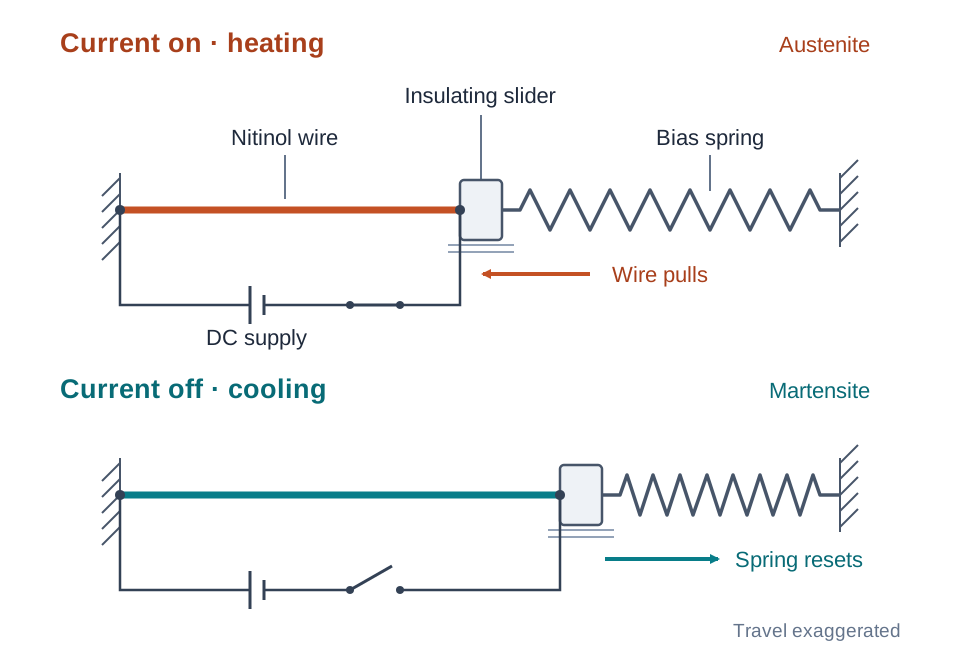
A shape memory alloy (SMA) is a metal alloy that can be bent or deformed while cool, and returns to its pre-set original shape when heated above its solid-state transition temperature. The most widely used SMA is Nitinol, an alloy of nickel and titanium.
Solid-State Phase Transformation
Shape recovery involves no melting whatsoever. The transformation occurs entirely in the solid state between two distinct crystal arrangements:
- Austenite Phase: The high-temperature, parent crystal phase. In this state, the alloy is stiff, strong, and locked into its memorised shape.
- Martensite Phase: Below the transition temperature, the alloy shifts to a softer, ductile crystal phase that can be bent into a temporary shape under low force.
- Thermal Activation: Heating the deformed martensite past the transition temperature forces the atoms back into the rigid austenite structure, recovering the parent shape and pulling against resisting loads.
Actuator Wires and the Bias Spring
In technology mechanisms, Nitinol actuator wire (muscle wire) contracts by approximately 4% of its overall length when heated by passing an electric current through it. The current meets electrical resistance in the wire, converting electrical energy into heat. The heating power is given by , where is power in watts, is current in amps, and is resistance in ohms.
Cooling alone will not reset a one-way actuator wire. Once the current stops, cooling simply returns the wire to its soft martensite state—it does not push itself back out. A mechanical reset force, such as a steel bias spring or a counter-weight, is required to pull the softened wire back to its extended length so the cycle can repeat.
Actuator Sizing Calculation
In design questions, mechanism travel dictates the required wire length.
A locking latch requires of travel, and the Nitinol wire contracts by :
If the product enclosure can only fit of wire, the direct stroke is:
Because is insufficient, the designer must route the wire around a miniature pulley or connect it to a lever mechanism to multiply the movement.
Superelasticity
At temperatures slightly above its transition point, Nitinol displays superelasticity. Mechanical stress causes an immediate phase transformation, allowing the alloy to absorb massive elastic strain—up to ten times that of spring steel—and spring back instantly without any heat. This is exploited in flexible spectacle frames and orthodontic archwires.
Piezoelectric, Self-Healing, and Modern Functional Materials
Piezoelectric Materials
Piezoelectric materials link mechanical stress directly to electrical charge. Squeezing the crystal shifts its positive and negative charges apart, generating an electrical potential difference.
- Direct piezoelectric effect: Mechanical force (compression, impact, or vibration) produces an electrical voltage. Examples include push-button spark igniters in gas heaters, percussion drum pads, and structural vibration sensors.
- Inverse piezoelectric effect: An applied electrical voltage causes physical deformation or rapid vibration. Examples include high-frequency alarm buzzers, ultrasonic medical scanners, and quartz clock resonators.
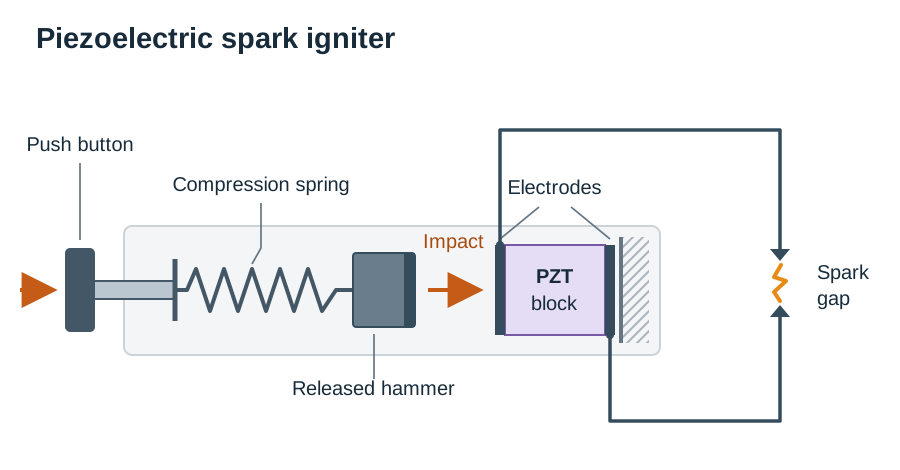
In a push-button spark lighter, pressing the button compresses an internal spring until a small hammer is released. The hammer strikes a lead zirconate titanate (PZT) ceramic block. This sudden impact creates a potential difference of several thousand volts that arcs across a spark gap to ignite the gas, requiring no battery.
Self-Healing Materials
Self-healing materials automatically repair micro-cracks before they spread and cause catastrophic failure:
- Micro-encapsulated polymers: Microscopic hollow spheres containing a liquid resin are mixed with discrete catalyst particles inside a material. A developing crack snaps the capsules, releasing the monomer into the fissure. On contact with the catalyst, the resin polymerises and hardens, bonding the crack shut.
- Bacterial bio-concrete: Dormant bacterial spores (Bacillus) and nutrient packets (calcium lactate) are blended into the dry concrete mix. When a crack lets water and oxygen reach the spores, the bacteria become active, consume the calcium lactate, and produce insoluble calcium carbonate (limestone). The limestone precipitates out, sealing the crack and preventing moisture from reaching the steel reinforcement rebar.
Photoluminescent Materials and QTC
- Photoluminescent materials absorb light energy and re-emit it slowly as a visible glow in darkness. They provide non-electrical emergency exit signs, stair-edge strips, and switch surrounds that remain visible during power outages.
- Quantum tunnelling composite (QTC) is a flexible polymer packed with tiny conductive metal particles. At rest, it is an electrical insulator. When squeezed, compressed, or stretched, the particles come close enough for electrical charge to pass through, causing its resistance to drop sharply. QTC creates soft touch controls, pressure-sensitive membrane buttons, and smart clothing switches without rigid moving parts.
Material Selection, Workshop Testing, and Safety
The 7-Step Material Selection Routine
Follow this sequence when answering design questions or writing project specifications:
- Function: State what the component must physically do.
- Properties: List the essential properties in correct syllabus terms (e.g. high toughness, good corrosion resistance, low thermal conductivity).
- Stimulus check: Verify that the operating environment delivers the required trigger (e.g. ambient body heat of or accessible low-voltage electrical power).
- Candidate materials: Identify suitable materials and compare their working characteristics.
- Workshop testing: Test and record measurable properties using standardised procedures.
- Evaluate against specification: Check whether the performance meets the design constraints.
- Environmental and end-of-life impact: Assess recyclability, embodied energy, and disposal.
The "Name a Material and Outline a Property" Exam Drill
Questions regularly ask to name a material for a part and outline an appropriate property. Full marks require three elements: the named material, the correct technical property, and a justification tied directly to the product.
| Part / Requirement | Appropriate Material | Property and Justification |
|---|---|---|
| Walking-frame structural tube | Aluminium alloy | High strength-to-weight ratio — strong enough to support user weight while remaining light to lift. |
| Outdoor grab rail | Stainless steel | High corrosion resistance — will not rust when wet, keeping the hand grip hygienic and sound. |
| Hand-held alarm casing | ABS thermoplastic | High impact toughness and easily injection moulded — withstands accidental drops onto hard floors. |
| Hot-surface visual warning | Thermochromic polymer | Reversible colour change above a set temperature — alerts the user to burn risk without needing electric power. |
| Low-force soft push-button | Quantum tunnelling composite | Pressure-variable electrical resistance — allows users with limited hand strength to activate controls easily. |
Simple Workshop Testing Procedures
Examiners award marks for tests written in logical, numbered steps with reasons for key actions.
Testing the trigger temperature of a thermochromic sheet:
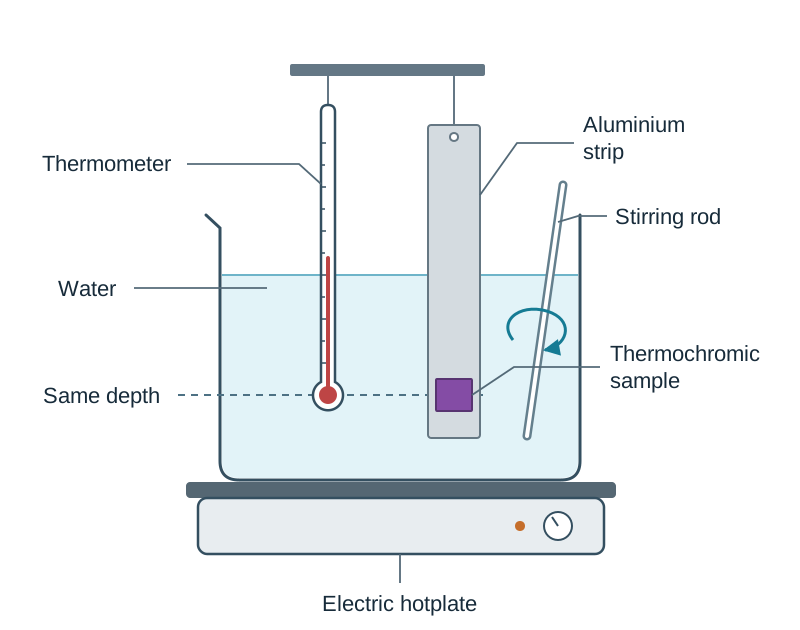
- Cut a small sample of the thermochromic sheet and bond it to a thin strip of aluminium, which conducts heat evenly to the sample.
- Suspend a laboratory thermometer and the strip side by side in a beaker of water, ensuring the thermometer bulb sits at the same depth as the sample so both experience the same temperature.
- Heat the beaker slowly on an electric hotplate; gentle heating prevents local hot spots in the water.
- Stir continuously and record the thermometer reading the instant the colour begins to shift, and again when the colour change is complete.
- Remove the heat source and record the temperature at which the original colour returns, verifying that the change is fully reversible.
- Repeat the test three times, calculate the mean value, and compare it against the product specification.
Measuring the stroke of a Nitinol actuator wire:
- Clamp the top end of a known length of Nitinol wire and attach a known hanging mass to the free end to hold it straight.
- Align a steel rule against the assembly and record the free starting length (datum).
- Apply the specified low-voltage current to heat the wire resistively until all contraction ceases, then record the new length.
- Calculate the stroke: , and express it as a percentage of original length.
- Cut the current and time how many seconds the mass takes to pull the wire back to its datum, establishing the mechanism cycle rate.
Health and Safety when Processing Functional Materials
Short exam questions often require identifying a hazard and its matching workshop precaution:
- Heated SMA wire: Reaches temperatures over (burn hazard). Precaution: use low-voltage current pulses rather than continuous power, mount the wire behind a protective casing, and never touch live actuator wires.
- Machining carbon fibre or GRP: Generates airborne micro-fibres and dust (lung, eye, and skin irritation). Precaution: operate local exhaust ventilation, wear an approved particulate dust mask and safety goggles, and vacuum waste rather than dry sweeping.
- Chemical resins and adhesives: Emit volatile fumes and cause contact dermatitis. Precaution: work in a well-ventilated area or fume cupboard, wear nitrile gloves and eye protection, and refer to manufacturer safety data sheets.
- Piezoelectric igniters: Produce sudden multi-kilovolt arcs (electric shock and flash hazard). Precaution: keep the spark gap clear of open flammable solvent containers and avoid holding bare electrode leads.
Coursework Application: 2027 Higher Level Brief
The Leaving Certificate Technology coursework carries 200 marks (50% of total subject marks at Higher Level, divided equally: design folio 100 marks, artefact 100 marks). The coursework must be completed in school under teacher supervision and be available for assessment by Friday 19 March 2027.
Brief Parameters and Syllabus Alignment
The 2027 Higher Level thematic brief focuses on the Ageing Society—designing and manufacturing an artefact that supports independent living, wellbeing, or social participation. The project mandates an electro-mechanical element, a focus on modern materials and processes, and an overall size limit where no dimension exceeds 500 mm.
Where Materials Earn Marks in the Design Folio
- Environmental impact of the project (10 marks): Carry out an analysis of available manufacturing materials. Note that smart materials can complicate end-of-life recycling: embedded leuco dye capsules, piezo ceramics, and alloy wires cannot be separated easily from polymer housings.
- Research, investigation and specifications (7 marks): Research existing user aids and specify the precise material properties required (e.g. non-slip touch surfaces, anti-glare screens, low mass).
- Sketches and drawings for manufacture (18 marks): Fully annotate all parts, explicitly naming materials, smart components, and fixing methods on assembly drawings.
- Production planning (10 marks): Include a full materials and components list with realistic costings. Smart components are relatively costly; documenting their price shows genuine project management.
- Testing, evaluation and critical reflection (10 marks): Record quantitative test results for materials and mechanisms (e.g. actuator stroke, switch trigger force, temperature response).
In the physical artefact, originality and creativity (15 marks) rewards the creative and appropriate use of materials, while production skills (30 marks) rewards high-quality processing and assembly.
Advantages and Disadvantages of Smart Materials in Design
When evaluating smart materials in an exam or project folio, balance these clear points:
Advantages:
- Senses and actuates in one single part, reducing assembly parts, wiring looms, and mechanical joint failures.
- Many types require zero electrical power (thermochromic, photochromic, photoluminescent), continuing to function during power failures.
- Operates silently with minimal volume—ideal where geared electric motors would be too bulky or noisy.
- Delivers broad-surface visual feedback rather than an isolated indicator light.
Disadvantages:
- Higher cost per gram compared to standard engineering plastics and metals.
- Limited mechanical output: Nitinol actuator wire contracts only 3% to 5% of its free length.
- Susceptible to fatigue and degradation: thermochromic dyes fade under extended UV exposure, and SMA wires suffer fatigue after repeated stress cycles.
- Slow cycle times: an SMA wire must cool fully before the return spring can reset it.
- Difficult recycling: embedded additives and mixed material assemblies cannot be processed in standard recycling streams.
Key terms
- Smart Material
- A functional material whose properties can be modified in a controllable and reversible way in direct response to an external environmental stimulus.
- Stimulus
- An external environmental change—such as heat, light, mechanical force, or voltage—that triggers a property shift in a responsive material.
- Thermochromic
- A material property describing a reversible, visible change in colour or opacity across specific temperature thresholds.
- Photochromic
- A material property describing a reversible change in optical transmission (darkening) when exposed to ultraviolet (UV) radiation.
- Electrochromic
- A material property describing a reversible change in optical transmission or opacity triggered by an applied electrical voltage.
- Shape Memory Alloy (SMA)
- A metal alloy that can be deformed while cool and returns to its memorised parent geometry when heated past its transition temperature.
- Nitinol
- An alloy of nickel and titanium widely used in engineering and medicine for its shape memory effect and superelasticity.
- Martensite
- The relatively soft, ductile crystal phase of a shape memory alloy that exists below its transition temperature, allowing easy deformation.
- Austenite
- The rigid, high-temperature parent crystal phase of a shape memory alloy that embodies its memorised shape.
- Superelasticity
- The ability of certain shape memory alloys to withstand severe mechanical strain and spring back completely without heating.
- Direct Piezoelectric Effect
- The generation of an electrical voltage across a material as a direct result of applied mechanical stress or impact.
- Inverse Piezoelectric Effect
- The rapid physical deformation or vibration of a material resulting from an applied electrical voltage.
- Bias Spring
- A mechanical return spring used alongside a one-way shape memory actuator wire to pull the softened wire back to its extended length upon cooling.
- Self-Healing Material
- A material engineered with internal microcapsules or dormant bacteria that autonomously seal cracks and prevent progressive damage.
- Photoluminescent
- A material that absorbs ambient light energy and slowly releases it as a visible glow in dark conditions.
- Quantum Tunnelling Composite (QTC)
- A flexible polymer containing conductive particles whose electrical resistance drops dramatically when subjected to mechanical pressure.
Check yourself
Examination questions describe smart materials as having properties that may be changed in what two ways?
In a controllable and reversible way — the same stimulus always produces the same change, and the material returns to its resting state when the stimulus is removed.
Which crystal lattice phase is soft and easily deformed in a shape memory alloy?
The Martensite phase, which is present below the transition temperature.
A designer requires window glazing that a seated user can darken on demand using a push-button. Why is electrochromic glass chosen over photochromic glass?
Electrochromic glass darkens in response to an applied electrical voltage that can be switched by the user, whereas photochromic glass reacts only to UV radiation from the sun and cannot be controlled on demand.
Why must a mechanical bias spring be paired with a one-way Nitinol actuator wire in a cyclic mechanism?
Cooling only softens the wire back to martensite without extending it; the bias spring provides the mechanical force needed to pull the wire back to its starting length.
What trigger activates the dormant bacteria in self-healing bio-concrete, and what substance seals the crack?
Water and oxygen entering through a crack activate the bacteria, which consume calcium lactate nutrients to produce insoluble calcium carbonate (limestone) that seals the fissure.
How do the direct and inverse piezoelectric effects differ in terms of inputs and outputs?
The direct effect converts mechanical stress into an electrical voltage, while the inverse effect converts an applied electrical voltage into mechanical vibration or deformation.
Under the 2027 assessment arrangements, how many long questions must a Higher Level candidate answer in Section C of the written paper?
Candidates must answer exactly one long question from the five available option questions.