
A plastic is a man-made material built from very long chain molecules called polymers. Most plastics are made from crude oil feedstocks, though some are produced from renewable plant sources. In Leaving Certificate Technology, plastics bridge both the mandatory Core (Materials and Production) and the Materials Technology option. The Core requires you to shape, join, and finish plastics safely and competently, while the Materials Technology option requires an understanding of their internal structure, properties, processing, degradation, and environmental impact. For 2027, the Higher Level written paper (2½ hours, 50% of total marks) requires you to answer 12 of 15 short questions in Section A (core), two long questions in Section B (core), and one of five long option questions in Section C (an adjustment reducing Section C from two questions to one). The remaining 50% is awarded for the coursework project (200 marks: 100 marks for the design folio and 100 marks for the artefact).
Polymer Structure: Thermoplastics vs Thermosetting Plastics
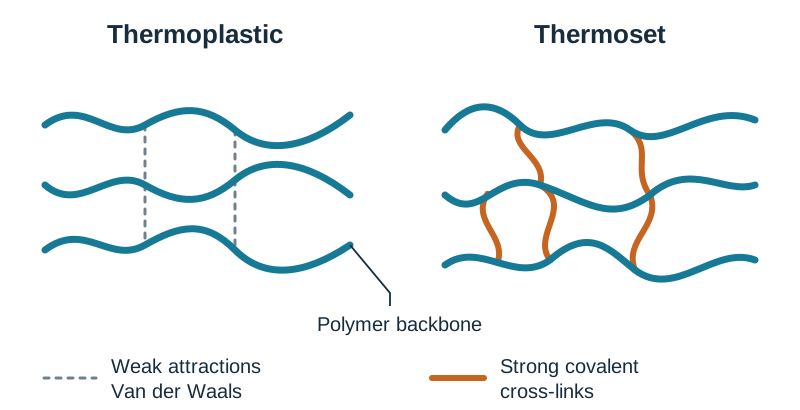
A plastic is a synthetic material built from polymers. Polymers are formed when small, reactive chemical units called monomers link together end-to-end in a reaction known as polymerisation. Strong primary covalent bonds hold the atoms together along each individual polymer chain, but the mechanical and thermal behaviour of the plastic depends entirely on how adjacent chains connect to one another.
Think of a thermoplastic as a bowl of cooked spaghetti: when heated, the strands can slide past each other easily. A thermosetting plastic is more like a fishing net where every strand is permanently knotted to its neighbours: heating cannot untie the knots, so the material cannot soften or flow.
Thermoplastics
In thermoplastics, the long polymer chains lie alongside one another, held together only by weak secondary intermolecular forces called Van der Waals forces. When heated gently, thermal energy overcomes these weak forces, allowing the chains to slip past each other. The plastic becomes soft, rubbery, and easily reshaped. As it cools, the weak forces between the chains take hold again and lock the chains into their new positions, so the sheet keeps the shape you gave it. The temperature at which an amorphous thermoplastic changes from rigid to flexible on heating is called its glass transition temperature.
Because this heating and cooling cycle involves physical changes rather than chemical reactions, thermoplastics can be repeatedly reheated, reshaped, and recycled by remelting. However, repeated thermal cycling eventually shortens the molecular chains and reduces impact strength.
Thermosetting Plastics
Thermosetting plastics undergo an irreversible chemical reaction during their initial curing stage under heat and pressure, or when mixed with a chemical hardener. This reaction forms permanent, rigid covalent bridges between adjacent chains, known as cross-linking. These cross-links tie the separate chains into a single, three-dimensional network.
Once cured, these covalent bonds cannot be broken by reheating. Applying heat will not melt the material; instead, excessive heat causes it to char, decompose, and give off fumes. Thermosets cannot be reshaped or remelted. At best, cured thermoset scrap is ground up and reused as a low-cost bulk filler (this is called down-cycling, because the polymer ends up in a lower-value application), or it is incinerated for energy recovery.
| Feature | Thermoplastics | Thermosetting Plastics |
|---|---|---|
| Inter-chain bonding | Weak secondary Van der Waals forces | Strong primary covalent cross-links |
| Thermal behaviour | Softens reversibly when heated; hardens and holds the new shape on cooling | Remains permanently rigid; chars and decomposes at high temperatures |
| Workshop reshaping | Can be line-bent and vacuum formed | Cannot be bent or vacuum formed once cured |
| Recyclability | Melt-recyclable into new products | Cannot be remelted; down-cycled as filler or incinerated |
| Common examples | Acrylic (PMMA), HIPS, PET, HDPE, LDPE, PP, PVC, Nylon | Urea formaldehyde, Melamine formaldehyde, Epoxy resin, Unsaturated polyester resin |
Mechanical and Physical Properties of Plastics
Property Vocabulary You Must Be Able to Define
Exam questions routinely ask for concise definitions of material properties accompanied by a named plastic example:
- Brittleness: The tendency of a material to fracture suddenly under load with little or no bending or stretching beforehand. Example: Acrylic snaps easily if struck or flexed too sharply.
- Toughness: The ability of a material to absorb sudden shocks or impacts without fracturing. Example: High Impact Polystyrene (HIPS) and High-Density Polyethylene (HDPE) resist impact.
- Hardness: The resistance of a surface to scratching, abrasion, or indentation. Example: Melamine formaldehyde worktops resist surface scratching.
- Ductility: The ability of a material to be drawn out or stretched into thin wires or filaments without breaking. Example: Nylon is drawn into strong synthetic fibres and fishing lines.
- Elasticity: The ability of a material to return to its original shape and dimensions after an applied force is removed. Example: A polypropylene living hinge flexes repeatedly and springs back.
- Plasticity: The ability of a material to be permanently deformed into a new shape without breaking and retain that shape when the load is removed. Example: Heated acrylic sheet bent over a jig retains its new angle when cool.
- Malleability: The ability of a material to be permanently shaped by compressive forces (such as rolling or pressing) without cracking.
- Durability: The ability of a material to resist wear, chemical attack, and environmental weathering over a long service life. Example: Unplasticised PVC (uPVC) rainwater gutters.
- Self-finishing: Plastics are moulded or extruded with an integral, smooth surface colour, eliminating the need for applied paint, stain, or varnish.
Additives: Modifying Polymer Properties
Raw polymers are rarely processed alone. Manufacturers blend chemical additives into the base resin during compounding:
- Plasticisers: Small molecules inserted between polymer chains to weaken intermolecular bonding, making the plastic softer and more flexible. Unplasticised PVC (uPVC) is rigid and used for window profiles and gutters, whereas plasticised PVC is flexible and used for wire insulation and hosepipes.
- Fillers: Inexpensive powdered minerals (chalk, talc) or short glass fibres added to reduce raw material cost, increase stiffness, and reduce shrinkage.
- Pigments: Fine coloured powders dispersed through the polymer to give uniform self-colour throughout the part.
- UV stabilisers: Compounds that absorb harmful ultraviolet radiation to protect outdoor plastics from photodegradation.
- Flame retardants: Chemical additives that reduce flammability and slow flame spread in electronic housings.
- Impact modifiers: Synthetic rubbers (such as polybutadiene added to brittle polystyrene to produce HIPS) that absorb impact energy and stop cracks propagating.
Polymer Selection and the Two-Part Answer Rule
In both written exam questions and design folios, never write just 'plastic' or state that a material was chosen because it is 'strong'. Full marks require naming a specific polymer and providing a precise property directly linked to the component's working function.
The Two-Part Answer Template
- Name a specific plastic (e.g. Polypropylene).
- State a distinct property and link it to the functional job (e.g. It has excellent fatigue resistance under repeated bending, allowing an integral living hinge to open and close thousands of times without snapping).
Common Thermoplastics and Their Primary Uses
- Acrylic (PMMA): Stiff and hard with outstanding optical transparency (up to 92% light transmission). It can be buffed to a brilliant gloss, but it is brittle and scratches easily. Applications: Display fascias, protective machine windows, instrument dials.
- High Impact Polystyrene (HIPS): Inexpensive, lightweight, and modified with rubber for impact toughness. It heats evenly and draws well over moulds. Applications: Vacuum-formed casings, internal model chassis, packaging trays.
- Polyethylene Terephthalate (PET): Tough, lightweight, transparent, and an excellent barrier against moisture and carbon dioxide gas. Applications: Blow-moulded beverage bottles, food blister packs.
- High-Density Polyethylene (HDPE): Rigid, chemically resistant, waxy surface, and very tough. Applications: Milk containers, chemical drums, wheelie bins.
- Low-Density Polyethylene (LDPE): Highly flexible, tough, waterproof, and translucent. Applications: Squeezy wash bottles, flexible packaging film, cable sheathing.
- Polypropylene (PP): Lightweight, fatigue-resistant under flexing, and chemically resistant. Because it survives thousands of flex cycles without work-fatigue cracking, it is the primary choice for one-piece mouldings with an integral (living) hinge (e.g. pill dispensers, flip-top bottle lids).
- Polyvinyl Chloride (PVC): Rigid uPVC is weather-resistant and flame-retardant (gutters, window frames); flexible plasticised PVC provides electrical insulation (wire sheathing).
- Nylon (Polyamide): High tensile strength, self-lubricating, and resistant to frictional abrasion. Applications: Drive gears, bushes, pulleys, bearings.
Common Thermosetting Plastics and Their Primary Uses
- Urea Formaldehyde: Hard, scratch-resistant, flame-retardant, and an outstanding electrical insulator. Because it does not soften when warm and is an excellent electrical insulator, urea formaldehyde is widely used for electrical fittings such as plug tops, socket bodies, and switch plates.
- Melamine Formaldehyde: Extremely hard, scratch-resistant, stain-resistant, and hygienic. Applications: Decorative laminate worktop surfaces (e.g. Formica), institutional picnicware.
- Epoxy Resin: Exceptional adhesive shear strength, low cure shrinkage, and high chemical resistance. Applications: High-strength two-part bonding adhesives, printed circuit board substrates, resin matrix in carbon-fibre composites.
- Unsaturated Polyester Resin: Viscous liquid resin that cures rigid when mixed with a catalyst (hardener). Combined with woven glass matting to create Glass-Reinforced Plastic (GRP).
Industrial vs Workshop Processing and Production Volume
The choice of manufacturing process depends heavily on production volume, tooling costs, and workshop safety. For a school project making 1 to 24 casings, vacuum forming or 3D printing is selected because tooling costs only a few euro and takes an hour to prepare. For an industrial run of 240,000 casings, injection moulding is selected because the €30,000 machined tool-steel mould cost is spread across hundreds of thousands of parts, yielding a cycle time of seconds.
Industrial Processes
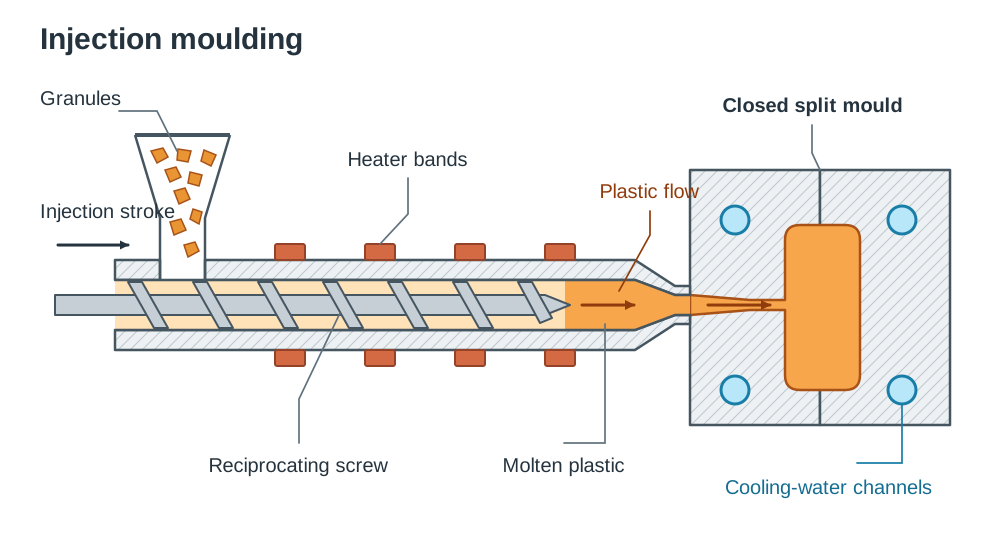
- Injection Moulding: Mass-production process for complex 3D thermoplastic components (such as remote control bodies and lego bricks). Thermoplastic granules feed by gravity from a hopper into a heated barrel. A rotating reciprocating screw conveys, shears, and melts the plastic. Once sufficient melt collects in front of the screw, the screw drives forward hydraulically like a ram, forcing the molten plastic under high pressure into a closed, water-cooled metal mould. The part chills rapidly, the split mould opens, and ejector pins push the part clear.
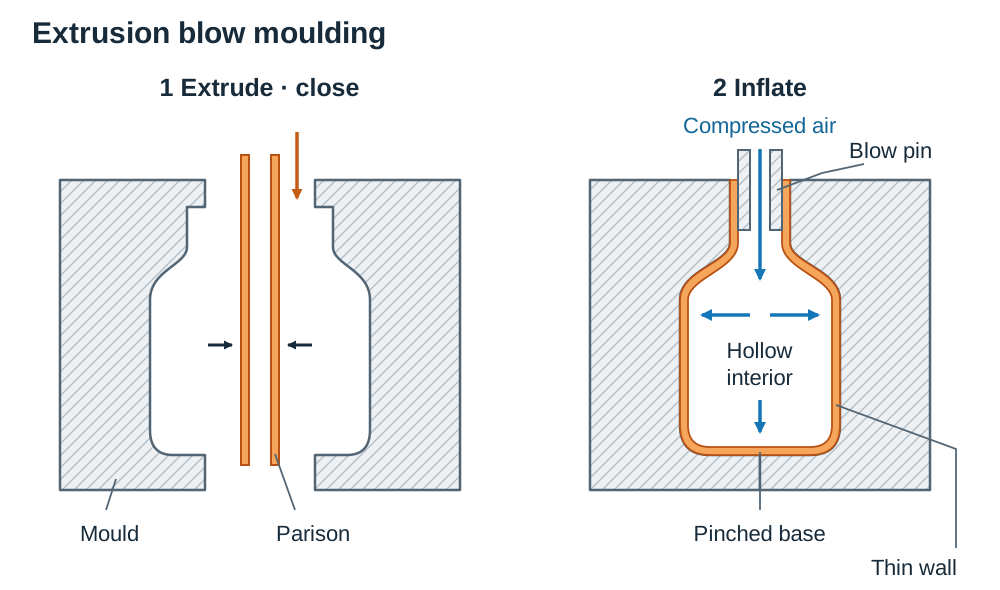
- Extrusion Blow Moulding: Mass-production process for hollow, thin-walled thermoplastic containers (bottles, jars, drums, fuel tanks). Molten plastic is extruded vertically downwards as a hollow tube called a parison. A two-part cooled metal mould closes around the parison, pinching and welding the bottom seam closed. A blow pin enters the neck and injects compressed air, inflating the pliable parison against the cold mould walls. The plastic solidifies, the mould opens, and the hollow container is ejected.
- Compression Moulding: Used predominantly for thermosetting plastics. A pre-weighed charge of uncured thermosetting resin is placed into an open, heated steel mould cavity. A matching punch descends under heavy hydraulic pressure, forcing the resin into the contours while heat and pressure trigger cross-linking (curing). The mould opens, and the rigid part is ejected and trimmed of flash.
3D Printing (Additive Manufacture) vs Subtractive Machining
In Fused Deposition Modelling (FDM) 3D printing, a CAD model is sliced into horizontal layers. A heated nozzle melts a thermoplastic filament (commonly PLA or ABS) and deposits it layer by layer onto a build plate, each layer fusing to the preceding layer as it cools.
- Additive vs Subtractive: 3D printing is additive (material is deposited only where needed, creating minimal waste). Milling, turning, or routing is subtractive (cutting away from a solid blank, converting valuable stock into waste swarf).
- Energy consumption: Long print times mean a single 3D-printed part consumes significant electrical energy per unit; however, it avoids the massive embodied energy required to machine heavy industrial tooling.
- Waste generation: 3D printing produces very little waste (limited to support scaffolding and purges); subtractive processes often turn 40–80% of a billet into waste swarf.
- Materials used: 3D printing operates on-demand with minimal stock inventory, whereas conventional machining requires stocking large volumes of standard sheet or bar sizes.
Workshop Fabrication: Line Bending, Vacuum Forming, and GRP
Line Bending (Strip Heating) — Ordered Steps
Used to fold thermoplastic sheet (acrylic or HIPS) into display stands, brackets, and casings:
- Mark the fold line: Draw the bend position on the protective film using a fine felt-tip pen, marking both faces. Reason: A pen leaves no score mark or scratch, and marking both sides makes alignment easy on the heater.
- Peel back the film: Strip the protective backing only immediately along the bend line before heating. Reason: Leaving film over the heater causes it to melt, bubble, and scorch onto the plastic.
- Align over the strip heater: Place the marked line directly over the narrow heating element at the set height. Reason: Confines heat to a narrow strip so the adjacent areas remain flat and rigid.
- Heat both faces: On sheet thicker than 3 mm, rotate the sheet periodically to heat both sides. Reason: Ensures the full thickness softens evenly, preventing stretching, tearing, or stress whitening on the outer face.
- Check pliability: Test with gentle finger pressure. When the strip becomes rubbery and sags under its own weight, remove it. Reason: Bending too early fractures the brittle sheet; overheating causes blistering and optical distortion.
- Form in a bending jig: Transfer the sheet immediately into a wooden jig or former set to the required angle and clamp it lightly. Reason: The jig ensures a square, repeatable bend and prevents twisting.
- Hold until cool: Keep the part clamped until the plastic drops below its glass transition temperature. Reason: Van der Waals forces re-establish to lock the new shape; releasing too early allows the bend to spring back.
- Clean and check: Inspect the angle with a set square or protractor.
GRP (Fibreglass) Hand Lay-Up — Ordered Steps
Used for high-strength, lightweight, waterproof curved mouldings (boat hulls, covers, vehicle panels):
- Prepare the mould: Apply several coats of release wax or PVA release agent to the mould surface. Reason: Prevents the curing resin from bonding permanently to the mould.
- Apply the gel coat: Brush on an unreinforced, pigmented layer of unsaturated polyester resin mixed with catalyst and let it cure until tacky. Reason: Provides a smooth, impermeable, coloured, weather-resistant outer finish that hides the glass fibres beneath.
- Mix the main resin: Blend unsaturated polyester resin with the correct ratio of liquid catalyst (hardener). Reason: The catalyst initiates chemical cross-linking; too much catalyst causes excessive exothermic heat and cracking, while too little leaves the resin sticky and uncured.
- Lay up glass matting and resin: Place chopped strand glass matting into the mould and stipple the catalysed resin through the fibres using a stippling brush and grooved roller. Reason: Eliminates air pockets and fully wets the fibres. Glass fibres carry the tensile loads, while the resin matrix resists compression and transfers load between fibres.
- Build up layers: Apply additional layers of glass matting and resin to reach the design thickness.
- Cure and release: Allow the laminate to cure fully at room temperature, pop the part from the mould, and trim the edge flash with a junior hacksaw or file.
Joining, Edge Finishing, and Workshop Safety
Joining Plastics: Classify Before You Describe
Exam questions specifically require classifying joining methods into permanent or semi-permanent:
- Permanent (cannot be dismantled without destroying the joint):
- Solvent welding (chemical bonding): Using liquid solvent (such as Tensol cement on acrylic). The solvent temporarily dissolves the contacting polymer chains. When clamped, the chains intermingle; as the solvent evaporates, the joint hardens into a single fused piece.
- Adhesive bonding: Two-part epoxy resin creates a high-strength chemical bond between dissimilar materials (e.g. acrylic to aluminium). Cyanoacrylate (superglue) provides rapid bonding on small, non-porous joints.
- Thermal welding: Hot-gas or friction welding melts compatible thermoplastic joint faces together.
- Semi-permanent (can be dismantled and reassembled for servicing or battery replacement):
- Machine screws into threaded brass inserts (heat-staked or ultrasonic inserts in plastic bosses).
- Self-tapping screws driven into moulded pilot holes.
- Nuts, bolts, and wide flat washers: The washer is essential to distribute compressive clamping force over a broad area, preventing hoop stress from cracking brittle plastic around the hole.
Note on metallurgical joining: Soldering, brazing, and arc welding are metallurgical processes that require melting metals; they cannot be used on plastics.
The Standard Edge Finishing Sequence for Acrylic
Sawing acrylic leaves a rough, frosted, kerf-marked edge. To restore high optical transparency, carry out this four-step sequence:
- Cross filing: Clamp the acrylic between wooden vice jaws. Push a flat second-cut file across the edge at an angle to remove heavy saw marks and level high spots.
- Draw filing: Hold the file with both hands perpendicular to the edge and draw it smoothly along the length of the sheet. This shears away transverse file marks, leaving a smooth, flat edge.
- Wet-and-dry abrasive paper: Wrap silicon carbide paper around a flat wooden sanding block. Sand the edge progressively through 240, 400, 600, and 1200 grit. Always use clean water as a lubricant to flush away acrylic swarf and prevent frictional heat from gumming up the surface.
- Buffing (polishing): Apply a mild polishing compound (such as Tripoli or jeweller's rouge) to a rotating cotton mop buffing wheel. Sweep the edge across the lower quadrant of the mop wheel. Constant motion prevents localised frictional heat from melting the edge. (Industrially, edges are sometimes flame polished using a specialised gas torch to glaze the surface, but this carries severe fire and fume risks and is not suitable for routine school project work).
Safe Working Procedures with Plastics
- Heating and forming: Heaters and softened plastic cause deep contact burns. Wear heat-resistant gloves, do not touch strip-heater elements, and place hot mouldings on cooling racks.
- Fumes and ventilation: Overheated plastics (especially PVC) emit toxic and irritant fumes. Work in a well-ventilated area or under local extraction. Never overheat plastic to the point of scorching or smoking.
- Solvent cements and resins: Tensol, polyester resin, and catalysts give off harmful organic vapours. Use in a fume cupboard or well-ventilated space, wear nitrile gloves and eye protection, keep containers away from naked flames, and reseal lids immediately.
- Machining and drilling: Clamp all acrylic work firmly over a sacrificial timber block; never hold sheet by hand at the pillar drill. Wear safety goggles, as brittle plastic chips can shatter and fly.
- Buffing safety: Always hold the plastic workpiece below the horizontal centreline of the rotating mop wheel so any accidental grab throws the workpiece downward away from your face. Secure loose hair and roll up sleeves.
Testing Plastics and Analytical Calculations
If you take the Materials Technology option, the syllabus expects you to carry out simple tests to demonstrate the properties of chosen materials, to classify materials from the results, and to use simple data from tensile, compressive, bending, shear, and torsion tests in design situations.
Workshop and Laboratory Test Set-Ups
- Tensile testing (Strength): A test specimen of known original cross-sectional area is gripped in the jaws of a tensometer. A tensile pulling force is applied gradually, and elongation is recorded until fracture occurs. Peak load divided by original area gives the Ultimate Tensile Strength (UTS).
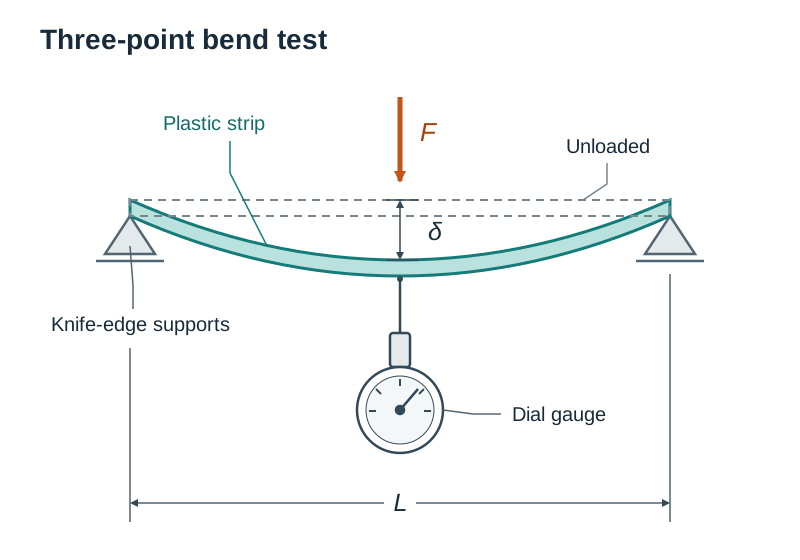
- Three-point bend testing (Stiffness): A plastic strip is supported horizontally on two knife edges a set span distance apart. A central downward load is applied, and the deflection is measured with a dial gauge. Stiffer plastics deflect less under the same load.
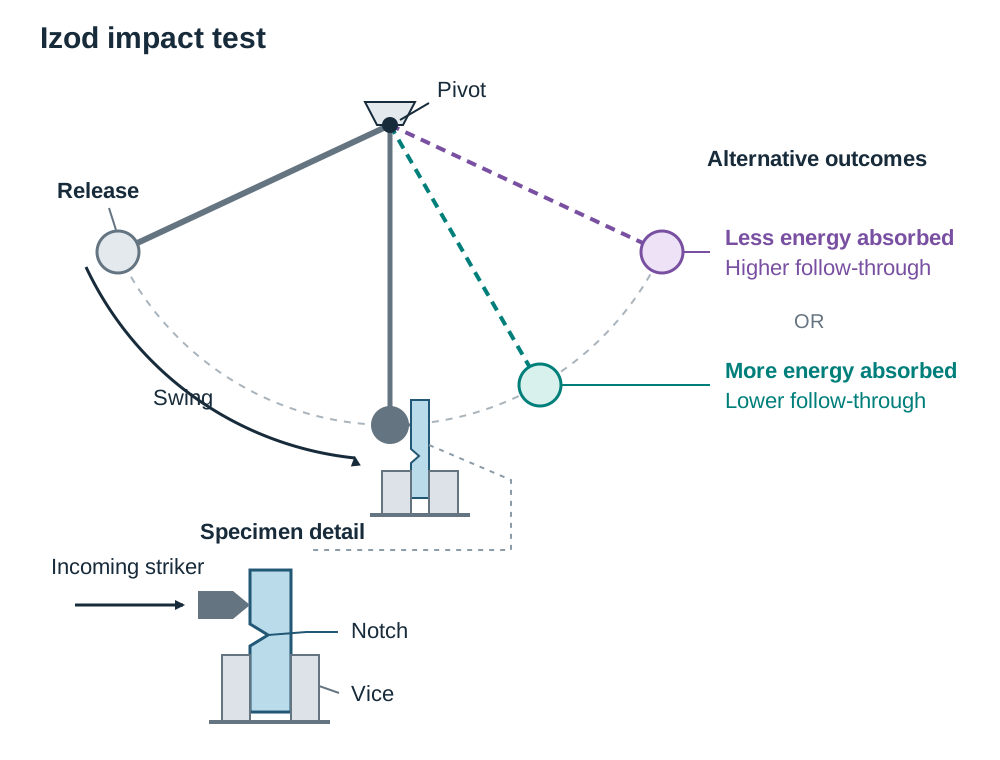
- Impact testing (Toughness): The Izod test clamps a notched specimen vertically in a vice. A weighted pendulum is released from a fixed height, strikes the notched face, fractures the sample, and swings through. Tough materials absorb large amounts of kinetic energy during fracture, resulting in a low follow-through swing height; brittle plastics absorb very little energy, allowing the pendulum to swing high.
- Hardness testing: Brinell (hardened steel ball) and Vickers (diamond pyramid) are standard hardness tests for metals, where a smaller indentation diameter indicates a harder surface. On softer polymers, indenters cause elastic deflection; industry tests plastics using a Shore durometer, which presses a spring-loaded pin into the surface and reads hardness directly on a scale. A simple workshop method is a comparative scratch test against materials of known hardness.
Tensile Stress Formula
To compare materials of different physical dimensions fairly, raw breaking force is converted to engineering stress ():
Where:
- = Engineering stress in Newtons per square millimetre (), which is identical to Megapascals ().
- = Applied tensile force in Newtons (). Convert kilonewtons by multiplying by 1000: .
- = Original cross-sectional area in square millimetres (), calculated as for rectangular specimens.
Degradation, Sustainability, and the Circular Economy
While plastics do not rust or suffer electrochemical oxidation like ferrous metals, they are susceptible to environmental degradation over time.
Environmental Degradation
- Ultraviolet (UV) photodegradation: Solar UV radiation breaks down primary covalent bonds along the polymer backbone. Over time, outdoor plastics suffer colour fading, a chalky surface texture, micro-cracking, and embrittlement. UV stabilisers and carbon black pigments are compounded into outdoor polymers (such as uPVC gutters and HDPE bins) to absorb UV energy.
- Creep under sustained load: Creep is the slow, progressive, permanent deformation of a material subjected to a continuous mechanical load over an extended period. For example, a plastic shelf or battery-support bracket will gradually sag over months even though the stress is far below its yield point. Elevated temperatures accelerate creep significantly.
- Heat and thermal degradation: Excessive operating temperatures weaken intermolecular bonding, leading to softening, dimensional distortion, and thermal degradation.
- Chemical attack and crazing: Solvents or prolonged contact with elastomers (such as rubber bands left on clear plastic rulers) cause plasticiser migration and networks of micro-cracks known as crazing.
Sustainability Terms You Should Be Able to Define
- Single-use plastic: A plastic item designed to be used only once and then discarded or recycled rather than reused. Example: A disposable drinking straw, coffee-cup lid, or food pouch.
- Biodegradable: A material that can be broken down naturally by micro-organisms into simple compounds like water, carbon dioxide, and biomass. Most conventional crude-oil plastics are non-biodegradable and persist in landfill or marine ecosystems for centuries.
- Bioplastic: A plastic manufactured wholly or partly from renewable biological resources (such as corn starch or sugarcane) rather than crude oil. Example: Polylactic Acid (PLA), widely used in 3D printing filament. Note: Being bio-based does not automatically mean a plastic is biodegradable at room temperature; PLA requires industrial high-temperature composting to decompose.
Disadvantages of Heavy PET Bottle Use
- Derived from crude oil, an unsustainable and non-renewable fossil resource.
- Non-biodegradable, contributing to long-term pollution in landfill and marine environments.
- The manufacturing process is energy-intensive and involves petrochemical emissions.
Why Plastic Bottles Are Difficult to Recycle
- Mixed polymer assemblies: The main bottle body is PET, the screw cap is Polypropylene (PP), and the label is often another polymer. These must be separated because different plastics melt at different temperatures and will not fuse.
- Cross-contamination: A small contamination of PVC in a batch of molten PET degrades the entire batch into unusable, brittle plastic.
- Residue: Food and drink residues contaminate wash water and compromise recycled polymer clarity.
- Economics: Because individual bottles are very light, collection, sorting, and transport costs can exceed the scrap market value of the raw flake.
Resin Identification Codes (SPI)
You should know codes 1, 2, and 5 securely; treat the rest as background:
- Code 1 (PET): Polyethylene Terephthalate — clear drink bottles.
- Code 2 (HDPE): High-Density Polyethylene — milk jugs, bleach bottles.
- Code 3 (PVC): Polyvinyl Chloride — pipes, medical tubing.
- Code 4 (LDPE): Low-Density Polyethylene — carrier bags, squeeze bottles.
- Code 5 (PP): Polypropylene — yoghurt pots, lunchboxes, living-hinge caps.
- Code 6 (PS): Polystyrene — disposable cutlery, protective foam packaging.
- Code 7 (OTHER): All other plastics, multi-layer laminates, acrylic, polycarbonate.
The Circular Economy and Folio Marks
A circular economy designs out waste by keeping materials and components at their highest utility through repair, reuse, remanufacture, and closed-loop recycling, replacing the linear 'take-make-dispose' model.
In the Higher Level coursework folio, environmental awareness carries 10 marks under Section 3 (Environmental impact of the project). Maximize these marks by:
- Documenting design for disassembly: Using machine screws and threaded inserts rather than permanent glues, allowing internal electronics and batteries to be separated from plastic casings for recycling.
- Choosing mono-material construction: Specifying a single polymer family (e.g. HIPS for casing, cover, and battery clip) so the entire assembly can be recycled without sorting.
- Detailing sheet nesting layouts: Demonstrating efficient cutting patterns on acrylic or HIPS sheets to minimise scrap, and stating how clean offcuts will be repurposed for internal brackets.
Key terms
- Polymerisation
- The chemical reaction in which small monomer molecules link together end-to-end to form long polymer chains.
- Monomer
- A small molecular unit that chemically bonds with identical or similar molecules to form a polymer chain.
- Thermoplastic
- A polymer whose molecular chains are held together only by weak secondary Van der Waals forces, allowing it to be repeatedly softened by heating and reshaped upon cooling.
- Thermosetting Plastic
- A polymer that undergoes an irreversible chemical reaction during curing, forming permanent covalent cross-links between chains that prevent it from softening or remelting when reheated.
- Van der Waals Forces
- Weak secondary intermolecular attractive forces acting between separate polymer chains in a thermoplastic, which are readily overcome by heat.
- Cross-linking
- The formation of permanent primary covalent chemical bonds bridging adjacent polymer chains, locking them into a rigid 3D molecular lattice.
- Glass Transition Temperature
- The characteristic temperature at which an amorphous thermoplastic changes from a hard, glassy, rigid state to a flexible, rubbery state.
- Brittleness
- The tendency of a material to fracture or snap suddenly under load with little or no plastic deformation beforehand.
- Toughness
- The capacity of a material to absorb sudden impact energy or shock without fracturing.
- Hardness
- The resistance of a material's surface to scratching, abrasion, wear, or localized indentation.
- Ductility
- The ability of a material to be drawn out or stretched into thin wires or filaments without breaking.
- Elasticity
- The ability of a material to deform under load and return completely to its original shape and dimensions once the load is removed.
- Plasticity
- The ability of a material to undergo permanent deformation under load without cracking, retaining its new shape when the load is removed.
- Malleability
- The ability of a material to be permanently shaped or thinned by compressive forces (hammering, rolling, pressing) without cracking.
- Self-finishing
- The characteristic of plastics to be produced with a final, smooth, integral surface finish and colour, requiring no applied paint, stain, or varnish.
- Plasticiser
- A chemical additive blended into polymers to weaken intermolecular bonding, increasing flexibility, softness, and workability (e.g. converting rigid uPVC to flexible PVC).
- Injection Moulding
- A mass-production process where thermoplastic granules are melted in a heated barrel by a rotating screw and then rammed under high pressure into a closed, water-cooled metal mould.
- Parison
- A hot, extruded hollow tube of molten thermoplastic that is clamped into a mould and expanded with compressed air during blow moulding.
- Draft Angle
- A slight taper (typically 2 to 5 degrees) incorporated on the vertical faces of a former or mould cavity to allow the cooled, formed part to release cleanly.
- Solvent Welding
- A permanent joining method where a chemical solvent dissolves the contacting surfaces of compatible thermoplastics, allowing polymer chains to intermingle before the solvent evaporates.
- Creep
- The slow, progressive, permanent deformation of a material subjected to a continuous mechanical load over an extended period, accelerated by heat.
- UV Photodegradation
- The breakdown of covalent chemical bonds along polymer chains caused by solar ultraviolet radiation, resulting in chalkiness, colour fading, and embrittlement.
- Single-use Plastic
- A plastic product designed to be used only once before being discarded or sent for recycling rather than reused.
- Circular Economy
- An economic model that eliminates waste by keeping products, components, and materials circulating at high value through reuse, repair, remanufacture, and closed-loop recycling.
Check yourself
What specific molecular bonding mechanism allows thermoplastics to be repeatedly melted, shaped, and reformed?
Their long polymer chains are held together only by weak secondary Van der Waals forces, which are easily overcome by heat without breaking the strong covalent bonds along the chains.
Why is urea formaldehyde used for domestic electrical plug and socket housings rather than a common thermoplastic?
Urea formaldehyde is a thermosetting plastic with permanent covalent cross-links; it is an outstanding electrical insulator, highly rigid, and will not soften or deform if electrical components become warm.
Name the hollow tube of molten thermoplastic that is extruded and inflated inside a mould during blow moulding.
A parison.
State two essential design features required on a positive wooden former used for vacuum forming.
A draft angle (a 2 to 5 degree taper on vertical walls to allow clean release) and rounded corners (minimum 3 mm radius to prevent sheet thinning or tearing), plus fine vent holes to evacuate trapped air.
Why is water continuously applied when sanding acrylic with wet-and-dry abrasive paper?
Water acts as a coolant to prevent frictional heat from softening or crazing the plastic surface, and it flushes away acrylic dust (swarf) so the paper does not clog.
A plastic test piece with a cross-sectional area of 20 mm² breaks in a tensometer at a tensile force of 1200 N. Calculate its ultimate tensile strength.
60 N/mm² (or 60 MPa), calculated from sigma = F / A (1200 N ÷ 20 mm²).
Explain each of the following in relation to plastic materials: (i) monomer, (ii) brittleness.
(i) A monomer is a small reactive molecule that joins with many other identical molecules during polymerisation to form a long polymer chain. (ii) Brittleness is the tendency of a material to fracture suddenly under load with little or no bending or stretching beforehand.
Explain, using an example, the term single-use plastic.
A single-use plastic is an item designed to be used once and then thrown away or recycled rather than reused — for example, a plastic drinking straw, which is discarded after one drink.
What is creep in relation to plastic components?
Creep is the slow, progressive, permanent deformation of a material subjected to a continuous mechanical load over an extended period, which is accelerated by warm temperatures.