

In Leaving Certificate Technology, fabrics form one of the six fundamental material classifications alongside metals, woods, polymers, ceramics, and composites. Fabrics are flexible sheet materials produced by interlacing or bonding thin fibres. Because cloth carries high tensile loads effectively but buckles under compression and bends with negligible resistance, it is rarely used in isolation; in technology projects, fabrics are typically tensioned across rigid chassis components or embedded as reinforcing plies inside polymer resins. Within the syllabus, students must master both the core requirements (shaping, joining, and finishing flexible materials) and the in-depth Materials Technology option (structure, mechanical and environmental testing, degradation, and production constraints). Understanding fabrics is vital for written exam questions on material selection and composites, as well as the coursework project, where fabric components provide tactile comfort, wearable strapping, and lightweight enclosures.
Classification of Fibres and Structural Construction
Fabrics are categorised primarily by the raw origin of their constituent fibres: natural or synthetic.
- Natural fibres: Harvested directly from botanical sources (cellulose) or animal fleece and secretions (protein). Examples include cotton (seed hair), linen (flax stem), wool (sheep fleece), and silk (silkworm cocoon filament). Natural fibres offer breathability and skin comfort, but they readily absorb moisture, take longer to dry, and are vulnerable to biological decay.
- Synthetic fibres: Synthesised chemically from petrochemical polymers. Examples include nylon (polyamide), polyester, acrylic, elastane, and para-aramids such as Kevlar. Synthetics provide superior tensile strength, low moisture uptake, high abrasion resistance, and chemical stability. Most are thermoplastic, meaning they soften and melt under heat.
- Blends: Combining natural and synthetic fibres (such as 65% polyester / 35% cotton) delivers a balanced textile that pairs the breathability of cotton with the crease resistance and tensile strength of polyester.
Structural Construction
Fibres are twisted into continuous strands called yarns, which are then assembled into sheets by weaving, knitting, or non-woven bonding.
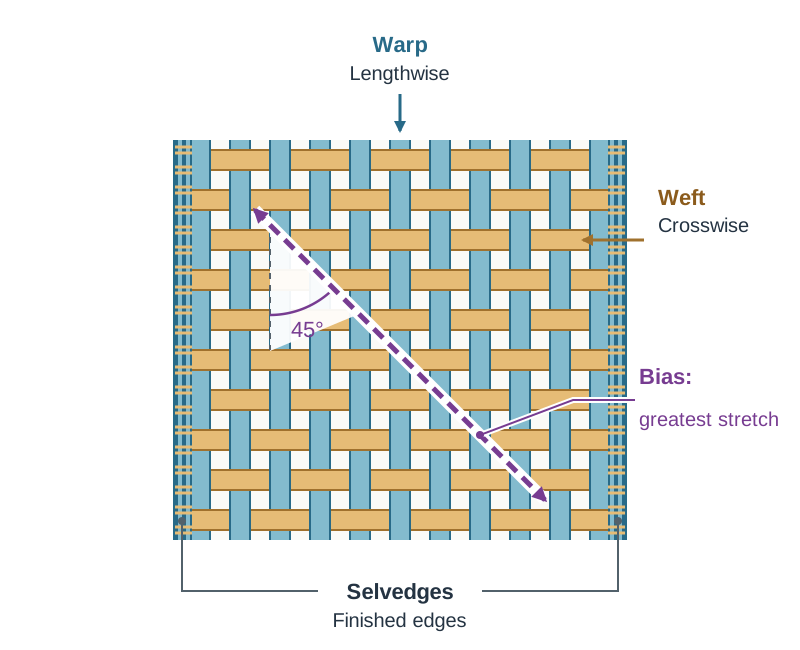
- Woven fabrics: Produced on a loom by interlacing two perpendicular yarn sets. Lengthwise yarns form the warp, while crosswise yarns form the weft. The securely finished edges running parallel to the warp are the selvedges. Woven cloth is dimensionally stable along the warp and weft, but it pulls diagonally along the bias (at 45° to the weave), where it stretches significantly. Note that canvas is a heavy, plain-woven fabric construction rather than a raw fibre; historically woven from flax or cotton, modern high-durability canvas is usually woven from polyester.
- Knitted fabrics: Formed from interlocking loops of yarn. This looped geometry lets knits flex, stretch, and drape across compound curves without needing elastomeric fibres.
- Non-woven fabrics (e.g., felt): Formed by compressing, interlocking, or heat-bonding loose fibres directly without spinning yarns. Non-woven fabrics do not fray when cut, but they lack the tensile strength of woven cloth.
Fabric Properties & Workshop Testing
Selecting a textile requires matching its measurable properties to the operating environment. Examiners award marks for specific textile property terms rather than rigid-material terms like malleability or ductility.
| Property | Meaning for a Fabric | Example Application |
|---|---|---|
| Tensile Strength | Resistance to tearing under pulling forces | Polyester webbing in a lifting harness |
| Abrasion Resistance | Resistance to being worn away by surface rubbing | Ballistic nylon on the base of an instrument pouch |
| Absorbency | Capacity of fibres to absorb and hold moisture | Cotton towel linings (high); polyester covers (low) |
| Thermal Insulation | Ability to trap air and slow down heat loss | Wool or synthetic fleece lining on an assistive lap blanket |
| Elasticity | Capacity to stretch under load and recover completely | Knitted elastane blend in an ergonomic wrist brace |
| Drape / Flexibility | Ease of bending and conforming around compound curves | Lining fabric fitted across a contoured support cushion |
| Crease Resistance | Ability to recover shape after folding or packing | Polyester/cotton blend on a wearable enclosure |
| Fabric Weight (GSM) | Mass expressed in grams per square metre () | Lightweight 120 gsm lining versus heavy 450 gsm structural canvas |
Exam Answer Template (Name → Property → Link): When asked to justify a material, follow this three-part rule: "Woven polyester webbing (name), because it combines high tensile strength with low stretch (property), so the support harness will carry the battery load without sagging or tearing during daily use (link to application)."
Simple Workshop Testing
The Materials Technology option requires simple comparative testing using fair test procedures:
- Tensile Testing: In rigid materials, tensile strength equals force divided by cross-sectional area (). Because flexible textiles compress unevenly in calipers, workshop tests record the breaking force per unit width () across uniform test strips (e.g., 25 mm or 50 mm wide).
- Elastic Recovery: Mark a 100 mm gauge length along a strip, suspend a calibrated mass, measure extended length (), remove the mass, and measure recovered length (). Any difference between and the original 100 mm represents permanent plastic stretch.
- Water Absorbency: Weigh dry fabric swatches (), submerge them in water for 10 minutes, allow them to drain for 60 seconds, and reweigh (). Calculate percentage moisture uptake as .
Dry fabric acts as an electrical insulator, making cloth sleeving useful for tidying and protecting wiring runs. Remember that SEC coursework instructions require electrical circuits on student artefacts to operate on low voltage.
Fabrics as Reinforcement in Composite Materials
A composite material combines two or more distinct materials to achieve structural properties superior to those of the components acting alone. In modern technology, fabrics often serve as structural fibre reinforcement encased in a thermosetting resin matrix.
- Glass-Reinforced Plastic (GRP): Woven glass cloth or chopped-strand mat combined with polyester resin. GRP is strong in tension, waterproof, non-conductive, resistant to corrosion, and easily moulded into compound curves. It is widely used for boat hulls, architectural panels, and protective housings.
- Carbon Fibre Composite: Woven carbon fibre cloth set in high-performance epoxy resin. This composite delivers an exceptional strength-to-weight ratio and outstanding stiffness. It is specified for racing bicycle frames, aerospace components, and lightweight robotic limbs, though it is expensive and cannot be reshaped after curing.
- Aramid Fibre Composite (Kevlar): Woven aramid cloth bonded with epoxy resin. Kevlar provides remarkable toughness, impact absorption, and cut resistance, making it ideal for impact panels and protective shells.
In these materials, the fabric reinforcement absorbs and transmits the tensile stresses, while the rigid polymer matrix holds the fibres in alignment, protects them from surface abrasion, and distributes compressive loads across the structure.
Hand Lay-Up Moulding Process
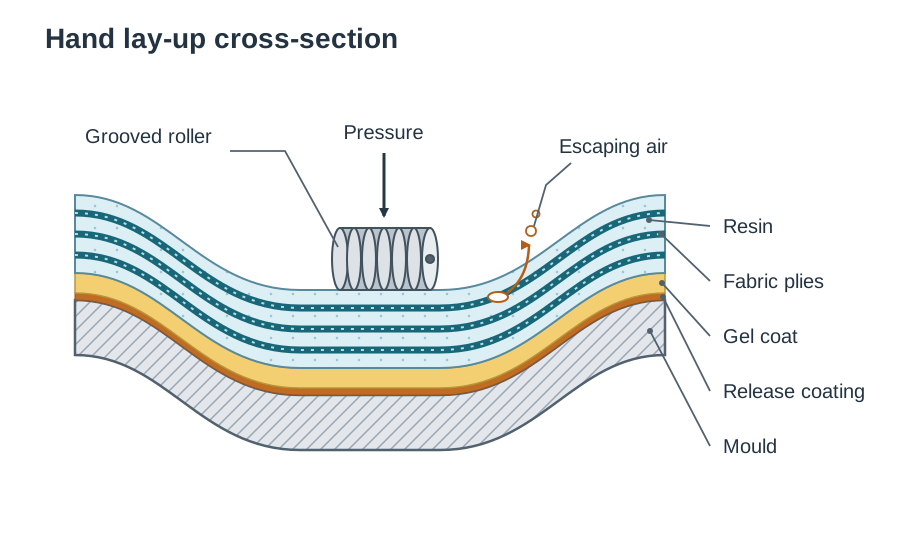
- Prepare the mould by applying wax and a chemical release agent so the cured component can be removed without sticking.
- Brush on a gel coat resin layer to produce a smooth, pigmented, weather-resistant outer finish.
- Position the fabric reinforcement (glass or carbon cloth) inside the mould and stipple catalysed resin through the weave using a brush or stippling roller to wet out every fibre, as dry patches create weak voids.
- Consolidate the laminate with a grooved metal roller to drive out trapped air bubbles that reduce mechanical strength.
- Layer additional plies to reach the specified structural thickness, allow the resin to cure, trim the perimeter flash edge, and release the component from the mould.
Safety: Thermosetting resins emit styrene and organic solvent vapours. Work under dedicated fume extraction, wearing nitrile gloves, safety goggles, and a vapour respirator.
Directional Loading: Woven cloth reinforcement provides directional strength along the yarn axes. Aligning cloth layers at alternating angles (e.g., 0°, 45°, and 90°) produces a laminate that resists multi-directional stresses.
Workshop Processing: Marking, Cutting, and Shaping
Flexible fabrics distort when marked or cut, requiring distinct handling compared to sheet timber or metals.
Marking and Pattern Development
- Scribing tools and standard pencils snag threads and leave permanent stains. Use tailor's chalk, removable marking pens, or tracing wheels over carbon paper.
- Cut flat templates from 1 mm card or rigid polypropylene sheet. Align the template's grainline indicator parallel to the fabric's warp threads to prevent uneven elongation when loaded.
- Always include a seam allowance of 10 mm to 15 mm outside finished component boundaries on the pattern. Cutting panels without this margin results in an undersized assembly.
Cutting and Edge Processing
- Hand Cutting: Use sharp fabric shears or a rotary wheel cutter on a self-healing mat. Pinking shears produce a zigzag edge that interrupts thread continuity and suppresses fraying in woven natural fabrics.
- Thermal Edge Sealing: When cutting thermoplastic synthetics (nylon, polyester, polypropylene), cold scissors leave loose raw edges that fray. An electrically heated hot knife cutter or a soldering iron with a cutting blade slices through the fabric while melting the polymer ends into a continuous sealed bead.
- Fibre Distinction: Natural fibres like cotton and linen do not melt; they char when exposed to heat. Because thermal sealing does not work on naturals, their edges must be mechanically bound, hemmed, or overlocked.
Workshop Safety Precautions
- Hot knife blades operate above 250 °C; always place them in heat-resistant stands when not in hand.
- Synthetic cutting generates polymer fumes; work under local exhaust ventilation.
- Hazard Warning: Never laser cut PVC-coated fabric. Heating polyvinyl chloride releases toxic chlorine gas and corrosive hydrochloric acid vapour, creating severe respiratory hazards and damaging laser optics.
Joining Processes: Permanent and Semi-Permanent
Fabric joints fall into mechanical, adhesive, and thermal categories, classified by joint permanence.
Named Fabric Joints and Seams
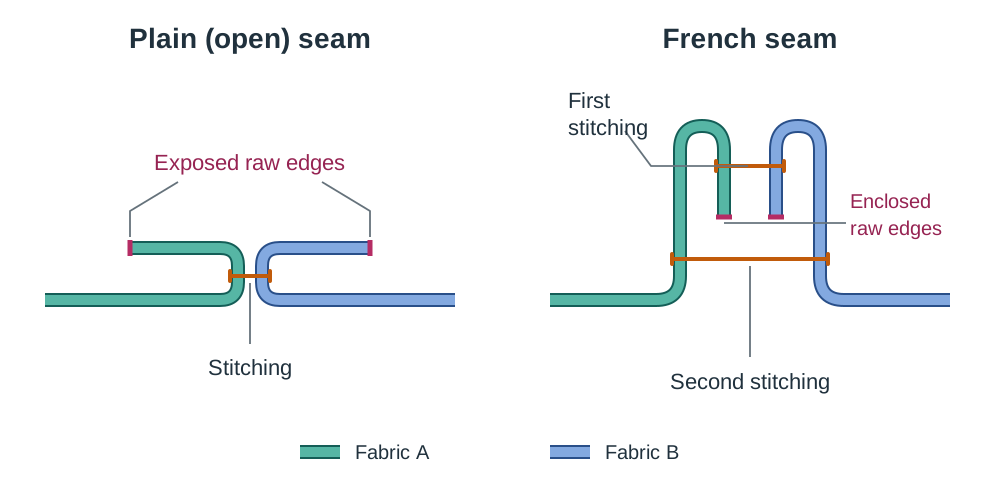
- Plain (Open) Seam: Two fabric pieces laid face-to-face, machine-stitched 10 mm to 15 mm inside the raw edge, then opened out and pressed flat. This is the standard joint for textile bags and enclosures.
- Lapped Seam: One piece overlaps the edge of another and is secured by two parallel lines of stitching. Used on heavy-duty webbing and load-bearing straps because both stitch lines share the tensile shear load.
- French Seam: The raw seam allowance is folded and fully enclosed inside a secondary line of stitching. This eliminates fraying on unlined enclosures without needing an overlocker.
- Hem: The raw edge is folded twice against itself and stitched down, creating a neat, unravel-proof perimeter.
- Overlocked (Serged) Edge: A specialist multi-thread machine trims the edge and wraps it in interlocking thread loops to seal the raw yarn ends.
- Hand Stitches: A running stitch serves to tack assemblies temporarily during fitting, while a backstitch provides a strong, durable hand-sewn seam where machine access is restricted.
- Fusible Bonding Web: A heat-activated adhesive web ironed between two fabric layers. It creates a flat permanent bond without surface thread lines and is often used to stiffen structural flaps.
Permanent versus Semi-Permanent Connections
- Permanent Connections: Joints intended to remain intact for the life of the product, requiring destruction of the fastening to separate:
- Machine lockstitching: Interlocking needle and bobbin threads. For high-tensile strap mounts, stitch a box-and-cross pattern (a perimeter box with internal diagonals) to distribute load across a wide surface area.
- Thermal and ultrasonic welding: High-frequency vibrations generate localized friction that melts and fuses overlapping thermoplastic sheets into a continuous, fray-free seam without needle holes, making it ideal for waterproof enclosures.
- Adhesive bonding: Flexible neoprene contact adhesives or elastomeric polyurethanes bond cloth to wood or plastics. Rigid adhesives like cyanoacrylate (superglue) dry brittle and crack under flexing, while water-based PVA soaks into yarns, dries stiff, and fails when exposed to moisture.
- Rivets and eyelets: Pop rivets clamp webbing securely to metal chassis parts. Always fit wide backing washers under the rivet head to keep the fastener from pulling through the flexible weave.
- Semi-Permanent Connections: Fasteners designed for repeated non-destructive opening and closing:
- Hook-and-loop fasteners (Velcro): Interlocking nylon hooks and loop piles. Ideal for users with limited grip or dexterity (such as arthritis), as wide straps require minimal pinch force compared to small press studs.
- Zips: Interlocking plastic or metal teeth that open and close straight or contoured seams reliably.
- Press studs (snaps): Mechanical snap fasteners that click together firmly, useful for battery inspection covers.
Degradation, Surface Treatments, and Sustainability
Fabrics degrade through physical, chemical, and biological mechanisms when exposed to the environment.
Degradation Mechanisms
- Physical Abrasion: Constant friction breaks surface yarns, leading to thinning, tearing, or pilling (the formation of tangled fibre lint balls).
- Chemical Attack (UV Photodegradation): Solar ultraviolet radiation breaks covalent bonds within polymer chains. Nylon and silk lose tensile strength and become brittle upon prolonged outdoor exposure. Polyester has significantly higher inherent resistance to UV radiation.
- Biological Attack (Rot and Mildew): Fungi, mould, and bacteria digest natural organic fibres (cellulose in cotton/linen, protein in wool) under damp, warm, poorly ventilated conditions. This causes rot, surface staining, and complete structural failure. Synthetic fibres are not digested by microorganisms, although surface dirt in damp conditions can still host mould stains.
Protective, Functional, and Decorative Finishes
- Durable Water Repellent (DWR): A chemical treatment that raises the fabric's surface tension, causing water droplets to bead up and roll off without soaking the weave.
- Polyurethane (PU) Backing: A continuous liquid polymer film laminated to the underside of the fabric, blocking pores to create an impermeable waterproof barrier.
- Antimicrobial Finish: Chemical agents applied to the fibres to inhibit bacterial growth and odours on medical and assistive aids handled daily.
- Functional Visibility: Stitching retro-reflective tape or piping along structural seams ensures older pedestrians or mobility aid users remain visible to traffic at night.
- Decorative Finishes: Dyeing infuses colorants throughout the fibre; screen printing forces ink through stencil mesh to produce durable graphics and signage; appliqué involves stitching contrasting fabric patches onto the main panel to provide tactile differentiation.
Sustainable Design
Traditional linear manufacturing follows a wasteful make-use-dispose pattern. Sustainable engineering prioritises closed-loop systems:
- Mono-Material Assemblies: Fabricating a product entirely from polyester (polyester canvas, polyester webbing, polyester thread) allows straightforward recycling at end-of-life without difficult sorting.
- Design for Disassembly: Using semi-permanent fastenings (zips or hook-and-loop) allows fabric covers to be removed for washing, repair, or replacement without discarding the rigid chassis.
Production Techniques, Quality Standards, and Assessment
Once-Off versus Batch Production
- Once-Off (Craft) Production: Fabricates a single bespoke item (such as an exam project prototype). It relies on manual tools and offers total flexibility to modify designs on the fly, but it is labour-intensive, costly per unit, and prone to dimensional variations.
- Batch Production: Produces a set quantity of identical units using stacked lay-plans, rigid templates, and sewing machine edge guides. Tooling takes time to set up upfront, but it ensures dimensional repeatability, shortens unit cycle times, and reduces waste.
Quality Standards and Appraisal Criteria
Evaluate completed fabric components against clear, measurable standards:
- Finished panel dimensions sit within specified tolerances (e.g., of the working drawing).
- Machine stitch lines run straight and parallel to edges without puckering (puckering indicates uneven thread tension or stretching while feeding).
- All cut edges are sealed (hot-knifed, hemmed, or overlocked) with no fraying yarns.
- Mechanical fasteners align correctly and engage smoothly on the first attempt.
2027 Examination and Assessment Context
- Leaving Certificate Assessment: Technology is assessed via a written terminal examination (50%) and a coursework project (50%). At Higher Level, the written examination lasts 2½ hours.
- 2027 Written Exam Structure: Section A (answer 12 of 15 short questions from the core) and Section B (answer two long questions from the core) are unchanged. In Section C (five optional topics), candidates answer one long option question instead of two.
- Coursework Project Breakdown (200 marks total):
- Design Folio (100 marks): Directly rewards fabric development under Environmental impact (10 marks: material sustainability, mono-material choices), Design ideas (18 marks: developing three annotated solutions and justifying the optimum choice), Production planning (10 marks: lay-plans, costings, and schedules), and Product realisation (10 marks: photographic manufacturing sequence).
- Artefact (100 marks): Evaluated under Production skills (30 marks: processing, assembly, and demonstrating a range of skills by combining flexible fabrics with rigid chassis materials), Functionality (20 marks), Originality and creativity (15 marks), and Quality and finish (15 marks: neat seams, edge sealing, and safe construction).
Key terms
- Fabric
- A flexible sheet material manufactured by weaving, knitting, bonding, or felting fibres together.
- Warp and Weft
- The two perpendicular yarn sets in a woven fabric: warp runs lengthwise parallel to the selvedge, while weft is woven across the width.
- Bias
- The diagonal direction at 45° across warp and weft yarns, exhibiting the highest degree of natural stretch in a woven fabric.
- Natural Fibre
- A fibre harvested directly from botanical sources (such as cotton or linen) or animal sources (such as wool or silk).
- Synthetic Fibre
- A manufactured fibre synthesised chemically from petrochemical polymers, including nylon, polyester, and Kevlar.
- Composite
- A material formed by combining two or more distinct materials (such as woven fabric reinforcement inside a polymer resin matrix) to achieve superior mechanical properties.
- Hot Knife Cutter
- An electrically heated thermal blade used to cut thermoplastic synthetic fabrics while simultaneously fusing cut edge yarns to prevent fraying.
- Seam Allowance
- The extra fabric border (typically 10 mm to 15 mm) added beyond the finished stitching line on a pattern to allow joining.
- Box-and-Cross Stitch
- A structural stitch pattern forming a rectangle with an internal 'X', used to distribute heavy tensile loads across webbing attachments.
- Hook-and-Loop Fastener
- A semi-permanent mechanical closure system comprising two nylon tape strips: one faced with miniature stiff hooks and the other with dense loops.
- Photodegradation
- The breakdown of polymer chemical bonds caused by solar ultraviolet radiation, causing fading, embrittlement, and loss of tensile strength.
- Durable Water Repellent (DWR)
- A surface treatment applied to fabrics that increases surface tension so water droplets bead and roll off without soaking the weave.
- Lay-Plan
- A scaled technical arrangement diagram showing how pattern templates are nested across fabric yardage to maximise material yield and minimise cutting waste.
- Biological Attack
- The breakdown of natural cellulose or protein fibres by fungi, mould, and bacteria under damp, warm, poorly ventilated conditions.
Check yourself
What is the structural difference between the warp, the weft, and the bias in a woven fabric?
Warp yarns run lengthwise parallel to the selvedge; weft yarns are woven crosswise across warp yarns. The bias is the diagonal direction at 45° to both, exhibiting maximum natural stretch.
Why will a natural cotton equipment cover rot in damp storage while a polyester cover will not?
Cotton consists of natural cellulose fibres that fungi, mould, and bacteria digest in warm, damp conditions. Polyester is a synthetic polymer that microorganisms cannot break down.
A finished rectangular fabric panel must measure 240 mm × 160 mm. With a 12 mm seam allowance on all four edges, what are the cut dimensions?
264 mm × 184 mm. Add 2 × 12 mm (24 mm) to both the finished length and the finished width.
Classify a machine lockstitched seam and a nylon zip as permanent or semi-permanent, giving the reason for each.
A lockstitched seam is permanent because the thread fastening must be cut or destroyed to take it apart. A nylon zip is semi-permanent because it is designed to open and close repeatedly without damage.
Why can an electrically heated hot knife seal cut edges on nylon cloth but not on linen cloth?
Nylon is a thermoplastic synthetic that melts under heat, fusing cut yarn ends into a solid bead. Linen is a natural plant fibre that chars and burns rather than melting, requiring mechanical edge finishes like hemming or overlocking.
In a carbon fibre composite component, what distinct mechanical roles do the woven fabric and the epoxy matrix play?
The woven carbon cloth carries the tensile loads and provides stiffness, while the epoxy resin holds the fibres in position, protects them from moisture and abrasion, and transfers stress between them.