

Materials and Production is a core section of the Leaving Certificate Technology syllabus. It examines how materials are selected, measured, marked, shaped, joined, finished, and managed sustainably and safely. The core syllabus requires you to understand six material families: ceramics, composites, fabrics, metals, plastics, and woods. This topic appears across Section A short questions and Section B compulsory core questions on the written paper. It also carries significant weight in the Leaving Certificate project (thematic brief for 2027: 'Supporting independent living, wellbeing, or social participation in an ageing society'), where the SEC marking scheme evaluates production skills, quality and finish, and environmental impact.
Material Properties and the Six Material Families
A material property describes how a material behaves. In the examination, naming a material is rarely enough on its own; you must justify why it suits the product. A reliable way to structure a material justification is: '[Material] is chosen for its [named property], which means that [the product can do what it needs to do].'
Mechanical Properties
Mechanical properties describe how a material responds when physical forces are applied to it:
- Strength: The ability of a material to withstand applied forces without breaking or failing. It is defined by the type of load: tensile (pulling), compressive (crushing), shear (sliding), or torsional (twisting).
- Hardness: The resistance of a material's surface to scratching, wear, abrasion, and indentation.
- Toughness: The ability of a material to absorb sudden shock energy or impact loads without shattering (the direct opposite of brittleness).
- Brittleness: The tendency of a material to fracture or shatter with little to no plastic deformation when struck.
- Elasticity: The ability of a material to deform under load and return completely to its original dimensions once that load is removed.
- Plasticity: The ability of a material to undergo permanent deformation under load without cracking or rupturing.
- Malleability: The ability of a material to be flattened, hammered, or rolled into thin sheets under compressive force without cracking.
- Ductility: The ability of a material to be drawn or stretched out plastically into a thin wire under tensile force without breaking.
- Stiffness: The ability of a material to resist elastic deflection or bending when subjected to a load.
Commonly Confused Mechanical Terms
- Hard vs Tough: Glass and pottery are extremely hard because their surfaces resist scratching, but they are brittle and shatter on impact. Mild steel and polypropylene are tough because they absorb heavy impacts without shattering.
- Elastic vs Plastic: An elastic material springs back to its original shape when released (like a steel spring or rubber band). A plastic material stays in its deformed shape permanently (like soft clay or hot acrylic bent over a strip heater).
- Malleable vs Ductile: Malleable materials can be squashed or hammered into thin sheets (such as lead or aluminium sheet). Ductile materials can be pulled in tension into long wires (such as copper wire).
Physical Properties
Physical properties are inherent characteristics built into the material itself, independent of external loads:
- Density: Mass per unit volume (). Low-density materials like aluminium and ABS reduce user fatigue in portable devices.
- Electrical Conductivity: The ability to conduct electric current. Copper and brass are conductors; PVC and acrylic are insulators.
- Thermal Conductivity: The rate at which heat transfers through a material. Metals conduct heat rapidly, while woods and thermosetting plastics act as thermal insulators.
- Corrosion Resistance: The ability to resist chemical or electrochemical breakdown when exposed to the environment.
The Six Material Families
- Metals: Typically strong, stiff, dense, and good conductors of electricity and heat. Divided into ferrous metals (contain iron, magnetic, prone to rust, such as mild steel and cast iron), non-ferrous metals (contain no iron, non-magnetic, corrosion-resistant, such as aluminium, copper, and zinc), and alloys (mixtures of metals engineered for enhanced properties, such as brass and stainless steel).
Note on heat treatment: While advanced heat treatment belongs to the Materials Technology option, you must know that metal is annealed (heated and cooled slowly) before heavy cold forming to relieve internal stresses and restore ductility so it bends without cracking.
- Plastics (Polymers): Lightweight, waterproof, chemical-resistant, and good electrical insulators. Thermoplastics consist of linear or branched chains held by weak secondary bonds; they soften when heated, can be reshaped repeatedly, and can be mechanically recycled (acrylic, polypropylene, polythene, ABS). Thermosetting plastics form permanent chemical cross-links during curing; once cured, they cannot soften or melt on reheating and will char instead (epoxy resin, melamine formaldehyde, urea formaldehyde).
- Woods: Fibrous, natural material with good strength along the grain. Hardwood and softwood is a botanical distinction, not a measure of physical hardness: hardwoods come from broad-leaved deciduous trees (oak, beech, and balsa, which is botanically a hardwood but extremely soft); softwoods come from coniferous evergreen trees (Scots pine, spruce, and yew, which is a softwood but relatively hard). Manufactured boards (plywood, MDF) are engineered panels that overcome natural defects, offering uniform strength across the sheet.
- Ceramics: Inorganic, non-metallic materials (clay, porcelain, glass) formed while soft and hardened by high-temperature kiln firing. Key point: once fired in a kiln, clay hardens permanently into a rigid, hard, brittle ceramic that cannot be bent, sawn, or carved with standard workshop tools; all shaping must be completed while the clay is soft.
- Composites: Materials created by combining a matrix (binder) and a reinforcement (fibres or bars) to achieve properties superior to either constituent alone, such as Glass-Reinforced Plastic (GRP), Carbon-Fibre-Reinforced Polymer (CFRP), and reinforced concrete.
- Fabrics: Flexible sheet materials formed from spun yarns or interlocking fibres. Divided into natural fibres (cotton, wool) and synthetic fibres (polyester, nylon). Woven fabrics resist stretching along the warp and weft, while knitted fabrics stretch elastically.
Master Material Decision Table
| Material | Key Properties | Suitable Shaping Process | Suitable Joining Method | Suitable Finish | Recyclability |
|---|---|---|---|---|---|
| Mild steel | Tough, ductile, high tensile strength, prone to rust | Hacksaw, drilling, folding, MIG welding, sand casting | Welding, brazing, nuts and bolts, rivets | Primer + gloss paint, plastic dip coating, galvanising | High (remelted using scrap furnaces) |
| Aluminium | Low density, corrosion-resistant, ductile, good thermal conductor | Piercing saw, machining, CNC routing, die casting | Machine screws, rivets, TIG welding | Anodising, powder coating | High (95% energy saving over raw bauxite) |
| Acrylic (PMMA) | Stiff, brittle, optical clarity, scratches easily | Laser cutting, scroll saw, line bending (strip heater) | Tensol cement (solvent welding), machine screws | Edge draw-filing, wet-and-dry paper, buffing wheel | Moderate (thermoplastic; requires sorting) |
| ABS | Tough, impact-resistant, rigid, lightweight | Injection moulding, 3D printing (FDM), CNC routing | Solvent cement, self-tapping screws into bosses | Self-finishing from mould/print, vapour smoothing | Moderate (thermoplastic; code 7) |
| Scots pine | Lightweight, straight grain, easy to work, prone to rot | Handsaw, wood chisel, bandsaw, wood lathe | Mortise and tenon, housing joint, dowels, PVA glue | Polyurethane varnish, exterior wood stain | Biodegradable / renewable (FSC-certified) |
| MDF | Homogeneous, no grain direction, flat, dust hazard | CNC router, panel saw, laser cutting | Knock-down fittings, dowels, corner blocks, PVA | Primer/sealer + spray paint, melamine laminate | Low (contains urea-formaldehyde resin) |
| GRP | High strength-to-weight ratio, waterproof, rigid | Hand lay-up in open mould, vacuum bagging | Epoxy resin, stainless steel bolts with backing plates | In-mould pigmented gel coat | Very low (thermoset matrix cannot be remelted) |
| Pottery clay | Plastic when wet, hard and brittle when bisque-fired | Hand pinch/coil, wheel throwing, slip casting | Slip (liquid clay) while green/leather-hard | Fired mineral glaze (waterproof vitreous layer) | Very low (chemically altered; downcycled as aggregate) |
| Polyester fabric | High tensile strength, flexible, non-absorbent, fast drying | Shears along pattern templates, hot wire cutter | Machine stitching (thread), hook-and-loop, zips | Hemming edges, waterproof polyurethane backing | Low to moderate (requires mechanical/chemical recycling) |
Precision Marking Out, Tool Selection, and Information Transfer
Accurate manufacturing starts with correct marking out. Any measurement mistake made on raw material carries through cutting, shaping, and assembly, resulting in misaligned holes and failed joints.
The Datum Principle
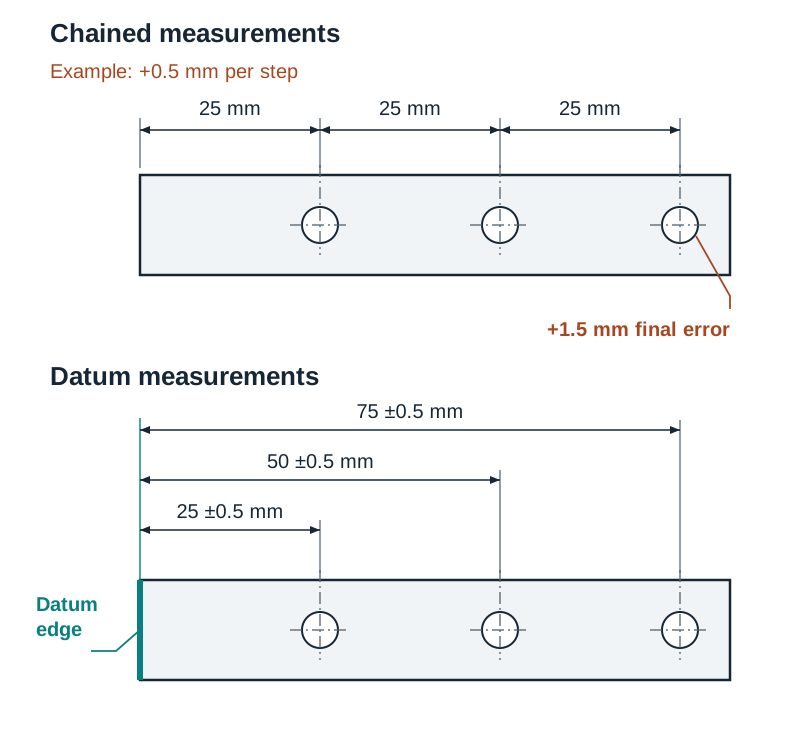
A datum is an established, true reference edge, surface, or centreline from which all subsequent measurements and markings originate. Measuring every feature directly from a single datum edge prevents errors from compounding. Each mark carries only its own individual tolerance rather than accumulating across the workpiece.
- Without a datum (step-by-step measuring): If you mark three holes spaced 25 mm apart by measuring from hole 1 to hole 2, and then from hole 2 to hole 3, a small error of +0.5 mm on each step compounds into a cumulative error of +1.5 mm by the third hole.
- With a datum edge: Mark hole 1 at 25 mm, hole 2 at 50 mm, and hole 3 at 75 mm, all measured from the same true edge. Each hole is positioned with an individual tolerance of only ±0.5 mm, keeping all features aligned.
Transferring Information from Drawings, Templates, and Jigs
The syllabus requires you to transfer information accurately from drawings, models, sketches, templates, and patterns:
- Read each dimension from the working drawing and mark it once from the datum edge.
- Steel rule: used for general linear measurement; it can be read to about 0.5 mm. Because the zero graduation starts exactly at the end of the rule, it can also be used into an internal corner.
- Vernier calliper: measures external and internal dimensions and hole depths, readable to about 0.1 mm — use it to check a rod diameter or sheet thickness that a rule cannot resolve.
- Micrometer: for the finest work, readable to about 0.01 mm on small thicknesses and diameters.
- Scriber and marking blue: On metals, brush on marking-out (engineer's) blue first; the scribed line scratched by the hardened point then shows up clearly. Always follow with a centre punch at every hole centre before drilling to prevent the drill bit from wandering.
- Template: a thin card, MDF, or acrylic profile of a component. Hold it firmly on the workpiece, scribe or trace around it, and cut to the line. Use a template when the same curved or irregular profile is needed on several parts, ensuring identical parts without repeated measuring.
- Pattern: a full-scale former used to create a mould cavity (in sand casting) or to lay out fabric panels aligned with the weave grain line.
- Jig: a purpose-made device that both holds the workpiece in position and guides the cutting tool (for example, a drilling jig fitted with hardened steel bushes). A jig eliminates marking out entirely during batch production, speeds up output, and ensures all parts remain within tight dimensional tolerances.
Choosing the Right Tool for the Material
| Operation | Woods | Metals and plastics |
|---|---|---|
| Straight cutting | Tenon saw, panel saw; jigsaw, bandsaw | Hacksaw (18–32 tpi blade); bandsaw with metal blade |
| Curved cutting | Coping saw; scroll saw, bandsaw | Piercing saw; coping saw with a fine metal blade |
| Cutting down to a line | Bench plane, spokeshave, bevel-edge chisel; disc sander | Flat and half-round files, needle files; disc sander at low speed |
| Holes | Bradawl, twist bit, forstner bit in a pillar drill | Centre punch first, then twist drill in a pillar drill with cutting fluid |
| Holding the work | Woodworker's bench vice, bench hook, G-cramp, sash cramp | Engineer's machine vice, toolmaker's clamps |
| Checking a finished size | Steel rule, try square | Vernier calliper, micrometer |
Shaping and Processing: Wasting, Deforming, Moulding, and Casting
Manufacturing shapes raw materials through wasting (cutting away unwanted stock), deforming (reshaping without material loss), moulding, casting, or additive fabrication.
Additive Manufacturing (3D Printing)
Additive manufacturing builds a three-dimensional part layer by layer directly from a 3D CAD model, in contrast to subtractive machining which cuts away material.
Fused Deposition Modelling (FDM), the standard process used in schools:
- Model the component in 3D CAD and export it as an STL file.
- Slicing software slices the digital model into thin horizontal layers, setting tool paths, nozzle temperatures, infill density, and support structures.
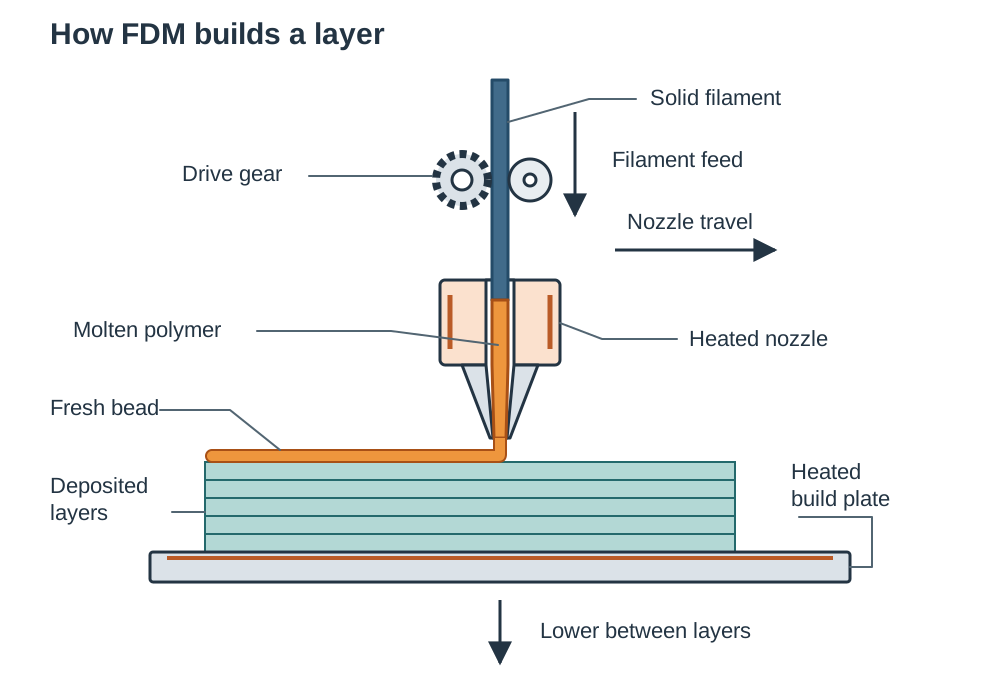
- A drive gear feeds thermoplastic filament (PLA, PETG, or ABS) into an electrically heated nozzle, where it liquefies.
- The nozzle traces the layer profile onto a heated build plate; each deposited bead fuses to the layer beneath as it solidifies.
- The build platform drops (or the gantry rises) by one layer thickness, and the next layer is deposited until complete.
- Supports are snapped away, and surfaces can be sanded or vapour-smoothed.
Additive vs Subtractive: Additive manufacturing places material only where needed, generating negligible material waste and enabling complex internal geometries and hollow honeycomb structures. Subtractive methods (sawing, turning, milling, routing) cut away solid stock as swarf and chips. However, 3D printing can take hours per part, meaning energy consumption per individual unit can be high.
Laser Cutting and CNC Routing
- Laser Cutting: A focused CO₂ laser beam vaporises a narrow kerf along a vector path directed by CAD data. Excellent for cutting intricate, flat profiles in acrylic, plywood, and MDF. PVC must never be cut with a laser, as thermal decomposition releases toxic and corrosive hydrogen chloride gas.
- CNC Routing: A computer-controlled high-speed rotating cutter moves along programmed X, Y, and Z tool paths to cut 2D outlines, 3D surface reliefs, and recesses in timber, MDF, and dense plastics. Stored programs guarantee exact repeatability across batches.
Industrial Moulding Processes
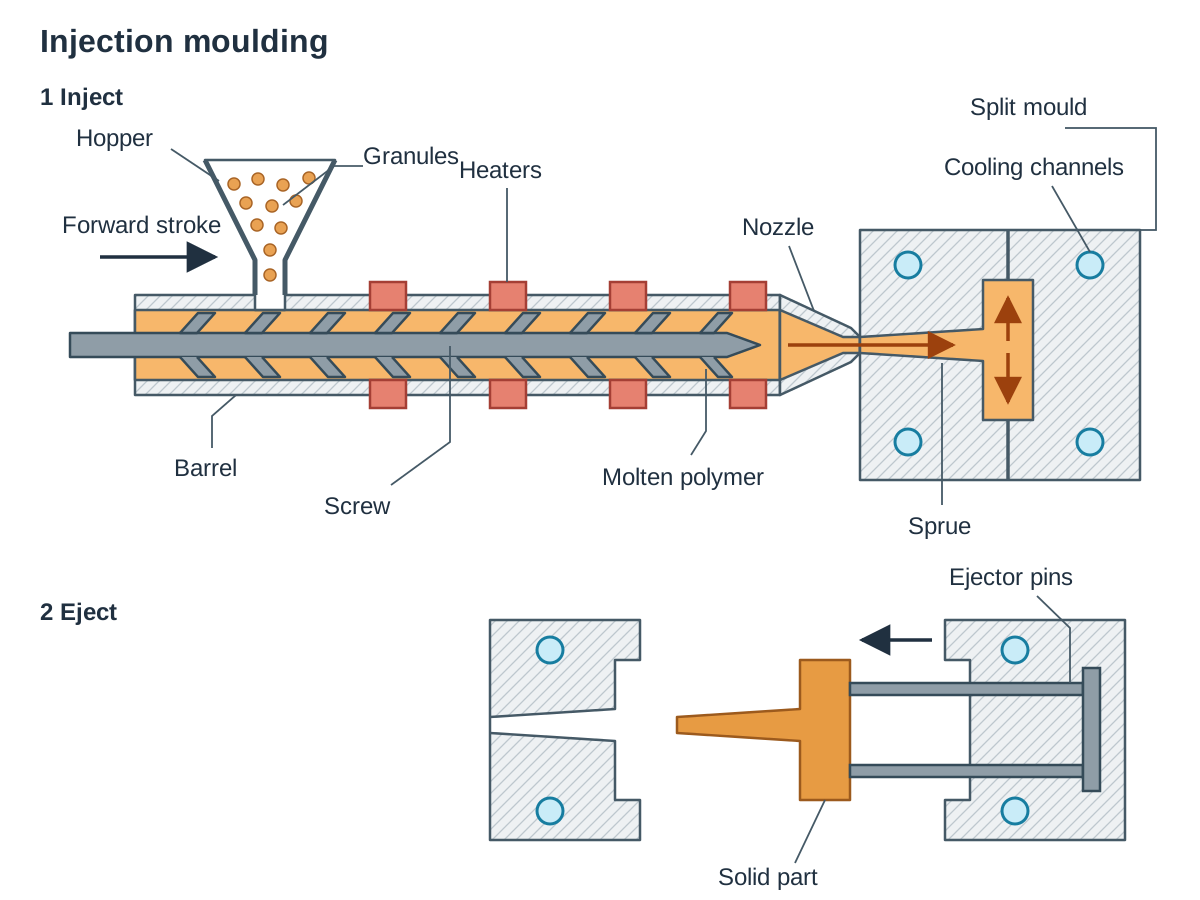
- Injection Moulding (Thermoplastics): Granules feed from an overhead hopper into a heated cylindrical barrel containing an Archimedean screw. External heating bands and friction melt the plastic. The screw acts as a hydraulic ram, injecting a shot of molten polymer under high pressure through a nozzle and sprue into a water-cooled, split steel mould. After rapid cooling, the mould halves open, and ejector pins push the rigid part out.
- Compression Moulding (Thermosetting Plastics): A pre-weighed charge of uncured thermosetting moulding powder is placed into a heated lower mould cavity. A hydraulic press closes the upper mould tool under high pressure. Heat and pressure cause the material to soften and flow into every detail of the cavity, where it cures as the polymer chains cross-link permanently. The part sets rigid while hot and is ejected without chilling. Once cured, it cannot be softened by reheating.
- Blow Moulding: Produces hollow thermoplastic containers. A tubular sleeve of molten plastic, called a parison, is extruded vertically downward between open mould halves. The mould closes, pinching the bottom of the parison shut. A blow pin injects compressed air, expanding the parison against the cold mould walls. The cooled part solidifies and is ejected with minimal flashing.
- Vacuum Forming: Clamps a thermoplastic sheet over a mould, heats it until pliable, and draws a vacuum beneath it so atmospheric pressure forces the sheet over the mould.
Casting Metals and Concrete
Casting pours liquid material into a mould cavity where it solidifies, producing complex shapes that would be wasteful to cut from solid.
- Sand Casting (metals for one-offs and small batches):
- Make a wooden pattern slightly oversized to compensate for shrinkage, with tapered draft angles so it lifts cleanly from the sand.
- Ram moulding sand around the pattern in a two-part moulding box (the drag at the bottom, the cope at the top).
- Separate the box halves, withdraw the pattern, and cut a pouring basin, runner, and riser.
- Reassemble the box and pour molten metal (such as aluminium at roughly ) into the pouring basin in one steady stream.
- Allow the metal to cool and solidify, then break open the sacrificial sand mould.
- Saw off the runner and riser sprues and machine the casting to final dimensions.
- Die Casting: Liquid metal is forced under high hydraulic pressure into a reusable, hardened alloy-steel die. It produces high dimensional accuracy and fine surface finish in mass production, but tooling costs are very high.
- Casting Concrete: Build rigid, sealed timber formwork and apply mould release oil. Position steel reinforcing mesh in the tensile zone, held away from mould faces with spacers. Pour the wet mix of cement, sand, aggregate, and water in layers, tamping or vibrating to eliminate structural air voids. Keep damp to allow chemical hydration (curing), then strike the formwork.
GRP Lay-Up, Ceramics, and Fabrics
- Glass-Reinforced Plastic (GRP) Lay-Up: Clean the open mould and apply release wax. Brush on a layer of pigmented polyester resin (the gel coat) and allow it to become tacky. Lay tailored sheets of chopped strand glass mat into the mould. Stipple catalyzed polyester resin (with MEKP hardener) through the fibres with a brush until fully wetted and translucent. Consolidate with a ridged metal roller to expel trapped air bubbles. Cure at room temperature, demould, and trim edges.
- Ceramics Sequence: Shape wet clay while plastic (rolling, pressing, or throwing). Dry slowly to avoid cracking. Fire in a kiln () to produce porous bisque ware. Apply a liquid mineral glaze suspension and fire again at higher temperatures to fuse a non-porous, glassy coating.
- Fabrics Sequence: Align paper patterns along the fabric grain line, mark with tailor's chalk including a 15 mm seam allowance, cut with sharp shears, fold and hem edges to stop fraying, and join structural panels with straight or zigzag machine stitching.
Explaining Processes with Annotated Sketches
Process questions frequently require you to 'describe, with the aid of annotated sketches'. Marks are awarded for both the sketches and the written notes, so an answer with no sketch — or a sketch with no notes — cannot reach full marks. A full-mark response requires:
- A sequence of clear, chronological sketches showing each key stage (for example, three distinct sketches for blow moulding: parison extruded, mould closed and inflated, part cooled and ejected).
- Sectional or cut-away views that reveal internal machine mechanisms (such as the screw, heaters, and water channels in injection moulding).
- Correctly labelled components with leader lines pointing directly to parts (hopper, nozzle, split mould, sprue, ejector pins).
- Concise notes under each stage stating what is happening and explaining why.
Joining Techniques: Permanent vs Semi-Permanent Assembly
Components must be assembled into rigid structures or mechanisms using permanent or semi-permanent joints.
Joining Timber: Named Permanent Joints
- Butt Joint: End grain glued against a flat face. This is the simplest joint but structurally the weakest, because glue absorbs poorly into porous end grain. It should be reinforced with dowels or corner blocks.
- Dowel Joint: Hardwood dowel pins glued into accurately aligned holes drilled in mating pieces. Dowels increase the mechanical glue surface area and ensure precise location during assembly; widely used in manufactured board furniture.
- Corner or Tee Halving Joint: Half the thickness of each timber member is cut away so that the joined faces finish flush. It provides moderate strength and resists twisting forces.
- Housing (Dado) Joint: A trench routed or sawn across the grain of an upright to support the full thickness of a shelf. It carries downward compressive loads securely on solid timber.
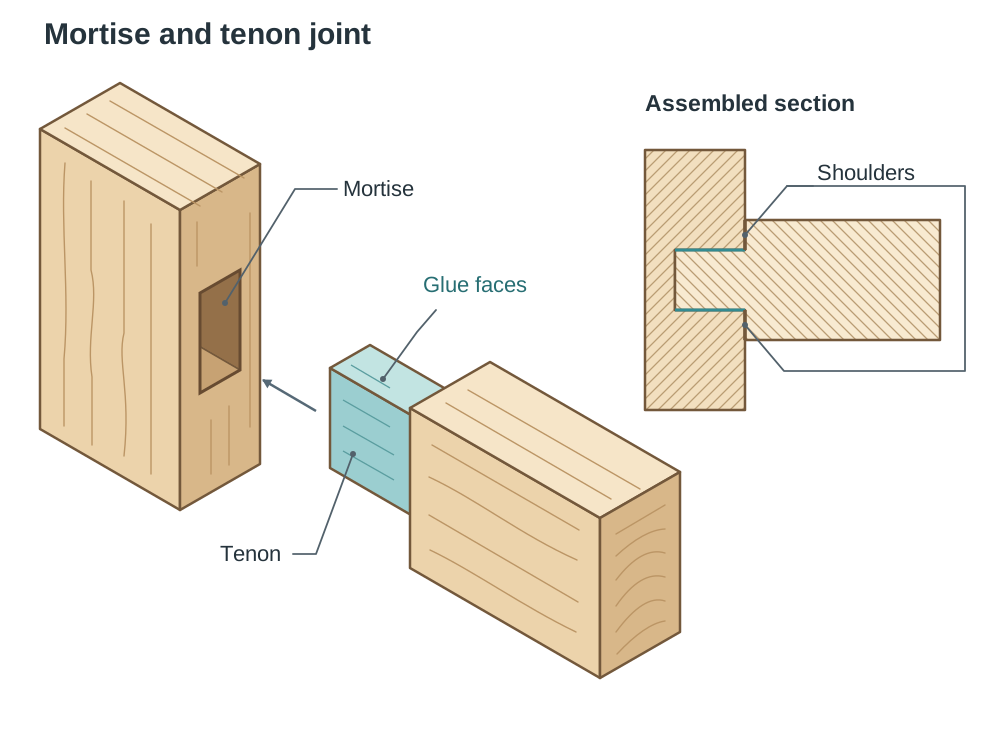
- Mortise and Tenon: A rectangular tenon fits into a matching cut mortise pocket. This is the strongest traditional frame joint; its large long-grain glue area and mechanical interlock resist racking and torsional forces.
Adhesives across Material Families
- PVA (Polyvinyl Acetate): Water-based wood glue that penetrates porous timber fibres, forming strong bonds when cramped under pressure for several hours.
- Solvent Cement (Tensol / Dichloromethane): Dissolves mating surfaces of thermoplastics (such as acrylic), welding the polymer chains together as the solvent flashes off.
- Epoxy Resin: A two-part thermosetting resin and hardener mixed in equal parts. Bonds non-porous metals, glass, ceramics, and plastics by chemical cross-linking with zero shrinkage.
- Cyanoacrylate (Super Glue): Fast-acting adhesive that polymerises almost instantly on contact with surface moisture, ideal for small, non-porous assemblies.
Thermal Joining of Metals
- Soldering (Soft Soldering): Melts a filler alloy of tin and copper (melting point below ) to join copper or brass. The parent metals do not melt; capillary action draws the molten solder into the joint after chemical flux cleans the oxide film. Ideal for electrical circuitry and delicate wire assemblies.
- Brazing: Uses a brass or bronze filler rod that melts at about , well above soft solder but still below the melting point of the steel components being joined. Borax flux cleans the surfaces, and the steel is heated to dull red without melting, creating strong joints with far less distortion than welding.
- Fusion Welding (MIG / TIG): Melts the edges of the parent metals themselves using an electric arc () with a shielding gas. The molten weld pool solidifies into a continuous joint with strength matching the base metal.
Semi-Permanent Joints (Joints That Can Be Taken Apart)
Semi-permanent joints can be dismantled and reassembled repeatedly without damaging the components. They are necessary for battery replacement, internal repairs, maintenance, and end-of-life recycling:
- Machine Screws, Nuts, and Washers: Threaded fasteners passing through clearance holes. Washers spread the clamping pressure over a wider surface area to prevent crushing softer materials.
- Self-Tapping Screws: Hardened steel screws with coarse threads that cut their own mating internal thread into pre-drilled pilot holes in sheet metal or moulded plastic bosses.
- Knock-Down (KD) Fittings: Cam-lock fasteners and connecting bolts used in flat-pack furniture to join manufactured boards securely using basic hand tools.
- Textile Fasteners: Zips, press studs, and hook-and-loop (Velcro) tape for flexible, repeatedly openable fabric covers.
Degradation, Surface Preparation, and Protective Finishes
Materials deteriorate when exposed to harsh operating environments. Applying an appropriate finish creates a barrier that extends operational life and improves aesthetics.
Environmental Attack Mechanisms
- Rusting (Ferrous Metals): Iron and mild steel react with both water (moisture) and oxygen (air) simultaneously to form hydrated iron oxide (rust). Rust is porous and flaky; it crumbles away, constantly exposing fresh metal beneath to progressive attack until failure occurs. Non-ferrous metals like aluminium do not rust; they form a microscopically thin, airtight oxide film that protects underlying metal from deeper corrosion.
- Wood Decay: Persistently damp conditions allow wood-rotting fungal spores to germinate and digest structural cellulose and lignin fibres. Alternating humidity cycles cause timber to swell, shrink, warp, and split.
- UV Degradation of Plastics: Ultraviolet radiation from sunlight breaks down covalent bonds in polymer chains, causing outdoor plastics to fade, turn chalky, become brittle, and crack.
Surface Preparation
A finish will fail if applied over contaminated or rough surfaces. Preparation must always precede application:
- Abrasive progression: Smooth surfaces systematically through grit grades (such as P80 coarse P120 medium P240 fine). Always sand wood in the direction of the grain to prevent cross-grain scratching.
- Deburring: Remove sharp metal or plastic edges using a file or scraper so paint does not thin out over sharp corners.
- Degreasing: Wipe metal surfaces with solvent cleaner to remove machine oils, cutting fluids, and fingerprints before priming.
Protective Finishes
- Mild steel (paint / powder coating): Primer seals the steel against air and moisture; top coats provide colour. Powder coating sprays electrostatically charged dry polymer powder onto the steel before baking in an oven, forming a durable, pinhole-free skin.
- Mild steel (plastic dip coating): The metal part is pre-heated in an oven to and dipped into a fluidised bed of polyethylene powder. The powder melts onto the metal to form a thick, smooth, insulating, weatherproof skin.
- Aluminium (anodising): An electrochemical process in an acid bath that thickens the natural surface oxide film, making it wear-resistant and allowing colour dyes to be sealed into its pores.
- Woods (polyurethane varnish / stain): Varnish forms a hard, transparent, waterproof polymer skin that protects against spills and moisture while keeping natural wood grain visible. Preservative stains penetrate deep into fibres with fungicides to stop rot.
- Plastics (edge polishing): Edges are draw-filed, scraped flat, rubbed with wet-and-dry paper, and polished on a buffing wheel with polishing compound.
- Ceramics (fired mineral glaze): Kiln-melted glaze forms an impermeable, glassy, hygienic surface that seals porous ceramic bodies against liquid absorption.
Sacrificial (Cathodic) Protection
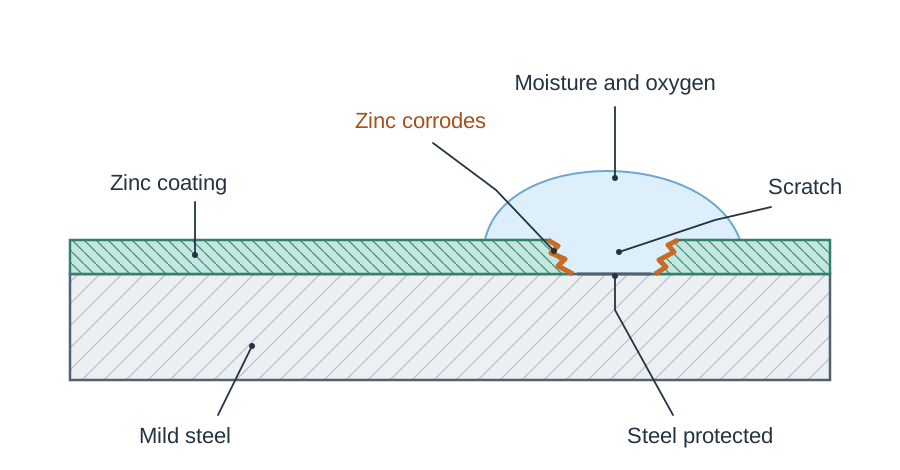
Galvanising dips clean mild steel into molten zinc (). The zinc protects the steel in two separate ways:
- Barrier protection: The zinc coating seals the surface, preventing moisture and oxygen from contacting the iron underneath.
- Sacrificial protection: Zinc is electrochemically more reactive than iron. Where the coating is scratched, drilled, or chipped, the zinc corrodes in preference to the steel, sacrificing itself to preserve the exposed iron. A sacrificial anode works on the same electrochemical principle.
Environmental Factors in Choosing a Finish
The syllabus requires you to select finishes with due regard for environmental factors. This includes both weathering and the environmental impact of the finishing product itself:
- Water-based paints and varnishes release far fewer volatile organic compounds (VOCs) than solvent-based finishes, improving air quality.
- Powder coating produces almost no liquid chemical effluent, and overspray can be collected and reused.
- Leftover solvents, thinners, and oily rags must be treated as hazardous chemical waste, never poured down drains.
Workshop Health, Safety, and Safe Working Procedures
Safety in the technology workshop is a legal and practical requirement. Safe working habits protect you and others from serious injury.
Four-Stage Safe Working Procedure
Structure your written answers and practical work using this four-phase sequence:
- Preparation: Review working drawings, inspect hand tools for cracked handles or mushroomed heads, select sharp cutters, fit required PPE, and check emergency stop button locations.
- Setup: Clamp workpieces securely in a vice or holding jig. Fit and set the correct guard for that machine (on a bandsaw, lower the blade guard until it just clears the work to minimise exposed blade; on a pillar drill, close the chuck guard before starting; on a grinder, set the tool rest and eye shield). Select the correct speed for the material and cutter diameter, and remove the chuck key before switching on.
- Operation: Maintain good balance, cut away from your body with hand tools, use push sticks when feeding stock, and never leave running machinery unattended.
- Shutdown and housekeeping: Isolate the machine at the master switch, wait for rotating spindles to come to a complete standstill, sweep away swarf with a hand brush (never bare hands), and return tools to designated racks.
Entanglement Hazard
Never wear gloves, loose clothing, ties, or jewellery near rotating machine spindles (such as pillar drills, lathes, or sanders). Long hair must be tied securely back. Gloves can catch in rotating tooling and drag your hand directly into the spindle.
Risk Assessment Framework
- Hazard: Anything with the potential to cause harm (a rotating drill bit, hot plastic, solvent vapour, fine wood dust).
- Risk: The likelihood of that hazard causing injury, combined with the severity of that injury.
- Control Measure: The action taken to eliminate or reduce the risk (guards, local exhaust extraction, clamps, PPE, safe working procedures).
When writing a risk assessment in your project folio, present it as a three-column table: Hazard | Risk | Control Measure.
Workshop Safety Signs
- Red circle with a diagonal cross-bar: Prohibition (do not operate, no entry).
- Yellow triangle with black border/symbol: Warning (hazard present, e.g. laser radiation, hot surface, toxic substance).
- Blue solid circle with white symbol: Mandatory (an action that must be taken, e.g. eye protection must be worn, dust mask must be worn).
- Green square/rectangle with white symbol: Safe condition (emergency exits, first aid kits, eye wash stations).
- Red square: Fire equipment (fire extinguishers, fire blankets, fire alarms).
Process-Specific Workshop Hazards and Precautions
| Process | Specific Hazard | Mandatory Safety Precaution |
|---|---|---|
| Soldering & Brazing | Contact burns from iron (); toxic rosin/flux fumes | Always rest the iron in an insulated stand; work under local fume extraction or in a well-ventilated room. |
| Strip Heating & Forming | Severe skin contact burns from hot plastic sheet or exposed heating elements | Wear heat-resistant gloves; leave formed parts in jigs until cool before handling. |
| GRP Composite Lay-Up | Styrene vapour inhalation; resin contact dermatitis; airborne glass-fibre skin irritation | Work in a dedicated ventilated extraction booth; wear nitrile chemical gloves, safety glasses, and a particulate mask when trimming. |
| MDF Sanding / Machining | Inhalation of ultra-fine wood dust and toxic urea-formaldehyde resin particles | Connect power tools to an active dust extraction unit; wear a properly fitted FFP2/FFP3 particulate dust mask. |
| Laser Cutting | Highly toxic hydrogen chloride gas and machine damage from prohibited plastics; fire risk | Never cut PVC or vinyl; keep the interlocked lid closed during cutting; never leave the running laser cutter unattended. |
Sustainable Resource Management and Production Efficiency
The syllabus requires you to recognise the need for economic and sustainable use of energy and materials, including recycling, and to take account of time.
Core Sustainability Definitions
- Sustainable development: Meeting the needs of the present without compromising the ability of future generations to meet their own needs.
- Circular economy: An economic model of production and consumption in which products and materials are shared, leased, reused, repaired, refurbished, and recycled for as long as possible, keeping materials in productive use and eliminating waste. Its opposite is the linear 'take–make–dispose' model.
- Carbon footprint: The total greenhouse gas emissions, expressed in carbon dioxide equivalent (), generated across the life of a product or service.
- Embodied energy: The cumulative energy consumed to extract raw materials, refine them, transport them, and manufacture the final product.
- Life cycle analysis (LCA): A systematic evaluation of the environmental impacts of a product across all stages: raw material extraction, processing, manufacture, distribution, use, and end-of-life disposal.
- Renewable material: A resource that natural ecological cycles can replenish within a human lifespan (e.g. managed timber). Non-renewable resources (crude oil, metal ores) are finite and permanently depleted once consumed.
- Biopolymer: A polymer derived from renewable biological sources like corn starch or sugarcane (such as PLA), which can be industrially composted under controlled conditions.
The Three Rs Hierarchy
Always present the Three Rs in their strict order of priority:
- Reduce (most preferred): Minimising material and energy consumption at the design stage. By designing rib-stiffened thin walls, eliminating unnecessary packaging, and using lightweight structures, less raw material needs to be extracted, refined, and transported in the first place.
- Reuse: Finding another application for products or off-cuts without chemical reprocessing (e.g. using sheet off-cuts for brackets, or designing refillable enclosures).
- Recycle (the last of the three, not the first): Reprocessing scrap into new stock. It is far better than landfill, but it still uses energy to collect, transport, sort, and remelt the material, which is why reducing comes first.
Design for Disassembly (DfD)
Products designed to support a circular economy incorporate:
- Threaded mechanical fasteners (machine screws, bolts) rather than irreversible chemical adhesives or welded joints.
- Standardised drive heads so simple hand tools can dismantle the entire unit.
- Moulded polymer identification codes (1 to 7) to streamline sorting at recycling facilities.
- Avoiding bonded composite sandwiches that cannot be separated mechanically.
Production Efficiency: Material and Time
- Sheet Nesting (Tessellation): Arranging cut parts closely on a sheet like jigsaw pieces. Shared cut lines reduce scrap skeleton waste and cutting time.
- Kerf Loss: The kerf is the width of material removed by the cutting tool blade, laser beam, or saw. Layouts must account for kerf width so finished parts do not come out undersized.
- Time Efficiency: Sequencing operations logically (e.g. batch-drilling all identical holes in one setup) to eliminate tool changeovers and workshop bottlenecks.
Integrating Materials and Production in the 2027 Project
The Leaving Certificate 2027 Higher Level thematic brief states: 'In a context of your choice, and with a focus on modern materials and processes, design and manufacture a working model of a device, system, or technical aid that demonstrates a solution aimed at supporting independent living, wellbeing, or social participation in an ageing society. Your solution should include an electro-mechanical element and should also be well presented.'
Key Coursework Parameters
- Submission Date: The coursework (Design Folio and Artefact) must be available for assessment by Friday 19 March 2027.
- Dimensional Limit: The maximum dimension of the artefact presented for assessment must not exceed 500 mm.
- Assessment Weighting: Coursework is weighted at 50% (200 marks total) at Higher Level: Design Folio carries 100 marks (50% of coursework); Artefact carries 100 marks (50% of coursework).
- Note on marking schemes: The 2027 brief states that while general headings and marks will largely remain the same, breakdowns may vary depending on the actual brief.
Where Materials and Production Work Earns Marks
- Folio Section 3 – Environmental Impact (10 marks): Comparative tables evaluating materials by embodied energy, durability, recyclability, and Design for Disassembly.
- Folio Section 7 – Production Planning (10 marks): Bill of materials, costing, cutting lists, nesting layouts, and Gantt charts.
- Folio Section 8 – Product Realisation (10 marks): Step-by-step photographic record showing your manufacturing skills in the workshop.
- Artefact Section 3 – Production Skills (30 marks): The single largest heading for the artefact. Rewards processing accuracy, clean joint execution, and high skill across multiple material families.
- Artefact Section 5 – Quality and Finish (15 marks): Surface preparation, deburred edges, high-quality finishes, smooth mechanism movement, and safe operation for older users.
Modern Materials for the 2027 Brief
The syllabus does not use the specific phrase 'smart materials', so treat the following examples as modern materials suited to the 2027 brief for an ageing population. Always justify your choice in the folio:
- PETG and ABS: Tough, impact-resistant 3D-printed or vacuum-formed casings; PETG withstands chemical cleaning wipes used in healthcare.
- PLA filament: Plant-based, easy to print for non-structural housings.
- Carbon-Fibre-Reinforced Polymer (CFRP): Extreme stiffness with low weight, ideal for lightweight walking aids or reacher arms.
- Hollow aluminium extrusions: High strength-to-weight ratio, corrosion-resistant, and easily assembled with machine bolts.
- Thermochromic film: Changes colour with temperature; provides an automatic visual scald warning on hot liquids for users with reduced skin sensitivity.
- Shape Memory Alloy (Nitinol wire): Contracts when heated by an electrical current, functioning as a silent, compact solid-state actuator without motors or gearboxes.
- Conductive fabrics & pressure-sensitive textiles: Soft, flexible occupancy or grip sensors integrated into seats, mats, or handles without hard mechanical switches.
- Silicone overmoulding: Soft-touch, warm, non-slip handles that reduce pressure points for arthritic hands.
Key terms
- Hardness
- The mechanical property of a material to resist surface wear, scratching, abrasion, and indentation.
- Toughness
- The mechanical property of a material to absorb sudden shock or impact energy without fracturing or shattering.
- Malleability
- The ability of a material to be permanently deformed, hammered, or rolled into thin sheets under compressive force without cracking.
- Ductility
- The ability of a material to be drawn or stretched out plastically into a thin wire under tensile force without breaking.
- Ferrous Metal
- A metal or alloy containing iron as its primary constituent (e.g. mild steel, cast iron); prone to rust and magnetic.
- Non-Ferrous Metal
- A metal or alloy containing no iron (e.g. aluminium, copper, brass); non-magnetic and naturally corrosion-resistant.
- Thermoplastic
- A polymer consisting of linear chains held by weak secondary bonds that softens when heated and hardens on cooling, allowing repeated reshaping and recycling.
- Thermosetting Plastic
- A polymer that cures permanently through chemical cross-linking; once set, it cannot soften or melt upon reheating and will char instead.
- Composite Material
- A material formed by combining a matrix and a reinforcement to achieve properties superior to either constituent alone.
- Datum
- A chosen true reference edge, surface, or point from which all subsequent measurements and layout marks originate to prevent compounding errors.
- Wasting
- Any manufacturing process that shapes a workpiece by cutting, filing, drilling, or machining away unwanted material as swarf, chips, or dust.
- Additive Manufacturing
- A production process that builds three-dimensional components layer by layer directly from 3D CAD data, generating minimal material waste.
- Injection Moulding
- A cyclic mass-production process where molten thermoplastic is injected under high pressure into a chilled split steel mould.
- Kerf
- The width of material removed or lost as waste during a cutting operation by a saw blade, laser beam, or milling cutter.
- Anodising
- An electrochemical process that thickens the natural protective oxide film on aluminium, providing wear resistance and enabling dye absorption.
- Design for Disassembly (DfD)
- Designing products with reversible mechanical fasteners and labelled materials so parts can be easily separated for repair, reuse, and recycling.
- Circular Economy
- An economic model that keeps products, components, and materials circulating in productive use through sharing, repair, refurbishment, and recycling, eliminating waste.
- Embodied Energy
- The cumulative energy required to extract raw materials, refine them, transport them, and manufacture a finished product.
Check yourself
What two environmental factors must be present simultaneously for mild steel to rust?
Moisture (water) and oxygen (air).
Explain the difference between malleability and ductility, naming an example of each.
Malleability is the ability to be hammered or rolled into thin sheets under compression without cracking (e.g. aluminium sheet). Ductility is the ability to be drawn out plastically into a thin wire under tension without breaking (e.g. copper wire).
Why can thermoplastics be repeatedly reheated and reshaped, while thermosetting plastics cannot?
Thermoplastics have separate linear polymer chains held by weak secondary bonds that soften when heated. Thermosetting plastics have rigid, permanent covalent cross-links between chains that char and decompose rather than melt upon reheating.
A battery compartment cover on an assistive device must be opened every few months. Name a suitable joining method and justify it.
A semi-permanent method such as machine screws into threaded inserts or a moulded snap-fit catch. This allows repeated opening and secure closing without damaging the casing or requiring specialised tools.
Name a suitable finish for an outdoor aluminium handle and state its protective mechanism.
Anodising. It is an electrochemical process that thickens the natural surface oxide film, making the aluminium highly wear-resistant and corrosion-resistant.
How does galvanising protect mild steel both as a barrier and sacrificially?
It provides a barrier coating that blocks moisture and oxygen from reaching the iron. If scratched, the zinc corrodes in preference to the steel because zinc is electrochemically more reactive than iron, protecting the exposed steel sacrificially.
Why must an operator never wear gloves when operating a pillar drill?
Gloves can catch in the rotating drill bit or spindle, dragging the operator's hand directly into the machine and causing severe entanglement injuries.
A batch of eight 170 mm × 130 mm panels is cut from a 600 mm × 400 mm sheet. Calculate the percentage of the sheet converted into waste.
Total sheet area = 600 × 400 = 240,000 mm². Total usable panel area = 8 × (170 × 130) = 8 × 22,100 = 176,800 mm². Waste area = 240,000 - 176,800 = 63,200 mm². Percentage waste = (63,200 / 240,000) × 100 = 26.33%.
What is the maximum allowable dimension for the physical artefact submitted for the 2027 Leaving Certificate Technology project?
The maximum dimension must not exceed 500 mm.
How many option questions must a Higher Level candidate answer in Section C of the 2027 written paper?
One of five option questions (adjusted from two of five).