
The present tense (el presente de indicativo) is the bedrock of Leaving Certificate Spanish, carrying substantial weight across the oral exam (25% at Higher Level) and written production (25%). It enables you to communicate personal details, outline daily routines, express likes and attitudes, state intentions, and structure points in an opinion piece. In both spoken and written assessment, marks are awarded for transferring meaning clearly and for the accuracy and range of vocabulary and grammatical structures used. Knowing the regular endings, stem changes, irregular yo forms and common verb + infinitive frames helps you write and speak accurately. Accuracy and range of language are part of how your answers are assessed.
Regular Verbs and Modes of Address
Spanish infinitives fall into three distinct families ending in -ar, -er, or -ir. To conjugate any regular verb, remove this ending to isolate the stem, then attach the person ending corresponding to your subject.
Conjugation Endings
| Subject | -ar: hablar (to speak) | -er: beber (to drink) | -ir: vivir (to live) |
|---|---|---|---|
| yo (I) | hablo | bebo | vivo |
| tú (you, informal sing.) | hablas | bebes | vives |
| él / ella (he / she) | habla | bebe | vive |
| usted (you, formal sing.) | habla | bebe | vive |
| nosotros / nosotras (we) | hablamos | bebemos | vivimos |
| vosotros / vosotras (you, informal pl.) | habláis | bebéis | vivís |
| ellos / ellas (they) | hablan | beben | viven |
| ustedes (you, formal pl.) | hablan | beben | viven |
Notice that -er and -ir verbs share identical endings across almost all forms. They diverge only in the nosotros (-emos versus -imos) and vosotros (-éis versus -ís) forms.
You usually leave out subject pronouns because the verb ending already shows who is doing the action: Hablo español todos los días (I speak Spanish every day). Include them when needed for contrast or emphasis: Yo hablo español, pero él habla francés (I speak Spanish, but he speaks French).
To make a sentence negative, place no directly before the conjugated verb: No bebo café por la tarde (I do not drink coffee in the afternoon).
Formal and Informal Register: Tú or Usted?
Selecting the correct mode of address matters whenever you speak or write to an adult you don't know, for example in a role-play:
- Use tú (plural vosotros) with friends, family members, classmates, and people your own age.
- Use usted (abbreviated Ud., plural ustedes / Uds.) when addressing an adult you do not know, a shopkeeper, a landlord, or an official. In oral role-plays set in hotels, train stations, or shops, adopt this formal register.
- Grammatically, usted takes the third-person singular form (identical to él/ella), and ustedes takes the third-person plural form (identical to ellos/ellas):
- ¿Tienes tiempo? (tú) → ¿Tiene usted tiempo? (Do you have time?)
- ¿Puedes ayudarme? (tú) → ¿Puede usted ayudarme? (Can you help me?)
- ¿Aceptan ustedes tarjetas de crédito? (Do you accept credit cards?)
- Always maintain a consistent register; never switch between tú and usted within the same interaction.
Radical-Changing Verbs and the Boot Rule
Radical-changing (stem-changing) verbs take standard regular endings, but their stem vowel alters whenever the syllable receives oral stress. This vowel shift affects the singular persons (yo, tú, él/ella/usted) and the third-person plural (ellos/ellas/ustedes). They do not happen in the nosotros or vosotros forms, which always retain the original vowel of the infinitive.
The Boot Rule Explained
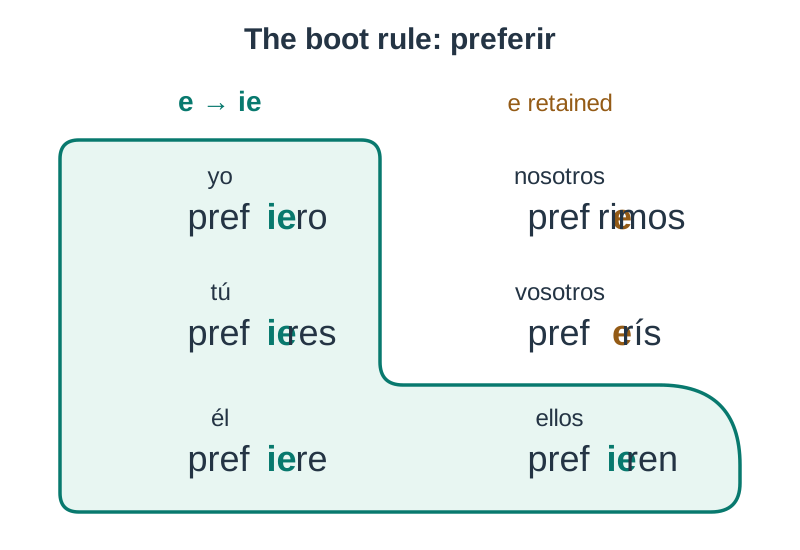
If you arrange conjugations in two vertical columns, drawing a boundary around the four forms that undergo a vowel change forms the graphic shape of a boot:
- yo (prefiero) | nosotros (preferimos) [outside boot]
- tú (prefieres) | vosotros (preferís) [outside boot]
- él (prefiere) | ellos (prefieren)
The Four Stem-Changing Categories
| Pattern | Infinitive | Boot Conjugations (yo / tú / él / ellos) | Non-changing (nosotros / vosotros) |
|---|---|---|---|
| e → ie | preferir (to prefer) | prefiero, prefieres, prefiere, prefieren | preferimos, preferís |
| o → ue | volver (to return) | vuelvo, vuelves, vuelve, vuelven | volvemos, volvéis |
| e → i | pedir (to ask for) | pido, pides, pide, piden | pedimos, pedís |
| u → ue | jugar (to play a sport) | juego, juegas, juega, juegan | jugamos, jugáis |
Key verbs in each group:
- e → ie: querer (quiero, quieres, quiere, quieren), pensar (pienso), empezar (empiezo), entender (entiendo), despertarse (me despierto).
- o → ue: poder (puedo), dormir (duermo), encontrar (encuentro), acostarse (me acuesto).
- e → i: servir (sirvo), repetir (repito), vestirse (me visto). Note that elegir (elijo), corregir (corrijo), and verbs like coger (cojo) also change g → j before o to preserve pronunciation.
- u → ue: jugar is the only common verb in this pattern. It requires the preposition a: Juego al fútbol los sábados (I play football on Saturdays).
Essential Irregulars, Yo-Go Verbs, and -cer / -cir Patterns
Several high-frequency verbs are entirely irregular, while others present an irregular first-person singular (yo) before proceeding with standard or stem-changed endings.
Core Irregular Verbs
- ser (to be: defining traits, identity, origin, profession, time): soy, eres, es, somos, sois, son. (Soy de Dublín; son las diez.)
- estar (to be: physical location, health, temporary condition): estoy, estás, está, estamos, estáis, están. (Estoy en la biblioteca; el suelo está sucio.)
- ir (to go): voy, vas, va, vamos, vais, van. (Voy al instituto en autobús.)
- haber (impersonal existential): hay means there is or there are and never takes a plural form: Hay un problema grave (There is a serious problem); Hay muchas ventajas (There are many advantages).
Full Conjugations of dar and ver
Neither of these verbs takes an accent mark on the one-syllable vosotros form:
- dar (to give): doy, das, da, damos, dais, dan
- ver (to see): veo, ves, ve, vemos, veis, ven
'Yo-Go' and Mixed Irregular Verbs
These verbs end in -go solely in the first-person singular:
- hacer (to do/make) → hago, haces, hace, hacemos, hacéis, hacen
- poner (to put) → pongo, pones, pone, ponemos, ponéis, ponen
- salir (to leave/go out) → salgo, sales, sale, salimos, salís, salen
- traer (to bring) → traigo, traes, trae, traemos, traéis, traen
- tener (to have; yo-go + stem change): tengo, tienes, tiene, tenemos, tenéis, tienen
- venir (to come; yo-go + stem change): vengo, vienes, viene, venimos, venís, vienen
- decir (to say/tell; yo-go + stem change): digo, dices, dice, decimos, decís, dicen
-cer / -cir Verbs: First Person Ends in -zco
Most verbs ending in a vowel followed by -cer or -cir add a z before the c in the yo form only (conozco, conduzco, parezco…). Hacer (hago) and decir (digo) are exceptions: learn them with the yo-go verbs above. All subsequent persons conjugate regularly:
- conocer → conozco (to know/be familiar with)
- conducir → conduzco (to drive)
- parecer → parezco (to seem)
- ofrecer → ofrezco (to offer)
- traducir → traduzco (to translate)
Distinguishing Saber and Conocer
Both translate as 'to know', but they are not interchangeable:
- saber (sé, sabes, sabe...): Used for factual knowledge, stored data, or knowing how to perform a skill (+ infinitive): Sé tocar el piano (I know how to play the piano).
- conocer (conozco, conoces, conoce...): Used for familiarity with people, places, or complex works. When the direct object is a person, it demands the personal a: Conozco a tu profesor (I know your teacher); No conozco esa ciudad (I am not familiar with that city).
Verbs Like Gustar and Expressing Opinions
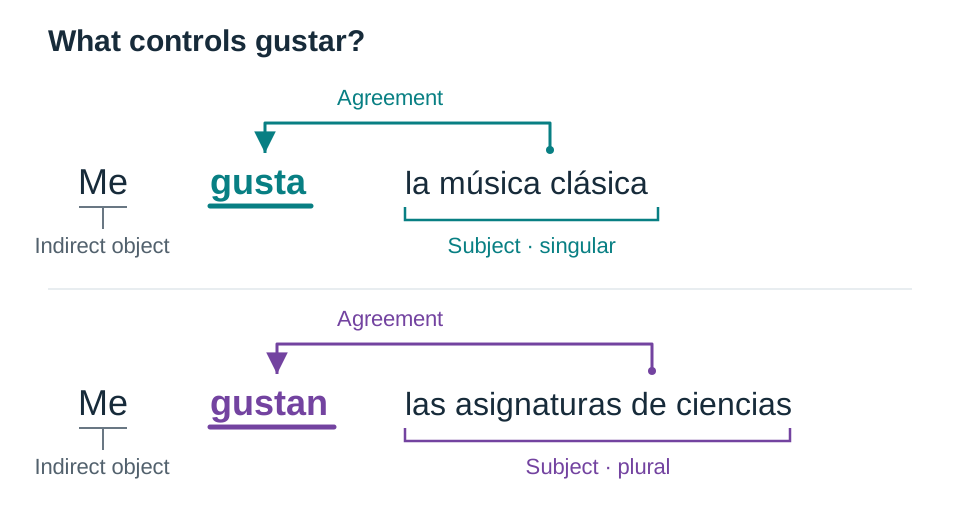
Verbs following the structure of gustar operate backwards compared to English: the entity being liked is the grammatical subject that drives the verb ending, while the person experiencing the feeling is represented by an indirect object pronoun (me, te, le, nos, os, les).
Mechanism and Agreement
- Use gusta when followed by a singular noun or any infinitive verb.
- Use gustan when followed by a plural noun.
- Me gusta la música clásica. (I like classical music.)
- Me gusta bailar y cantar. (I like dancing and singing.)
- Me gustan las asignaturas de ciencias. (I like science subjects.)
- A mi hermana le gustan las lenguas. (My sister likes languages.)
Add prepositional phrases (a mí, a ti, a él, a nosotros...) at the beginning of the clause for clarification or contrast: A mí me encanta el español, pero a ellos no les interesa nada (I love Spanish, but they are not interested in it at all).
Verbs Operating Under the Gustar Pattern
- encantar: to love something (Me encanta viajar)
- interesar: to interest (Nos interesa la política)
- molestar: to bother/annoy (Me molesta el ruido)
- preocupar: to worry (Me preocupan los exámenes del Leaving Cert)
- parecer: to seem/appear (¿Qué te parece la idea?)
- apetecer: to feel like doing something (No me apetece salir hoy)
- costar: to find something difficult (Me cuesta la gramática)
Never write Yo gusto el fútbol. That translates literally as 'I am pleasing to football'.
Reflexive Verbs, Routine, and Pronoun Placement
A verb is reflexive when the subject carries out an action upon itself. It requires a reflexive pronoun agreeing with the subject: me, te, se, nos, os, se.
Conjugation of levantarse (to get up)
- yo me levanto
- tú te levantas
- él / ella / usted se levanta
- nosotros / nosotras nos levantamos
- vosotros / vosotras os levantáis
- ellos / ellas / ustedes se levantan
Essential Daily Routine Verbs
- despertarse (e → ie): to wake up (me despierto)
- levantarse: to get out of bed (me levanto)
- ducharse: to shower (me ducho)
- vestirse (e → i): to get dressed (me visto)
- desayunar: to eat breakfast [non-reflexive] (desayuno tostadas)
- acostarse (o → ue): to go to bed (me acuesto a las once)
- dormirse (o → ue): to fall asleep (me duermo enseguida)
Placement Rules with Dual Verbs
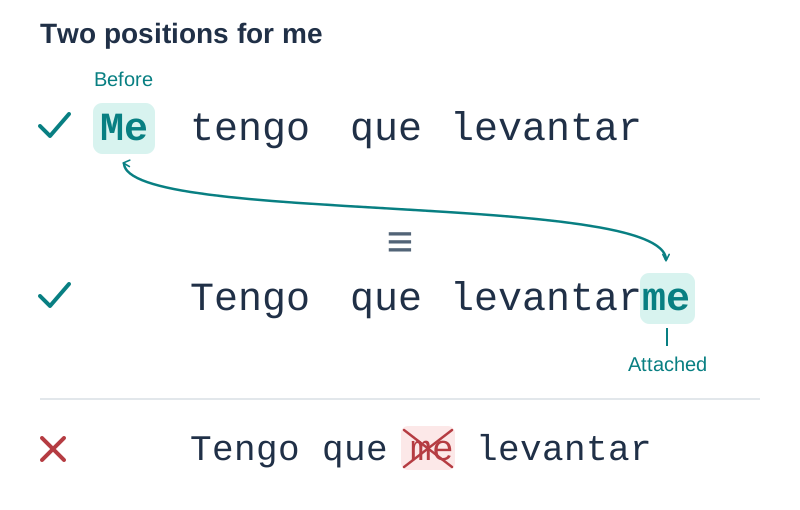
When combining an auxiliary or semi-auxiliary verb with an infinitive, you have two valid choices for positioning the pronoun:
- Before the conjugated verb: Me tengo que levantar a las siete.
- Attached directly to the end of the infinitive: Tengo que levantarme a las siete.
Never place the reflexive pronoun between the auxiliary verb and the infinitive (e.g. avoid Tengo que me levantar or Voy a me duchar).
Reciprocal Actions and Impersonal Signs
- Reciprocal actions: Plural pronouns convey 'each other': Mis amigos y yo nos ayudamos con los deberes (My friends and I help each other with homework).
- Impersonal 'se': Expresses an action without specifying an agent, frequent in public signage and reading passages:
- Aquí se habla español. (Spanish is spoken here / People speak Spanish here.)
- Se venden pisos. (Flats for sale.)
- Se prohíbe fumar. (Smoking is forbidden.)
Describing the Weather in the Present
The Leaving Certificate syllabus requires understanding and describing weather patterns and forecasts using specific present-tense verbal patterns.
Common Formations: Hacer, Haber, and Estar
- hace + noun:
- Hace calor / frío (It is hot / cold)
- Hace sol / viento (It is sunny / windy)
- Hace buen tiempo / mal tiempo (The weather is good / bad)
- hay + noun:
- Hay niebla (It is foggy)
- Hay tormentas (There are storms)
- Hay chubascos (There are showers)
- está + adjective:
- Está nublado (It is cloudy)
- El cielo está despejado (The sky is clear)
Radical-Changing Weather Verbs
These meteorological verbs function exclusively in the third-person singular:
- llover (o → ue): llueve (Llueve mucho en el oeste de Irlanda - It rains a lot in the west of Ireland)
- nevar (e → ie): nieva (Nieva en las montañas en invierno - It snows in the mountains in winter)
- tronar (o → ue): truena (Cuando truena, me quedo en casa - When it thunders, I stay at home)
Plans, Duration, and the Continuous Aspect
The present tense handles future plans, ongoing activities, and continuous states through specialised constructions.
Expressing Plans and Intentions: Verb + Infinitive
- ir a + infinitive (going to): Voy a estudiar Derecho en la universidad. (I am going to study Law at university.)
- pensar + infinitive (to plan/intend to; e → ie): Pienso buscar un trabajo a tiempo parcial. (I plan to look for a part-time job.)
- esperar + infinitive (to hope to): Espero sacar buenos resultados. (I hope to get good results.)
- querer + infinitive (to want to; e → ie): Quiero mejorar mi español oral. (I want to improve my spoken Spanish.)
- tener que + infinitive (personal obligation): Tengo que estudiar todos los días. (I have to study every day.)
- hay que + infinitive (general/impersonal necessity): Hay que proteger el medio ambiente. (We must protect the environment.)
- soler + infinitive (habitual action, 'usually'; o → ue): Suelo levantarme temprano los sábados. (I usually get up early on Saturdays.)
Duration: 'How Long You Have Been Doing Something'
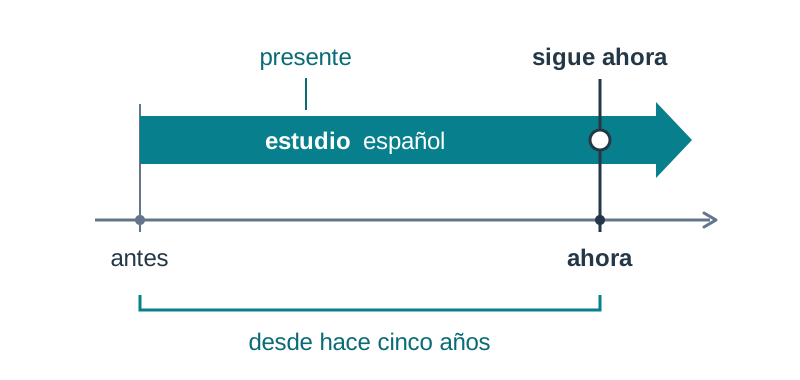
When an activity began in the past and is still ongoing right now, Spanish uses the present indicative, never a past or perfect tense:
- Present verb + desde hace + period: Estudio español desde hace cinco años. (I have been studying Spanish for five years.)
- Hace + period + que + present verb: Hace diez años que vivo en Galway. (I have lived in Galway for ten years.)
- Llevar + period + gerundio: Llevo dos meses trabajando en una tienda. (I have been working in a shop for two months.)
- Interrogative forms: ¿Desde cuándo estudias español? or ¿Cuánto tiempo hace que vives aquí?
The Present Continuous: Estar + Gerundio
Used to express an action happening immediately at the moment of speaking: present of estar + gerundio.
- Form the gerund by taking the stem and adding -ando for -ar verbs (hablando) or -iendo for -er/-ir verbs (comiendo, viviendo).
- Irregular gerunds:
- Vowel stems change unstressed -iendo to -yendo: leer → leyendo, oír → oyendo, creer → creyendo, traer → trayendo.
- Irregular form: ir → yendo.
- Stem-changing -ir verbs shift vowels: pedir → pidiendo, decir → diciendo, dormir → durmiendo, servir → sirviendo.
- Unlike English, never use the continuous tense for scheduled future events. Use the simple present or ir a + infinitive: Salgo mañana or Voy a salir mañana (I am leaving tomorrow).
Time Expressions and Set Formulae for Exam Tasks
Incorporating natural frequency markers and set phrases strengthens written exercises and oral responses.
Frequency and Time Expressions
- normalmente / por lo general (normally / generally)
- siempre (always) / nunca (never): Nunca salgo entre semana (I never go out on weekdays)
- a menudo (often) / a veces (sometimes) / de vez en cuando (from time to time)
- todos los días (every day) / los fines de semana (at weekends) / una vez a la semana (once a week)
- ahora mismo / en este momento (right now; often used with the present continuous: En este momento estoy estudiando)
The Opinion Piece (La Opinión Personal)
- A mi modo de ver, el problema tiene solución. (In my view, the problem has a solution.)
- Creo que los jóvenes sufren mucho estrés. (I believe that young people suffer a lot of stress. Note: Creo que takes the indicative present; negative No creo que triggers the subjunctive: No creo que sea justo.)
- Me parece que el gobierno debe actuar. (It seems to me that the government must act.)
- Desde mi punto de vista, vale la pena considerar... (From my point of view, it is worth considering...)
The Informal Letter / Email (Carta Informal)
- ¿Cómo estás? Espero que todo te vaya bien. (How are you? I hope everything is going well for you. Note: vaya is the subjunctive of ir; memorise this greeting as a fixed unit).
- Te escribo esta carta para contarte mis novedades. (I am writing to you to tell you my news.)
- ¿Por qué no vienes a visitarme este verano? (Why don't you come to visit me this summer?)
Question Forms and Interrogatives
Always place inverted question marks at the start and written accent marks on question words:
- ¿Cómo? (How?): ¿Cómo vas al instituto?
- ¿Dónde? (Where?): ¿Dónde vives?
- ¿Cuándo? (When?): ¿Cuándo vuelves?
- ¿Cuánto / cuánta? (How much?): ¿Cuánto cuesta el billete?
- ¿A qué hora? (At what time?): ¿A qué hora empieza la película?
Key terms
- Infinitivo (Infinitive)
- The unconjugated base form of a verb ending in -ar, -er, or -ir as listed in a dictionary.
- Raíz (Stem)
- The foundational part of a verb remaining once the infinitive ending (-ar, -er, -ir) is removed.
- Verbos de cambio radical (Stem-changing verbs)
- Verbs whose root vowel shifts (e → ie, o → ue, e → i, u → ue) under vocal stress in all persons except nosotros and vosotros.
- Verbos 'yo-go'
- Verbs that introduce an irregular -go ending solely in the first-person singular (yo) of the present tense (e.g. salgo, pongo, tengo).
- Pronombre reflexivo (Reflexive pronoun)
- A pronoun (me, te, se, nos, os, se) indicating that the subject performs an action upon or concerning itself.
- Gerundio (Gerund)
- The non-finite verb ending in -ando or -iendo, combined with estar to express actions in immediate progress.
- Verbos tipo gustar
- Verbs whose ending is dictated by the thing being liked (subject) while the person feeling it is marked by an indirect object pronoun.
- Usted / Ustedes
- Formal pronouns of address requiring third-person singular and plural verb conjugations respectively.
Check yourself
How do regular -er and -ir verbs differ in their present tense indicative endings?
They share identical endings across four forms, differing only in the nosotros form (-emos for -er vs -imos for -ir) and the vosotros form (-éis for -er vs -ís for -ir).
How would you ask 'Can you help me?' to a hotel receptionist using the formal register?
¿Puede usted ayudarme? (or ¿Me puede ayudar usted?), because usted demands the third-person singular verb form.
Translate into Spanish: 'I have been living in Cork for six years.'
Vivo en Cork desde hace seis años (or Hace seis años que vivo en Cork), using the present tense because the living is still happening.
Conjugate the verb 'jugar' for 'yo', 'nosotros', and 'ellos' in the present tense.
juego (u → ue stem change), jugamos (no stem change outside the boot), and juegan (u → ue stem change).
Why do the vosotros forms 'sois' and 'vais' not have written accent marks?
Because monosyllabic (one-syllable) verb forms in Spanish do not take written accent marks unless needed to distinguish words (such as sé vs se).
What is the gerundio of 'leer' and 'ir', and why is each spelling irregular?
leyendo: the stem le- ends in a vowel, so the i of -iendo becomes y. yendo: ir is irregular, so learn yendo as a one-off form.