

Adjectives and adverbs give precision, clarity, and stylistic maturity to your Spanish. In Leaving Certificate Higher Level Spanish, examiners assess your control of these modifiers across all written production tasks—such as opinion pieces, letters, notes, and diary entries—and in the oral examination. While adjectives describe nouns and must agree with them in gender and number, adverbs modify verbs, adjectives, or other adverbs and remain grammatically invariable. Getting endings, positions, and comparative structures right helps secure top marks for grammatical accuracy and structural range.
Adjective Agreement, Position, and Shortened Forms
Spanish adjectives must agree in gender and number with the noun they describe. To check your work accurately, you need to know the rules for forming the feminine and plural endings.
Making an Adjective Feminine
- Adjectives ending in -o change to -a: un chico simpático una chica simpática.
- Adjectives ending in -e, or in most consonants, stay the same: un día triste / una noche triste; un examen difícil / una pregunta difícil.
- Adjectives of nationality add -a, even when ending in a consonant: español española, inglés inglesa (notice that the written accent drops in the feminine).
- Adjectives ending in -dor add -a: trabajador trabajadora.
Making an Adjective Plural
- After a vowel, add -s: caro caros, interesante interesantes.
- After a consonant, add -es: difícil difíciles. Words ending in a vowel plus -n often gain a written accent to preserve their original stress: joven jóvenes.
- A final -z changes to -ces: feliz felices.
- For mixed groups of masculine and feminine nouns, always use the masculine plural: Mi hermano y mi hermana son altos (My brother and sister are tall).
Adjective Position and Shortened Forms (Apocopation)
Most descriptive adjectives sit directly after the noun (un viaje largo, ciudades históricas). However, limiting adjectives (demonstratives, possessives, and numbers) sit before the noun (este problema, mis amigos).
Certain common adjectives drop their final -o before a masculine singular noun:
- bueno buen: un buen amigo (a good friend)
- malo mal: un mal día (a bad day)
- primero primer: el primer año (the first year)
- tercero tercer: el tercer piso (the third floor)
- alguno algún and ninguno ningún (both gain a written accent)
Grande shortens to gran before any singular noun (masculine or feminine). In this position it shifts meaning to 'great' rather than 'big': un gran problema (a great/major problem), but una casa grande (a big house).
High-Yield Descriptive Vocabulary
These adjectives appear frequently in Leaving Certificate reading texts and written opinion questions:
- preocupante (worrying)
- injusto/a (unfair)
- imprescindible (essential)
- agobiante (overwhelming / stressful)
- asequible (affordable)
- peligroso/a (dangerous)
- sano/a (healthy)
Demonstratives and Possessives
Demonstrative and possessive structures sit before nouns or stand alone as pronouns. Mastering them allows you to refer to specific ideas and avoid repetitive phrasing.
Demonstratives (Three Degrees of Distance)
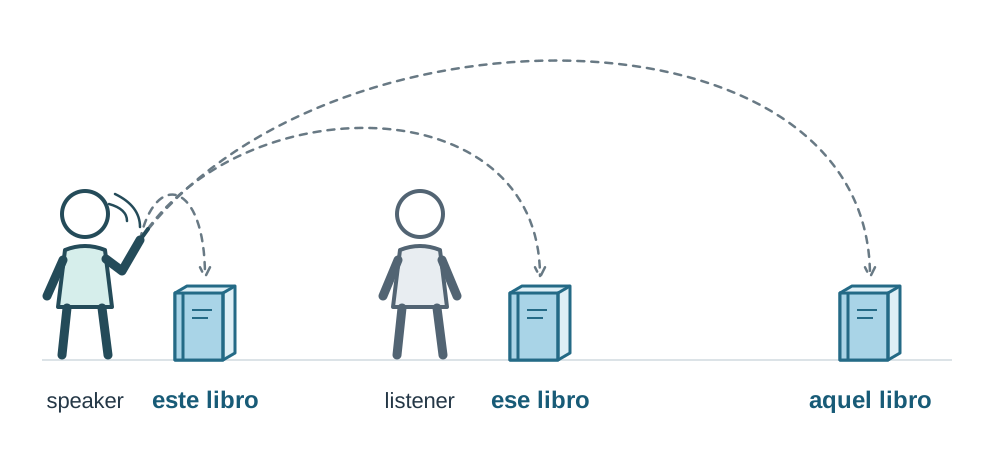
Spanish specifies three physical and temporal distances rather than just two:
- Near the speaker (this / these): este (m.sg.), esta (f.sg.), estos (m.pl.), estas (f.pl.).
- Este problema es grave. (This problem is serious.)
- Near the listener or not far away (that / those): ese (m.sg.), esa (f.sg.), esos (m.pl.), esas (f.pl.).
- Esa estación está cerrada. (That station is closed.)
- Far away in space or remote in time (that over there / those long ago): aquel (m.sg.), aquella (f.sg.), aquellos (m.pl.), aquellas (f.pl.).
- Aquella montaña es altísima. (That mountain over there is very high.)
- En aquella época no había móviles. (In those days there were no mobile phones.)
To refer to an entire statement, situation, or abstract idea rather than a specific noun, use the neuter forms esto (this) or eso (that). Neuter forms never change:
- Eso es inaceptable. (That is unacceptable.)
- Esto me preocupa mucho. (This worries me a lot.)
Take care not to confuse the masculine singular forms (este, ese, aquel) with neuter forms. Write este problema, never esto problema.
Possessive Adjectives and Pronouns
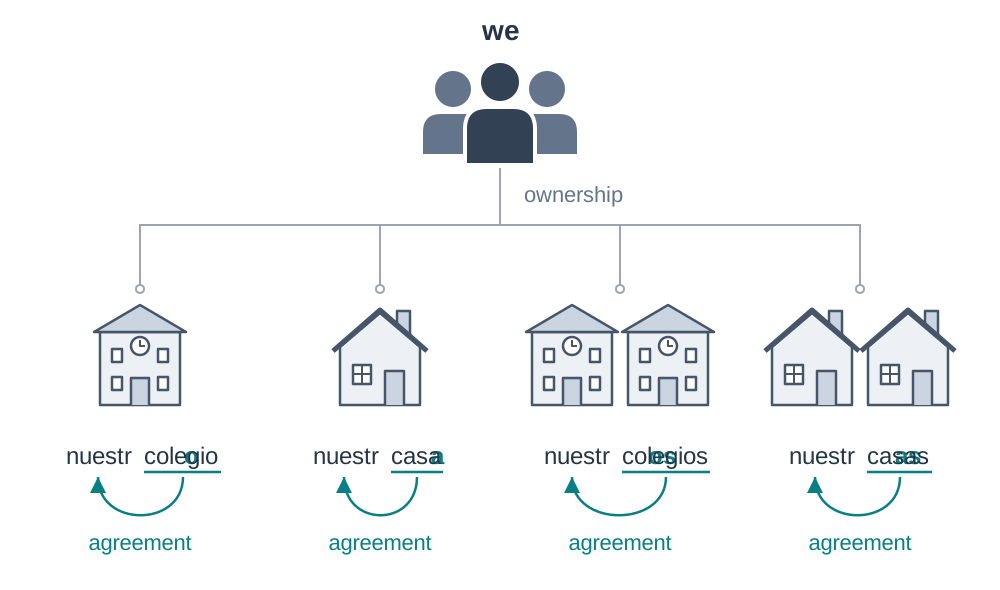
Short-form possessive adjectives precede the noun. A vital rule is that the possessive agrees with the thing owned, never with the owner.
| Owner | Singular Noun | Plural Noun |
|---|---|---|
| My | mi | mis |
| Your (tú) | tu | tus |
| His / Her / Its / Formal your (usted) | su | sus |
| Our | nuestro / nuestra | nuestros / nuestras |
| Your (vosotros/-as) | vuestro / vuestra | vuestros / vuestras |
| Their / Formal your (ustedes) | su | sus |
Only nuestro and vuestro change for gender (nuestro colegio, nuestra casa). The forms mi, tu, and su change only for number (mi libro, mis libros).
Because su and sus can mean his, her, its, their, or your, you can remove ambiguity in written tasks by using the definite article plus de: write el coche de ella instead of su coche, or la casa de ellos instead of su casa.
Stressed Possessives and Possessive Pronouns
Long-form possessives follow a noun (un amigo mío = a friend of mine; una idea tuya = an idea of yours). When combined with the definite article, they act as pronouns to prevent repetition:
- Mi móvil es viejo; el tuyo es nuevo. (My phone is old; yours is new.)
- Le entregué el mío. (I handed him/her mine.)
Comparatives, Superlatives, and Opinion Structures
Expressing preferences and evaluating issues requires clear comparative structures.
Basic Comparisons
- Superiority (more ... than): más + adjective + que
- El tren es más rápido que el autobús. (The train is faster than the bus.)
- Inferiority (less ... than): menos + adjective + que
- El albergue es menos ruidoso que el hotel. (The hostel is less noisy than the hotel.)
- Equality with adjectives and adverbs (as ... as): tan … como
- El desempleo juvenil es tan preocupante como la inflación. (Youth unemployment is as worrying as inflation.)
- Equality with nouns (as much / as many ... as): tanto/a/os/as + noun + como
- No tengo tanto dinero como tú. (I don't have as much money as you.)
- Había tantas opciones como en Madrid. (There were as many options as in Madrid.)
Additional Comparison Structures
- Before a number, use más de or menos de, not que: Había más de cien personas (There were more than a hundred people).
- Use lo mismo que to mean 'the same as': Cuesta lo mismo que el tren (It costs the same as the train).
- Use igual que to mean 'just like': Pienso igual que tú (I think just like you).
- The conditional tense softens a comparison: Sería más caro ir en avión (It would be more expensive to go by plane).
- Use mucho to intensify a comparative: mucho más barato (much cheaper).
Irregular Comparatives: Age, Size, and Quality
Four common adjectives have irregular comparative forms. Never add más to the irregular forms mejor, peor, mayor, menor. For physical size, más grande and más pequeño/a are correct:
- bueno/a mejor (better) el/la mejor (the best)
- malo/a peor (worse) el/la peor (the worst)
- grande mayor (older / greater) or más grande (physically bigger)
- pequeño/a menor (younger / lesser) or más pequeño (physically smaller)
Use más grande and más pequeño for physical dimensions: Madrid es más grande que Dublín. Reserve mayor and menor for age (mi hermano mayor = my older brother) and abstract importance (el mayor problema = the greatest problem). Never write más mayor or más mejor.
Relative Superlatives: Using de, Not en
To say someone or something is the 'most' or 'least' in a group, follow the pattern: *definite article (el / la / los / las) + noun + más / menos + adjective + de**. With mejor/peor (and mayor/menor), drop más and put the word before the noun: el mejor jugador del mundo*.
- Es el mejor jugador del mundo. (He is the best player in the world.)
- Es la ciudad más bonita de España. (It is the most beautiful city in Spain.)
Notice that Spanish always uses de after a superlative where English uses 'in'. Never write en el mundo or en España in these structures.
The Absolute Superlative (-ísimo)
The suffix -ísimo intensifies an adjective to mean 'extremely' or 'exceptionally':
- Drop the final vowel before adding the suffix: caro carísimo, urgente urgentísimo.
- If the adjective ends in a consonant, add -ísimo directly. The original accent mark disappears because -ísimo carries the stress: fácil facilísimo, difícil dificilísimo.
- Keep the consonant sound with spelling changes: -co -quísimo (rico riquísimo), -go -guísimo (largo larguísimo), -z -císimo (feliz felicísimo).
Remember to make -ísimo agree with the noun: unas películas buenísimas (some really great films).
High-Level Opinion Formula: Lo + Adjective
Combining the neuter article lo with a masculine singular adjective creates the abstract meaning 'the ... thing' or 'the ... part':
- Lo peor es que muchos jóvenes tienen que emigrar. (The worst thing is that many young people have to emigrate.)
- Lo bueno es que hay más oportunidades. (The good thing is that there are more opportunities.)
- Lo más importante es actuar enseguida. (The most important thing is to act immediately.)
Adverb Formation, Usage, and Syllabus Exponents
Adverbs modify verbs, adjectives, or other adverbs. They describe how, when, where, or to what degree an action occurs, and they are completely invariable.
Forming Adverbs with -mente
Most English -ly adverbs translate into Spanish using -mente:
- If an adjective has separate masculine and feminine forms, take the feminine singular + -mente:
- rápido rápida rápidamente (quickly)
- claro clara claramente (clearly)
- cuidadoso cuidadosa cuidadosamente (carefully)
- If the adjective ends in -e or a consonant, add -mente directly: constante constantemente, fácil fácilmente.
- Adverbs keep the accent of the adjective: fácil fácilmente, rápido rápidamente.
When coordinating two -mente adverbs with y (and) or o (or), attach the -mente suffix only to the second adverb, keeping the first in its feminine singular adjective form: Debemos actuar rápida y eficazmente (We must act quickly and effectively).
Invariable Adverbs: Bien vs Buen, Mal vs Mal
Do not attach -mente to words that are already adverbs. Adjectives describe nouns, whereas adverbs describe verbs:
- Es un buen estudiante. (Adjective modifying estudiante.)
- Estudia bien. (Adverb modifying the verb estudia.)
- Fue un mal partido. (Adjective modifying partido.)
- Jugaron mal. (Adverb modifying the verb jugaron.)
Muy vs Mucho and Degree Adverbs
Confusing muy and mucho is a frequent error in student writing:
- muy (very) precedes adjectives and adverbs: muy caro, muy rápidamente.
- mucho (a lot) modifies verbs: Estudio mucho, Me gusta mucho. It never goes before an ordinary adjective (not mucho caro), but it can strengthen a comparative: mucho más caro, mucho mejor.
- mucho/a/os/as (many, a lot of) functions as an adjective before nouns and agrees: muchos problemas, mucha gente.
- Never write muy mucho. Write muchísimo instead.
Other helpful degree adverbs include bastante (quite/fairly: bastante difícil), demasiado (too: demasiado caro), and poco (not very: poco interesante).
Frequency Adverbs for Diaries and Oral Responses
- siempre (always)
- nunca (never)
- a menudo (often)
- a veces (sometimes)
- todavía (still / yet)
- ya (already / now)
Words for Place: Adverbs and Prepositions
Without a noun, these words function as adverbs (El taxi espera delante). When placed before a noun, they require de, and de + el contracts to del:
- delante del hotel (in front of the hotel) / detrás de la estación (behind the station)
- cerca del centro (near the centre) / lejos de aquí (far from here)
- encima de la mesa (on top of the table) / debajo de la cama (under the bed)
Communicating Time and Urgency
Use these expressions in notes, letters, and oral role-plays:
- lo antes posible (as soon as possible)
- en cuanto + subjunctive for future actions: en cuanto puedas (as soon as you can), en cuanto llegue (as soon as I arrive). When referring to a past event or regular habit, use the indicative: En cuanto llegué, te llamé (As soon as I arrived, I called you).
- es urgentísimo (it is extremely urgent)
- enseguida (immediately / right away)
- de madrugada (in the early hours / at dawn)
- al mediodía (at midday)
- antes del mediodía (before midday)
Key terms
- Agreement / Concordancia
- The grammatical matching in gender (masculine/feminine) and number (singular/plural) between a noun and its modifying articles and adjectives.
- Apocopation / Apócope
- The shortening of certain adjectives before a singular noun, such as bueno becoming buen or grande becoming gran.
- Demonstrative / Demostrativo
- A word indicating relative physical or temporal distance from the speaker, covering three zones: este (near speaker), ese (near listener), and aquel (distant).
- Possessive Pronoun / Pronombre posesivo
- A combination of the definite article and a long-form possessive (el mío, la tuya, los nuestros) used to replace a noun and show ownership.
- Comparative of Superiority / Comparativo de superioridad
- A grammatical pattern comparing two elements where one has a greater quality, formed with más + adjective + que.
- Comparative of Equality / Comparativo de igualdad
- A pattern showing that two elements share identical degrees of a quality, using tan + adjective + como or tanto/a/os/as + noun + como.
- Relative Superlative / Superlativo relativo
- A structure identifying the highest or lowest degree within a group, formed with the definite article + más/menos + adjective + de (or el/la mejor/peor + noun + de).
- Absolute Superlative / Superlativo absoluto
- An intensified adjective meaning 'extremely' or 'exceptionally', formed by appending the suffix -ísimo/-ísima.
- Invariable / Invariable
- A grammatical property of adverbs meaning they do not change their form for gender or number.
Check yourself
Which demonstrative adjective completes this sentence: '_____ (These) medidas son muy urgentes'?
Estas. 'Medidas' is feminine plural, so the near-distance demonstrative 'estas' is required.
How do you form the adverb from the adjective 'lento' (slow)?
Lentamente. Take the feminine singular form 'lenta' and append '-mente'.
Translate into Spanish: 'Public transport is better than the car.'
El transporte público es mejor que el coche. (Use the irregular comparative 'mejor', never 'más bueno' or 'más mejor'.)
How do you stylishly coordinate the adverbs 'rápidamente' and 'eficazmente' joined by 'y'?
Rápida y eficazmente. When coordinating two '-mente' adverbs with 'y' or 'o', append '-mente' only to the final adverb.
Complete the sentence with the correct preposition: 'Es la playa más bonita _____ Irlanda.'
de. Spanish uses 'de' (not 'en') after a superlative to indicate 'in'.
Choose 'su' or 'sus': '_____ padres son muy amables.'
Sus. Possessive adjectives agree with the thing owned, and 'padres' is plural.
Translate into Spanish: 'those days long ago'.
Aquellos días. Use the demonstrative 'aquel' (masculine plural 'aquellos') to refer to a time remote in the past.
What is the absolute superlative form of 'rico'?
Riquísimo. The '-co' changes to '-qu-' before adding '-ísimo' to maintain the hard 'k' sound.