
Environmental and social issues appear right across Leaving Certificate Higher Level Spanish, from reading and listening comprehensions to the opinion piece, formal letter, and oral exam. This note covers the core vocabulary for climate action, gender equality, volunteering, migration, and crime. It also sets out the grammar you need to defend an opinion: the subjunctive mood after value judgements, the conditional for proposing solutions, hypothetical si clauses, and the passive voice for reporting events.
Reading and Listening: Essential Topic Vocabulary
Reading and listening make up half the total marks at Higher Level (30% reading, 20% listening). Comprehension questions on current affairs often hinge on specific vocabulary. Unless an exam question explicitly tells you otherwise, always answer reading and listening questions in English (or Irish). When a question asks for full details, provide every piece of factual information mentioned in that part of the text, including numbers, time limits, and reasons.
Core Comprehension Lexis
| Spanish | English |
|---|---|
| el medio ambiente / medioambiental | the environment / environmental |
| la contaminación (atmosférica / del agua) | (air / water) pollution |
| reciclar / el reciclaje | to recycle / recycling |
| los plásticos de un solo uso | single-use plastics |
| la huella de carbono | carbon footprint |
| las especies en peligro de extinción | endangered species |
| la autoestima | self-esteem |
| el acoso escolar / el ciberacoso | school bullying / cyberbullying |
| las redes sociales | social media |
| socializarse / relacionarse | to socialise / to mix with people |
| el juego limpio | fair play |
| sin recursos / sin medios | without resources, poor |
| los barrios pobres / marginales | poor / deprived areas |
| la pobreza / el hambre (f.) | poverty / hunger |
| las personas sin hogar | homeless people |
| el Tercer Mundo / los países en vías de desarrollo | the Third World / developing countries |
| una ONG (organización no gubernamental) | an NGO, charity |
| sin ánimo de lucro | non-profit |
| recaudar fondos | to raise funds |
| donar / una donación | to donate / a donation |
| los refugiados / los solicitantes de asilo | refugees / asylum seekers |
| las minorías étnicas | ethnic minorities |
| tener demasiado tiempo libre | to have too much free time |
The Environment: Climate Crises and Civic Solutions
Exam tasks about the environment usually ask you to identify a problem and propose practical civic habits. Move beyond vague phrasing like hacer cosas buenas by using precise verbs and nouns.
Environmental Vocabulary
| Spanish | English |
|---|---|
| el calentamiento global | global warming |
| el cambio climático | climate change |
| el efecto invernadero | greenhouse effect |
| la deforestación / la tala indiscriminada | deforestation / indiscriminate logging |
| la sequía | drought |
| las inundaciones | floods |
| los combustibles fósiles | fossil fuels |
| las energías renovables | renewable energies |
| la sobreexplotación de recursos | overexploitation of resources |
| el desarrollo sostenible | sustainable development |
| el consumismo | consumerism |
| las mareas negras | oil spills |
| los residuos / la basura | waste / rubbish |
Civic Habits: Ahorrar vs Salvar
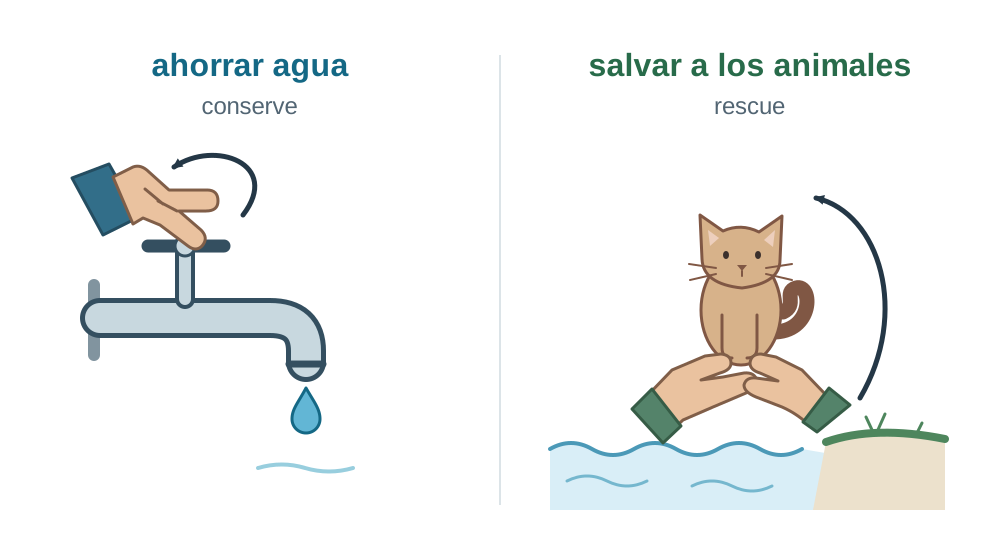
English uses the verb 'save' for several different ideas, which causes confusion. In Spanish, you must separate them:
- Ahorrar: Use this when economising, conserving resources, or saving money (ahorrar agua, ahorrar energía, ahorrar electricidad).
- Salvar: Use this when rescuing a life or saving the planet from destruction (salvar el planeta, salvar a los animales en peligro).
Practical habits to use in your writing and speaking:
- Apagar la luz y desenchufar los aparatos: Debemos apagar las luces al salir de una habitación y desenchufar los aparatos eléctricos para no malgastar electricidad. (We must turn off lights when leaving a room and unplug electrical appliances to avoid wasting electricity.)
- Cerrar el grifo: Es imprescindible cerrar el grifo mientras nos lavamos los dientes. (It is essential to turn off the tap while brushing our teeth.)
- Consumir productos de temporada: Comprar alimentos locales y de temporada reduce la huella de carbono. (Buying local, seasonal food reduces our carbon footprint.)
- Fomentar el transporte público: El gobierno debe fomentar el transporte público para aliviar los atascos. (The government must promote public transport to ease traffic jams.)
Migration, Integration, and Cultural Diversity
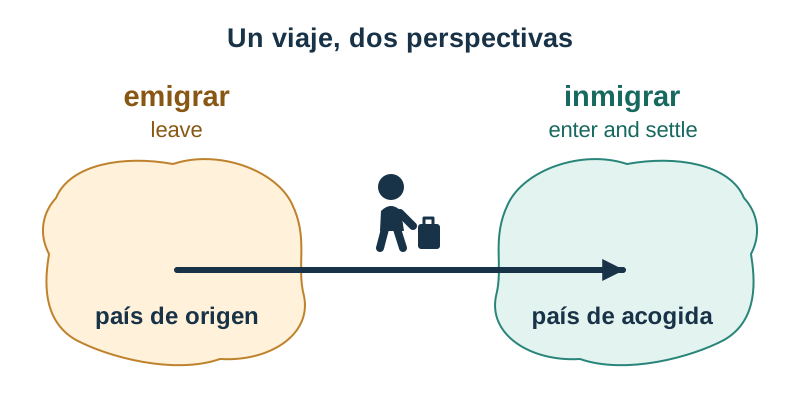
Discussions on migration require clarity about whether people are leaving a country or arriving in one.
Emigrar or Inmigrar?
Confusing these two verbs is a common slip in written essays and reading comprehensions:
- Emigrar (la emigración / el emigrante): To leave one's home country to live abroad. Durante las crisis económicas, muchos jóvenes con talento emigran al extranjero en busca de trabajo. (During economic crises, many talented young people emigrate abroad in search of work.)
- Inmigrar (la inmigración / el inmigrante): To enter and settle into a new host country. Miles de personas inmigran a Europa cada año con la esperanza de mejorar su calidad de vida. (Thousands of people immigrate to Europe each year hoping to improve their quality of life.)
Debating Integration
| Spanish | English |
|---|---|
| el país receptor / de acogida | host country |
| la barrera lingüística | language barrier |
| las condiciones laborales precarias | precarious / insecure working conditions |
| el choque cultural | culture shock |
| la fuga de cerebros | brain drain (emigration of qualified workers) |
| la xenofobia y el racismo | xenophobia and racism |
| una sociedad multicultural | a multicultural society |
| la convivencia pacífica | peaceful coexistence |
| enriquecer la cultura | to enrich culture (La diversidad cultural enriquece nuestra comunidad.) |
| integrarse en la sociedad | to integrate into society |
Crime, Security, and Reporting Incidents
Crime and public safety feature in current affairs texts, emergency listening extracts, and oral role-plays. The syllabus requires you to be able to give an account of a theft, accident, or assault.
Crime and Security Vocabulary
| Spanish | English |
|---|---|
| el delito / el crimen | crime, offence / serious crime (e.g. murder) |
| la delincuencia (juvenil) | (juvenile) delinquency, crime |
| el/la delincuente | criminal, offender |
| el robo / robar | theft, robbery / to steal, rob |
| el ladrón / la ladrona | thief |
| el atraco / atracar | mugging, hold-up / to mug, hold up |
| el hurto | petty theft, pickpocketing |
| la estafa / estafar | scam, fraud / to swindle |
| el tráfico de drogas / el narcotráfico | drug trafficking |
| la violencia de género | gender-based violence |
| el acoso / el ciberacoso | harassment, bullying / cyberbullying |
| la víctima | victim (always feminine grammatically, even for a male victim) |
| el/la testigo | witness |
| denunciar / poner una denuncia | to report a crime to the police |
| detener / arrestar | to arrest |
| la comisaría | police station |
| la cárcel / la prisión | prison |
| condenar a alguien a (cinco años de cárcel) | to sentence someone to (five years in prison) |
| la pena de muerte | the death penalty |
| la seguridad ciudadana | public safety |
Reporting What Happened: Passive Voice and Se
When recounting incidents in writing or oral exams, you have three clear grammatical tools:
1. The passive with ser (ser + past participle): Use this to focus on the person or thing affected. The participle agrees in gender and number with the subject like an adjective.
- El ladrón fue detenido por la policía. (The thief was arrested by the police.)
- Las víctimas fueron trasladadas al hospital. (The victims were transferred to hospital.)
- Un ciclista ha sido atropellado por un camión. (A cyclist has been knocked down by a lorry.)
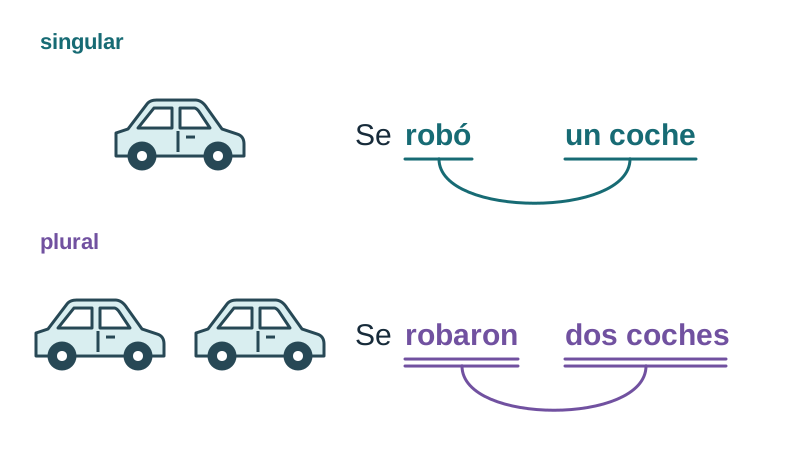
2. Passive se: Standard in news items when the person carrying out the action is unstated. The verb agrees with the noun that follows.
- Se robó un coche anoche.* (A car was stolen last night.)
- Se robaron dos coches anoche.* (Two cars were stolen last night.)
3. Third-person plural without a subject: Natural Spanish for everyday occurrences where English says 'I had my phone stolen' or 'someone stole my phone'. Do not translate 'I was robbed' as Fui robado. Use:
- Me robaron la cartera en el autobús.* (My wallet was stolen on the bus.)
- Me han robado el móvil.* (My phone has been stolen.)
Grammar for Opinions: Subjunctive, Debería, and Si Clauses
To achieve high language marks, you must show examiner-tested grammatical structures instead of relying exclusively on the present indicative.
1. Impersonal Value Judgements vs Facts
- Impersonal phrases conveying urgency, necessity, or subjective assessment require the present subjunctive when followed by que.
- Expressions stating objective truth or fact take the indicative when affirmative.
| Expression Type | Trigger Expression | Mood | Example Sentence |
|---|---|---|---|
| Value / Urgency | Es urgente que...<br>Es necesario que...<br>Es injusto que... | Subjunctive | Es urgente que los gobiernos tomen medidas.<br>Es injusto que las mujeres cobren menos. |
| Certainty / Fact | Es verdad que...<br>Es obvio que...<br>Es indudable que... | Indicative | Es verdad que el clima cambia con rapidez.<br>Es obvio que hay mucha delincuencia. |
Note on Negation: When an expression of certainty is negated, it expresses doubt and flips to the subjunctive: No es verdad que los jóvenes seamos indiferentes.
2. Giving an Opinion: Creo que vs No creo que
- Affirmative belief states a direct viewpoint and takes the indicative: Creo que la educación es la solución. (I believe that education is the solution.)
- Negated belief or doubt introduces uncertainty and takes the subjunctive: No creo que los políticos hagan lo suficiente. (I do not believe politicians are doing enough.) / Dudo que la situación mejore pronto. (I doubt the situation will improve soon.)
3. More Ways to Give and Qualify an Opinion
- Indicative (certainty): Estoy convencido/a de que el reciclaje es imprescindible. (I am convinced that recycling is essential.) / Reconozco que hemos avanzado, pero... (I admit that we have made progress, but...)
- Subjunctive (possibility or doubt): Puede que la situación cambie en el futuro. (The situation may change in the future.) / No me fío de que las empresas cumplan las normas. (I do not trust companies to comply with the regulations.)
- Summarising and clarifying: Si te entiendo bien, quieres decir que... (If I understand you correctly, you mean that...) / En resumen... (In short...)
4. Expressing Obligation with Debería
Use the conditional of deber to state what authorities or individuals ought to do:
- El gobierno debería penalizar a las fábricas que contaminan los ríos. (The government should penalise factories that pollute rivers.)
- Deberíamos compartir las tareas domésticas en casa. (We should share household chores at home.)
5. Proposing Solutions with Si Clauses
Form hypothetical solutions using: Si + imperfect subjunctive, then conditional. To form the imperfect subjunctive: take the 3rd person plural preterite (ellos form), drop -ron, and add -ra (utilizaron → utilizara; tuvieron → tuviera; hubo/hubieron → hubiera).
- Si la gente utilizara el transporte público, disminuiría la contaminación. (If people used public transport, pollution would decrease.)
- Si el gobierno invirtiera más dinero en energías limpias, protegeríamos el medio ambiente. (If the government invested more money in clean energy, we would protect the environment.)
Exam Strategy: Opinion Pieces, Letters, and the Oral Exam
Always check your exam paper for the specific mark breakdown, required word count, and task instructions, as formats and options can vary.
The Opinion Piece
- Plan your response around three main parts: an opening stance, two developed arguments, and a short conclusion.
- If the question is linked to a reading passage, never copy phrases directly from the text. Direct quotations do not earn language marks. Rephrase the idea in your own words. For example, if the text says pequeñas acciones pueden cambiar el mundo, write creo que cada gesto cuenta or hasta la acción más sencilla marca la diferencia.
- Write to the word count given on the paper. It has varied (about 75 words in 2017, 80–100 in 2021). Keep your arguments sharp and focused.
The Letter or Email: Make and Develop Five Points
When a letter or email task provides prompt points, the marking scheme rewards making five relevant points and developing each one. Developing a point means stating your argument and immediately supporting it with a reason, an example, or a consequence (typically two to three sentences per point). A single line like Los jóvenes reciclan earns minimal credit.
Model Developed Point (Prompt: Many animal species are in danger of extinction): Por otra parte, me preocupa muchísimo que tantas especies animales estén en peligro de extinción. La destrucción de su hábitat natural y la contaminación de los océanos son las causas principales. Si no protegemos la biodiversidad ahora, las futuras generaciones nunca verán animales como el lince ibérico.
Why it scores well: The point is clearly stated, supported by causes (habitat loss, ocean pollution), followed by a consequence using a si clause, and employs the subjunctive after me preocupa que (estén).
Layout Conventions: Set out your letter correctly so it reads like authentic correspondence, but remember that layout does not replace developed points:
- Date: Dublín, a 15 de marzo de 2027
- Greeting: Estimado/a Director/a:
- Opening statement of purpose: Le escribo esta carta para expresar mi opinión sobre...
- Sign-off: Le agradezco de antemano su atención.
- Valediction: Le saluda atentamente, followed by your signature.
Oral Exam: General Conversation
The Leaving Certificate Spanish oral lasts 15 minutes and consists of a general conversation alongside an oral role-play. Expect questions on environmental habits, equality, and local current affairs:
- ¿Qué haces tú en casa para cuidar el medio ambiente? (En casa siempre apagamos las luces, cerramos el grifo y reciclamos los envases de plástico.)
- ¿Crees que existe una verdadera igualdad entre hombres y mujeres? (Pienso que hemos mejorado bastante, pero aún existe la brecha salarial y pocas mujeres dirigen grandes empresas.)
- ¿Crees que hay mucha emigración en Irlanda hoy en día? (Sí, bastantes jóvenes titulados emigran a Australia o a Canadá en busca de salarios más altos y una mejor calidad de vida.)
- ¿Te sientes seguro/a en tu barrio o hay mucha delincuencia? (Mi barrio es tranquilo, aunque a veces se cometen hurtos menores. Creo que una mayor presencia policial mejoraría la seguridad ciudadana.)
Key terms
- el calentamiento global
- Global warming. Example: El calentamiento global provoca el deshielo de los polos.
- el efecto invernadero
- The greenhouse effect. Example: Los gases contaminantes aumentan el efecto invernadero.
- la sequía
- Drought. Example: La sequía prolongada destruye los cultivos en el campo.
- la brecha salarial (de género)
- The (gender) pay gap. Example: Es necesario erradicar la brecha salarial de género en las empresas.
- el techo de cristal
- The glass ceiling; invisible barriers to career progression. Example: Muchas mujeres luchan por romper el techo de cristal.
- la corresponsabilidad
- Shared domestic and caring responsibility. Example: La corresponsabilidad en el hogar favorece una convivencia equilibrada.
- el país receptor
- Host country for immigrants. Example: España es un país receptor clave dentro de Europa.
- la fuga de cerebros
- Brain drain; emigration of educated workers. Example: La fuga de cerebros priva al país de jóvenes investigadores.
- el hurto
- Petty theft or pickpocketing. Example: El hurto de carteras ocurre con frecuencia en el transporte público.
- la delincuencia juvenil
- Youth crime. Example: La delincuencia juvenil suele relacionarse con la falta de oportunidades laborales.
- la víctima
- Victim (always grammatically feminine). Example: La víctima denunció el atraco en la comisaría.
- el voluntariado
- Volunteering. Example: Hacer un voluntariado enseña el valor de la solidaridad.
Check yourself
Which Spanish verb should you use for conserving electricity, and which verb is used for rescuing an endangered species?
Use 'ahorrar' for conserving electricity ('ahorrar electricidad') and 'salvar' for rescuing an endangered species ('salvar una especie').
Translate into natural Spanish: 'My bag was stolen on the train.'
'Me robaron el bolso en el tren' or 'Me han robado el bolso en el tren'.
Why does 'Creo que el reciclaje es útil' take the indicative, whereas 'No creo que el reciclaje sea inútil' takes the subjunctive?
'Creo que' asserts a belief as a fact and takes the indicative, while 'No creo que' denies that certainty, introducing doubt which triggers the subjunctive mood.
What does developing a point mean when writing an exam letter or email based on prompts?
It means stating the point clearly in Spanish and then expanding it with a reason, a concrete example, or a consequence over two to three sentences.
How do you form the imperfect subjunctive verb in a hypothetical si clause like 'Si la gente (usar) el transporte público'?
Take the 3rd person plural preterite ('usaron'), drop '-ron', and add '-ra' to give 'usara': 'Si la gente usara el transporte público...'.
Social Equality, the Workplace, and Volunteering
Social justice, workplace parity, and community solidarity are common themes in oral discussions and written tasks.
Gender Equality and Work
Useful Idiomatic Phrases
Volunteering and Community Action