
The opinion piece (texto de opinión) is a core written production task in the Leaving Certificate Spanish Higher Level paper, appearing after the Section B reading comprehension. Worth 50 marks, it assesses your ability to construct an authentic, structured argument in Spanish. The task is marked equally under two criteria: Content/Communication (25 marks) for relevance, clarity of thought, and coherence, and Language (25 marks) for vocabulary range, correct tense usage, and grammatical accuracy.
Task Formats and the Two Question Types
In recent Higher Level examinations, the opinion task appears in one of two distinct formats following the second reading comprehension text. You must check the instructions carefully on your paper and adhere strictly to the stated format.
1. Choice of Statements
You are given two or three short statements linked thematically to the reading text. You select one statement and write an argument of 80 to 150 words. For example, a recent paper offered choices between Hay que celebrar nuestra cultura, Vivir en otro país puede ser difícil, and El deporte es importante para todos.
2. Text-Linked Question
You answer a single question directly related to the theme of the passage, writing to the specific length indicated on the examination paper. Past tasks have specified lengths of approximately 75, 100, or 150 words. For example, after an article on sport, the prompt asked whether elite sportspeople make good role models for young people today, setting a target of approximately 75 words.
For either format, you must observe these essential exam guidelines:
- Always write to the word count stated on the paper.
- If a prompt asks you to 'give reasons', provide at least two distinct reasons with examples.
- While you may adapt relevant vocabulary from the reading comprehension, phrases copied from the text earn no marks. Examiners evaluate your own original phrasing.
- Bringing in the Irish context or your personal experience helps fulfil the communicative task and shows analytical depth.
Marking Criteria and Assessment Bands
The State Examinations Commission divides the 50 marks evenly between two criteria, each scored across three broad bands.
Content/Communication (25 marks)
- 18–25 marks: High level of coherence, clear argumentation, and communicative intention fulfilled.
- 9–17 marks: Reasonable coherence and comprehensibility.
- 0–8 marks: Lack of coherence; difficult to understand.
Language (25 marks)
- 18–25 marks: Idiomatic Spanish, good level of vocabulary, few grammatical or spelling mistakes, and correct usage of tenses.
- 9–17 marks: Reasonable coherence and comprehensibility.
- 0–8 marks: Lack of coherence; difficult to understand.
Content and Language are evaluated as separate criteria. However, memorised essays that ignore the specific prompt score very poorly under Content, and disconnected sentences fail to demonstrate meaningful communication. Note that a separate formal letter to the editor task (such as the 2019 option requiring five distinct points) has its own specific format and marking scheme and should not be confused with this general opinion format.
Planning Routine and Argument Structure
A disciplined structure keeps your writing coherent and helps you stay within the word limit. Before writing, spend two minutes working through this sequence:
- Underline the key terms in the statement or question.
- Decide your stance (agreement, disagreement, or a balanced view).
- Jot down two clear arguments, each supported by an example or personal reflection.
- Note one counterpoint or concession to show balance.
- Draft a concluding sentence with fresh phrasing.
- Check your grammar checklist: one subjunctive trigger, one conditional structure, one past-tense observation, and three connecting words.
Three-Part Argument Structure
- Introduction (1–2 sentences): State your position immediately. Phrases such as Estoy totalmente de acuerdo con esta afirmación (I completely agree with this statement) or No comparto esta idea en absoluto (I do not share this idea at all) define your thesis right away. For a text-linked prompt, open with an observation such as El texto plantea un tema muy interesante sobre... (The text raises a very interesting issue regarding...).
- Body (2–3 paragraphs or points): Develop your two main arguments. Back up your points by introducing personal experience or comparing the target culture with Ireland. Use connectors to transition into a counterpoint (Sin embargo, Por otro lado) to demonstrate critical maturity.
- Conclusion (1–2 sentences): Wrap up the piece using a closing discourse marker like En resumen or A modo de conclusión, restating your stance without repeating identical phrasing.
Engaging in Discussion: Connectors and Opinion Markers
The syllabus outlines specific communicative exponents for proposing points of view, ordering arguments, and negotiating differing stances.
Presenting Opinions and Stances
- A mi modo de ver... (The way I see it...)
- Desde mi punto de vista... (From my point of view...)
- Me atrevo a decir que... (I would go as far as to say that...)
- Reconozco que... / Confieso que... (I admit that... / I confess that...)
- No es para tanto. (It is not that big a deal.)
Ordering, Adding, and Contrasting
- En primer lugar... / En segundo lugar... (Firstly... / Secondly...)
- Por un lado... por otro lado... (On the one hand... on the other hand...)
- Por una parte... por otra... (This can mean 'on the one hand... on the other...', or por otra parte alone can mean 'furthermore' / 'besides' when adding an extra point.)
- Sin embargo... (However...)
- Al contrario... (On the contrary...)
- Puesto que... / Ya que... (Since... / Given that...)
- Por lo tanto... (Therefore...)
- En resumen... (In summary...)
Linking to Ireland
- En Irlanda, la situación es parecida / muy diferente, ya que... (In Ireland, the situation is similar / very different, since...)
- Según mi propia experiencia en Irlanda... (According to my own experience in Ireland...)
Mastering the Subjunctive and Mood Contrasts
To reach the 18–25 band for Language, you should naturally integrate higher-level mood contrasts. The basic rule governs this: certainty takes the indicative, while doubt, denial, emotion, and impersonal necessity demand the subjunctive.
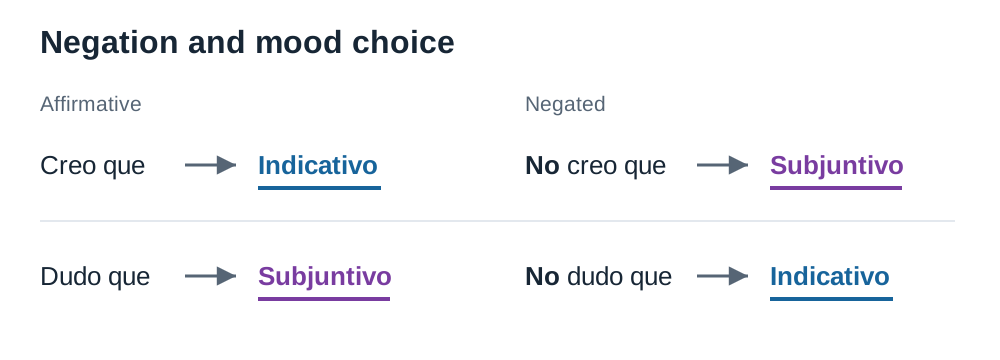
Belief vs Denied Belief
- Affirmative belief takes the indicative: Creo que los jóvenes tienen demasiado estrés. (I believe that young people have too much stress.)
- Negated belief requires the subjunctive: No creo que + subjunctive, as in No creo que los jóvenes tengan una vida fácil. (I do not believe that young people have an easy life.)
Doubt vs Denied Doubt
- Active doubt requires the subjunctive: Dudo que la tecnología resuelva todos nuestros problemas. (I doubt that technology will solve all our problems.)
- Denied doubt switches back to the indicative: No dudo que es una cuestión difícil. (I do not doubt that it is a difficult matter.)
Impersonal Value Judgements vs Certainty
- Subjective judgements and necessity take the subjunctive: Es necesario que el gobierno tome medidas urgentes. (The government needs to take urgent action — where tome is the present subjunctive of tomar.) / Es una pena que haya tanta pobreza. (It is a pity there is so much poverty.) / Puede que los jóvenes tengan razón. (It may be that young people are right.)
- Affirmative expressions of fact or certainty take the indicative: Es verdad que la vida es cara. (It is true that life is expensive.) / Es evidente que el problema existe. (It is evident that the problem exists.)
- When certainty is negated, it shifts to the subjunctive: No es verdad que la vida sea fácil. (It is not true that life is easy.) / No es cierto que todos los jóvenes sean perezosos. (It is not true that all young people are lazy.)
A Convinced Stance: Subjunctive vs Indicative
- A mí me convence este argumento. (I find this argument convincing.) → indicative
- A mí no me convence que sea la solución. (I am not convinced that it is the solution.) → subjunctive
Tense Variety: Past Reflections, Hypotheticals, and the Future
Examiners specifically reward the correct use of tenses across past, present, and future time frames. Avoid writing an entire piece in the present tense.
Adding Past Experience
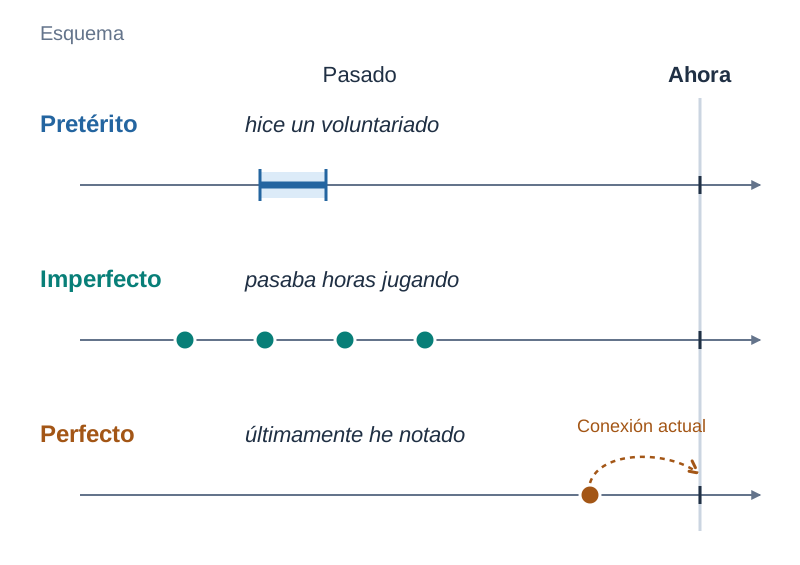
- Preterite (completed actions in the past): El verano pasado hice un voluntariado en una tienda benéfica. (Last summer I volunteered in a charity shop.) / Cuando fui a España, me di cuenta de la importancia del idioma. (When I went to Spain, I realised the importance of the language.)
- Imperfect (habitual actions or past descriptions): Cuando era más joven, pasaba horas jugando al aire libre. (When I was younger, I used to spend hours playing outdoors.)
- Perfect (actions connected to the present): Siempre he pensado que la familia es lo primero. (I have always thought that family comes first.) / Últimamente he notado que los precios han subido mucho. (Lately I have noticed that prices have risen a lot.)
Hypothetical Conditions
Use the standard Leaving Certificate hypothetical construction: Si + imperfect subjunctive → conditional.
- Si los adolescentes pasaran menos tiempo frente a las pantallas, tendrían mejores relaciones sociales. (If teenagers spent less time in front of screens, they would have better social relationships.)
- Si el gobierno invirtiera más dinero en la vivienda, los jóvenes podrían independizarse. (If the government invested more money in housing, young people could become independent.)
Never follow si (if) with a present subjunctive. Phrasing such as si tenga is grammatically incorrect in Spanish. Use si tengo for real conditions, or si tuviera for hypothetical ones.
Projecting into the Future
- En el futuro, los jóvenes tendrán que adaptarse a un mercado laboral muy competitivo. (In the future, young people will have to adapt to a very competitive job market.)
Thematic Syllabus Vocabulary
The Leaving Certificate syllabus covers specific social and cultural themes. Use these high-frequency terms to write with precision:
Society, Family, and Equality
- la brecha generacional (the generation gap)
- la convivencia (coexistence / living together)
- la igualdad de género (gender equality)
- el racismo (racism)
- las minorías étnicas (ethnic minorities)
Money, Housing, and Consumerism
- el coste de la vida (the cost of living)
- el alquiler (rent)
- la vivienda (housing)
- el consumismo (consumerism)
- la moda rápida (fast fashion)
Volunteering and Global Issues
- el voluntariado (volunteering)
- hacer de voluntario/a (to volunteer)
- ayudar a los demás (to help others)
- los países en vías de desarrollo (developing countries)
- el calentamiento global (global warming)
- las especies en peligro de extinción (endangered species)
Health, Lifestyle, and Travel
- llevar una vida sana (to lead a healthy life)
- el trabajo en equipo (teamwork)
- la autoestima (self-esteem)
- vivir en el extranjero (to live abroad)
- echar de menos (to miss someone/home)
- ampliar los horizontes (to broaden one's horizons)
Key terms
- Texto de opinión
- The formal opinion writing task on the Leaving Certificate Higher Level Spanish paper, written in response to a statement or reading-text question.
- Contenido/Comunicación
- The 25-mark criterion assessing relevance to the prompt, logical reasoning, fulfilment of communicative intent, and overall coherence.
- Lenguaje
- The 25-mark criterion evaluating grammatical accuracy, correct use of tenses, range of vocabulary, spelling, and authentic Spanish idiom.
- Conector discursivo
- A transitional linking phrase (such as 'sin embargo', 'por lo tanto', or 'por otra parte') that establishes cohesive ties between arguments.
- Modo subjuntivo
- The verb mood required in subordinate clauses following verbs of doubt, negative belief, emotional reaction, and impersonal evaluation.
- Oración condicional hipotética
- A conditional sentence structure that couples 'si' + imperfect subjunctive with the conditional tense to discuss hypothetical situations.
Check yourself
What are the two different task formats that can appear for the Leaving Certificate Spanish opinion piece?
A choice among two or three thematic statements (written in 80–150 words), or a single text-linked question about the reading passage (written to a specific target such as approx. 75, 100, or 150 words).
Which mood follows 'No es verdad que...' versus 'Es verdad que...'?
'Es verdad que...' expresses certainty and takes the indicative, whereas 'No es verdad que...' denies certainty and triggers the subjunctive (e.g., 'No es verdad que la vida sea fácil').
What is the correct verb formula for an unreal or hypothetical condition in Spanish?
Si + Imperfect Subjunctive followed by the Conditional tense (e.g., 'Si tuviera más dinero, viajaría por el mundo').
If an exam question asks for 'approx. 75 words', how should you approach length?
Aim for 75 to 85 words. Writing significantly less leaves points underdeveloped, while writing over 120 words wastes time and risks unnecessary accuracy errors.
Identify and correct the two grammatical errors in: 'La gente creen que la problema del clima es grave.'
'La gente cree que el problema del clima es grave.' ('La gente' takes a singular verb 'cree', and 'problema' is a masculine noun requiring 'el').