
Mastering future and conditional structures is essential for scoring in the top bracket of Leaving Certificate Higher Level Spanish. These forms allow you to discuss your college and career plans in the oral exam, construct accurate turns in the dialogue, maintain formal register in letters or emails, and express balanced arguments in the opinion piece. This note covers the near future, the simple future, intentional phrases, polite conditional requests, the twelve shared irregular stems, future time clauses with the subjunctive, reported speech rules, and si-clause patterns.
Expressing the Future: Near Future, Simple Future, and Intentions
Spanish gives you two main tenses to discuss events that have not happened yet, along with several verbal constructions that express degrees of intention and planning.
1. El futuro próximo (The Near Future)
Form this tense using the present indicative of ir + a + infinitive. It expresses immediate plans, arrangements, or events you feel certain about:
- Voy a estudiar ingeniería el año que viene. (I am going to study engineering next year.)
- Vamos a alquilar un piso en Valencia. (We are going to rent a flat in Valencia.)
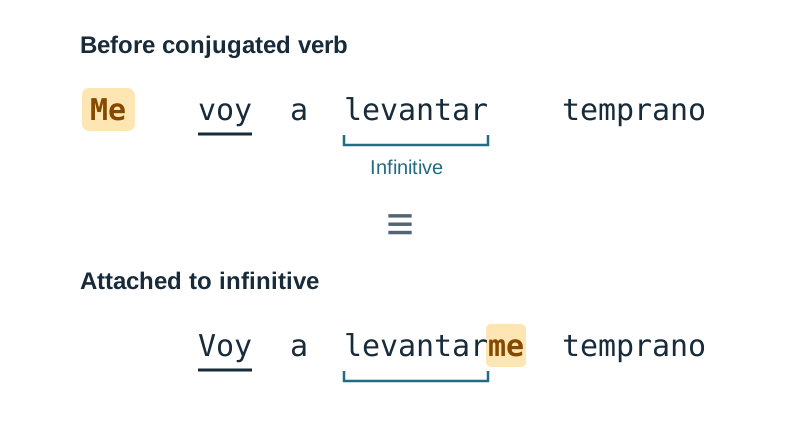
With reflexive verbs, you can place the pronoun before the conjugated form of ir or attach it directly to the end of the infinitive:
- Me voy a levantar temprano OR Voy a levantarme temprano. (I am going to get up early.)
2. El futuro simple (The Simple Future)
To form the simple future of regular verbs, take the complete infinitive and add the future endings directly to it. The endings are identical for -ar, -er, and -ir verbs:
| Person | Ending | Hablar (to speak) | Comer (to eat) | Vivir (to live) |
|---|---|---|---|---|
| yo | -é | hablaré | comeré | viviré |
| tú | -ás | hablarás | comerás | vivirás |
| él / ella / usted | -á | hablará | comerá | vivirá |
| nosotros / nosotras | -emos | hablaremos | comeremos | viviremos |
| vosotros / vosotras | -éis | hablaréis | comeréis | viviréis |
| ellos / ellas / ustedes | -án | hablarán | comerán | vivirán |
Notice that five of the six forms take a written accent. Only the nosotros form does not.
3. Communicative Intentions, Promises, and Offers
Relying solely on voy a makes your written work repetitive. Use these phrases to declare intentions, make promises, and offer assistance:
- Pensar + infinitive (to plan / intend to): Pienso tomarme un año sabático. (I intend to take a gap year.)
- Esperar + infinitive (to hope to): Espero conseguir los puntos necesarios. (I hope to get the necessary points.)
- Tener la intención de + infinitive: Tengo la intención de buscar un trabajo a tiempo parcial. (I intend to look for a part-time job.)
- Te prometo que + future: Te prometo que te llamaré mañana. (I promise I will ring you tomorrow.)
- No te preocupes, yo + future: No te preocupes, yo traeré la comida. (Don't worry, I will bring the food.)
- Si quieres, yo puedo + infinitive: Si quieres, yo puedo recogerte en la estación. (If you want, I can collect you at the station.)
The Conditional Tense, 'Me Gustaría', and Polite Registers
The conditional tense translates to 'would + verb' in English. Like the simple future, form it by taking the complete infinitive and adding endings that are identical across -ar, -er, and -ir verbs:
| Person | Ending | Hablar | Comer | Vivir |
|---|---|---|---|---|
| yo | -ía | hablaría | comería | viviría |
| tú | -ías | hablarías | comerías | vivirías |
| él / ella / usted | -ía | hablaría | comería | viviría |
| nosotros / nosotras | -íamos | hablaríamos | comeríamos | viviríamos |
| vosotros / vosotras | -íais | hablaríais | comeríais | viviríais |
| ellos / ellas / ustedes | -ían | hablarían | comerían | vivirían |
Every single conditional ending carries a written accent on the letter í.
Saying What You Would Like to Do: me gustaría + infinitive
Gustaría is the conditional of gustar. Like gustar, it works backwards: the person goes in the indirect object pronoun, while the verb stays singular when followed by an infinitive:
- me gustaría (I would like), te gustaría (you would like), le gustaría (he/she/you formal would like), nos gustaría (we would like), os gustaría (you all would like), les gustaría (they would like)
- Me gustaría estudiar medicina en Cork. (I would like to study medicine in Cork.)
- ¿Qué te gustaría hacer después del instituto? (What would you like to do after school?)
- Me encantaría pasar un año en Sevilla. (I would love to spend a year in Seville.)
Never say Yo gustaría estudiar. Always use the object pronoun: Me gustaría estudiar.
Polite Requests, Advice, and Offers
- Polite requests in letters and role-plays: ¿Podría usted decirme a qué hora sale el tren? (Could you tell me what time the train leaves?); ¿Sería posible reservar una habitación individual? (Would it be possible to book a single room?)
- Giving advice with Yo que tú + conditional: A simple way to give advice in a dialogue or informal note is Yo que tú + conditional (Yo que tú, descansaría un poco — If I were you, I would rest a bit).
- Conditional offers: Yo podría traer las bebidas. (I could bring the drinks.)
Future Time Clauses and Indirect Speech
Two grammar areas cause regular marks loss at Higher Level: time clauses anticipating future events, and reporting future statements in the past.
'When I finish...': cuando + present subjunctive
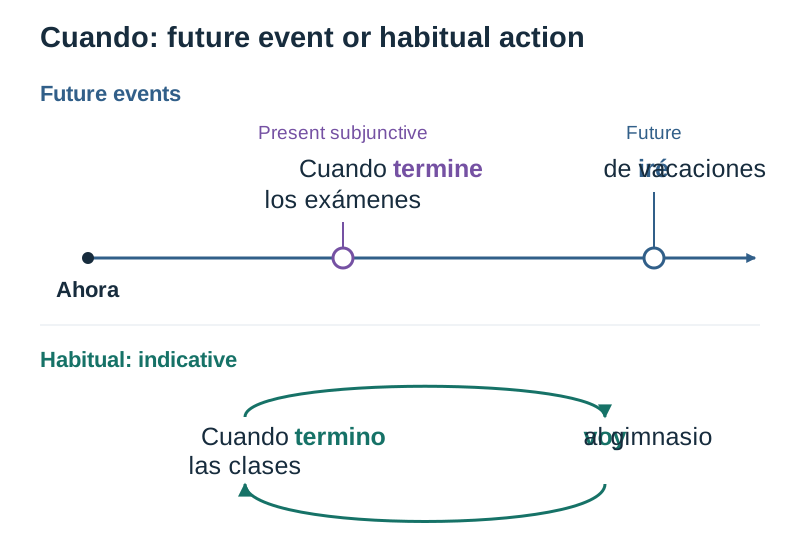
When a time conjunction such as cuando (when), en cuanto (as soon as), or hasta que (until) introduces an action that has not yet happened, the verb that follows must be in the present subjunctive, never the future tense. The main clause then takes the future:
- Cuando termine los exámenes, iré de vacaciones. (When I finish the exams, I will go on holiday.)
- En cuanto tenga los resultados, te llamaré. (As soon as I have the results, I will call you.)
- Esperaré aquí hasta que llegue el autobús. (I will wait here until the bus arrives.)
If you are describing a habitual action or a past event, use the indicative instead: Cuando termino las clases, voy al gimnasio. (When I finish classes, I go to the gym.)
Reporting What Someone Said (Indirect Speech)
The tense of your reporting verb determines what happens to a future statement:
- If the reporting verb is in the present or perfect (dice que, ha dicho que, han anunciado que), the future stays future:
- Han anunciado que lloverá mañana. (They have announced that it will rain tomorrow.)
- El recado es que llegará por la tarde. (The message is that she will arrive in the afternoon.)
- If the reporting verb is in the preterite or imperfect (dijo que, me dijeron que, aseguraba que), the future shifts into the conditional:
- Me dijo que llegaría a las ocho. (He told me he would arrive at eight.)
- Nos aseguraron que vendrían a la fiesta. (They assured us that they would come to the party.)
Conditional Sentences: Mastering 'Si' Clauses (SPF vs SIC)
Si-clauses let you show a range of tenses in one sentence, and range of structures is one of the syllabus assessment criteria. Used correctly, they strengthen your written and oral answers.
Pattern 1: Realistic or Likely Conditions (SPF)
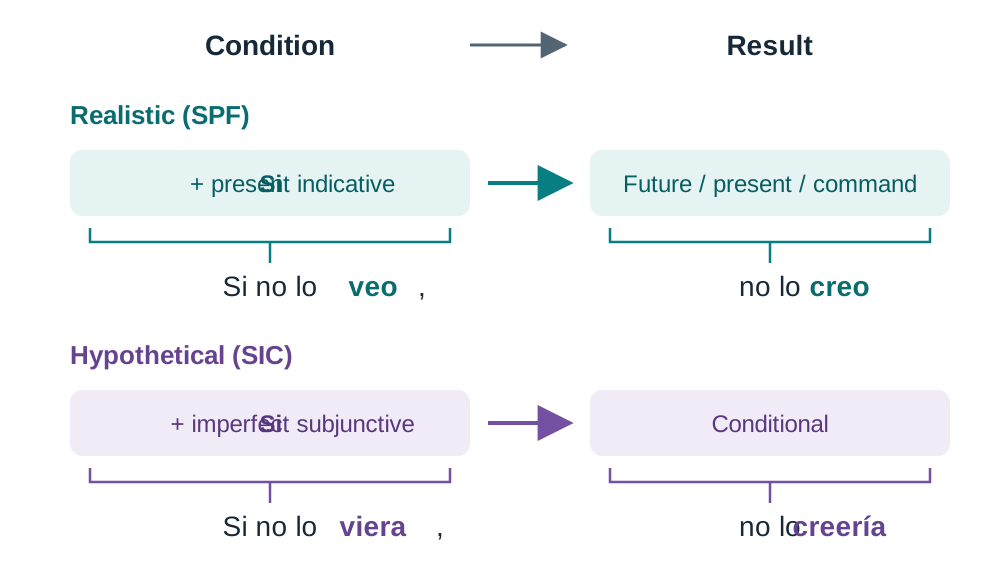
Use this formula when the condition is possible, realistic, or probable: Si + present indicative → simple future (or present / command)
- Si saco buenas notas en junio, estudiaré derecho. (If I get good marks in June, I will study law.)
- Si tienes dudas, pregúntale al profesor. (If you have doubts, ask the teacher.)
- Si no lo veo, no lo creo. (If I don't see it, I don't believe it.)
Pattern 2: Hypothetical or Contrary-to-Fact Conditions (SIC)
Use this formula to imagine an unreal, improbable, or hypothetical situation in the present or future: Si + imperfect subjunctive → conditional
- Si tuviera más tiempo libre, practicaría más deporte. (If I had more free time, I would do more sport.)
- Si fuera presidente del gobierno, invertiría más en educación. (If I were prime minister, I would invest more in education.)
- Si no lo viera, no lo creería. (If I didn't see it, I wouldn't believe it.)
Forming the Imperfect Subjunctive
Take the third-person plural (ellos) form of the preterite, drop the -ron, and add: -ra, -ras, -ra, -ramos, -rais, -ran. The nosotros form always carries an accent on the vowel immediately preceding -ramos:
- tener → tuvieron → tuviéramos
- ser / ir → fueron → fuéramos
- hacer → hicieron → hiciéramos
- Si tuviéramos más dinero, viajaríamos por todo el mundo. (If we had more money, we would travel all over the world.)
The Golden Rule of 'Si'
When si means 'if' (a condition), it is never followed immediately by the simple future or the conditional:
- Incorrect: Si tendré tiempo... or Si tendría tiempo...
- Correct: Si tengo tiempo... (SPF) OR Si tuviera tiempo... (SIC)
You can swap the order of the two clauses without changing the meaning. When the si-clause comes first, put a comma after it; when it comes second, you normally leave the comma out: Iría a España si tuviera suficiente dinero.
High-Yield Phrases for Writing Tasks and Exam Vocabulary
Deploying set structures across letters, opinion pieces, and dialogues helps you meet the criteria for grammatical range and register.
Formal Letters and Emails
- Le agradecería que me enviara información sobre... (I would be grateful if you could send me information about...)
- ¿Sería posible reservar una plaza para el curso? (Would it be possible to reserve a place for the course?)
- ¿Podría decirme si el alojamiento está incluido? (Could you tell me if accommodation is included?)
- Quedo a la espera de su respuesta. (I look forward to your reply.)
Informal Notes and Diary Entries
- El año que viene voy a pasar dos semanas en Santander. (Next year I am going to spend two weeks in Santander.)
- Espero que todo salga bien con los exámenes. (I hope everything goes well with the exams.)
- Ojalá pueda encontrar un trabajo este verano. (Hopefully I can find a job this summer.)
Opinion Piece Model: Technology and Future Employment
En el futuro, la inteligencia artificial transformará muchos sectores laborales. Sin embargo, creo que siempre habrá puestos esenciales para las personas. Si el gobierno invirtiera más en formación digital, los jóvenes estarían mejor preparados para los retos del mañana. (In the future, artificial intelligence will transform many employment sectors. However, I believe there will always be essential jobs for people. If the government invested more in digital training, young people would be better prepared for tomorrow's challenges.)
Reading and Listening Horizon Vocabulary
Recognising these vocabulary items in comprehension passages will help you understand predictions and future developments:
- se prevé que (it is forecast / expected that)
- está previsto (it is planned / scheduled)
- a partir de (from... onwards)
- en los próximos años (in the coming years)
- pronto (soon)
- mañana por la mañana (tomorrow morning)
- a corto / largo plazo (in the short / long term)
- podría ser / pudiera ser (it could be / it might be)
Key terms
- Futuro simple
- The simple future tense ('will'), formed by adding -é, -ás, -á, -emos, -éis, -án to the complete infinitive or irregular stem.
- Condicional
- The conditional tense ('would'), formed by adding -ía, -ías, -ía, -íamos, -íais, -ían to the complete infinitive or irregular stem.
- Futuro próximo
- The near future construction formed with the present tense of 'ir + a + infinitive' (e.g. voy a viajar).
- SPF Formula
- Mnemonic for probable conditions: Si + present indicative → simple future (or present indicative / command).
- SIC Formula
- Mnemonic for hypothetical conditions: Si + imperfect subjunctive → conditional.
- Imperfecto de subjuntivo
- The imperfect subjunctive mood (e.g. tuviera, fuera), formed from the preterite ellos root and required after 'si' in hypothetical sentences.
- Discurso indirecto
- Reported speech. Future verbs stay in the future after a present or perfect reporting verb, but shift to the conditional after a past reporting verb.
- Yo que tú
- A conversational formula meaning 'If I were you', followed by the conditional tense to give friendly advice.
Check yourself
What are the irregular stems for 'decir', 'hacer', and 'poder' in the future and conditional tenses?
The stems are 'dir-', 'har-', and 'podr-'.
Correct the error in this future sentence: 'Cuando seré mayor, viviré en el extranjero.'
'Cuando sea mayor, viviré en el extranjero.' Because 'cuando' refers to a future moment, it requires the present subjunctive ('sea'), not the future tense.
Translate into Spanish: 'I would like to study languages at university.'
'Me gustaría estudiar idiomas en la universidad.' (Always use the pronoun 'me', never 'yo gustaría').
Contrast the reported speech in these two sentences: 'Dice que ___ (venir)' vs 'Dijo que ___ (venir)'.
'Dice que vendrá' (reporting verb in the present keeps the future) vs 'Dijo que vendría' (reporting verb in the past shifts the future into the conditional).
Identify and correct the mistake: 'Si nosotros tuvieramos más dinero, compraríamos una casa.'
Add the written accent to the nosotros form of the imperfect subjunctive: 'Si nosotros tuviéramos más dinero, compraríamos una casa.'
Translate this piece of advice using the syllabus formula: 'If I were you, I would speak to the teacher.'
'Yo que tú, hablaría con el profesor' (or 'con la profesora').