

This note covers the core parts of Section D (Moral Decision-Making) for Leaving Certificate Religious Education at Higher Level. You will learn to compare the religious person and the moral person, understand Christian moral foundations in the Covenant, Decalogue, and Jesus' preaching, trace how conscience develops through Lawrence Kohlberg's stages, and work through serious moral dilemmas using civil law, diverse religious traditions, and philosophical theories. Companion notes cover the other Section D outcomes: the meanings of morality and ancient Hebrew, Greek and Roman thinking (1.1); personal and community values and charters such as the UN Declaration of Human Rights (1.2); non-Christian ethical systems and changes since the Enlightenment (2.1); sin and moral failure (2.3); fundamentalism and relativism (3.1); and the sources of moral principles, moral freedom, virtue and the morally mature person (4.1).
The Religious Person and the Moral Person
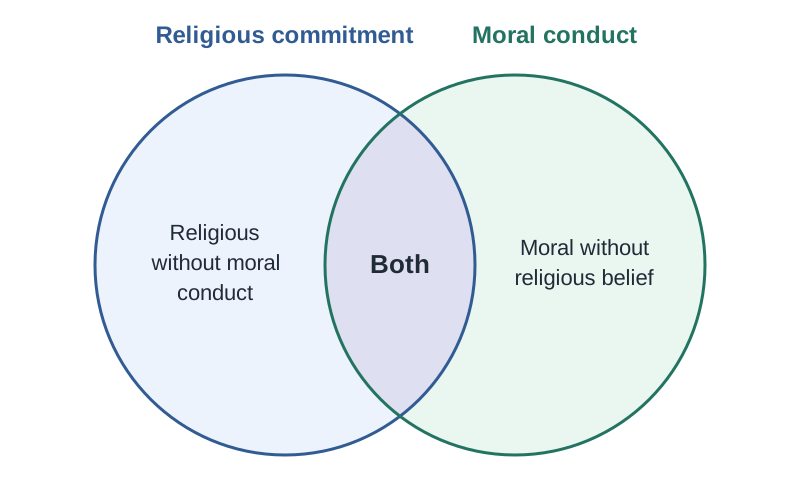
A central idea in the syllabus is that morality is a natural human phenomenon. A person does not have to be religious to live a deeply moral life, and being religious does not automatically make someone act morally.
Definitions and Core Differences
- Religion is about a person's relationship with God or the transcendent. It is expressed through belief, worship, prayer, ritual, and belonging to a faith community.
- Morality is about how a person treats others, themselves, and the world. It deals with right and wrong conduct, resting on values such as justice, honesty, fairness, and compassion.
A religious person believes in God or a higher power and lives that out through worship, personal prayer, and participation in their faith community. A moral person lives by strong ethical values and treats others with care and fairness; they may or may not hold religious beliefs.
| Dimension | The Religious Person | The Moral Person (religious or not) |
|---|---|---|
| Starting point | Faith in God, scripture, and sacred tradition | Can rest on human reason, empathy, shared experience and conscience without religious faith |
| Core question | "What does God ask of me in this situation?" | "What is the right, fair, or compassionate thing to do?" |
| Wrongdoing | Understood as sin—damaging the relationship with God and community | Can be understood as moral failure, injustice or harm to others without reference to God |
| Practices | Includes worship, prayer, sacraments, and ritual observance | Does not require prayer, worship, or rituals to act ethically |
Similarities Between Them
- Both are guided by deeply held values that shape their choices.
- Both belong to communities that help form those values, whether a parish, a school, a family, or wider society.
- Both can be motivated by genuine care for other people and a desire to make society fairer.
- Both believe that choosing the good matters and try to act consistently on their values.
The Key Exam Insight
Being religious and being moral are distinct human realities. A person can be religious but behave immorally, like an employer who attends church every Sunday but underpays staff. Conversely, a person can be an atheist or humanist who volunteers weekly at a homeless shelter, demonstrating a profoundly moral life without religious faith. In an ideal believer, faith and moral action are joined together.
Sample Answer (Syllabus Outcome 2.1)
A religious person believes in God and expresses this through worship, prayer, and belonging to a faith community, for example a Muslim praying five times daily. A moral person lives by values such as honesty, fairness, and compassion, treating others with dignity. Both are guided by principles and by communities that shape their worldview. However, a religious person's values are rooted in scripture and a relationship with God, and they see wrongdoing as sin. A non-religious moral person grounds values in human reason and empathy, viewing wrongdoing as harm to others or society. Being religious does not guarantee moral behaviour, and a person can live an exemplary moral life without religious belief.
The Common Good and Civil Law
Living together in community requires balancing the freedom of the individual with the wellbeing of everyone.
Two Definitions of the Common Good
- Catholic Definition (Vatican II, Gaudium et Spes 26): The common good is "the sum of those conditions of social life which allow social groups and their individual members relatively thorough and ready access to their own fulfilment."*
- Civic Definition: The common good is the shared wellbeing of the entire community—such as clean air, safe roads, public health, and fair laws—which benefits everyone and cannot be achieved by individuals acting alone.
How Irish Civil Law Expresses the Common Good
Irish civil law does not treat individual rights as absolute. The State regularly passes laws to protect all citizens:
- The workplace smoking ban (Public Health (Tobacco) Acts) restricts an individual's freedom to smoke in enclosed public spaces to protect the health of workers and the public.
- Drink-driving limits and speed controls (Road Traffic Acts) restrict how motorists drive in order to prevent injury and save lives on shared roads.
Balancing Individual Rights with the Common Good
Article 43.1 of Bunreacht na hÉireann guarantees the natural right to private property. However, Article 43.2 says that the exercise of property rights ought to be regulated by principles of social justice. It allows the State to limit that exercise by law to reconcile it with the common good—that is, what the good of the whole community requires.
The State puts this balance into practice through laws such as progressive taxation, where higher earners pay a higher percentage of tax, and compulsory purchase orders, where the State buys private land at market value to build public infrastructure like roads, schools, or hospitals.
Christian Foundations: Covenant, Decalogue, and Jesus' Preaching
Christian morality developed out of the historical experience of the Jewish people and found its central focus in the life and teaching of Jesus of Nazareth.
Religious, Social, and Cultural Context of the Decalogue and Covenant
- Religious Context: The Israelites understood that Yahweh had rescued them from slavery in Egypt during the Exodus. At Mount Sinai, God established a covenant, a solemn, binding agreement: "I will be your God, and you shall be my people." The Decalogue (Ten Commandments) set out Israel's side of this relationship. It begins: "I am the Lord your God, who brought you out of the land of Egypt" (Exodus 20:2). Moral living was therefore an act of gratitude and faithfulness to God.
- Social Context: The Israelites were wandering nomadic tribes in the desert. They needed basic rules to survive as one community and prevent chaos. The commandments protected life, marriage, property, truthfulness, and family stability.
- Cultural Context: In the ancient Near East, powerful rulers made treaties with smaller nations, called suzerain-vassal treaties. These treaties listed what the ruler had done for the people and then specified the loyalty expected in return. The Covenant mirrored this familiar legal form, with one radical difference: the King was God, and the law applied equally to everyone in the community, rich and poor alike.
Structure of the Decalogue
In Catholic tradition, the commandments fall into two clear tables:
- Duties to God (Commandments 1–3): Worship God alone, respect God's holy name, and keep the Sabbath day holy.
- Duties to the Community (Commandments 4–10): Honour parents, and do not kill, commit adultery, steal, give false witness, or covet. Other Christian traditions number these slightly differently.
Five Key Principles in the Ethical Vision of Jesus
Jesus did not replace the moral law; he went to its roots, calling for metanoia, a deep change of heart so that good actions flow from within.
- The Law of Love (Agape)*: In the Great Commandment (Mark 12:29–31), Jesus taught that all the commandments depend on loving God completely and loving one's neighbour as oneself. In the Parable of the Good Samaritan (Luke 10:25–37), he showed that the neighbour is anyone in need, even a traditional enemy.
- Right Relationship (Dikaiosyne)*: Justice in the Gospels means being in honest, truthful, and peaceful relationship with God, with others, and with the wider community. In the Sermon on the Mount, Jesus insists that before offering a gift at the altar, a person must first make peace with their brother or sister (Matthew 5:23–24).
- Metanoia (Interior Transformation): Jesus taught that true goodness comes from the heart, not outward rule-following alone. What defiles a person comes from within, such as greed, malice, and pride (Mark 7:21–23).
- Compassion over Rigid Law: Human life and dignity always take precedence over strict legal rules. Jesus cured the man with the withered hand on the Sabbath (Mark 3:1–6) and defended his hungry disciples plucking grain on the Sabbath (Mark 2:23–28), declaring that the Sabbath was made for man, not man for the Sabbath.
- Inclusion of the Outcast and Concern for the Poor: Jesus welcomed the excluded people of his society, including tax collectors, foreigners, and sinners, eating with Zacchaeus (Luke 19:1–10). Catholic Social Teaching later drew on this to develop the concept of the preferential option for the poor.
The Catholic Tradition on Religion and Morality
In Roman Catholic moral theology, the relationship between religion and morality rests on four linked convictions:
- Faith and morality are inseparable: Living morally is the direct response of a disciple to God's love revealed in Jesus Christ.
- Morality is knowable by human reason: Through natural law—the moral order built into human nature—any person, whether a believer or not, can grasp foundational moral truths, such as treating others fairly and protecting life.
- Faith enriches moral life: Scripture, tradition, and the teachings of the Church supply a deeper motivation for moral action, directed toward the Kingdom of God.
- Conscience is primary: The Church teaches that a person must always follow their sincerely formed conscience, which is guided by prayer, reason, and Church teaching.
Conscience: Meaning, Growth, and Authority
Conscience is central to mature ethical life. It is not an unthinking gut feeling or an inner voice whispering ready-made answers.
Two Descriptions of Conscience
- Catholic Description: Conscience is a judgment of human reason by which a person recognises the moral quality of a concrete act they are going to do, are doing, or have done (Catechism of the Catholic Church, 1778). Vatican II describes conscience as a person's "most secret core and sanctuary" where they are alone with God (Gaudium et Spes, 16).
- Psychological Description: Sigmund Freud described conscience as the superego, an internalised judge formed during childhood by absorbing the rules, commands, and expectations of parents and society. It enforces rules through feelings of guilt and anxiety.
Lawrence Kohlberg's Stages of Moral Development
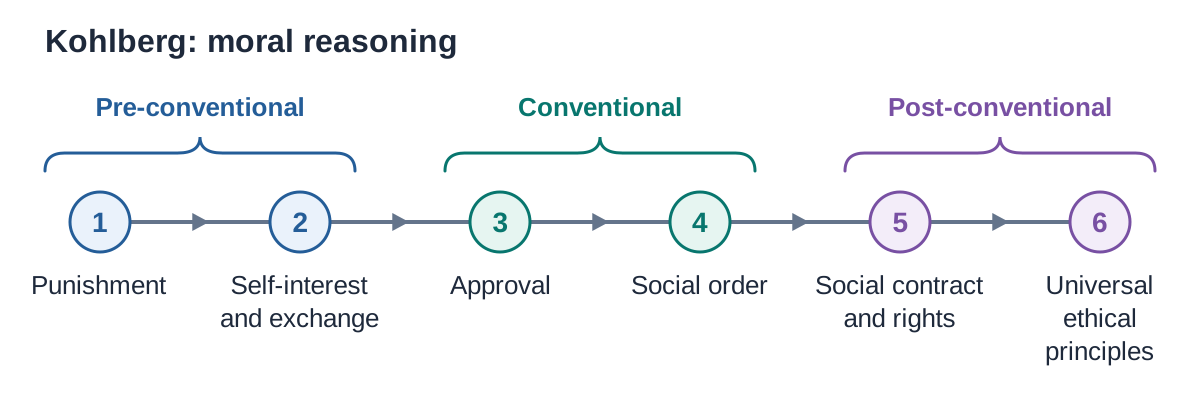
Psychologist Lawrence Kohlberg argued that moral reasoning develops through three levels, each containing two stages:
- Pre-conventional Level (Typical of childhood):
- Stage 1: Obedience and Punishment Orientation. An action is judged wrong simply because it brings physical punishment. The child obeys to avoid pain.
- Stage 2: Individualism and Exchange. Right action is what satisfies one's own immediate needs. It operates on a "you scratch my back, I'll scratch yours" basis.
- Conventional Level (Typical of adolescents and most adults):
- Stage 3: Good Interpersonal Relationships ('Good boy/good girl'). Morality is guided by seeking approval from family and friends. (In Irish textbooks, a conscience that simply copies surrounding expectations is called a mirrored conscience).
- Stage 4: Maintaining Social Order. Right action means doing one's duty, obeying authority, and following the law to keep society stable.
- Post-conventional Level (Moral maturity):
- Stage 5: Social Contract and Individual Rights. Laws are recognised as social agreements made to protect human rights. If a law is unjust or damages human dignity, citizens work to reform it through democratic consensus.
- Stage 6: Universal Ethical Principles. Moral decisions are based on universal ethical principles of justice, equality, and human dignity. A person will follow these principles even if it means breaking civil law or facing severe personal cost.
Informing the Conscience
An informed conscience is a moral judgment educated through critical thinking, factual evidence, prayer, and dialogue with moral traditions. Because conscience can be distorted by prejudice or ignorance, informing it is a lifelong duty. People inform their conscience by examining reliable facts, consulting religious texts and leaders, studying moral philosophy, and listening carefully to those affected by their choices.
Key Terms: Amoral, Immoral, and Moral Immaturity
- Amoral: Lacking the cognitive ability or moral awareness to understand right and wrong, such as an infant or someone with severe cognitive impairment.
- Immoral: Knowing what is morally right or wrong, but freely choosing to do what is wrong.
- Moral immaturity: Blindly following rules, peers, or authority figures without personal reflection or genuine conviction.
Conscience in Conflict with Authority
At times, personal conscience clashes with religious or civil authority. A clear modern example is conscientious objection in healthcare. Under Section 22 of Ireland's Health (Regulation of Termination of Pregnancy) Act 2018, a doctor or nurse may refuse on grounds of conscience to carry out an abortion procedure, provided they arrange for the patient's care to be transferred to another doctor. Here, the civil law accommodates personal conscience while still protecting the legal rights of the patient. Here the three authorities can point different ways: civil law permits termination in defined circumstances; Catholic Church teaching forbids taking part in abortion; and an individual doctor or nurse must decide in conscience, which may agree with Church teaching, or may differ from it in the case of a person who disagrees with their church's position.
Moral Principles and Theories
When making serious ethical decisions, philosophers and traditions use distinct methods to judge right and wrong.
Three Core Theories
- Deontological Ethics: Associated with Immanuel Kant (1724–1804). The basic guiding question is: "What is my duty, regardless of the consequences?" Kant taught the categorical imperative: act only according to principles you could want to become universal laws, and treat every human being as an end in themselves, never merely as a means to an end.
- Utilitarianism: A consequentialist (outcome-based) theory formulated by Jeremy Bentham and John Stuart Mill. The basic guiding question is: "What action produces the greatest good for the greatest number?" Right and wrong are decided solely by the overall happiness or reduction of suffering that follows an act.
- Virtue Ethics: Traced back to Aristotle (384–322 BC). The basic guiding question is: "What would a virtuous person do in this situation?" It focuses on character rather than isolated rules or calculations. Aristotle described virtue as the golden mean—the balanced path between two extremes (for example, courage is the mean between cowardice and recklessness).
The Principle of Double Effect
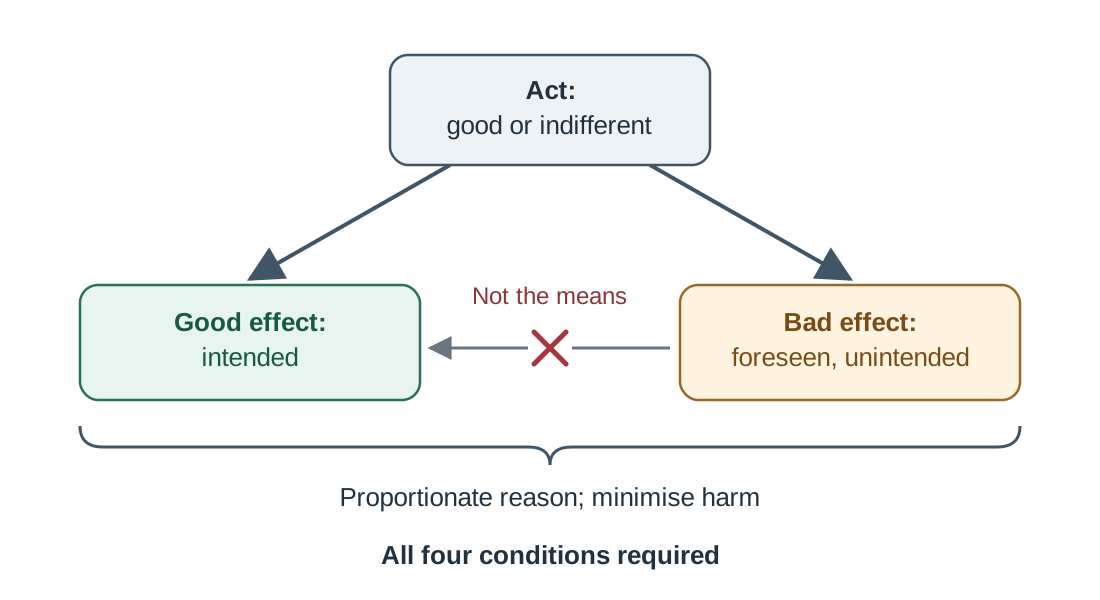
The Principle of Double Effect originated in Thomas Aquinas's discussion of self-defence, and was later developed into four conditions by Catholic moral theologians. It determines whether an action is permissible when it produces both a good effect and an unavoidable bad side effect. All four conditions must be met:
- Nature of the act: The act itself must be morally good or indifferent. It cannot be intrinsically evil.
- Proper intention: The person must intend only the good effect. The bad effect may be foreseen, but it cannot be desired as an end.
- Means and ends: The bad effect must not be the means used to achieve the good effect. A good end cannot justify an immoral means.
- Proportionality: There must be a grave, proportionate reason for permitting the foreseen bad effect, and reasonable effort must be made to minimise harm.
Decision-Making in Action: Two Higher Level Applications
At Higher Level, you must demonstrate how a morally mature person makes serious decisions, applying the process across two different areas of human experience.
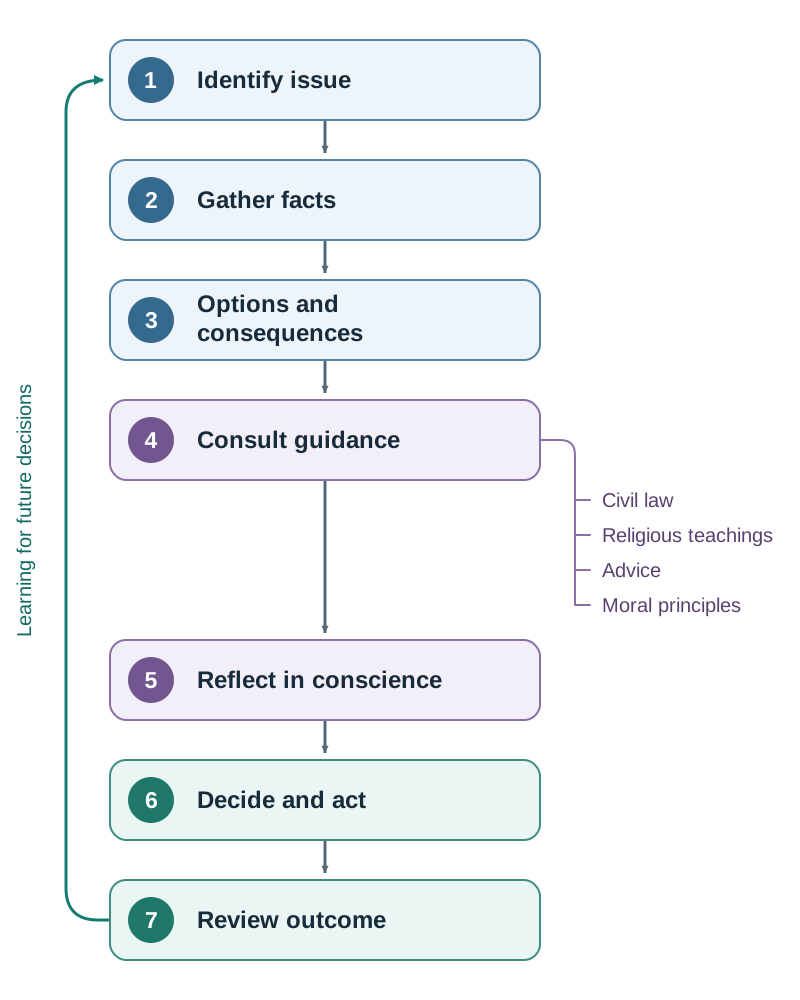
The Decision-Making Process for a Morally Mature Person
- Identify the issue: Define the ethical problem clearly and determine who is affected.
- Gather the facts: Obtain accurate, objective information rather than relying on rumours or assumptions.
- Consider the options and consequences: Work out the available choices and predict their short- and long-term effects on all parties.
- Consult sources of guidance: Examine the civil law, consult religious teachings, seek advice from trusted people, and test options against moral principles.
- Reflect in conscience: Pause, pray or meditate, and examine personal motives honestly.
- Decide and act: Make the decision with conviction and carry it out with integrity.
- Review: Evaluate the outcome afterwards and learn from the experience.
---
Example 1: Political and Economic Questions (Carbon Taxation and Poverty)
Should the State continue to increase carbon tax on domestic heating fuels to tackle climate change, when this increases costs for low-income families?
Applying the process: A morally mature person identifies the issue (climate duty vs fuel poverty), gathers objective facts (the tax trajectory and who pays), weighs options and consequences, consults civil law and religious traditions (below), reflects in conscience, decides, and reviews the outcome.
- Civil Law (Ireland): Ireland introduced carbon taxation through measures including the Finance Act 2010. The later Finance Act 2020 set a schedule of annual increases toward €100 per tonne by 2030. Government has committed part of the carbon tax revenue each year, through the Budget, to home energy retrofits and increases in the Fuel Allowance and other supports for low-income households.
- Two Religious Traditions:
- Roman Catholicism: Pope Francis (Laudato Si', 2015) emphasises care for our common home alongside the preferential option for the poor. Catholic Social Teaching argues that environmental protection and social justice are inseparable. Economic policies must protect the earth without placing an unfair burden on those least able to pay.
- Islam: Islam teaches that humans are trustees of the earth (Khilafah). The Prophet Muhammad prohibited wastefulness. Social justice (Adl) demands that wealth must not circulate only among the rich (Qur'an 59:7). Through mandatory charity (Zakat, set at 2.5% of surplus wealth held above the Nisab threshold), resources must be transferred to the poor. Islam therefore supports environmental protection provided the vulnerable are shielded from economic hardship.
- Conscientious Considerations: The duty to protect future generations from catastrophic global warming; the duty to ensure elderly and low-income neighbours can heat their homes this winter; fairness in how tax burdens are distributed; and personal willingness to reduce energy consumption.
- Different Outcomes and Reasons for Disagreement:
- Outcome A: A person supports the carbon tax increases, provided all revenues go directly to fuel subsidies and retrofits for the poor, prioritising long-term planetary survival.
- Outcome B: Another person opposes further fuel tax increases until clean heating alternatives are affordable and accessible to every family, prioritising immediate relief from poverty.
- Why they differ: They weigh values differently. Both are morally mature, but one prioritises long-term ecological consequences while the other prioritises immediate economic fairness.
- Application of Three Moral Theories:
- Deontological Ethics: Focuses on universal duties. Applying Kant's categorical imperative, a deontologist could argue that we have a duty not to harm other people, including future generations, by polluting the shared atmosphere, since no one could will pollution as a universal law. However, the State also has an absolute duty not to expose citizens to freezing living conditions. A deontologist demands that social protections be guaranteed before raising fuel taxes.
- Utilitarianism: Calculates outcomes. Raising the tax cuts greenhouse gas emissions, reducing long-term global deaths and displacement from extreme weather. However, taking €200 from a poor family causes severe suffering, whereas taking €200 from a wealthy family causes almost none. A utilitarian supports the carbon tax only if the revenues are redistributed to prevent net suffering among low-income households.
- Virtue Ethics: Asks what kind of society this policy creates. It calls for the virtues of stewardship, prudence, and justice toward future generations, while rejecting the vices of corporate greed and indifference to the poor.
---
Example 2: Medical Ethics (Assisted Dying / Voluntary Euthanasia)
Should the law allow a doctor to assist a terminally ill person in ending their life to relieve severe suffering?
Applying the process: A morally mature person identifies the issue (relief of suffering vs protection of life), gathers accurate facts (the patient's prognosis, what palliative care can offer, the current law), weighs the options and their consequences, consults civil law and religious traditions (below), reflects honestly in conscience, decides, and later reviews the decision.
- Civil Law (Ireland): Assisting a suicide is a serious criminal offence in Ireland under Section 2(2) of the Criminal Law (Suicide) Act 1993, carrying a maximum sentence of 14 years' imprisonment. The Irish Supreme Court upheld the constitutional validity of this absolute ban in Fleming v Ireland (2013). In 2024, an Oireachtas Joint Committee recommended legalising assisted dying under strict conditions; that recommendation did not itself change the law. Check for subsequent legislative changes when using this example for the 2027 exam.
- Two Religious Traditions:
- Roman Catholicism: Teaches that all human life is sacred from conception to natural death. Directly causing death is always morally wrong. However, the Church allows patients to refuse extraordinary or burdensome medical treatments that merely prolong dying. Furthermore, doctors may administer high doses of pain relief that foreseeably shorten life, as long as the intention is to alleviate pain and not to cause death (an application of the Principle of Double Effect). The Church strongly advocates for high-quality hospice and palliative care.
- Islam: Teaches that life is a sacred trust (amanah) from Allah, who alone determines the moment of death: "Do not kill yourselves" (Qur'an 4:29). Active euthanasia and assisted suicide are forbidden (haram). Suffering borne with patience (sabr) is believed to have spiritual meaning, and families have an absolute duty to care for sick relatives.
- Conscientious Considerations: Compassion for a dying person enduring intractable pain; respect for patient autonomy; fear of subtle pressure on vulnerable, disabled, or elderly patients who might feel like a burden; and the traditional medical commitment to "do no harm".
- Different Outcomes and Reasons for Disagreement:
- Outcome A: A mature person concludes that voluntary assisted dying should be legalised with strict safeguards, believing that personal autonomy and relieving agony outweigh other concerns.
- Outcome B: Another mature person concludes that the ban must stay in place, arguing that legalising assisted dying weakens societal protections for the elderly and vulnerable, and instead campaigns for universal access to palliative care.
- Why they differ: They hold different foundational values. Person A prioritises individual autonomy and relieving physical suffering, while Person B prioritises the sanctity of life and protecting vulnerable groups in society.
Key terms
- Religion
- A communal system of beliefs, worship, prayer, and ritual practices centred on a relationship with God or the transcendent.
- Morality
- A natural human phenomenon concerning standards, values, and principles that distinguish right from wrong conduct, existing independently of religious belief.
- The Common Good
- The sum total of social conditions that allow individuals and groups in a community to reach their fulfilment and live with dignity.
- Covenant
- A sacred, binding agreement between God and Israel, establishing mutual loyalty and an ethical code of conduct for community life.
- Decalogue
- The Ten Commandments given at Mount Sinai, setting out foundational duties to God and community within the Hebrew Covenant.
- Agape
- Unconditional, self-giving love that seeks the good of others, including enemies, as taught and lived by Jesus of Nazareth.
- Right Relationship
- The biblical concept (dikaiosyne) of living in justice, peace, and mutual respect with God, with other people, and with creation.
- Metanoia
- A deep conversion and change of heart, shifting moral focus from external compliance to authentic personal integrity and compassion.
- Natural Law
- The moral order built into human nature, knowable through human reason, enabling any person to discern fundamental moral truths.
- Informed Conscience
- A mature moral faculty educated and formed through critical reason, factual inquiry, prayerful reflection, and ethical dialogue.
- Amoral
- Completely lacking the cognitive capacity or moral awareness required to distinguish right from wrong, as in an infant.
- Immoral
- Having the capacity and awareness to know what is right, but freely choosing to do what is wrong.
- Deontological Ethics
- An ethical system, associated with Immanuel Kant, that judges the morality of an action by whether it adheres to universal duties and rules, regardless of the consequences.
- Utilitarianism
- A consequentialist ethical philosophy, formulated by Bentham and Mill, holding that the right action is the one that produces the greatest happiness or good for the greatest number.
- Virtue Ethics
- An ethical framework, traced to Aristotle, that focuses on building good moral character and virtues (such as courage, justice, and prudence) rather than following strict rules or calculating outcomes.
- Principle of Double Effect
- An ethical framework rooted in Thomas Aquinas and developed by Catholic moralists, setting out four conditions under which an action with both a good and an unavoidable bad effect is morally permissible.
- Zakat
- The obligatory Islamic charitable payment of 2.5% on surplus qualifying wealth held above the Nisab threshold, serving as a legal and spiritual tool for social justice (Adl).
Check yourself
State one similarity and one difference between a religious person and a moral person.
A similarity is that both are guided by deeply held values and belong to communities that shape those values. A difference is that a religious person's morality is rooted in faith, scripture, and a relationship with God, whereas a moral person may ground their values in human reason and empathy alone.
Give one example of a person who is religious but acts immorally, and one of a person who is moral but not religious.
A religious person acting immorally is an employer who attends church every Sunday but exploits their workers. A moral person who is not religious is an atheist who volunteers regularly in a hospice or food bank out of compassion for others.
Outline the religious, social, and cultural context of the Sinai Covenant.
Religiously, it was a response of gratitude for God's liberation of Israel from Egypt; socially, it gave wandering desert tribes clear rules to protect life, family, and property; culturally, it adopted the ancient Near Eastern suzerain-vassal treaty format, but with God as the King and all citizens treated equally.
Explain the difference between amoral and immoral using an example.
An amoral agent lacks the capacity to know right from wrong, like a six-month-old infant pulling someone's hair. An immoral agent understands right and wrong but freely chooses to do wrong, like an adult stealing a wallet.
State the guiding principle of Utilitarianism as a question.
"Which action produces the greatest happiness or good for the greatest number of people?"
How does Irish civil law balance private property rights with the common good?
Article 43.1 recognises the right to private ownership. Article 43.2 says the exercise of property rights ought to be regulated by the principles of social justice and permits the State to delimit that exercise by law to reconcile it with the common good.