

This note covers what Muslims believe about God, how God communicates through divine revelation, what it means to be human, and how people attain salvation. It also examines how the Muslim community is organised and led from local mosques to global networks, preparing students for Section A and Section C of the Leaving Certificate Higher Level examination.
Islamic Monotheism: Tawhid, Revelation, and the Purpose of Life
At the core of Islamic faith is Tawhid, the belief in the absolute and indivisible oneness of God (Allah). Allah has no partners, equals, or offspring. In Islamic theology, associating anything created with the divine is called shirk, and it is considered the most serious theological error.
Islamic belief balances God's utter transcendence with intimate closeness:
- Transcendence: Allah exists beyond time, space, and human imagination. Nothing in creation is like Him (Surah 112: Al-Ikhlas). For this reason, any visual or physical depiction of Allah is strictly forbidden.
- Immanence and Mercy: While supreme and transcendent, Allah is also intimately close to human beings, described in scripture as closer to a person than their own jugular vein (Surah 50:16). Allah is described by ninety-nine "Beautiful Names" (al-Asma' al-Husna), such as al-Rahman (the Most Gracious) and al-'Adl (the Just). Every chapter of the Qur'an except Surah 9 opens with the Bismillah: "In the name of Allah, the Most Gracious, the Most Merciful".
The Six Articles of Faith (Iman)
Sunni theology summarises core beliefs into six articles of faith:
- Allah: the one unique Creator and Sustainer.
- Angels: divine messengers and servants, such as the Archangel Jibril (Gabriel) and the two recording angels, the Kiraman Katibin ("the noble writers").
- Revealed Books: scriptures sent by God, including the Tawrat (Torah) given to Musa, the Zabur (Psalms) to Dawud, the Injil (Gospel) to Isa, and the Qur'an given to Muhammad.
- Prophets: messengers sent to every nation, beginning with Adam and ending with Muhammad, the "Seal of the Prophets".
- Day of Judgement (Yawm al-Din): the universal resurrection and moral reckoning.
- Divine Decree (al-Qadr)*: Allah's complete knowledge and sovereignty over all things, existing alongside genuine human free will.
Influence on a Believer's Purpose in Life
Because Allah is all-powerful (al-Qadir) and all-knowing (al-'Alim), the purpose of human life is willing submission (Islam) to His guidance. A Muslim's life centres on worship ('ibadah) in all its forms, obeying moral laws, praying five times daily, giving charity to the needy, and fulfilling their duty as God's trustee on earth.
Divine Revelation (Wahy) and Its Impact on Practice
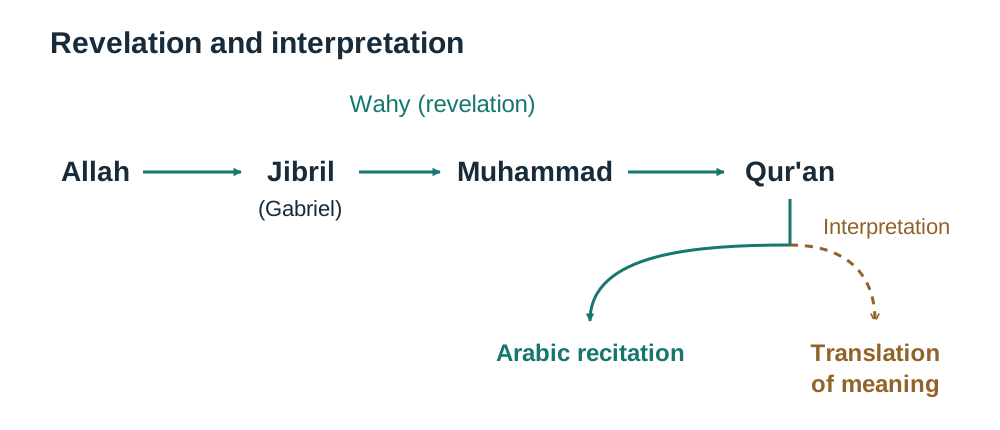
Divine communication in Islam is known as Wahy (divine revelation). Muslims believe Allah communicated His final, uncorrupted message through the Archangel Jibril to the Prophet Muhammad over a period of twenty-three years, beginning in 610 CE in the cave of Hira on the Night of Power (Laylat al-Qadr) with the command: "Iqra!" ("Recite!"; Surah 96).
Because the Qur'an is understood as the literal, verbatim word of Allah dictated in Arabic, this belief directly shapes both Muslim religious practice and text interpretation:
- Recitation in Arabic: The Qur'an must be recited in its original Arabic during daily prayer (Salah), creating unity across Muslims of every language.
- Physical Reverence: Believers perform ritual washing (wudu) before handling the Arabic text. The book is kept on a high, clean shelf and never placed on the floor.
- Memorisation: Memorising scripture is a high spiritual achievement. A person who memorises the entire Qur'an earns the title hafiz (or hafiza for a woman).
- Textual Interpretation: A translation is regarded merely as an interpretation of the text's meaning, not the sacred Qur'an itself. Scholarly explanation of scripture, known as tafsir, must stay faithful to classical Arabic grammar and the living example of the Prophet.
The Human Person and the Vision of Salvation
Islam teaches that people are not born with original sin. Instead, every person enters the world in a state of Fitrah—an innate moral purity and natural spiritual inclination to recognise and worship Allah.
Profile of the Human Person in Islam
- Created Good: Endowed with intellect ('aql) and moral free will (ikhtiyar).
- Appointed as Khalifah: According to Surah 2:30, Allah placed humanity as His khalifah (steward or trustee) on earth. The physical universe belongs to Allah; humans are trusted caretakers who must protect the natural environment, treat animals justly, and build fair societies.
- Servants of God: Every person is an 'abd (servant) of Allah. Their true fulfilment lies in worship ('ibadah): "I did not create jinn and humans except to worship Me" (Surah 51:56).
- Prone to Weakness: Although naturally good, people are prone to forgetfulness (ghaflah), arrogance, and worldly temptation. When a person sins, they can turn directly to God in sincere repentance (tawbah), without needing any human priest or ritual sacrifice.
What Happens After Death: From the Grave to the Day of Judgement
Earthly life is a period of moral testing for the afterlife (Akhirah):
- The Grave: After burial, Islamic tradition holds that two angels, Munkar and Nakir, question the deceased about their Lord, religion, and prophet.
- The Day of Judgement (Yawm al-Din): All human beings are bodily resurrected before Allah. The records written by the Kiraman Katibin* are opened.
- The Scales of Justice (Mizan): Each person's good and bad deeds are weighed on the cosmic scales. Righteous believers whose good deeds outweigh bad actions are rewarded with Jannah (Paradise), a place of eternal peace. Those who rejected truth and persisted in unrepented evil enter Jahannam* (Hell).
- Divine Mercy (Rahmah): Good deeds are essential, but salvation is never viewed as an automatic mechanical entitlement earned by human effort alone. Entry into Paradise ultimately depends on the unearned mercy (rahmah*) and forgiveness of Allah.
Practical Devotion: The Five Pillars of Islam
A Muslim expresses submission through daily conduct, following what is permissible (halal) and avoiding what is forbidden (haram). The central spiritual and ethical framework consists of the Five Pillars of Islam (Arkan al-Islam):
| Pillar | Arabic Term | Meaning and Practice |
|---|---|---|
| Declaration of Faith | Shahada | The core creed: "There is no god but Allah, and Muhammad is the messenger of Allah." Sincere public recitation marks entry into the faith and anchors daily worship. |
| Ritual Prayer | Salah | Five obligatory prayers daily: Fajr (dawn), Zuhr (midday), Asr (afternoon), Maghrib (sunset), and Isha (nightfall). Believers pray facing the Ka'bah in Mecca (the direction is known as the qibla), with standing, bowing, and prostrating embodying total humility before God. |
| Welfare Contribution | Zakat | An obligatory annual contribution of 2.5% of surplus wealth and savings given to support the poor and vulnerable, purifying wealth and reducing inequality. |
| Fasting | Sawm | Total abstinence from food, drink, smoking, and sexual relations from dawn until sunset during the month of Ramadan. Fasting builds self-discipline, gratitude, and empathy with those who are hungry. Ramadan concludes with the festival of Eid al-Fitr. |
| Pilgrimage | Hajj | An annual pilgrimage to Mecca required once in a lifetime for every adult Muslim with the financial and physical means. Millions gather wearing simple white garments (ihram), showing complete human equality before Allah. It takes place during the Islamic month of Dhu al-Hijjah and coincides with Eid al-Adha (recalling Ibrahim's willingness to sacrifice his son). |
Religious Authority, Islamic Law, and Community Leadership
Authority is the recognised right to guide or decide what members of a religion believe and do. Members accept this direction because they believe it comes from a legitimate source.
In Islam, all ultimate authority belongs to Allah alone. This authority reaches the community through four recognised sources, applied in strict hierarchical order:
- The Qur'an: The literal, revealed word of Allah; the primary source that cannot be overridden by any human ruling.
- The Sunnah: The living example, customs, and rulings of the Prophet Muhammad, preserved in textual records called Hadith. Scholars evaluate Hadith critically, grading them from sound (sahih) to weak (da'if).
- Ijma: The consensus of qualified Islamic legal scholars on an issue where primary texts do not provide a direct ruling.
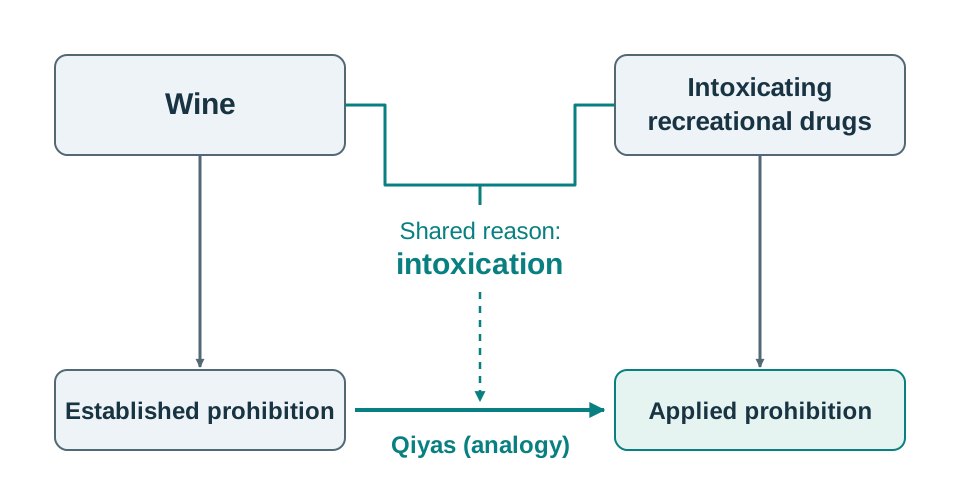
- Qiyas: Reasoning by analogy from an established scriptural ruling to a new situation. For example, because the Qur'an forbids wine because of its intoxicating effect, jurists use qiyas to rule that modern recreational drugs are also forbidden.
Sharia ("the straight path") is the comprehensive moral and legal guidance that scholars derive from these four sources. It covers personal worship, family law, trade ethics, and social justice. Scholars (ulama) and qualified legal specialists (muftis) have authority only because of their learning; a mufti may issue a non-binding legal opinion called a fatwa.
The Sunni and Shi'a Division
When the Prophet Muhammad died in 632 CE, the community had to decide who should lead them:
- Sunni Muslims (roughly 85–90%): The majority accepted Abu Bakr, chosen by community consensus, as the first caliph (successor), followed by Umar, Uthman, and Ali. Sunnis believe community leadership does not need to descend from the Prophet's bloodline. Authority rests on the Qur'an, Sunnah, and scholar consensus.
- Shi'a Muslims (roughly 10–15%): "Shi'a" means the party of Ali. They believe Muhammad designated his cousin and son-in-law Ali as leader, and that legitimate spiritual and political authority belongs exclusively to the Prophet's family (Ahl al-Bayt) through a lineage of divinely guided Imams.
- The largest branch, the Twelvers, honours twelve Imams, believing the twelfth (the Mahdi) is hidden and will return.
- Today, individual Shi'a Muslims choose a senior living jurist, known as a marja' ("source of emulation", often titled Grand Ayatollah), whose rulings on practice they follow.
- Each year on the 10th of Muharram (Ashura), Shi'a communities hold gatherings (majalis) to mourn the martyrdom of Ali's son, Imam Hussein, killed at the Battle of Karbala in 680 CE, marking the occasion with traditional mourning rites (matam).
Community Organisation: Local Mosques and the Global Ummah
The global family of Muslim believers is the Ummah, uniting roughly two billion people across racial, linguistic, and cultural boundaries.
Organisation at the Global Level
Islam has no central worldwide headquarters, supreme council, or universal head. The global Ummah is linked through:
- Shared Worship: Universal adherence to the Five Pillars, facing the Ka'bah, and using Arabic during Salah.
- The Hajj: Gathering around two million pilgrims from every country in Mecca each year.
- Renowned Centres of Scholarship: Ancient universities like al-Azhar in Cairo, whose faculty publish guidance respected across the Sunni world.
- International Consultative Bodies: The Organisation of Islamic Cooperation (OIC), grouping 57 member states to address shared diplomatic and humanitarian matters.
The Local Mosque (Masjid)
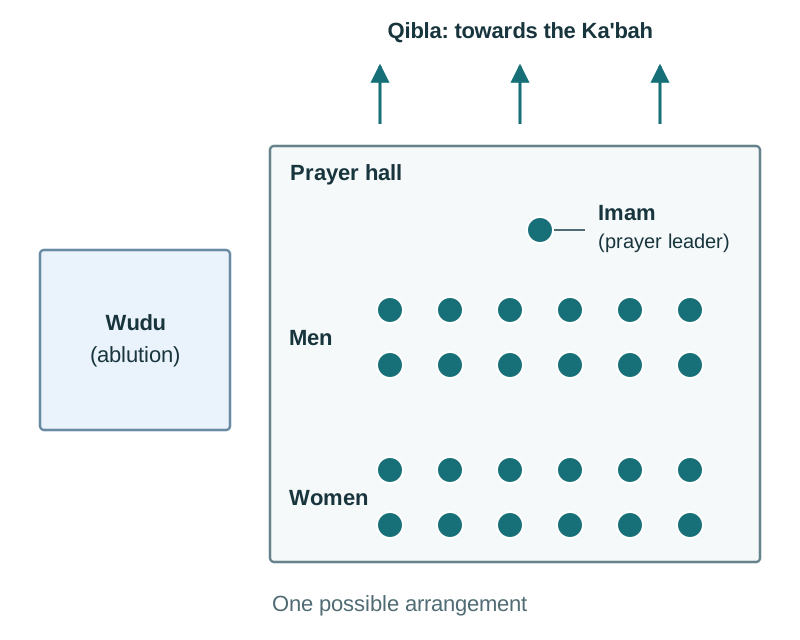
Locally, each mosque operates independently under a committee or trust. Its physical layout reflects Islamic theology:
- Wudu Area: Facilities for ritual ablution before prayer.
- Prayer Hall: An open carpeted area with no pews, statues, or altars. Worshippers pray shoulder-to-shoulder in straight lines behind the Imam, illustrating human equality.
- Modesty Arrangements: Mosques provide separate prayer spaces or position women behind men so that physical prostrations remain modest and focused.
- Friday Prayer (Jumu'ah): Muslim men are required to attend the Friday congregational midday prayer, which includes a sermon (Khutbah*); women may attend or pray at home.
- The Sunni Imam: A respected, educated prayer leader. The Imam is not an ordained priest, has no sacramental power, and cannot forgive sins.
The Irish Context and Relations with the Wider World
Census 2022 recorded about 82,000 Muslims living in Ireland. An important national landmark is the Islamic Cultural Centre of Ireland (ICCI) in Clonskeagh, Dublin (opened 1996). It includes a main mosque, the state-funded Muslim National School, community and educational halls, a restaurant serving halal food, and administrative services. The centre regularly hosts civic leaders, school tours, and inter-faith dialogue events.
Islam recognises Jews and Christians as Ahl al-Kitab ("People of the Book"), honoring their shared heritage of monotheism and prophetic revelation. This theological foundation encourages peaceful civic cooperation and dialogue within diverse modern societies.
Key terms
- Tawhid
- The foundational Islamic doctrine affirming the absolute, indivisible oneness and uniqueness of Allah.
- Shirk
- The sin of attributing partners, rivals, or divine attributes to anything other than Allah; the gravest sin in Islam.
- Wahy
- Divine revelation; the direct transmission of God's uncorrupted speech to prophets, specifically through the Archangel Jibril to Muhammad.
- Fitrah
- The innate, pure disposition with which all human beings are born, naturally inclining them toward belief in God and moral goodness.
- Khalifah
- A steward or trustee appointed by Allah on earth to look after creation responsibly and justly (Surah 2:30).
- Akhirah
- The afterlife; the eternal stage of existence that begins with bodily resurrection and divine judgement.
- Yawm al-Din
- The Day of Judgement, when every resurrected individual is evaluated by Allah based on their intentions, faith, and deeds.
- Mizan
- The cosmic scales of divine justice used on the Day of Judgement to weigh a person's good deeds against their bad deeds.
- Tawbah
- Sincere repentance offered directly to Allah, which cleanses sin without any need for priestly absolution.
- Rahmah
- Divine mercy; the supreme, unearned grace through which Allah forgives human shortcomings and admits believers to Paradise.
- Ummah
- The worldwide community of all Muslim believers, unified across ethnic, cultural, and national boundaries.
- Authority
- The recognised right to guide or decide what members of a religious tradition believe and do, grounded in a legitimate sacred source.
- Sunnah
- The living example, customs, and established practices of the Prophet Muhammad; the second primary source of Islamic law.
- Hadith
- Recorded reports of the sayings, actions, and approvals of the Prophet Muhammad, graded by scholars according to authenticity.
- Ijma
- The unanimous consensus of qualified Islamic legal scholars on an issue not explicitly decided by the Qur'an or Sunnah.
- Qiyas
- Analogical reasoning used by Islamic scholars to apply an established legal ruling from scripture to a novel situation.
- Sharia
- The comprehensive body of moral, spiritual, and legal guidance derived by scholars from the Qur'an, Sunnah, Ijma, and Qiyas.
- Caliph
- A historical successor to the Prophet Muhammad as political and administrative leader of the Muslim community.
- Sunni
- The majority branch of Islam (85-90%), which accepted Abu Bakr as the first caliph and bases authority on scripture, tradition, and consensus.
- Shi'a
- The branch of Islam (10-15%) that maintains communal leadership belonged by divine right to Ali and his descendants through the Imams.
- Marja'
- A senior Shi'a legal authority (often a Grand Ayatollah) whose published rulings on religious practice are followed by believers.
- Jumu'ah
- The obligatory congregational midday prayer held in mosques every Friday, accompanied by a sermon (Khutbah).
- Khutbah
- The formal two-part religious sermon delivered by an Imam during Friday Jumu'ah prayers and on Eid festivals.
- Ahl al-Kitab
- "People of the Book"; the Islamic term for Jews and Christians, recognising their monotheistic faith and shared biblical heritage.
Check yourself
What is Tawhid, and what is its theological opposite in Islam?
Tawhid is the absolute oneness and uniqueness of Allah. Its direct opposite is shirk, which is the sin of associating partners or rivals with Allah.
How does the doctrine of Fitrah influence the Islamic understanding of salvation?
Because humans are born morally pure and naturally inclined toward God, they do not inherit original sin or need a divine redeemer. Salvation requires following divine guidance, doing good deeds, and repenting directly to Allah.
What is meant by describing humans as khalifah on earth?
It means humans are appointed as God's stewards or trustees on earth (Surah 2:30), responsible for protecting creation and answering to Allah on the Day of Judgement for how they managed it.
Name the four sources of authority in Islam in order of importance.
1. The Qur'an; 2. The Sunnah (recorded in Hadith); 3. Ijma (scholarly consensus); 4. Qiyas (analogical reasoning).
Why did Sunni and Shi'a Muslims split after 632 CE?
They disagreed over succession after the Prophet Muhammad's death: Sunnis accepted Abu Bakr as caliph based on community consensus, while Shi'as believed leadership belonged to Ali and the Prophet's family (Ahl al-Bayt).
Give two ways the belief that the Qur'an is divine revelation influences how Muslims treat it.
Believers perform ritual washing (wudu) before touching the Arabic text, keep it on a high shelf, recite it in Arabic during prayer, and treat translations only as interpretations.
What role does the Mizan play on the Day of Judgement (Yawm al-Din)?
The Mizan is the cosmic scales of divine justice used by Allah to weigh an individual's recorded good deeds against their bad deeds.