

Section D of Leaving Certificate Religious Education explores how people and communities decide what is right and wrong. Living in a modern pluralist society brings diverse worldviews into contact, sparking moral debates that often pull toward the opposing extremes of fundamentalism and relativism. To resolve these dilemmas, moral thinkers rely on structured ethical theories including virtue ethics, deontology, and utilitarianism. Reaching moral maturity requires understanding the sources that shape personal principles, growing through stages of moral reasoning, developing good habits of character, and exercising moral freedom through ongoing dialogue and an informed conscience (explored further in Topic 4.2).
Morality in a Pluralist Society: Sources of Conflict
A pluralist society brings together people of diverse cultural backgrounds, religious traditions, and secular worldviews. Disagreements naturally arise over public policy and private conduct. A moral conflict happens when opposing groups hold incompatible convictions on what is right or wrong, each convinced of the ethical correctness of their own stance.
You must be able to give two contemporary examples of moral conflict and identify the source of the conflict in each. The syllabus does not set particular examples. Euthanasia and drug policy are two strong choices.
1. The Euthanasia Debate (Assisted Dying)
- Arguments in favour: Supporters argue from compassion and individual autonomy. When a terminally ill patient faces unbearable suffering that cannot be relieved, allowing a peaceful death respects their right to make decisions about their own life and prevents prolonged physical agony.
- Arguments opposing: Opponents appeal to the sanctity of life, holding that human life has intrinsic, inviolable worth from conception until natural death. They highlight the medical principle "first, do no harm" associated with the Hippocratic tradition and raise the slippery slope concern that vulnerable elderly or disabled individuals might feel pressured to end their lives.
- Sources of conflict: A clash of values between personal autonomy and the sanctity of life. Underlying this is a tension between religious views (viewing life as a sacred gift from God) and secular views (prioritising individual choice).
2. Drug Policy and Substance Legalisation
- Arguments in favour: Advocates argue from personal liberty and harm reduction. Adults should have sovereignty over their bodies, and regulating substances removes profits from criminal gangs while treating addiction through healthcare rather than prison.
- Arguments opposing: Opponents argue that legalisation undermines the common good. Wider access risks increased addiction, mental health issues, road accidents, and public healthcare costs.
- Sources of conflict: A fundamental clash between individual liberty and the state's obligation to protect public health and the common good.
Two Extremes: Fundamentalism and Relativism
The syllabus treats fundamentalism and relativism as direct opposites. Fundamentalism claims there is one absolute moral truth possessed entirely by one's own group. Relativism claims there is no objective moral truth at all.
| Feature | Fundamentalism | Relativism |
|---|---|---|
| Core belief | Strict adherence to literal rules, sacred texts, or dogmas as the only truth. | Denial of universal, objective moral standards; morality depends on culture or taste. |
| View of truth | Absolute, singular, and fully known. | Completely subjective and variable. |
| Attitude to dialogue | Refuses dialogue or compromise with other worldviews. | Dialogues without evaluating or challenging moral claims. |
| Main danger | Intolerance, legalism, and authoritarianism. | Moral paralysis and inability to condemn clear injustices. |
Contemporary Examples of Fundamentalism
- Example 1 (Religious): The Taliban in Afghanistan enforce a strict, literal interpretation of Islamic law. Since 2021, this has included banning girls from secondary and university education, rejecting dialogue with differing viewpoints, including many Muslim scholars who reject this reading.
- Example 2 (Religious – biblical literalism): Some groups hold that the creation accounts in Genesis must be read literally as science. They campaign to have this taught in place of evolution in some US schools, rejecting any other reading of the text.
Contemporary Examples of Relativism
- Example 1 (Cultural relativism): Arguing that human rights violations, such as female genital mutilation or denying women basic legal status, cannot be condemned by outside communities because they represent local cultural traditions.
- Example 2 (Individual relativism): A person claiming that illegally downloading media or evading taxes is acceptable for them because "what is right for you is not necessarily right for me, so nobody can judge another."
Moral Theories in Action: Guiding Principles and Thinkers
The syllabus asks you to state the basic guiding principle of a theory either as a question or as a statement. Learn at least three theories well enough to do both.
| Moral Theory & Thinker | Guiding Question & Statement | How It Decides Right and Wrong |
|---|---|---|
| Virtue Ethics<br>(Aristotle) | Question: "What kind of person will I become if I do this?"<br>Statement: "Act as a person of virtuous character would act." | Focuses on character. Right actions flow from cultivating good habits (virtues) aimed at eudaimonia (human flourishing) by finding the golden mean. |
| Deontological Ethics<br>(Immanuel Kant) | Question: "Is this action my moral duty, regardless of results?"<br>Statement: "Fulfil your moral duty, regardless of the consequences." | Duty-based ethics. Uses Kant's categorical imperative: act only on principles you could will to become universal laws, and treat people as ends, never merely as means. |
| Utilitarianism<br>(Jeremy Bentham, John Stuart Mill) | Question: "Which choice produces the greatest good for the greatest number?"<br>Statement: "Act always to maximise overall happiness and minimise pain." | Consequentialist theory. Evaluates actions strictly by net outcomes. Bentham measured pleasure quantitatively; Mill distinguished higher intellectual pleasures from lower bodily ones. |
| Teleological Ethics<br>(Broad philosophical family) | Question: "What end or goal will this action achieve, and is it good?"<br>Statement: "Judge the morality of an action by the purpose (telos) it fulfils." | Judges rightness by the end or outcome achieved. Utilitarianism is one specific branch of teleological ethics. |
| Hedonism<br>(Epicurus) | Question: "Which choice brings the most pleasure and least pain?"<br>Statement: "Pleasure is the highest good and pain the greatest evil." | Epicurus taught that the highest pleasures are calm, stable, and lasting—such as friendship, simple living, and freedom from mental anxiety—rather than crude indulgence. |
| Modern Perspectives on Natural Law (rooted in St Thomas Aquinas) | Question: "Does this action align with reasoned human nature?"<br>Statement: "Do good and avoid evil using reason to guide human nature." | Discovers objective moral principles through human reason reflecting on natural human inclinations toward life, truth, society, and flourishing. Modern natural law thinkers use reason to apply Aquinas's first principle, 'do good and avoid evil', to present-day situations, asking what truly helps human beings to flourish. |
| Right Relationship<br>(Judeo-Christian tradition) | Question: "Does this choice build right relationship with God, myself, others, and the earth?"<br>Statement: "Live in loving harmony with God, self, neighbour, and creation." | Rooted in biblical covenant and Jesus' commandment of love (Mark 12:30–31). Evaluates actions by whether they heal, nurture, or fracture communal and ecological trust. |
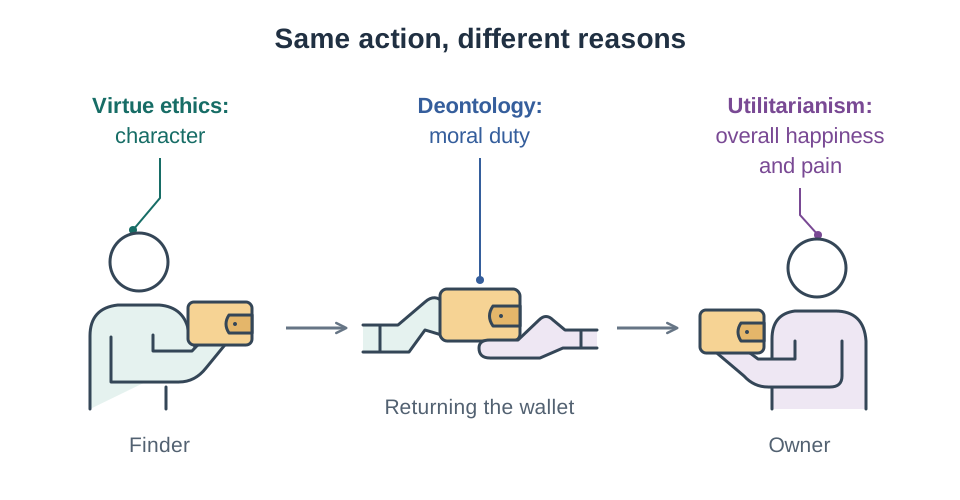
Tip: You only need three of these seven theories for the syllabus, but exam questions give a list and ask you to choose. Learn three thoroughly (guiding principle, named thinker, example choice, strength and weakness) rather than seven thinly.
One Choice, Seven Theories: A Found Wallet with €200 and ID
- Hedonism: Returning it brings peace of mind and avoids the fear of being caught.
- Utilitarianism: The owner's relief and retained identity documents produce greater net happiness than the finder's short-term gain.
- Deontological ethics: Returning it fulfils the universal moral duty not to steal, regardless of whether anyone saw you find it.
- Teleological ethics: Returning the wallet fulfils the good end of building social trust and honesty.
- Virtue ethics: An honest and just person returns the property, strengthening their personal character.
- Natural law: Reason shows that respecting private property is necessary for people to live together peacefully.
- Right relationship: Returning the wallet restores trust between neighbours and shows respect for the community.
Virtue Ethics in Contemporary Life
Most ethical systems ask "What should I do?" Virtue ethics asks "What kind of person should I be?" It prioritises character over mechanical rulebooks.
Aristotle's Account of Virtue
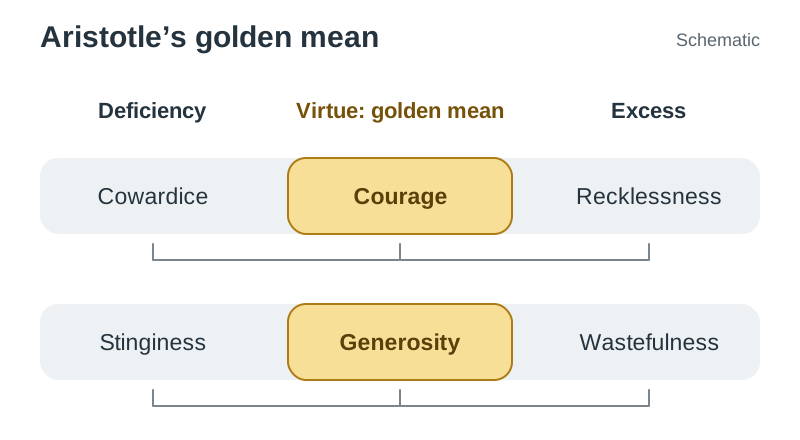
Aristotle taught that virtue is not innate; we become virtuous by habit, repeatedly choosing good actions until they become second nature: "we become just by doing just acts, brave by doing brave acts." He identified the golden mean: every moral virtue represents a balanced middle ground between two vices—one of deficiency and one of excess.
- Courage is the mean between cowardice (deficiency) and recklessness (excess).
- Generosity is the mean between stinginess (deficiency) and wastefulness (excess).
The goal of cultivating virtue is eudaimonia, meaning authentic human flourishing. The Christian tradition later incorporated four cardinal virtues rooted in this approach: prudence, justice, fortitude (courage), and temperance.
Applying Virtues in Contemporary Life
- Justice: The habit of giving each person their due. A student practises justice in a contemporary setting by speaking up when a peer is unfairly excluded from a social group chat or bullied online, defending fairness at personal social cost.
- Temperance (Balance): The habit of exercising moderation across competing appetites and demands. A student practises temperance by balancing intensive study schedules with sleep, nutrition, and exercise, or by exercising discipline with alcohol and social media use.
Moral Development, Freedom, and Moral Maturity
Moral principles are core values that guide ethical judgements. They develop over a lifetime through six key sources: family, peers, culture, the media (e.g. the #MeToo movement challenging cultural acceptance of sexual abuse), religion and spirituality, and personal life experiences.
These sources can influence the reasons behind a choice. A family that stresses honesty may encourage a young person to return money found in a shop. Friends who challenge exclusion can encourage someone to include a classmate. A religious teaching such as loving your neighbour can guide a believer to help a person in need. These influences help shape moral principles; they do not remove the need to think and choose responsibly.
Growing in Morality: Lawrence Kohlberg's Stages
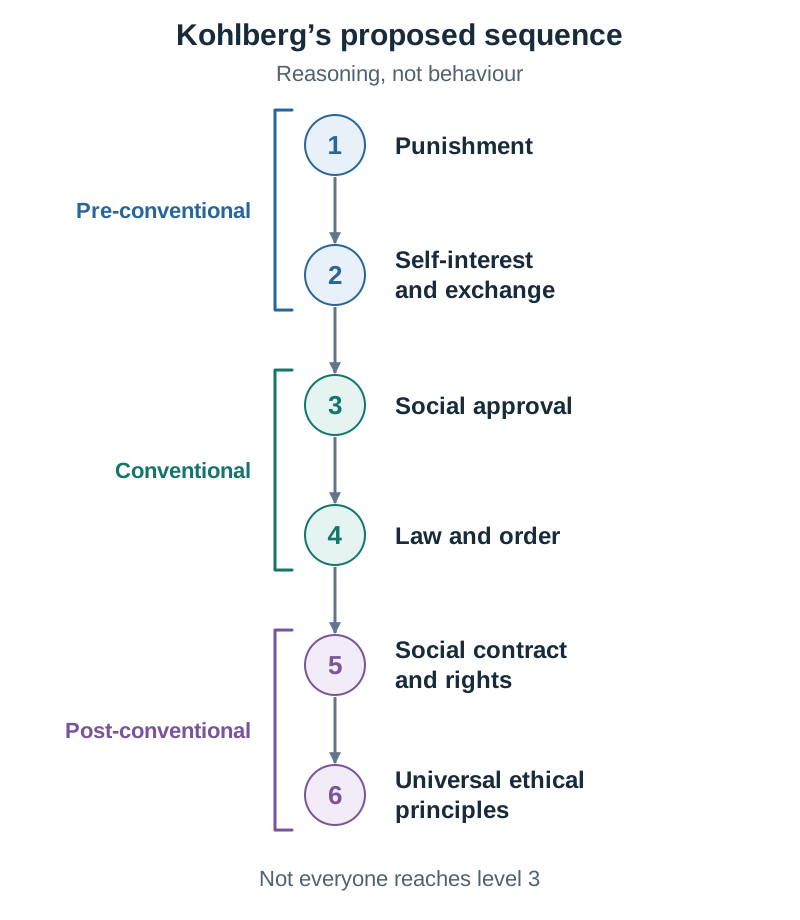
Lawrence Kohlberg argued that people progress through three levels of moral reasoning, each containing two stages. What matters is why a person acts, not merely what they decide.
- Level 1: Pre-Conventional (typical of young children)
- Stage 1 (Punishment and obedience): Right is avoiding punishment ("I will not copy homework because I might get detention").
- Stage 2 (Individual instrumental purpose): Right is serving personal interests through fair exchange ("I will help you if you let me borrow your game").
- Level 2: Conventional (most adolescents and adults)
- Stage 3 (Interpersonal conformity): Right is meeting social expectations and seeking peer approval ("I will dress this way so my friends accept me").
- Stage 4 (Law and order): Right is obeying social authority and maintaining social order ("The law must be obeyed unconditionally, or society collapses").
- Level 3: Post-Conventional (reached by some adults)
- Stage 5 (Social contract and individual rights): Laws are social agreements meant to serve human welfare and can be challenged democratically if unjust.
- Stage 6 (Universal ethical principles): Guided by self-chosen principles of universal justice and human dignity (such as Martin Luther King Jr. disobeying segregation laws).
Critique by Carol Gilligan: Gilligan challenged Kohlberg because his original study included only male participants. She argued that men tend toward an ethic of abstract justice and rules, whereas women often approach morality through an ethic of care, prioritising relationships, empathy, and mutual responsibility.
Moral Freedom and Maturity
Moral freedom is the ability to choose, through reason and conscience, what is right, free from unthinking habit, social manipulation, or fear of punishment, and to accept responsibility for that choice. It is not licence to do whatever one wants.
- Freedom from: Inner limits (addiction, panic) and outer limits (coercion, lack of information) that reduce moral responsibility.
- Freedom for: Directing personal liberty toward choosing the good and fostering personal growth.
A morally mature person displays distinct characteristics: they exercise moral freedom, form an informed conscience, take personal responsibility for their choices, balance individual rights with the common good, and commit to ongoing individual and community dialogue when handling difficult issues.
Key terms
- Moral Conflict
- A serious disagreement where opposing individuals or groups hold fundamentally incompatible convictions about what is right and wrong.
- Fundamentalism
- A rigid moral stance demanding strict adherence to literal rules or sacred texts, rejecting dialogue, compromise, or historical context.
- Relativism
- The philosophical position that objective, universal moral standards do not exist, making right and wrong dependent on personal preference or cultural customs.
- Virtue
- A habitual and firm disposition of character to deliberately choose and perform what is morally good.
- Virtue Ethics
- An ethical framework focusing on the character, habits, and intentions of the moral agent, aimed at achieving eudaimonia (human flourishing).
- Golden Mean
- Aristotle's principle that moral virtue is the balanced middle state between the opposing vices of excess and deficiency.
- Deontological Ethics
- A duty-based ethical framework holding that actions are intrinsically right or wrong based on whether they fulfil moral obligations, regardless of consequences.
- Categorical Imperative
- Immanuel Kant's central moral principle: act only on rules you could rationally will to become universal laws, treating people as ends and never merely as means.
- Utilitarianism
- A consequentialist moral theory holding that the right action is the one that produces the greatest balance of happiness or wellbeing for the greatest number.
- Moral Freedom
- The capacity to choose the good using reason and conscience, free from external force or unthinking habit, and to take responsibility for that choice.
- Right Relationship
- An ethical approach assessing moral goodness by whether an action builds, preserves, and restores harmony with God, oneself, other people, and the earth.
- Eudaimonia
- The Greek concept of ultimate human flourishing, happiness, and living well, identified by Aristotle as the goal of a virtuous life.
Check yourself
According to Aristotle, how does a person become virtuous?
By habit, repeatedly choosing and practising good actions until they become established traits of character.
Whose pleasure counts in hedonism compared to utilitarianism?
Hedonism evaluates pleasure from the perspective of the individual actor, whereas utilitarianism impartially weighs the pleasure and pain of everyone affected.
A teenager says, 'I won't cheat on the exam because my friends would think less of me.' Which Kohlberg stage is this?
Stage 3 (interpersonal conformity, conventional level), because the moral reasoning is motivated by securing peer approval.
What is the key difference between fundamentalism and relativism regarding moral truth?
Fundamentalism claims that absolute moral truth is entirely known and held by its own group, while relativism denies the existence of any objective moral truth.
What criticism did Carol Gilligan make of Lawrence Kohlberg's stages of moral development?
She pointed out that his research was conducted exclusively on males, arguing that he undervalued an 'ethic of care' rooted in relationships and mutual responsibility.