

People in every age ask what life is for, what is good and evil, and why we suffer. This topic explores how those perennial questions surface in contemporary culture, as well as the cultural distractions and indifference that can block them. It then traces how philosophy emerged in ancient Greece with the Sophists, Socrates, Plato, and Aristotle, before examining how the philosophical search for meaning shifted across major historical moments from the mediaeval world to the modern era.
The Contemporary Context: Three Perennial Questions
The human search for meaning is common to all people across all eras. In our culture today, this search continues to express itself through three enduring questions:
The Goal and Purpose of Life
People regularly wonder why they are here and what makes a life worthwhile. Popular culture often mirrors this search for identity and purpose:
- Billie Eilish, "What Was I Made For?" (2023): Written for the film Barbie, this song directly asks what the singer's life is for and whether she has a genuine identity beyond the expectations and roles projected onto her by others.
- The film Dead Poets Society: The English teacher, John Keating, urges his students to embrace carpe diem* ('seize the day') and lead extraordinary, deliberate lives rather than passively drifting into careers chosen for them by others.
The Meaning of Good and Evil
Modern societies constantly debate whether moral rules are universal truths or merely human agreements. This tension appears clearly in literature and cinema:
- Christopher Nolan's film Oppenheimer (2023):* J. Robert Oppenheimer directs the creation of the atomic bomb to end World War II, but is subsequently haunted by guilt over the catastrophic destruction unleashed. The film asks whether actions taken for an apparently good outcome can still be morally evil.
- William Golding's novel Lord of the Flies:* When ordinary schoolboys are left stranded on an island without adult supervision, their social order rapidly collapses into cruelty, violence, and murder. The story asks whether evil is an external corruption or something rooted inside human nature itself.
The Experience of Suffering
Suffering is unavoidable, and it shatters our assumptions about fairness and safety. When innocent people suffer, it forces us to ask why:
- Seamus Heaney's poem "Mid-Term Break": Heaney recounts returning home from boarding school after his four-year-old brother was killed in a road accident. The stark final line—"A four-foot box, a foot for every year"—captures how sudden, unearned tragedy forces the living to confront the painful mystery of innocent suffering.
- C.S. Lewis's book A Grief Observed:* Written in a personal journal after his wife died of cancer, Lewis openly records his anger, doubt, and sorrow, asking how a loving God could allow such agony, before slowly working towards a chastened, deeper faith.
Cultural Blocks and the Phenomenon of Indifference
While the capacity to reflect is universal, specific dynamics in contemporary society can stifle or block the search for meaning:
- Consumerism: Modern marketing frequently ties human dignity and happiness to wealth, brand identity, and possessions. This creates an illusion that buying goods can satisfy inner longings, keeping attention fixed on acquiring things rather than examining one's life.
- Constant distraction and digital saturation: Notifications, algorithmic social media feeds, and fast-paced work leave little quiet space for sustained reflection. Introspection and solitude are replaced by continuous entertainment.
The Phenomenon of Indifference
Indifference towards the search for meaning is not the same as intellectual atheism. An atheist has considered the question of God and answered negatively. Indifference, by contrast, is a lack of interest in the big questions of life. It takes two common forms:
- Religious rituals kept only as social occasions: Many families continue to mark major milestones—such as baptisms, First Communions, and church weddings—purely as family parties or social traditions. The outward ceremonies remain, but the participants never stop to ask what the ritual actually says about the meaning of their lives.
- Living for the next distraction: When daily life becomes an unbroken cycle of work, streaming television, gaming, and weekend socialising, a person may never pause to ask what their life is ultimately about. They are not opposed to religion or philosophy; the questions simply never arise because their days are already filled with immediate stimuli.
Practical Secularism
This functional disregard leads to practical secularism: organising daily routines, career ambitions, and relationships entirely detached from any overarching moral, philosophical, or spiritual framework, treating deeper existential questions as irrelevant to everyday survival.
The Birth of Philosophy: Nature, Purpose, and the Sophists
The word philosophy comes from the Greek philo (love) and sophia (wisdom), meaning 'the love of wisdom'.
- Its nature: Philosophy uses systematic human reason and logical argument to investigate reality, truth, morality, and how we ought to live.
- Its purpose: Philosophy enables people to search for meaning and values by critically evaluating claims for themselves, rather than unthinkingly accepting myth, custom, or political authority.
While religion and philosophy frequently address the same fundamental questions—such as the purpose of human existence—their methods differ. Religion relies on divine revelation and faith, whereas philosophy depends on human reason and rational debate.
The Sophists in Athenian Society
In the fifth century BCE, Athens was a direct democracy where citizens debated legislation in the public Assembly and represented themselves in legal disputes before the law courts. Political power and legal survival required persuasive speech. In response to this demand, the Sophists emerged as itinerant professional educators who charged substantial fees to train ambitious young men in rhetoric, the craft of persuasive public speaking.
- Moral relativism: The Sophists claimed that moral codes, laws, and religious customs were not universal, eternal truths, but human conventions (nomos) that varied from city to city. What was considered just in Athens might be considered unjust in Sparta. The Sophist Protagoras expressed this stance in his famous maxim: "Man is the measure of all things."
- Rhetoric over truth: Prominent Sophists such as Gorgias taught that masterly speech could convince an audience of virtually any position, regardless of whether it was objectively true or morally good.
Socrates and Plato severely criticised the Sophists because they charged money for wisdom, prioritised winning arguments over finding objective truth, and reduced morality to subjective opinion. This gave rise to the term 'sophistry', meaning clever but deceptive argument. Nevertheless, the Sophists were pivotal in the development of thought: they forced Athenians to question inherited assumptions and provoked Socrates and Plato to demonstrate that objective truth and virtue do exist.
Classical Athenian Philosophy: Socrates, Plato, and Aristotle
These three thinkers, each taught by the one before, shaped how Western thought answers two big questions: what is real, and how should we live?
Socrates (c. 469–399 BCE)
Socrates wrote nothing himself; his teaching survives through the dialogues of his student Plato. He rejected Sophist relativism, maintaining that objective moral truth exists and can be uncovered using human reason.
- The moral good and virtue (arete):* Socrates taught that the central purpose of human life is the care of the soul. He argued that 'the unexamined life is not worth living.' In his view, virtue is knowledge: if a person truly understands what is good, they will do it. Consequently, wrongdoing is the result of moral ignorance. He insisted that committing an injustice harms one's own soul far more than suffering an injustice at the hands of another.
- The importance of essences: Socrates was not satisfied with individual examples of good actions; he sought the universal essence or definition of moral concepts. Using the Socratic method, he asked a series of probing questions (such as "What is justice?" or "What is courage?") to expose internal contradictions in common assumptions and arrive at an unchanging definition.
- Why his ideas were important: Socrates turned philosophy away from cosmological speculation about the physical universe and established ethics as its primary focus, making reasoned self-examination and moral integrity central to Western culture; his search for universal definitions (essences) prepared the way for Plato's Theory of Forms.
Plato (c. 428–348 BCE)
Plato addressed how unchanging, absolute truths could exist when the material world around us is constantly decaying and changing.
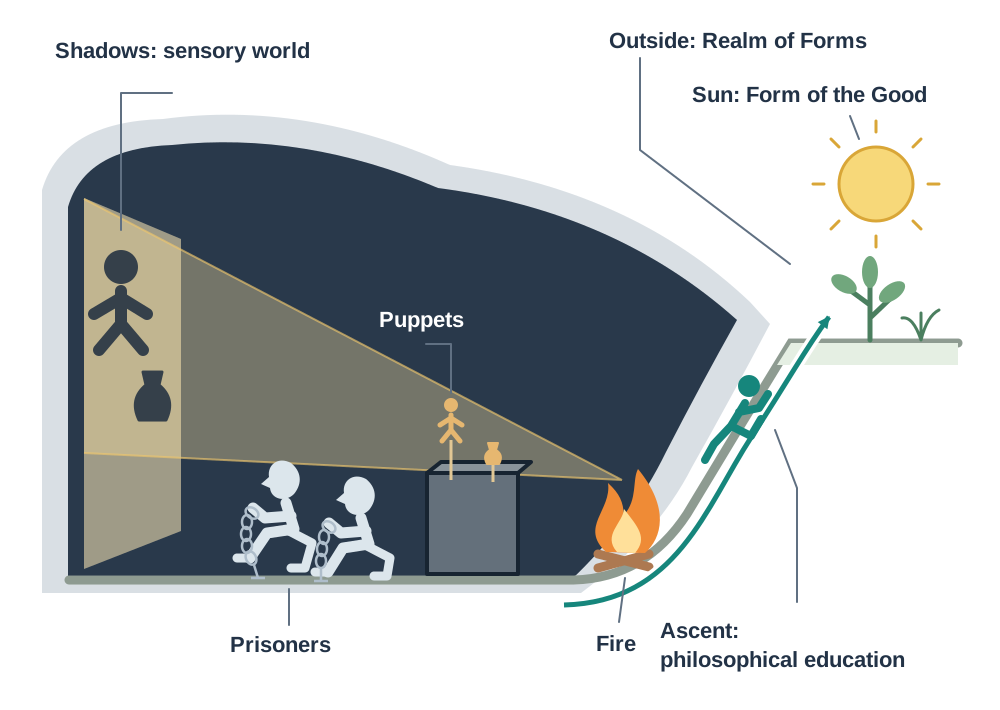
- The Theory of Forms: Plato argued that reality has two levels. The physical world perceived through the senses is imperfect, temporary, and in flux. True reality exists in an immaterial Realm of Forms—eternal, perfect blueprints of all things. A circle drawn in the sand is merely a flawed, temporary copy participating in the perfect, transcendent Form of Circularity. Above all other Forms stands the Form of the Good, the ultimate source of truth, order, and moral value.
- Dualism of human nature: Plato taught that a human being consists of two separate elements: a mortal physical body and an immortal, rational soul (psyche). The soul belongs to the Realm of Forms before birth. Bodily appetites pull the soul downward, whereas philosophical reasoning frees the soul to grasp divine truth.
- The Allegory of the Cave (from the Republic):* Plato asks us to imagine prisoners chained inside a dark cave, facing a wall. Behind them, a fire casts shadows of puppet figures onto the wall. Having seen nothing else, the prisoners believe the shadows are the true reality. When one prisoner escapes into the sunlight outside, he is at first blinded, but gradually sees real plants, trees, and eventually the sun itself. In this allegory, the shadows represent the physical world known through our senses; the climb represents philosophical education; the outside world represents the Realm of Forms; and the sun represents the Form of the Good.
- Why his ideas were important: Plato established philosophical idealism, asserting that truth is intellectual rather than purely material. His dualism between body and soul heavily influenced early Christian theology and European thinking about the spiritual life.
Aristotle (384–322 BCE)
Aristotle studied under Plato for twenty years, but rejected the idea of a detached Realm of Forms, insisting that truth must be discovered by observing the physical world.
- Matter and form (hylomorphism): Aristotle argued that physical objects are an inseparable union of matter (hyle, the raw material) and form (morphe, the design or structure that gives it an identity). A bronze statue cannot exist without both the bronze (matter) and the shape of the figure (form). The form does not reside in another realm; it exists inside the physical object itself.
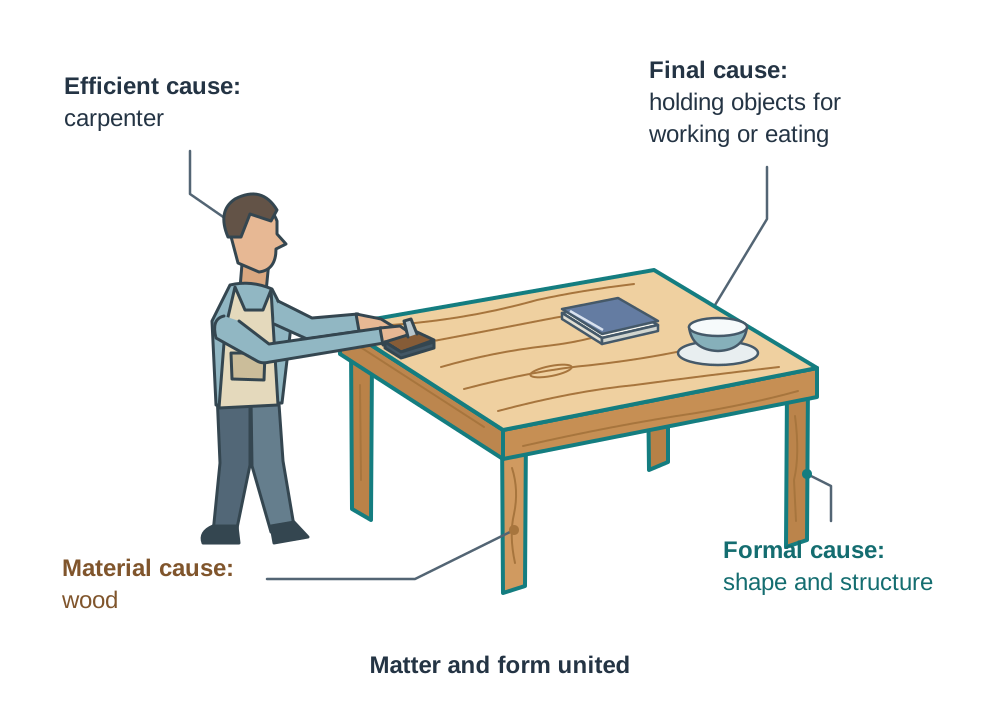
- Teleology and the four causes: Aristotle observed that everything in nature moves toward an inbuilt goal or purpose (telos). For humans, our ultimate purpose is eudaimonia (human flourishing or complete fulfilment), which we attain by practising intellectual and moral virtues guided by reason. To understand anything scientifically, he argued we must explain its four causes (using a wooden table as an everyday illustration):
- Material cause: what it is made of (wood).
- Formal cause: its shape and design (a flat top supported by legs).
- Efficient cause: what produced it (the carpenter).
- Final cause: its purpose or goal (to hold objects for working or eating).
- Logic: Aristotle also founded formal logic, developing the syllogism—a structured deductive argument where a conclusion is drawn from two premises (for example: All humans are mortal; Socrates is human; therefore, Socrates is mortal).
- Why his ideas were important: Aristotle established the foundations of biology, systematic observation, and virtue ethics, demonstrating that genuine wisdom comes from investigating the world directly through evidence and reason.
Key Moments in the Development of Philosophical Thought
The syllabus requires students to examine key moments in the development of philosophical thought from the classical to the contemporary period. While official guidelines note that the choice of milestones involves personal preference (specifically highlighting Descartes and modernity), three chronological turning points illustrate this progression:
Chronological Development of Philosophical Thought
| Period / Thinker | Core Concept | Impact on the Search for Meaning |
|---|---|---|
| Classical (c. 469–322 BCE)<br>Socrates, Plato, Aristotle | Objective virtue, Forms, and teleology (telos). | Meaning is discovered by using reason to understand objective reality and achieve human flourishing (eudaimonia). |
| Mediaeval (1225–1274)<br>Thomas Aquinas | Harmonising Christian revelation with Aristotelian reason. | Meaning is found in God; human beings reach beatitude through both rational inquiry and divine grace. |
| Early Modern (1596–1650)<br>René Descartes | Systematic doubt, the cogito, and rational certainty. | Certainty begins within the individual thinking mind rather than with external institutional authority. |
| Late Modern (1844–1900)<br>Friedrich Nietzsche | Cultural death of God, critique of slave morality, the Übermensch. | Inherited religious meaning has collapsed; human beings must courageously create their own values. |
| 20th Century / Contemporary<br>Jean-Paul Sartre | 'Existence precedes essence' (Existentialism). | Humans possess no built-in nature or purpose; we are entirely free and must define our own meaning through choices. |
1. The Mediaeval Synthesis: Thomas Aquinas (1225–1274)
- Key idea: In his major work, the Summa Theologiae, Aquinas demonstrated that Christian faith and human reason are not in conflict; both are gifts from God that work together. Reason allows us to discover natural truths through philosophy and observation, while divine revelation provides supernatural truths (such as the Trinity) that exceed human intellect.
- How this changed the search for meaning: Aquinas adapted Aristotle's teleology to Christianity. He argued that every human action aims at an end, but finite material goods like wealth, honours, and physical pleasure can never fully satisfy the human soul because our capacity for desire is unbounded. The ultimate goal of human life is beatitude—eternal communion with God. Aquinas anchored human meaning firmly in God, insisting that reason and faith walk hand in hand.
2. The Age of Reason: René Descartes (1596–1650)
- Key idea: Amid the seventeenth-century scientific revolution, Descartes sought an unshakeable foundation for human knowledge by using methodic doubt—temporarily doubting everything that could possibly be false. He noted that our senses can deceive us (through optical illusions or dreams), and even postulated an 'evil demon' capable of misleading his thoughts. He then realised that even if he is deceived, he must exist to be deceived. Doubting is thinking, which led to his breakthrough: "Cogito, ergo sum" ('I think, therefore I am').
- The wax argument and God: Using his wax example, Descartes noted that when a piece of wax, freshly taken from the honeycomb, is brought near a flame, its colour, scent, shape and texture alter entirely, yet our intellect knows it is still the same wax. Knowledge therefore comes from the mind's judgement, not sensory impressions. Crucially, Descartes did not reject religion. In his Meditations, he used reason to prove that God exists (holding that an imperfect mind could not invent the idea of an infinite, perfect being) and argued that a benevolent God would not allow our clear, distinct ideas to deceive us. Reality was divided into two substances: res cogitans (the immaterial thinking mind) and res extensa (the material physical body).
- How this changed the search for meaning: Descartes shifted the starting point of truth. In the Middle Ages, knowledge began with inherited tradition and divine revelation; with Descartes, certainty began with the individual thinking self, opening the door to modern philosophy.
3. The Late Modern Crisis: Friedrich Nietzsche (1844–1900)
- Key idea: Nietzsche was an atheist, but his famous declaration that "God is dead" (in The Gay Science, 1882) was not a boast. It was a cultural diagnosis. He observed that Enlightenment science and secularism had stripped away belief in the Christian God across European society. Because Western morality had rested upon that religious foundation, its loss would trigger widespread nihilism—the terrifying conviction that human existence has no objective meaning, purpose, or moral rules.
- The re-evaluation of values: Nietzsche rejected Christian ethics as 'slave morality', arguing that its praise of meekness, pity, and self-denial suppressed human excellence. To prevent society from succumbing to despair, he called for the rise of the Übermensch ('overman'): an individual with the creative courage to overcome nihilism, shed inherited doctrines, and forge their own values through the will to power.
- How this changed the search for meaning: Nietzsche insisted that transcendent, objective meaning is an illusion. With God gone, humans cannot discover an already-existing purpose; we must have the courage to invent our own.
Key terms
- Philosophy
- The systematic investigation of fundamental questions about reality, knowledge, and right action using human reason rather than myth or divine revelation.
- Moral Relativism
- The view associated with Sophists such as Protagoras that moral values are not universal or objective truths, but human conventions that change across cultures.
- Rhetoric
- The art of persuasive public speaking and debate, taught by the Sophists in democratic Athens to help citizens win legal and political arguments.
- Socratic Method
- A cooperative question-and-answer dialogue used by Socrates to expose flawed assumptions and draw out essential, universal definitions of virtue.
- Theory of Forms
- Plato's teaching that the physical world we sense is only an imperfect, changing reflection of a transcendent realm of eternal, immutable Forms.
- Form of the Good
- The supreme Form in Plato's philosophy, representing the ultimate source of truth, reality, and moral goodness, represented by the sun in the Cave allegory.
- Hylomorphism
- Aristotle's teaching that every physical substance is an inseparable union of matter (what it is made of) and form (the structure that makes it what it is).
- Telos
- The built-in goal, purpose, or end towards which an object, living organism, or human action naturally moves in Aristotle's philosophy.
- Eudaimonia
- Aristotle's term for human flourishing, happiness, or complete fulfilment, achieved by living a virtuous life guided by reason.
- Beatitude
- In the theology of Thomas Aquinas, the supreme and eternal happiness found only in union with God, which represents the ultimate purpose (telos) of human life.
- Methodic Doubt
- Descartes' systematic strategy of setting aside any belief that contains even the slightest possibility of doubt in order to discover a foundation of certain truth.
- Cogito, ergo sum
- Descartes' foundational certainty ('I think, therefore I am'), establishing that the very act of doubting proves the existence of the doubter as a thinking being.
- Nihilism
- The conviction that life has no objective purpose, intrinsic meaning, or universal moral value, identified by Nietzsche as the consequence of society abandoning God.
- Übermensch
- Nietzsche's concept of an 'overman' who moves beyond inherited religious morality to freely construct their own meaning, values, and purpose.
- Practical Secularism
- Living out daily life, work, and moral choices without reference to religious belief or spiritual considerations, treating existential questions as irrelevant.
- Indifference
- A passive lack of interest in existential questions about life, death, or ultimate meaning, distinct from an active intellectual rejection of God.
Check yourself
What did Protagoras mean by the statement 'Man is the measure of all things'?
He meant that moral values, laws, and truths are subjective human conventions that depend on personal or cultural perspectives, rather than universal cosmic standards.
In Plato's Allegory of the Cave, what do the shadows on the wall represent?
The shadows represent the temporary, changing physical world that human beings perceive through their senses, which they mistakenly accept as ultimate reality.
How do Plato and Aristotle differ on the location of 'form'?
Plato placed Forms in an independent, transcendent realm outside the material world; Aristotle held that form exists inside the physical object itself, inseparably united with its matter.
What are Aristotle's four causes? Illustrate them using a wooden chair.
Material cause (the wood), formal cause (the design and shape of a chair), efficient cause (the carpenter who built it), and final cause (its telos: providing a seat).
According to Thomas Aquinas, why can finite goods never give humans complete happiness?
Because wealth, honour, and pleasure are limited goods that cannot fully satisfy the human soul. Only union with God (beatitude) fulfils our ultimate purpose.
What is the key difference between atheism and the contemporary phenomenon of indifference?
An atheist has actively considered the question of God and rejected it, whereas an indifferent person simply does not engage with the question of meaning at all, living focused on immediate distractions.
Name two contemporary cultural works that explore the question of good and evil.
Christopher Nolan's film Oppenheimer (examining moral guilt and scientific destruction) and William Golding's novel Lord of the Flies (examining whether evil is innate to human nature).