

Long before Christianity arrived in the fifth century, people in Ireland had rich religious systems that evolved across the Neolithic, Bronze, and Iron Ages. Because these ancient communities left no written records, we study their beliefs through two main sources: archaeology (such as burial tombs, stone circles, and ritual deposits) and vernacular literature (early Irish myths and sagas written down by Christian monks from the eighth century onwards). When Christian missionaries like Patrick arrived, they rarely demolished existing sacred traditions. Instead, they used inculturation, adapting pagan holy wells, seasonal festivals, and sacred landscapes to express Christian ideas. In the Leaving Certificate syllabus, Pre-Christian Ireland is studied through either 2.1 Local Evidence or 2.2 National Evidence.
Syllabus Choice and How This Topic is Examined
Pre-Christian Ireland forms Part Two of Section I (Religion: The Irish Experience). In class and in the exam, you study either 2.1 Local evidence or 2.2 National evidence, not both.
- Route 2.1 (Local evidence): You must name local archaeological evidence of pre-Christian religion, describe the religious beliefs or practices linked to it, and describe a local devotional practice with pre-Christian roots, explaining its original form and its current form.
- Route 2.2 (National evidence): You must name a pre-Christian site of national significance, describe the beliefs and practices linked to it, and discuss two Irish myths or sagas that give insight into pre-Christian belief or practice.
Always check with your teacher which two Unit Three sections the State Examinations Commission (SEC) has designated for coursework in your exam year. Under SEC rules, any section prescribed for coursework does not appear on that year's written paper.
Archaeological Evidence and Inferred Beliefs
Most pre-Christian religious activity in Ireland happened outdoors at tombs, hilltops, stone circles, and water sources. Ritual buildings existed occasionally—such as the massive 40-metre timber structure at Emain Macha (Navan Fort, c. 95 BC), which was ritually filled with stones and burned—but permanent congregational halls were not the norm.
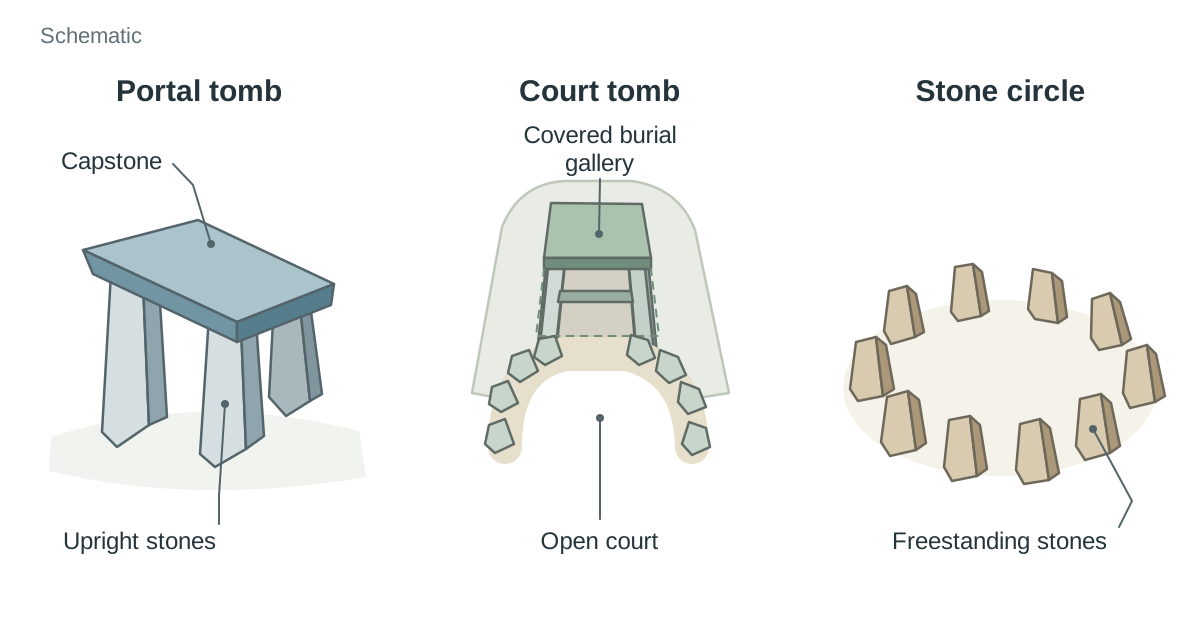
Main Types of Megalithic Monuments
- Passage Tombs (c. 3300–2900 BC): Round mounds of earth and stone covering a stone-lined passage that opens into burial chambers. Examples include Newgrange, Knowth, and Dowth in Co. Meath, and Loughcrew in Co. Meath.
- Portal Tombs or Dolmens (c. 3800–3200 BC): Built with two or more tall upright stones supporting an enormous sloping capstone. Examples include Poulnabrone in Co. Clare and Browne's Hill in Co. Carlow.
- Court Tombs (c. 3900–3500 BC): Featuring an open, semicircular courtyard in front of covered burial galleries, such as Creevykeel in Co. Sligo. The open court is thought to have served as an assembly area for rituals for the dead before remains were placed in the chambers.
- Stone Circles and Standing Stones (Bronze and Iron Ages): Freestanding megaliths arranged in circles or rows, such as Drombeg in Co. Cork and Beaghmore in Co. Tyrone. Some, like Drombeg, align with the setting sun at the winter solstice, pointing to seasonal ceremonies linked to solar cycles.
Worked Local Example (2.1): Poulnabrone Portal Tomb
- Physical Evidence: Poulnabrone in the Burren, Co. Clare, is a classic portal tomb. Excavations led by Dr Ann Lynch in 1986 and 1988 uncovered the unburnt and cremated remains of over twenty adults and children buried over several centuries (c. 3800–3200 BC). Finds included grave goods such as a polished stone axe, a bone pendant, quartz crystals, pottery fragments, and flint arrowheads.
- Beliefs Inferred:
- Collective Care for Ancestors: Burying community members of all ages in one shared tomb across generations suggests the community saw its dead as belonging together and worthy of ongoing honour.
- Belief in an Afterlife: Leaving personal objects with the bones suggests people believed the dead continued to exist in another realm where such items held value.
- Sacred Landscape and Territorial Marking: The prominent tomb on the limestone plateau acted as a visible anchor linking the living community to its land through its ancestors.
National Archaeological Evidence: Newgrange (Brú na Bóinne)
The syllabus requires you to name one pre-Christian site of national significance. Newgrange in Co. Meath is the standard choice, though Tara or Emain Macha are equally acceptable. Built around 3200 BC during the Neolithic period, Newgrange predates both the Great Pyramid of Giza and Stonehenge.
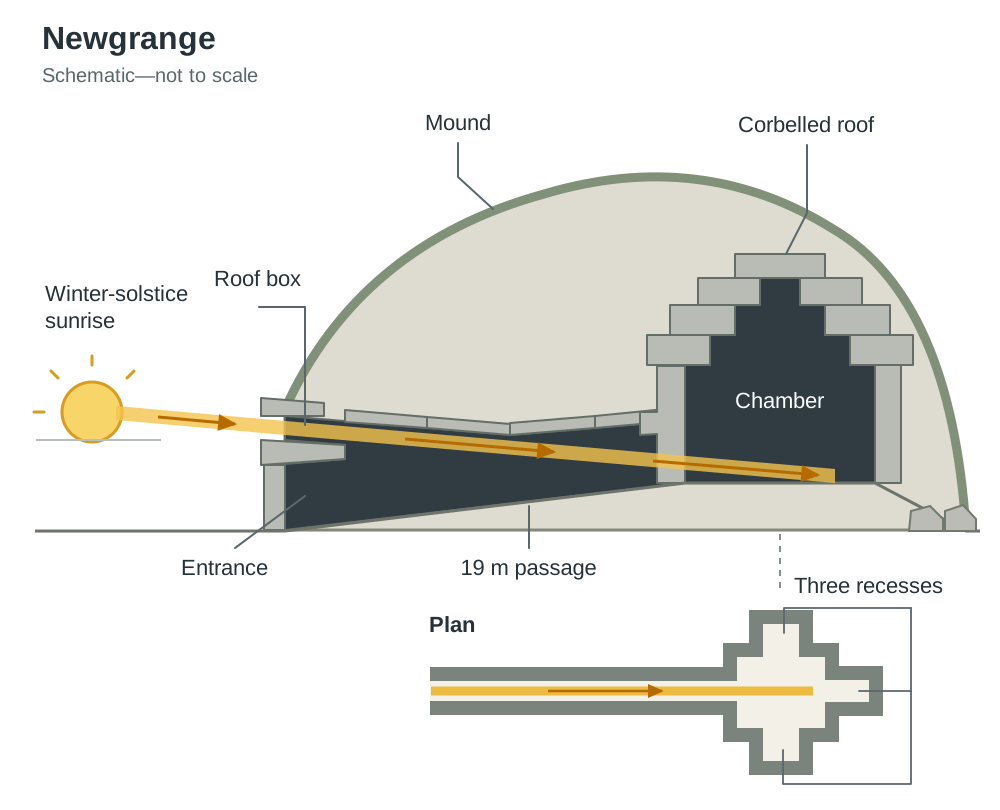
Architectural Features
- Mound and Kerb: A circular cairn of roughly 200,000 tonnes of water-rolled river pebbles and earth, about 80 metres across and 13 metres high. It is surrounded by 97 large greywacke kerbstones, many carved with megalithic art (spirals, lozenges, and triskeles), fronted by a reconstructed wall of white quartz.
- Passage and Chamber: A 19-metre stone passage rises gently to a cruciform chamber with three recesses. Its corbelled roof consists of overlapping slabs that have kept the inner chamber dry for over 5,000 years.
- The Roof Box: A specially constructed rectangular opening with stone lintels situated directly above the main entrance passage.
Religious Beliefs Deduced from the Site
- Solar Cult and Renewal of Life: At dawn on the winter solstice (around 21 December), the rising sun shines directly through the roof box. A narrow beam of light moves across the floor of the 19-metre passage and fills the central burial chamber for about 17 minutes. Because the winter solstice is the shortest day of the year, this precise alignment strongly suggests that Neolithic people saw the returning sun as a divine life-giver that conquered darkness and renewed the fertility of the earth.
- Ancestor Veneration and the Afterlife: Between 1962 and 1975, Professor Michael J. O'Kelly excavated the tomb, finding cremated and unburnt human bones deposited inside large stone basins in the chamber recesses. Alongside the remains lay grave goods, including pendants, beads, and bone pins. Leaving personal objects with the dead suggests that death was not seen as the end, and that the dead were thought to continue in some way. Many archaeologists believe the tomb was a place for honouring the ancestors.
Literary Evidence: Insights from Irish Myths and Sagas
Because pre-Christian Ireland passed down its traditions orally, literary records only exist because Christian monks copied them into manuscripts between the eighth and twelfth centuries, such as Lebor na hUidre (The Book of the Dun Cow) and the Book of Leinster. While recorded through a Christian filter, these tales preserve important memories of pre-Christian spirituality. For Route 2.2, you must provide two distinct myths or sagas.
Myth 1: The Conception of Oengus and the Winning of the Brú (Tochmarc Étaíne)
- Narrative Summary: In the Mythological Cycle, Newgrange is Brú na Bóinne, home of the divine Tuatha Dé Danann. Boann, goddess of the River Boyne, was married to Elcmar, ruler of the Brú. The high god, the Dagda, desired Boann. He sent Elcmar away on an errand and held the sun still in the sky for nine months. To Elcmar, only a single day seemed to pass, while Boann conceived and gave birth to their son, Oengus Óg. Later, on the Dagda's advice, Oengus asked Elcmar if he could stay in the Brú for lá agus oíche ('a day and a night'). Elcmar agreed, whereupon Oengus claimed the mound forever, arguing that all time is composed of alternating days and nights.
- Religious Insights:
- Divine Control over Time and the Sun: The story shows that people in later centuries linked the mound with the sun and with divine power over time and the seasons, echoing the solstice alignment built into the tomb thousands of years earlier.
- Animism: Boann represents both a goddess and the physical River Boyne, showing an animistic worldview where landscape features are living divine realities.
- The Otherworld as a Divine Dwelling: In the saga, the mound is not a grave but a síd, an entrance to the Otherworld where immortal beings live beyond ordinary time.
Myth 2: The Voyage of Bran (Immram Brain)
- Narrative Summary: Bran mac Febail is visited by a mysterious Otherworld woman bearing a blossoming silver apple-branch. She sings of Emain Ablach, a joyful paradise across the western ocean where there is no illness, sorrow, or death, and invites Bran to find it. Bran sails west with his companions. Along the way, he encounters the sea-god Manannán mac Lir, who rides his chariot across the sea as if it were a flowering meadow. Bran reaches the Land of Women and stays what feels like a single year. When the men decide to return to Ireland, Bran is warned not to step ashore. One companion, Nechtan, leaps onto the strand and immediately turns to dust: centuries have passed in Ireland while they were away. Bran tells his tale from his boat and sails away forever.
- Religious Insights:
- Geography of the Otherworld: Pre-Christian Irish belief placed the Otherworld in distinct realms—not only inside burial mounds, but also across the sea as an untroubled paradise of eternal youth.
- Supernatural Time: Time in the divine realm operated outside ordinary human experience, reflecting the belief in a sacred eternity.
- Sea Deities: Manannán demonstrates that nature and the elements were ruled by individual gods with their own distinct realms.
Critical Evaluation: Limits of the Evidence
Strong Higher Level answers show how we know about pre-Christian beliefs and how reliable that evidence is, rather than presenting every theory as proven fact.
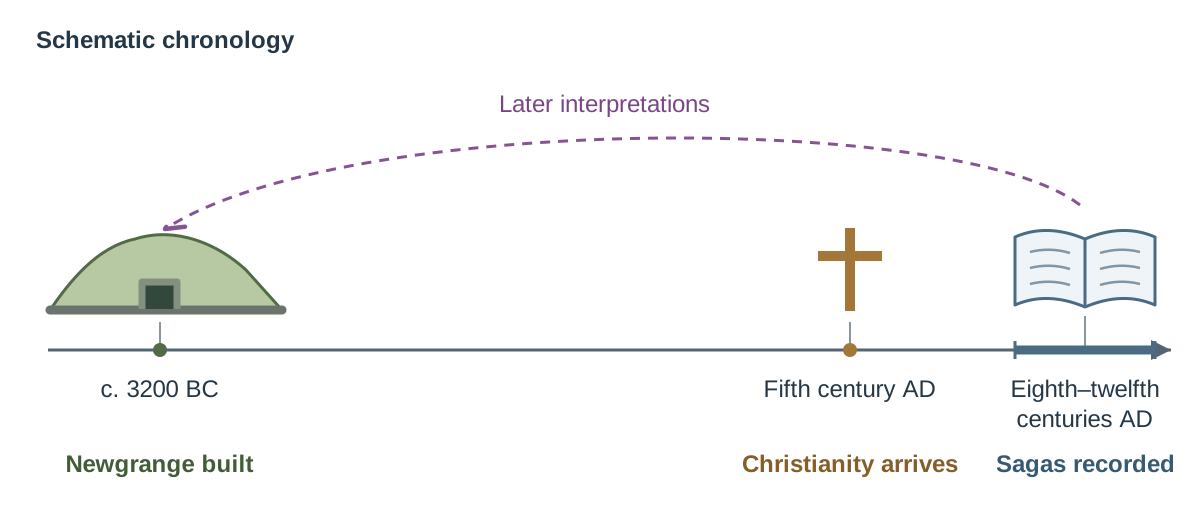
Distinguishing Evidence from Inference
- Archaeology shows actions, not dogmas: Excavations uncover cremated bones, stone basins, and solar alignments. These show what people built and deposited. The spiritual meanings—such as sun worship or ancestor veneration—are careful inferences made by archaeologists, not written statements of faith.
- Different eras: Newgrange was built around 3200 BC in the Stone Age. The myths in the Mythological Cycle were told in the Iron Age and early medieval period. Sagas like Tochmarc Étaíne reflect what later people believed about the mound, not necessarily what its original builders intended.
- The Christian filter: Monastic scribes wrote down the sagas centuries after Ireland converted. Scribes frequently euhemerised pagan gods (presenting the Tuatha Dé Danann as an ancient aristocratic race rather than genuine gods) or added Christian elements. For instance, in Immram Brain, Manannán prophesies the coming of Christ.
Inculturation and Surviving Devotions
Inculturation occurs when the Christian message is introduced into an existing culture by adopting familiar customs, sacred locations, and dates, and giving them Christian theological meaning. Early Irish Christianity adopted this approach widely, leaving visible pre-Christian roots in traditional folk religion.
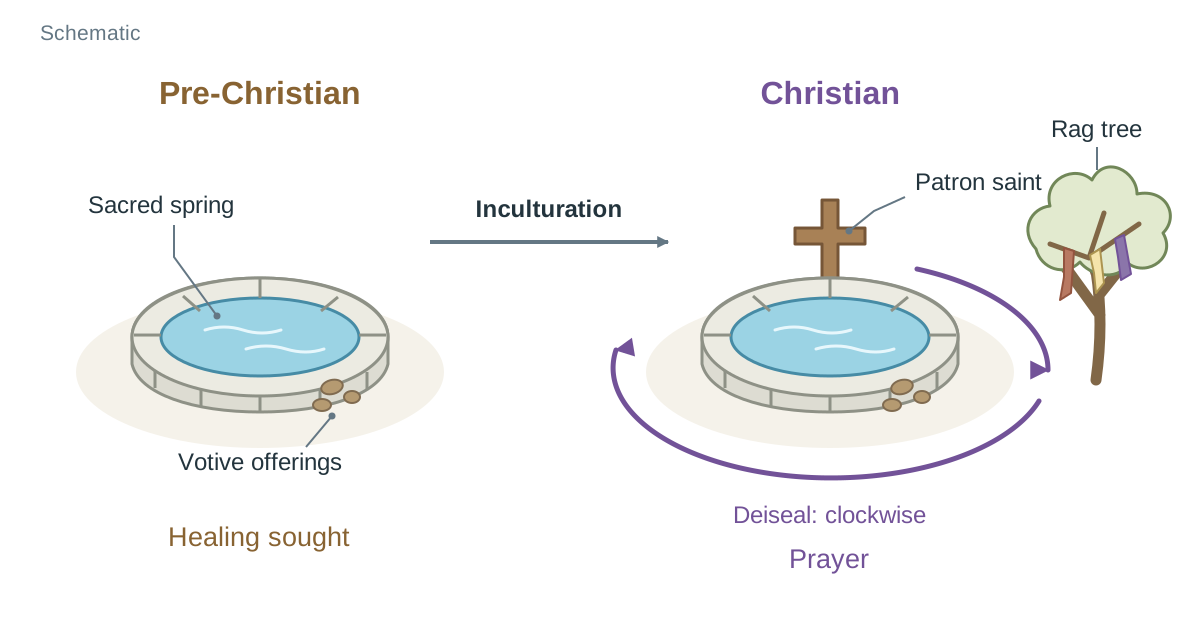
Holy Wells and Devotional Rounds
- Original Pre-Christian Form: Springs were treated as sacred sources of life and healing, protected by local guardian spirits. People left small votive offerings (such as pins or pebbles) in the water to seek cures.
- Christian Adaptation: Wells were rededicated to patron saints (such as Brigid, Patrick, or Colmcille). Pilgrims visit on the saint's feast day, drinking or washing in the water while performing prayer circuits around the well, often leaving offerings such as coins or holy medals. These circuits are walked deiseal (clockwise or sunwise), preserving the ancient custom of moving in harmony with the sun's path.
- Rag Trees: Beside many holy wells stands a rag tree or bush (often hawthorn). Historically, a strip of cloth was dipped into the well, rubbed on an ailment, and tied to the tree. As the cloth rotted in the rain, the illness was believed to fade. In Christian practice, pilgrims still tie ribbons or strips of cloth to the bush as physical tokens of prayer for the saint's intercession.
Seasonal Festivals and Continuity
| Pre-Christian Festival | Original Timing & Practice | Inculturated Christian & Modern Form |
|---|---|---|
| Imbolc (1 February) | Marked the beginning of spring, the lactation of ewes, and honoured the fertility goddess Brigid. | Feast of Saint Brigid; weaving rushes into Brigid's crosses to place over doorways for family protection. (Made an Irish public holiday in 2023). |
| Bealtaine (1 May) | Marked the start of summer; cattle were driven between twin bonfires to cleanse and protect them before open grazing. | May Day devotions to the Virgin Mary; gathering yellow flowers (furze, primroses) at doorsteps to welcome summer. |
| Lughnasa (1 August) | Harvest festival celebrating first fruits and the god Lugh; marked by communal hilltop assemblies, athletic games, and bilberry picking. | Christian pattern days; notably Reek Sunday on Croagh Patrick (last Sunday of July), where pilgrims climb the mountain, complete penitential stations, and attend Mass. |
| Samhain (1 November) | Marked the end of harvest and onset of winter; believed to be a time when boundaries between this world and the Otherworld grew thin. | All Saints' Day (1 Nov) and All Souls' Day (2 Nov); modern Halloween customs of dressing up, bonfires, and praying for deceased relatives. |
| Midsummer (c. 21–24 June) | Summer solstice fire ceremonies celebrating the peak power of the sun and seeking protection for growing crops. | St John's Eve bonfires (23 June); rural communities gather at crossroads and hills to light fires dedicated to St John the Baptist. |
Key terms
- Inculturation
- The process by which the Christian message is integrated into a local culture, adopting existing symbols, rituals, and sacred places while giving them new Christian meaning.
- Passage Tomb
- A Neolithic burial mound enclosing a stone-lined passage that leads to one or more internal burial chambers, such as Newgrange.
- Portal Tomb
- A Neolithic megalithic monument consisting of two or more upright stones supporting an enormous sloping capstone, commonly called a dolmen.
- Court Tomb
- A Neolithic tomb with an open, semicircular stone courtyard in front of covered burial chambers; the court is thought to have been used for ceremonies before remains were placed inside.
- Roof Box
- A specially engineered opening above the entrance of Newgrange that allows the rising sun around the winter solstice to illuminate the inner burial chamber.
- Winter Solstice
- The shortest day of the year (around 21 December), whose dawn marks the annual solar illumination of the burial chamber at Newgrange.
- Grave Goods
- Items such as pottery, personal ornaments, pins, and tools intentionally buried with human remains, suggesting a belief in an afterlife.
- Votive Offering
- An object deposited in a sacred place (such as a spring, river, or bog) without intention of recovery, offered as a gift to a deity or spirit.
- Deiseal
- Moving in a clockwise or sunwise direction during rituals, traditionally regarded as bringing blessing and harmony with cosmic movements.
- Otherworld
- The supernatural realm in pre-Christian Irish belief, known by names such as the síd, Tír na nÓg, or Mag Mell, inhabited by gods, spirits, and ancestors.
- Síd
- An ancient burial mound believed in Irish tradition to serve as a portal or dwelling place of supernatural beings (the aos sí).
- Tuatha Dé Danann
- The mythological tribe of gods and divine beings in Irish sagas who ruled Ireland before retreating into the mounds after the coming of mortals.
- Pattern Day
- The traditional feast day of a local patron saint (pátrún) in Ireland, often celebrated at a holy well or mountain with rounds of prayers and community gatherings.
- Lughnasa
- The ancient Irish festival marking the beginning of the harvest in early August, traditionally celebrated with hilltop gatherings and fairs.
Check yourself
What architectural feature at Newgrange allows sunlight to reach the inner chamber at dawn on the winter solstice?
The roof box, a stone-lintelled opening built directly above the main passage entrance.
Define the concept of inculturation in the context of Irish religious history.
The process where incoming Christianity adopted existing pagan sites, dates, and practices (such as holy wells or seasonal festivals) and invested them with Christian theological meaning.
Why must students exercise critical caution when using medieval myths as evidence for pre-Christian beliefs?
The myths were written down centuries later by Christian monks who viewed the old gods through a Christian filter, and the sagas reflect Iron Age/medieval ideas rather than Stone Age beliefs.
What is meant by moving 'deiseal' during rounds at a holy well, and what pre-Christian idea does it reflect?
It means moving clockwise or sunwise, reflecting the ancient practice of aligning human ritual movement with the natural path of the sun.
Name two pre-Christian religious insights that can be drawn from the saga Immram Brain (The Voyage of Bran).
Belief that the Otherworld could be an overseas paradise free from sickness and death, and that time in the Otherworld operated outside normal human time.